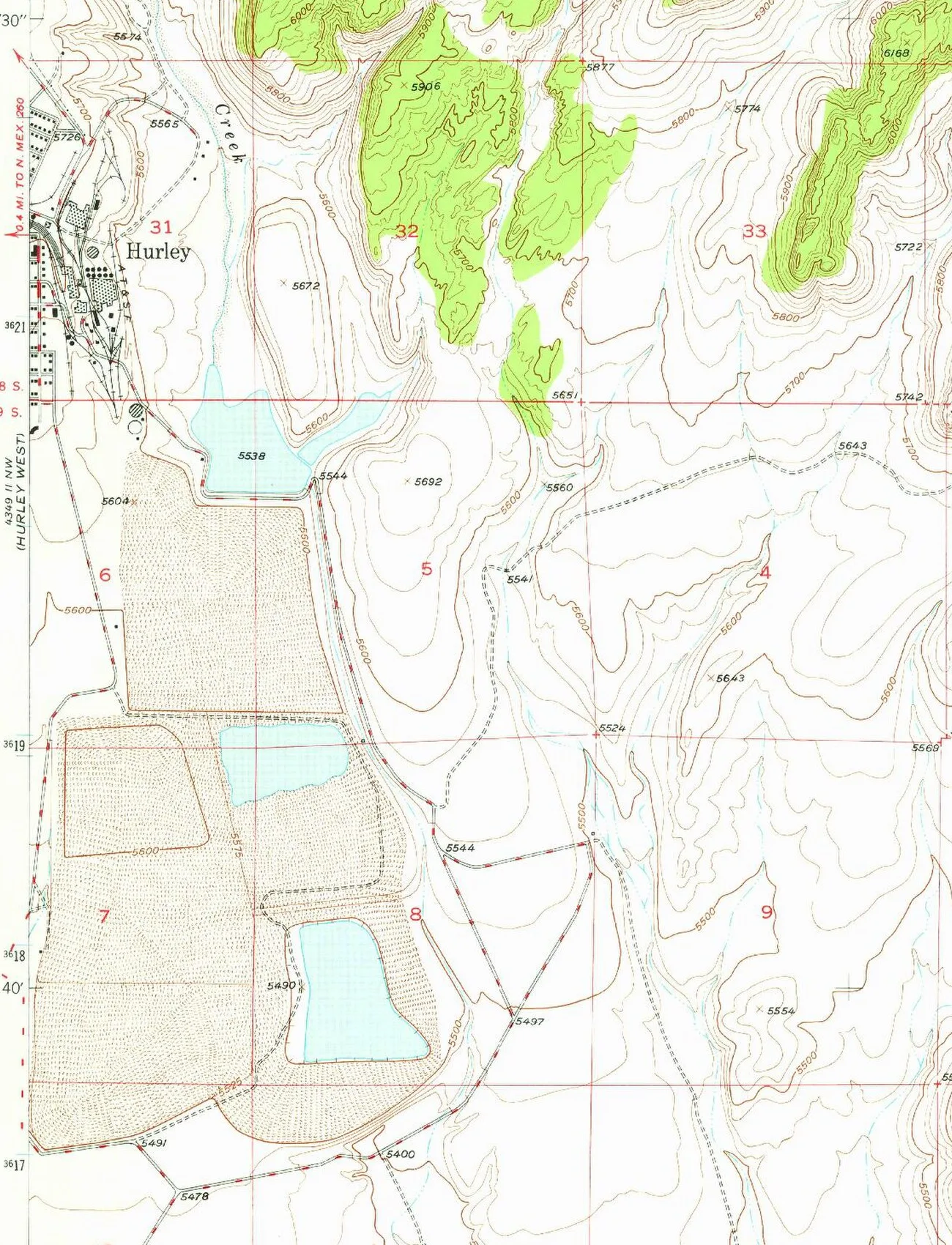
Hurley's copper smelter ran from 2 May 1939 to January 2002, gaining a second stack in 1967 and then an acid plant and a flash furnace as air rules on sulfur tightened; the state tourism page dates the felling of its two stacks to 5 June 2007.
Two-dollar tickets for a plunger: Hurley, May 2007
A community group in Hurley was selling raffle tickets at $2 each in May 2007, the Associated Press reported. The winner would push a ceremonial plunger to blow up the town's two smelter smokestacks. Manuel Carreon, 77, had lived in Hurley since he was seven and had worked at the plant for 41 years. He told the AP he would not be buying one. "Most of us old-timers hate to see the stacks go," he said.
Sources: Tim Korte, Associated Press (as printed in the Philadelphia Inquirer), Massive smokestacks to topple into history (2007-05-20): last para; near end; Tim Korte, Associated Press (as printed by the Philadelphia Inquirer), Massive smokestacks to topple into history (2007-05-20): last paragraphs; near end
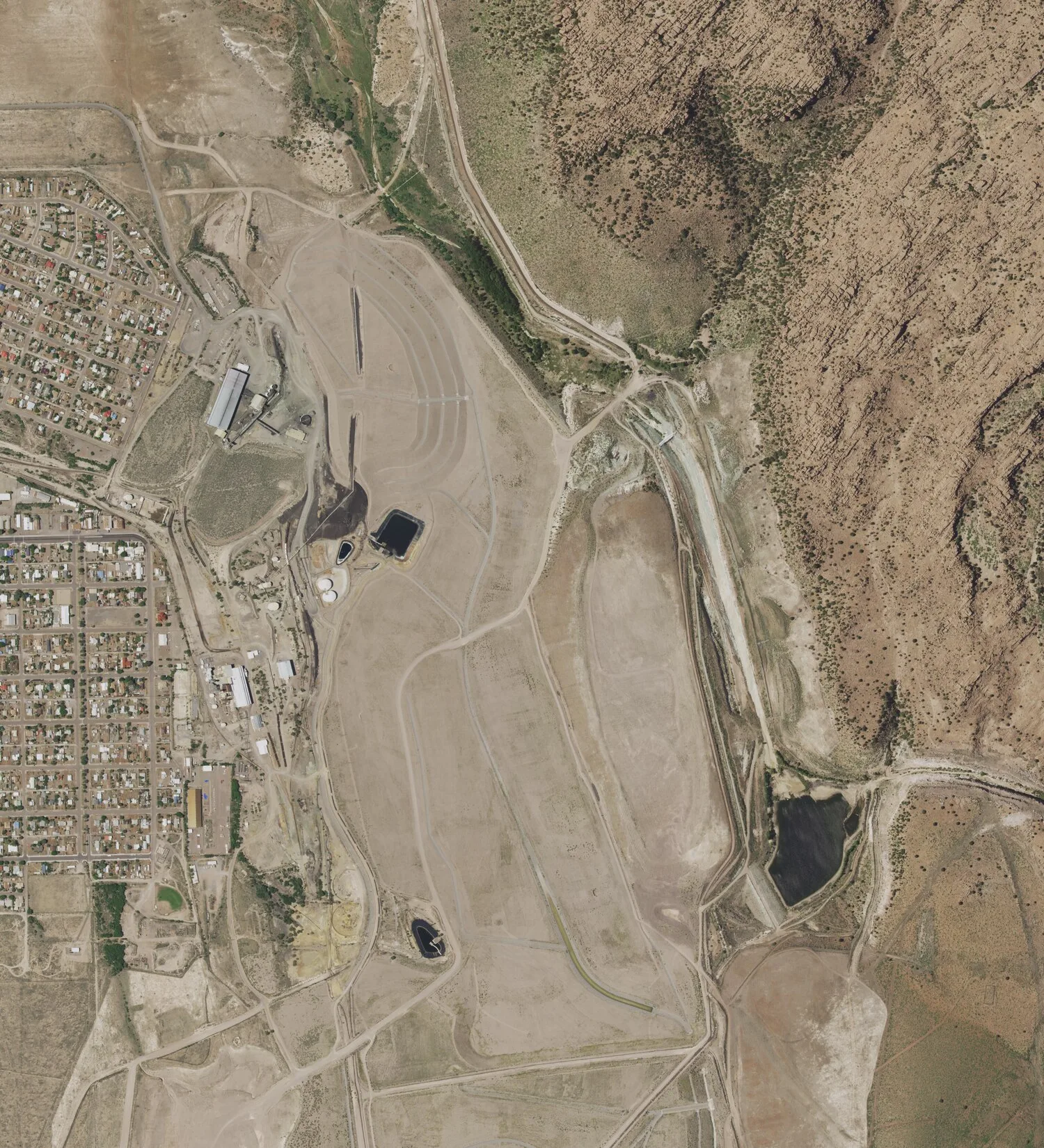
The AP found former residents travelling back to Hurley for a last look, some of them close to tears. Jim Kester, 70, had come from Austin, Texas. He had lived in Hurley as a boy in the 1940s, and he told the reporter that during the war the big furnaces lit the whole night sky when copper was poured. He was sorry, he said, to see the stacks go. By then, the AP reported, the smelter's large buildings and support shops had been removed. The two hollow towers, 625 and 500 feet tall by the AP's figures, rose over empty concrete foundations.
Sources: Tim Korte, Associated Press (as printed in the Philadelphia Inquirer), Massive smokestacks to topple into history (2007-05-20): para. 4; para. 2; para. 5; mid-article; Tim Korte, Associated Press (as printed by the Philadelphia Inquirer), Massive smokestacks to topple into history (2007-05-20): paragraph 5; paragraph 3; paragraph 13
Hurley's shorter stack had stood since 1939 and the taller one since 1967. Beneath them the smelter had started up in May 1939 and stopped in January 2002. In those years the plant gained a second stack, an acid plant and, in 1984, an entirely new furnace. The acid plant came with an air-pollution control program, and the new furnace captured more than 90 percent of the sulfur dioxide in its gases. In 1980 Kennecott told a state court that a sulfur rule, adopted to meet the federal Clean Air Act, would force the smelter to close. Taken together, these suggest that much of what happened to the smelter turned on what left through the two stacks, and on what the state and federal governments would allow.1, 2, 3, 4
Sources: John B. Huttl, assistant editor, "Chino Today", Engineering and Mining Journal, vol. 140 no. 9 (September 1939), pp. 29-32 (1939-09): p. 31, "The Smelter"; New Mexico Tourism Department, Hurley (New Mexico True visitor page) (undated (read 2026-11-15)): paragraph 4; New Mexico Court of Appeals (Walters, J.), Kennecott Copper Corp. v. New Mexico Environmental Improvement Board, 1980-NMCA-007, 94 N.M. 610, 614 P.2d 22 (1980-01-10): para. 3
A smelter of the company's own: Hurley, 1937-1939
For almost three decades Hurley was a mill town without a furnace. Two sources date its concentrator, the mill that separates copper minerals from crushed ore, to 1911: a Bureau of Mines circular has Chino milling its first ore at Hurley that year, and L. Michael Kaas's Mining History Association tour guide gives 1911 as the year the concentrator was built. Its product, called concentrate, travelled under a long-term contract to ASARCO's smelter at El Paso. When Chino reopened in January 1937, the crushing plant was moved from Santa Rita to Hurley and the mill's capacity rose from 15,000 to 17,500 tons of ore a day. The copper in all of it still left for Texas to be smelted.5, 6, 7, 8
Nevada Consolidated Copper Corporation, whose Chino Mines division ran the mine and the mill, authorized a smelter at Hurley in April 1937. A labor board decision of 1940 records the scale of the rebuilding. From January 1937 to March 1938 the company bought $1,779,500 worth of construction supplies for Santa Rita and Hurley, and it expected to use another $1,150,400 at the mine, mill and smelter in the rest of 1938. In November 1938 the Engineering and Mining Journal reported that the smelter had been under construction all year. It was expected, the journal said, to begin work when the contract with the El Paso smelter ended in March 1939.
Sources: John B. Huttl, assistant editor, "Chino Today", Engineering and Mining Journal, vol. 140 no. 9 (September 1939), pp. 29-32 (1939-09): p. 31, "The Smelter"; National Labor Relations Board, Matter of Nevada Consolidated Copper Corporation and International Union of Mine, Mill and Smelter Workers, 26 N.L.R.B. 1182 (decided 24 Aug. 1940) (1940-08-24): 26 N.L.R.B. at 1188; Engineering and Mining Journal, vol. 139 no. 11 (November 1938), New Mexico news: "Copper Mines at Santa Rita Reopened" (1938-11): New Mexico news section
Chino's Hurley smelter was blown in, the smelterman's term for lighting a furnace and putting it to work, on 2 May 1939. Nine days later the Hagerman Messenger, a New Mexico weekly, described Hurley as "bustling with activity", with three full-time shifts running what it called the Chino Mines' new $2,000,000 copper smelter. An annual review published by AIME, the mining engineers' institute, called the start-up "the event of greatest interest" in the copper region of the Southwest. From then on all of Chino's concentrate was smelted at Hurley.7
Sources: John B. Huttl, assistant editor, "Chino Today", Engineering and Mining Journal, vol. 140 no. 9 (September 1939), pp. 29-32 (1939-09): p. 31, "The Smelter"; Hagerman Messenger (Hagerman, N.M.), 11 May 1939, p. 3 (state news briefs) (1939-05-11): p. 3 (state news briefs); P. D. I. Honeyman, "Metallurgy of Copper: New Nevada Con. Smelter Now Operating" (AIME annual review for 1939, abstract page) (1940-01): abstract
One account gives a different year. The historian Ellen R. Baker writes that Chino built its smelter at Hurley in 1938. That year falls in the middle of the construction. The Engineering and Mining Journal, writing in September 1939, four months after the start-up, gives April 1937 for the authorization and May 1939 for the first smelting.
Sources: Ellen R. Baker, On Strike and on Film: Mexican American Families and Blacklisted Filmmakers in Cold War America (University of North Carolina Press, 2007), ch. 2, "Grant County's Mining District": ch. 2; John B. Huttl, assistant editor, "Chino Today", Engineering and Mining Journal, vol. 140 no. 9 (September 1939), pp. 29-32 (1939-09): p. 31, "The Smelter"
One furnace, two converters and a 500- or 501-foot stack: Hurley, 1939
John B. Huttl, an assistant editor of the Engineering and Mining Journal, described the new Hurley plant in September 1939. It had one reverberatory furnace, a long furnace in which flame passes over the charge and the roof throws the heat down onto it, and the Hurley furnace burned natural gas. Two converters, the vessels in which the furnace's molten product is finished, turned out blister copper. A 1942 labor board decision calls that crude metal the final product of the Hurley works. Ahead of the stack stood a Cottrell plant to take dust out of the gas.
Sources: John B. Huttl, assistant editor, "Chino Today", Engineering and Mining Journal, vol. 140 no. 9 (September 1939), pp. 29-32 (1939-09): p. 31; National Labor Relations Board, Matter of Kennecott Copper Corporation, Nevada Consolidated Copper Corporation and Brotherhood of Railroad Trainmen et al., 40 N.L.R.B. 986 (decided 29 Apr. 1942) (1942-04-29): 40 N.L.R.B. at 994
One feature of the layout drew comment. The AIME reviewer, in the annual review for 1939, wrote that the Hurley smelter had been designed to be fed by conveyor belts, with none of the tram cars and tracks usually seen around a smelter. Power and compressed air came from the mill's existing power house, which in turn used steam raised in the smelter's waste-heat boilers. At the end of the line the blister copper was cast into cakes, stored, and loaded into railroad box cars for shipment to a refinery.
Sources: P. D. I. Honeyman, "Metallurgy of Copper: New Nevada Con. Smelter Now Operating" (AIME annual review for 1939, abstract page) (1940-01): abstract; John B. Huttl, assistant editor, "Chino Today", Engineering and Mining Journal, vol. 140 no. 9 (September 1939), pp. 29-32 (1939-09): p. 32
Gas changed more than the furnace. In 1930 the Hurley power plant had burned slack coal hauled from the Gallup fields in northwestern New Mexico. A natural-gas pipeline reached Hurley from Deming in 1939, and Huttl found gas in use in almost every department of the works.9, 7
The stack Huttl described in 1939 was concrete, 42 feet 8 inches across at the base and 20 feet across at the top. It was lined with acid-proof brick laid over a layer of rock wool, and its top 40 feet were built of acid-proof brick.
Its height depends on the source. Huttl's 1939 article twice gives it as 501 feet. The Bureau of Mines yearbooks of 1966, 1967 and 1970, the Associated Press in 2007, the state tourism page and a 2010 street map of Hurley all call it the 500-foot stack.1, 10
Sources: John B. Huttl, assistant editor, "Chino Today", Engineering and Mining Journal, vol. 140 no. 9 (September 1939), pp. 29-32 (1939-09): p. 32; U.S. Bureau of Mines, Minerals Yearbook 1966, vol. III, The Mineral Industry of New Mexico (1967): copper, Chino Mines Division; Tim Korte, Associated Press (as printed in the Philadelphia Inquirer), Massive smokestacks to topple into history (2007-05-20): para. 4; New Mexico Tourism Department, Hurley (New Mexico True visitor page) (undated (read 2026-11-15)): paragraph 4; hurleynm.com / JW Art Gallery, Hurley Street Map (2010), with a numbered list 'Historic Hurley Buildings' (2010 (captured 2011-07-12)): legend items 13-14
The works in war and after: Hurley, 1940-1961
A National Labor Relations Board decision of 1942, which names Kennecott Copper Corporation alongside Nevada Consolidated, lists what stood at Hurley by then. There was a crushing mill, a flotation plant, a smelter with reverberatory furnaces and converters, and a power plant that generated all the electricity used in Hurley and at the Santa Rita mine. A power line to the mine had been finished in 1940, and by 1941 the mine's haulage ran entirely on electricity. In the first five months of 1943 the Santa Rita and Hurley operations shipped an average of 11,871,687 pounds of copper a month. The mine's copper and by-products for 1944 had a gross value of about $17 million.11
Sources: National Labor Relations Board, Matter of Kennecott Copper Corporation, Nevada Consolidated Copper Corporation and Brotherhood of Railroad Trainmen et al., 40 N.L.R.B. 986 (decided 29 Apr. 1942) (1942-04-29): 40 N.L.R.B. at 994; National Labor Relations Board, Matter of Kennecott Copper Corporation and International Union of Mine, Mill & Smelter Workers, Locals 63 and 69, 50 N.L.R.B. 842 (decided 25 June 1943) (1943-06-25): 50 N.L.R.B. at 843; National Labor Relations Board, Matter of Kennecott Copper Corporation and International Union of Mine, Mill & Smelter Workers, CIO, 63 N.L.R.B. 466 (decided 22 Aug. 1945) (1945-08-22): 63 N.L.R.B. at 467
Women were part of the wartime force. War Manpower Commission tabulations, kept in a federal fair-employment case file, count 906 people employed in May 1944 under the heading of the smelter at Hurley, and 936 in October. That heading evidently takes in the mill as well. Over those six months the number of women among them rose from 47 to 88.
In 1950 about 1,000 people worked at the Hurley plants and offices, against some 800 at the mine. In 1955 Chino recovered 63,490 short tons of copper from 7 million short tons of ore. Some of that copper was fire-refined at Hurley; the gold and silver were recovered from the blister copper that went on to an electrolytic refinery. Chino ran seven days a week in 1957, apart from twelve days beginning on 29 September when the power plant, mill and smelter were shut for major maintenance. A $6 million improvement program began that year, and half of the money went to add 15,625 kilowatts to the power plant.12, 13
Visitors were given the plant's figures. The Artesia Advocate reported that delegates to a state convention at Silver City toured the Hurley mill and smelter in June 1950. They were told, by the paper's account, that it made "200 to 250 tons" of copper a day, getting about 20 pounds of copper from 2,000 pounds of ore.
In August 1955 the Advocate carried a Kennecott advertisement about the stack. People living within thirty miles of the Hurley smelter, the company wrote, looked on the 500-foot chimney as a "business barometer". Smoke coming from the stack, the advertisement said, meant that 2,500 New Mexicans were at work and drawing nearly $1,000,000 a month in wages. The figures are the company's.
Safety at the Hurley smelter enters the record in the same years. An article in the New Mexico Historical Review in 2012, "The Toll Extracted: Workers and Safety in Southern New Mexico Mining", says Kennecott required hard hats, safety goggles and reinforced-toe boots from 1957. Kennecott also ran safety contests at the smelter and the mine, the article says, with turkeys, hams or green stamps as prizes. By the same account, there was a death at the Hurley smelter in June 1961. At the investigation Juan Chacon, the president of Local 890, loudly confronted the state mine inspector, William Hays. He tried, the article says, to put in evidence that the company had ignored workers' complaints about unsafe machinery.14, 15
A second and taller stack: Hurley, 1966-1970
Work on a second smokestack at Hurley began in 1966. The Bureau of Mines described it that year as a 625-foot stack to augment the 500-foot one, and said that the job, which included repairs to the old stack, would take two years. Its yearbook for 1967 reported the new stack complete. That was a strike year at Chino, and the yearbook says construction on contracted projects went on through it.1
Sources: U.S. Bureau of Mines, Minerals Yearbook 1966, vol. III, The Mineral Industry of New Mexico (1967): copper, Chino Mines Division; U.S. Bureau of Mines, Minerals Yearbook 1967, vol. III, The Mineral Industry of New Mexico (1968): copper section, Kennecott Chino
The sources never settled the new stack's height. Two Bureau of Mines yearbooks say 626 feet: the 1967 volume, which recorded the completion, and the volume for 1970. The 1966 yearbook, the Associated Press in 2007 and the state tourism department's page on Hurley all say 625. A street map of historic Hurley printed in 2010 gives 625 feet as well. It dates the stack's life from 1957 to 2007, ten years earlier than the yearbooks and the tourism page, which agree on 1967.1, 10
Sources: U.S. Bureau of Mines, Minerals Yearbook 1966, vol. III, The Mineral Industry of New Mexico (1967): copper, Chino Mines Division; U.S. Bureau of Mines, Minerals Yearbook 1967, vol. III, The Mineral Industry of New Mexico (1968): copper section, Kennecott Chino; Tim Korte, Associated Press (as printed in the Philadelphia Inquirer), Massive smokestacks to topple into history (2007-05-20): para. 4; Tim Korte, Associated Press (as printed by the Philadelphia Inquirer), Massive smokestacks to topple into history (2007-05-20): paragraph 4; schedule in paragraph 7 ('scheduled for demolition Friday'); New Mexico Tourism Department, Hurley (New Mexico True visitor page) (undated (read 2026-11-15)): paragraph 4; hurleynm.com / JW Art Gallery, Hurley Street Map (2010), with a numbered list 'Historic Hurley Buildings' (2010 (captured 2011-07-12)): legend items 13-14
Hurley's old stack was not retired. In 1970 the smelter put in a modernized electrostatic precipitator, a dust collector, and returned the 500-foot stack to use beside the new one. The Bureau of Mines listed both steps as parts of an air-pollution program.10
The acid plant and the town's bonds: Hurley, 1972-1978
The precipitator dealt with dust. For sulfur, Kennecott started a $21 million air-pollution control program at the Hurley smelter in 1972. It included an acid plant, a plant that takes sulfur dioxide out of smelter gas by turning it into sulfuric acid, planned at 600 tons a day.3
Paying for pollution control drew the Town of Hurley into court. In May 1972 the town agreed to issue industrial revenue bonds to acquire pollution-control facilities for the copper operation next door and lease them to Kennecott. The town then balked, doubting its authority to do so, and Kennecott sued. In 1973 the New Mexico Supreme Court affirmed a judgment that the financing served a proper public purpose. It held that pollution-control equipment counted as a project the town could finance with bonds even though it created no jobs, because reducing pollution in and near Hurley was itself a public purpose. The district court had found, as facts nobody contested, that a principal part of Kennecott's complex lay adjacent to the town. The operation, it found, contributed substantially to the economic welfare of the people of Hurley and Grant County.16, 17
In 1973 the acid plant was still being built, and about half of all capital spending at Hurley that year went to pollution abatement. Kennecott brought it on stream in 1974. The Bureau of Mines that year called it a 500-ton-a-day plant, not the 600 tons planned in 1972, and described it as only the first phase of bringing the smelter into compliance.3
Sources: U.S. Bureau of Mines, Minerals Yearbook 1973, vol. II, The Mineral Industry of New Mexico (1975): copper section; U.S. Bureau of Mines, Minerals Yearbook 1974, vol. II, The Mineral Industry of New Mexico (1976): copper section
Of the Hurley smelter itself the Bureau wrote, in its yearbook for 1974, that it was "old in both principle and construction". It would probably need a complete change of smelting method, the Bureau said, to remove the 90 percent, and later 95 percent, of sulfur dioxide that the rules were coming to require.
In the meantime Kennecott met the standards for the air around Hurley partly by smelting less. A supplementary control system began operating in August 1975. Holding back the furnaces to stay within the limits cost about two days of smelting a month for the rest of that year.
Monitoring around Hurley has shown no violation of the federal sulfur dioxide standards since 1975, the New Mexico Environment Department says. Even so, in 1978 the Environmental Protection Agency designated a part of Grant County a nonattainment area, a district counted as failing those standards, because of the smelter. The area took in everything within 3.5 miles of the plant, and any land above 6,470 feet within eight miles.
A closure warning and a court ruling: Hurley, 1975-1980
The argument over what the old Hurley smelter could be made to do reached the press in 1975. That December the Liberation News Service reprinted an article from Seer's Catalogue, an alternative paper in New Mexico. By its report, Kennecott was threatening to close its Chino mines and the Hurley smelter if the state made it comply with emission rules. One of them, a rule on particulates, would by that report have cut what came out of the Hurley stacks from about six tons a day to about a sixth of a ton.
The December 1975 report went on to the state's response. After the warning, it said, Governor Jerry Apodaca asked the state's Environmental Improvement Board to reconsider, and the board voted to hold new hearings on the economic effects of its rules. An environmental lobbyist, by the same account, called the company's stance blackmail.
A rule on sulfur came later, adopted by the state to meet the 1977 amendments to the federal Clean Air Act. It required Kennecott to cut the Hurley smelter's sulfur emissions from 10,900 pounds an hour to 3,550 after 1982 and to 3,000 after 1983. That meant capturing 87 percent of the sulfur where the plant had been capturing 60. Kennecott told the New Mexico Court of Appeals that the rule could be met only by rebuilding the smelter, at a cost of at least $100 million. Enforcing it, the company said, would force the smelter to close. On 10 January 1980 the court upheld the rule.
Further review of the ruling was denied on 24 June 1980. During that year Kennecott applied for a federal nonferrous smelter order that would let the Hurley smelter run until 1988 without certain pollution controls. It proposed to study five other ways of smelting, among them the Inco flash process it eventually chose.
Sources: U.S. Bureau of Mines, Minerals Yearbook 1980, vol. II, The Mineral Industry of New Mexico (1982): copper, Kennecott; New Mexico Court of Appeals (Walters, J.), Kennecott Copper Corp. v. New Mexico Environmental Improvement Board, 1980-NMCA-007, 94 N.M. 610, 614 P.2d 22 (1980-01-10): para. 3
Mitsubishi, a shutdown and the flash furnace: Hurley, 1980-1985
A partner came first. Kennecott and Mitsubishi signed a memorandum of intent on 10 June 1980 and a partnership agreement on 19 December. At the closing, set for 2 March 1981, a Mitsubishi subsidiary was to put $116 million into a new Chino Mines Company in return for a one-third interest. Kennecott was changing hands too: Standard Oil of Ohio's $1.77 billion takeover became final in June 1981.
Sources: U.S. Bureau of Mines, Minerals Yearbook 1980, vol. II, The Mineral Industry of New Mexico (1982): copper, Kennecott; U.S. Bureau of Mines, Minerals Yearbook 1981, vol. II, The Mineral Industry of New Mexico (1983): copper section
Accounts of the Mitsubishi purchase differ by a year. One railroad-history chronology dates it to 1980; the Bureau of Mines yearbooks show the agreement in 1980 and the closing the following March, in 1981.
The partners planned to spend $350 million. The plan included a new concentrator near Santa Rita, a slurry pipeline to carry its concentrate to the Hurley smelter, and changes at the smelter. Then demand for copper slackened. In 1982 Kennecott shut the concentrator in March, the Hurley smelter in May and stripping in the pit in June, its first closure for slack demand since the Depression. In September 1982 it announced a $100 million modernization of the smelter, in which an Inco oxygen flash furnace would replace the reverberatory furnace. That was the sum it had told the Court of Appeals was the least a rebuilding would cost. A flash furnace burns fine concentrate in a blast of oxygen.18, 19
Sources: U.S. Bureau of Mines, Minerals Yearbook 1981, vol. II, The Mineral Industry of New Mexico (1983): copper section; New Mexico Court of Appeals (Walters, J.), Kennecott Copper Corp. v. New Mexico Environmental Improvement Board, 1980-NMCA-007, 94 N.M. 610, 614 P.2d 22 (1980-01-10): para. 3
The state's Labor Market Review, a bulletin of the Employment Security Department, followed the 1982 shutdown as it happened. Its issue of 30 March 1982 reported that Chino Mines had announced an indefinite shutdown of its mine and mill, to be carried out over three months beginning on 28 March. About 600 workers were to be laid off at the end of March and most of the rest by 1 June. On 1 May Kennecott laid off a further 230 smelter workers. On 31 May it suspended operations at the Chino Mines Division and laid off 350 more. The April issue expected about 2,000 workers in Grant County to be out of work by late June. That count took in Phelps Dodge's Tyrone mine, suspended on 17 April, and Sharon Steel's Continental mine as well.
Recalls began small. By the end of July 1982 Kennecott had called back 45 of its 1,200 laid-off employees to train on equipment at the mine and mill. In September, the month of the modernization announcement, the company said it would cut its previous workforce of 1,600 to about 1,200 "when the Chino Mines Division is back in production", so Chino was still idle when that was said. The review's issue of 31 August 1983 reported that recalls had brought the payroll back to a little over 1,000 by late July.19
Sources: New Mexico Employment Security Department, New Mexico Labor Market Review, vol. 10 no. 9 - vol. 11 no. 8 (October 1981 - September 1982), 'Silver City Area' notes: vol. 11 no. 6 (30 July 1982), 'Silver City Area'; vol. 11 no. 8 (30 September 1982); New Mexico Employment Security Department, New Mexico Labor Market Review, vol. 11 no. 9 - vol. 12 no. 8 (October 1982 - September 1983), 'Silver City Area' notes: vol. 12 no. 7 (31 August 1983), 'Silver City Area'
Two figures survive for Chino's workforce before the 1982 layoff. Kennecott gave 1,600 in September 1982; the review's issue of August 1983 gives about 1,500.
Sources: New Mexico Employment Security Department, New Mexico Labor Market Review, vol. 10 no. 9 - vol. 11 no. 8 (October 1981 - September 1982), 'Silver City Area' notes: vol. 11 no. 8 (30 September 1982); New Mexico Employment Security Department, New Mexico Labor Market Review, vol. 11 no. 9 - vol. 12 no. 8 (October 1982 - September 1983), 'Silver City Area' notes: vol. 12 no. 7 (31 August 1983), 'Silver City Area'
The new concentrator and the pipeline ended two old Hurley routines. Milling moved to the mine. A rail enthusiast's 2019 report cites an article of a Santa Fe historical society. By that account the frequent ore trains between mine and smelter stopped in 1982, when Kennecott decided to send concentrate through the pipeline.
Sources: U.S. Bureau of Mines, Minerals Yearbook 1981, vol. II, The Mineral Industry of New Mexico (1983): copper section; CSX Transportation Historical Society member report, Southwestern RR - Hurley NM, Tue. 04-30-2019 (railfan photo report) (2019-04-30): photo caption 14
Hiring for the Hurley smelter project began in January 1983, with the construction force expected to reach 400 during the two years of work. That year the new concentrator, rated at 37,500 tons of ore a day, was fully at work. The old smelter, treating 30,000 tons of concentrate a month, could not keep pace with it: the blending shed filled completely and more concentrate was piled outside.20
Hurley's old reverberatory furnace was shut down for the last time on 4 September 1984. The state's Labor Market Review reported that Chino laid off about 100 workers for four weeks in late September while the new furnace was set up, and put it on line in early October. The Bureau of Mines dates its first charge to 15 October. By that account it captured more than 90 percent of the sulfur dioxide in its gases. The bulletin put the modification at $120 million, against the $100 million announced in 1982, and said it would almost double the smelter's capacity.4, 19
Sources place the finished rebuilding a year apart. The Bureau of Mines counted the rebuilt Hurley smelter as operational in late 1984; Kaas's Mining History Association tour guide dates the modernization to 1985.20, 21
In mid-February 1985 a malfunction at the Hurley smelter forced Chino to lay off 130 workers. A later issue of the review reported all of them recalled.
Phelps Dodge and the closing: Hurley, 1986-2005
In February 1986 the Hurley smelter cast its first anode copper, slabs of smelted copper made to be purified in an electrolytic refinery. The 22-mold casting wheel and its furnace had been moved from the old smelter at Anaconda, Montana, and the anodes went to El Paso for refining.
In November 1986 Phelps Dodge bought Kennecott's two-thirds of Chino Mines, the Hurley smelter included, for $88 million, and was to take over management on 1 January 1987. Kennecott was indemnified against environmental and reclamation obligations. In 1987 the new owner finished a $14 million upgrade of the flash smelter, which was rated at 25 million pounds of anode copper a month.22
The end came in steps. Phelps Dodge shut the Chino concentrator in March 2001 and closed the mine and the Hurley smelter in January 2002, each time announcing the closure as temporary. Its annual filing put the 2002 closures under a restructuring for the economic environment at a time of weak copper prices. Mining for leach material fully restarted in September 2003, the company reported, but the smelter did not restart. By the company's account it stayed on care and maintenance until the second quarter of 2005, when Phelps Dodge closed it permanently and began demolition. Its report for that year recorded one consequence: with the Chino smelter closed, Phelps Dodge would have "unnecessary refining capacity in the region."2, 23, 24
Sources: Phelps Dodge Corporation, Annual Report on Form 10-K for 2002 (filed 2003), 'Manufacturing and Sales' section: 'Manufacturing and Sales Segment' section; Phelps Dodge Corporation, Annual Report on Form 10-K for 2005 (filed 2006), 'Manufacturing Segment' section: 'Manufacturing Segment' section
Three dates for the fall of the stacks: Hurley, 2006-2007
When the Associated Press visited Hurley in May 2007, it reported that the stacks were scheduled to come down that Friday, 25 May. They did not. On 28 May the broadcaster KRWG reported that Phelps Dodge had levelled the stack of its Hidalgo smelter near Playas the week before. A recent ruling, the report said without explaining it, now allowed the company to demolish the two at Hurley. The state tourism department's page on Hurley says the stacks were taken down on 5 June 2007, and that most of the smelter's buildings had been removed in 2006 and 2007.
Sources: Tim Korte, Associated Press (as printed by the Philadelphia Inquirer), Massive smokestacks to topple into history (2007-05-20): paragraph 4; schedule in paragraph 7 ('scheduled for demolition Friday'); Marco Grajeda, KRWG, Phelps Dodge Set To Demolish Smokestacks (2007-05-28): introduction; Marco Grajeda, KRWG Public Media, Phelps Dodge Set to Demolish Smokestacks (2007-05-28): introduction; New Mexico Tourism Department, Hurley (New Mexico True tourism page) (n.d. (accessed 2026-11-15)): para. 3; New Mexico Tourism Department, Hurley (New Mexico True visitor page) (undated (read 2026-11-15)): paragraph 4
One official document gives a different date. The New Mexico Environment Department's sulfur dioxide plan for Grant County says the smelter was dismantled and the stacks removed in July 2006. That date cannot be right for the stacks, which the AP described standing over bare foundations ten months later. It does fall within the period the tourism page gives for the removal of the buildings.
Sources: New Mexico Environment Department, Air Quality Bureau, Grant County SO2 Limited Maintenance Plan (c. 2013): emission inventory section, p. 4; Tim Korte, Associated Press (as printed in the Philadelphia Inquirer), Massive smokestacks to topple into history (2007-05-20): mid-article; New Mexico Tourism Department, Hurley (New Mexico True tourism page) (n.d. (accessed 2026-11-15)): para. 3
In that plan the Hurley smelter appears as the only major source of sulfur dioxide that the area had. The state, it says, had kept four monitors in the area for more than thirty years, and one at Hurley since 1997.
Hurley's comprehensive plan of 2023 says the Southwestern Railroad's Whitewater Line still runs into the town to serve Chino. A rail enthusiast who photographed the yard in April 2019 found tank cars stored on the wye, the triangle of track that used to serve the Kennecott smelter.
Sources: Town of Hurley / Southwest New Mexico Council of Governments, Town of Hurley Comprehensive Plan (2023) (2023-06-13): Transportation, B. Rail; CSX Transportation Historical Society member report, Southwestern RR - Hurley NM, Tue. 04-30-2019 (railfan photo report) (2019-04-30): photo caption 2 (also captions 3, 5, 10)
Read more on Salars.net
Part 5 of 9 of the series Hurley, New Mexico: the mill and smelter town.
Sources
- A new 626-foot smelter stack was completed at Hurley in 1967 to supplement the old 500-foot stack. Minerals Yearbook 1967, vol. 3, Area Reports: Domestic, Minerals Yearbook 1967 vol. 3, New Mexico chapter, Copper. View source ↗ (documented)
- Phelps Dodge temporarily shut Chino's concentrator in March 2001 and temporarily closed the Chino mine and Hurley smelter in January 2002; the filing places the 2001 partial curtailment under a power-cost stabilization plan and the 2002 closures under restructuring for 'the economic environment' amid weak copper prices. Phelps Dodge Corporation Form 10-K405 for fiscal 2001, Phelps Dodge 10-K405 (2001), Item 1, Chino Mines Company. View source ↗ (documented)
- Kennecott started a $21 million air-pollution control program at the Hurley smelter in 1972, including a 600-ton-a-day acid plant. Minerals Yearbook 1972, vol. 2, Area Reports: Domestic, Minerals Yearbook 1972 vol. 2, Copper, p. 485. View source ↗ (documented)
- Hurley's old reverberatory furnace was shut down for the last time on September 4, 1984, and the new INCO flash furnace was first charged on October 15, capturing more than 90 percent of sulfur dioxide gases. Minerals Yearbook 1984, vol. 2, Area Reports: Domestic, Minerals Yearbook 1984 vol. 2, New Mexico chapter, p. 413. View source ↗ (documented)
- Chino's first concentrator was built at Hurley in 1911, with flotation added in 1914; the Hurley smelter began production in 1939. L. Michael Kaas, Silver City historical tour guide, Mining History Association (c. 2011, inferred), Kaas, Santa Rita section. View source ↗ (reported)
- When Chino reopened in January 1937, the crushing plant was moved from Santa Rita to Hurley and molybdenum was recovered as a byproduct for the first time; mill capacity rose from 15,000 to 17,500 tons a day. Information Circular 7837: Open-Pit Mining Methods and Practices at the Chino Mines Division, Kennecott Copper Corp., Grant County, N. Mex., IC 7837, History of district, p. 7. View source ↗ (documented)
- Chino's concentrates were smelted under a long-term contract at ASARCO's El Paso smelter until March 1939; after that all went to Kennecott's own Hurley smelter, fed by a natural-gas pipeline brought from Deming in 1939. Information Circular 7837: Open-Pit Mining Methods and Practices at the Chino Mines Division, Kennecott Copper Corp., Grant County, N. Mex., IC 7837, History of district, p. 7. View source ↗ (documented)
- Thorne dates the organization of the Chino Copper Co. to June 1909, says it was linked to Utah Copper's backers, had steam shovels at work by fall 1910, and milled its first ore at Hurley a year later. Mining practice at the Chino mines, Nevada Consolidated Copper Co., Santa Rita, N. Mex. (U.S. Bureau of Mines Information Circular 6412), p. 3 (page image checked). View source ↗ (documented)
- The Hurley power plant burned slack coal brought from the Gallup coal fields of northwestern New Mexico. Information Circular 6394: Milling Methods at the Hurley Plant of the Nevada Consolidated Copper Co., Hurley, New Mexico, IC 6394, Power, p. 2. View source ↗ (documented)
- In 1970 Kennecott's Hurley smelter put in a modernized electrostatic precipitator and returned the old 500-foot stack to use beside the 626-foot stack as part of an air-pollution program. Minerals Yearbook 1970, vol. 2, Area Reports: Domestic, Minerals Yearbook 1970 vol. 2, New Mexico chapter, Copper. View source ↗ (documented)
- A power line from Hurley to the Santa Rita mine was completed in 1940, seven electric locomotives arrived, and mine haulage was fully electrified by 1941. Information Circular 7837: Open-Pit Mining Methods and Practices at the Chino Mines Division, Kennecott Copper Corp., Grant County, N. Mex., IC 7837, History of district, p. 7. View source ↗ (documented)
- In 1950 the Chino mine was the largest single mining enterprise in New Mexico, with about 800 men at the mine, 1,000 at the Hurley plants and offices, and 200 more at the company hospital and other company-supported work. Minerals Yearbook 1950, Minerals Yearbook 1950, New Mexico chapter, Mining industry. View source ↗ (documented)
- In 1955 Chino recovered 63,490 short tons of copper from 7 million short tons of ore; ore went by rail to the Hurley plants, and gold and silver were recovered not from the copper fire-refined at Hurley but from blister copper shipped to the electrolytic refinery. Minerals Yearbook 1955, vol. 3, Area Reports: Domestic, Minerals Yearbook 1955 vol. 3, New Mexico chapter, Grant County. View source ↗ (documented)
- Kennecott required hard hats, safety goggles and reinforced-toe boots from 1957 and ran safety contests at the Hurley smelter and Chino mine, with prizes of turkeys, hams or green stamps. The Toll Extracted: Workers and Safety in Southern New Mexico Mining, New Mexico Historical Review 87:4 (2012), p. 435. View source ↗ (reported)
- After a June 1961 death at Kennecott's Hurley smelter, Local 890 president Juan Chacon loudly confronted state mine inspector William Hays at the investigation and sought to introduce evidence that the company had ignored workers' complaints about unsafe machinery. The Toll Extracted: Workers and Safety in Southern New Mexico Mining, New Mexico Historical Review 87:4 (2012), pp. 439-440. View source ↗ (reported)
- In May 1972 the Town of Hurley agreed to issue industrial revenue bonds to acquire pollution-control facilities for Kennecott's copper operation adjacent to the town, to be leased to Kennecott; when the town balked over its authority, Kennecott sued, and in 1973 the Supreme Court affirmed a judgment holding the financing a proper public purpose. Kennecott Copper Corp. v. Town of Hurley, 84 N.M. 743, static.case.law nm/84/cases/0743-01.json, district court findings 3-4 and conclusion 2; 'Affirmed', March 16, 1973. View source ↗ (documented)
- The district court in the Hurley bond case found, as uncontested facts, that Kennecott operated a large copper mining and refining complex in Grant County, a principal portion of which lay adjacent to the Town of Hurley, and that the operation contributed substantially to the economic welfare of the citizens of Grant County and Hurley. Kennecott Copper Corp. v. Town of Hurley, 84 N.M. 743, Kennecott Copper Corp. v. Town of Hurley, 84 N.M. 743 (1973), district court findings of uncontested facts 1-2 as quoted in the opinion. View source ↗ (documented)
- In 1982 Kennecott shut Chino's concentrator in March, its Hurley smelter in May and pit stripping in June, its first closure for slack demand since the Depression, and Phelps Dodge shut Tyrone in mid-April. Minerals Yearbook 1982, vol. 2, Area Reports: Domestic, Minerals Yearbook 1982 vol. 2, New Mexico chapter, Copper. View source ↗ (documented)
- In September 1982 Kennecott announced a $100 million modernization of the Hurley smelter, replacing its reverberatory furnace with an INCO oxygen flash furnace. Minerals Yearbook 1982, vol. 2, Area Reports: Domestic, Minerals Yearbook 1982 vol. 2, Copper. View source ↗ (documented)
- Kennecott's modernization program at Chino Mines (a Kennecott-Mitsubishi partnership) was completed in 1984: a new concentrator, rated in 1983 at 37,500 tons of copper ore a day, had become fully operational in 1983, and the rebuilt Hurley smelter became operational in late 1984. Minerals Yearbook 1984, vol. 2, Area Reports: Domestic, Minerals Yearbook 1984 vol. 2, New Mexico chapter, pp. 412-413 (djvu text, before the '413' page marker). View source ↗ (documented)
- The Hurley smelter was modernized in 1985 and closed in 2002; in 2010 Kaas described the Chino pit as 1,500 feet deep and 1.5 miles across, with production resumed in 2011 after a 2008 shutdown. L. Michael Kaas, Silver City historical tour guide, Mining History Association (c. 2011, inferred), Kaas, Santa Rita section. View source ↗ (reported)
- After taking over Chino, Phelps Dodge began a $55 million SX-EW plant there in 1987 and finished a $14 million upgrade of the Hurley flash smelter, rated at 25 million pounds of anode copper a month. Minerals Yearbook 1987, vol. 2, Area Reports: Domestic, Minerals Yearbook 1987 vol. 2, Copper. View source ↗ (documented)
- Phelps Dodge reported that the Chino concentrator shut temporarily in March 2001, the Hurley smelter closed temporarily in January 2002, mining for leach material fully restarted in September 2003, and milling reached 80 percent of capacity in the third quarter of 2004. Phelps Dodge Corporation Form 10-K for fiscal year 2006, PD 10-K 2006, Item 1, Mining and Sales Production: major changes in operations. View source ↗ (reported)
- Phelps Dodge's 2006 10-K reports that the Chino (Hurley) smelter, on care-and-maintenance since 2002, was permanently closed in the second quarter of 2005 and demolition was initiated. Phelps Dodge Corporation Form 10-K for fiscal year 2006, PD 10-K 2006, Item 1 (major changes in operations) and smelter discussion. View source ↗ (reported)
"Documented" means the source is a record of the time or a direct survey; "reported" means a later account or secondary history, attributed in the text.
Cite this page: “The smelter and the stacks, 1937 to 2007.” Grant County Atlas, Salars.net, first published 15 November 2026, revised 16 November 2026. https://atlas.salars.net/stories/hurley/the-smelter-and-the-stacks
Discussion
What would you add or question? Comments are reviewed before they appear.
Loading comments…