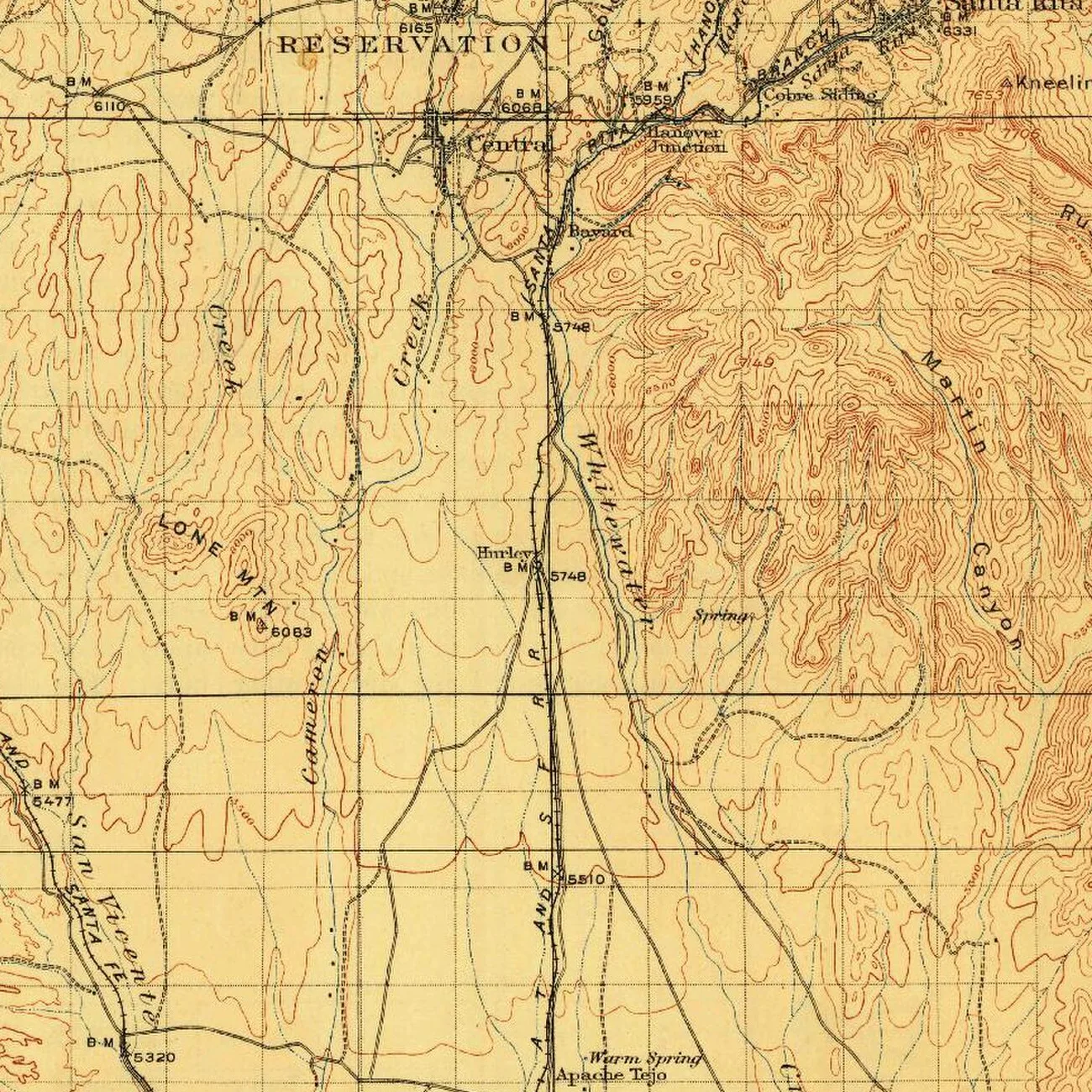
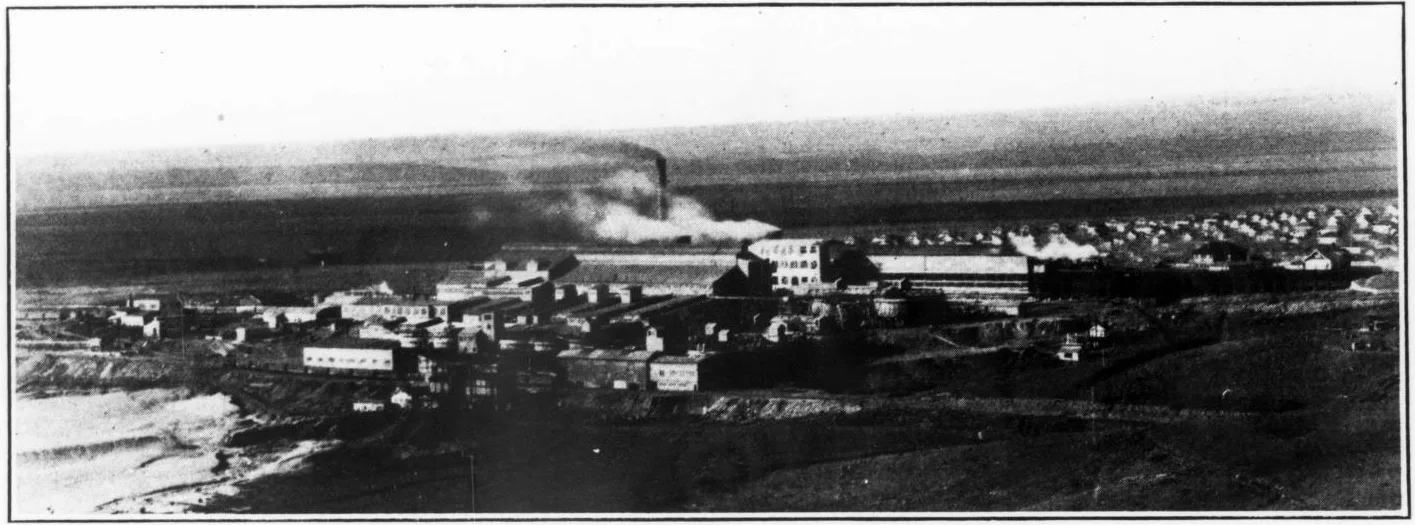
The Chino Copper Company chose a mill site in 1909 near an abandoned Santa Fe sidetrack called Hurley, on a federal list by 1906, and the concentrator it began there in 1910 grew to treat 13,500 tons of ore a day by 1930.
A station on a federal list, three years early: Hurley, 1891 to 1909
In 1906 the U.S. Geological Survey published the fourth edition of its Dictionary of Altitudes in the United States, a long table of places and their heights above the sea. Its New Mexico pages include a station called Hurley, entered on the authority of the Atchison, Topeka and Santa Fe Railway. The Chino Copper Company, which would build a mill and a town at that spot, was not organized until June 1909. The name was on the railroad's books three years before the company that made Hurley a town existed.1
A later railroad compilation excerpts David F. Myrick's history of New Mexico's railroads on how the track began. By Myrick's account the track was older still. He says an independent group opened the 14-mile Silver City and Northern Rail Road in 1891, running from Whitewater through the place later called Hurley to San Jose, a station just east of present-day Hanover Junction.2
By 1909 the line was the Santa Fe's branch from Whitewater to Fierro. John M. Sully, the Chino manager who built the town of Hurley, wrote in 1915 that the mill site had been chosen near "an abandoned sidetrack" on that branch, known as Hurley. A Masonic history published in 1977 agrees: before the mill, it says, Hurley was only a siding on the Santa Fe, nine miles from Santa Rita.
Sources: John M. Sully, manager, Chino Copper Company, "Chino Copper Company, Santa Rita - Hurley: The Story of the Santa Rita del Cobre Grant and Its Development from Discovery to the Present Date", in New Mexico, the Land of Opportunity: Official Data on the Resources and Industries of New Mexico (Panama-California Exposition souvenir, 1915), pp. 144-156; LaMoine "Red" Langston, A History of Masonry in New Mexico (Hall-Poorbaugh Press, 1977), "Hurley No. 55", pp. 248-249: p. 248
J. E. Hurley and the disagreement over dates: Hurley Siding, 1906 to 1910
Four published works agree on whose name Hurley carries. T. M. Pearce's place-name dictionary of 1965, Francis and Roberta Fugate's roadside history of 1989, Robert Julyan's place-name book of 1998 and Ellen R. Baker's 2007 book On Strike and on Film all say it was named for J. E. Hurley, general manager of the Atchison, Topeka and Santa Fe. Claude Dannelley, a longtime resident, agreed. He came to Hurley by covered wagon in 1910 and recorded his memories on tape in July 1960. The name, he said, was given when the branch from Whitewater to Fierro was laid, long before Chino acquired the property.
Sources: T. M. Pearce (ed.), New Mexico Place Names: A Geographical Dictionary (University of New Mexico Press, 1965), entry "Hurley": entry "Hurley"; Francis L. Fugate and Roberta B. Fugate, Roadside History of New Mexico (Mountain Press, 1989), p. 428: p. 428; Robert Julyan, The Place Names of New Mexico (rev. ed., University of New Mexico Press, 1998), entry "Hurley": entry "Hurley"; Ellen R. Baker, On Strike and on Film: Mexican American Families and Blacklisted Filmmakers in Cold War America (University of North Carolina Press, 2007), ch. 2, "Grant County's Mining District": ch. 2, note 53; Claude Dannelley (spelled Claud Dannelley / Donnelley within the text), Hurley, New Mexico: Historical Data from 1910-1960. 50 Years of Recorded Memories by Claude Dannelley (transcript of a tape begun July 13, 1960, with a later note of about 1963; 10 pages, distributed by JW Art Gallery, 'The Old Hurley Store') (1960-07-13 (note c. 1963; PDF posted c. 2010))
One account differs. A 1975 utility-company history makes J. E. Hurley a former general manager of the Nevada Consolidated Copper Company instead. That version stands alone and is evidently mistaken.
The books part ways on when the name arrived. Julyan says the place was "born as Hurley Siding" around 1910, when the Chino Copper Company bought the Santa Rita Mining Company and put in a rail link. Pearce says the stop was called Hurley Siding until 1910, when the town was started, which leaves room for an older siding.
Sources: Robert Julyan, The Place Names of New Mexico (rev. ed., University of New Mexico Press, 1998), entry "Hurley": entry "Hurley"; T. M. Pearce (ed.), New Mexico Place Names: A Geographical Dictionary (University of New Mexico Press, 1965), entry "Hurley": entry "Hurley"
Older records settle that much. The 1906 federal list shows the station name in use at Hurley before the purchase. Sully, the company's manager, describes a sidetrack that was already there in 1909, disused and carrying the name, when the site was picked. He does not say for whom it was named.
Sources: Henry Gannett (compiler), U.S. Geological Survey, A Dictionary of Altitudes in the United States (Fourth Edition), U.S. Geological Survey Bulletin 274 (1906), New Mexico table, p. 644: p. 644 (New Mexico, continued); John M. Sully, manager, Chino Copper Company, "Chino Copper Company, Santa Rita - Hurley: The Story of the Santa Rita del Cobre Grant and Its Development from Discovery to the Present Date", in New Mexico, the Land of Opportunity: Official Data on the Resources and Industries of New Mexico (Panama-California Exposition souvenir, 1915), pp. 144-156
Land, water and a site that allowed straight streets: Hurley, 1909 to 1910
In June 1909 the Chino Copper Company was organized, and a Bureau of Mines account links it to the backers of the Utah Copper Company. Its ore lay at Santa Rita. Its mill would stand at Hurley, about 600 feet lower and some nine and a half miles away by the Santa Fe branch. By the end of 1909, Sully wrote, the company was designing a mill to treat 2,000 tons of ore a day and acquiring land at Hurley. It had arranged for the water of the Apache Tejo spring, about four miles from the mill site, and held water rights on Whiskey, Cameron and Whitewater creeks.1
Sources: John M. Sully, manager, Chino Copper Company, "Chino Copper Company, Santa Rita - Hurley: The Story of the Santa Rita del Cobre Grant and Its Development from Discovery to the Present Date", in New Mexico, the Land of Opportunity: Official Data on the Resources and Industries of New Mexico (Panama-California Exposition souvenir, 1915), pp. 144-156; John B. Huttl, assistant editor, "Chino Today", Engineering and Mining Journal, vol. 140 no. 9 (September 1939), pp. 29-32 (1939-09): p. 29
On 18 July 1910 the El Paso Herald reported that the mill would stand on the "B ranch", a mile from Hurley station. The company had bought the ranch from the Victoria Land and Cattle Company for its water, the paper said, and had platted a townsite there under its control. A branch of the Santa Rita Store Company had opened at the mill site, by the Herald's report, and the grade for a branch railway to the mill was nearly finished.3, 4
Dannelley remembered the ranch's ownership differently from the Herald. He said its first owner, O. Brauhm, branded his cattle OB, that the last owner before Chino was Al O'Brien, and that the name was shortened from OB to B. The Herald of 1910 names the Victoria Land and Cattle Company as the seller.3
Sully explained the look of Hurley by its ground. The town sits on the edge of the plain where it breaks toward the mountains, he wrote in 1915, and there, unlike at Santa Rita, the houses could be set out in regular order. In her 2007 book Baker writes that Hurley was "merely a railroad depot" until Sully laid a grid of streets.
Sources: John M. Sully, manager, Chino Copper Company, "Chino Copper Company, Santa Rita - Hurley: The Story of the Santa Rita del Cobre Grant and Its Development from Discovery to the Present Date", in New Mexico, the Land of Opportunity: Official Data on the Resources and Industries of New Mexico (Panama-California Exposition souvenir, 1915), pp. 144-156; Ellen R. Baker, On Strike and on Film: Mexican American Families and Blacklisted Filmmakers in Cold War America (University of North Carolina Press, 2007), ch. 2, "Grant County's Mining District": ch. 2
Mule teams and cots under the trees: building the Hurley mill, 1910 to 1911
Claude Dannelley described the building season of 1910 at Hurley from memory. His family made permanent camp at the B ranch on 6 September 1910. He and his father hauled gravel from B creek to the mill site with two four-horse teams: six trips a day, a yard and a half to the trip, at 75 cents a yard. Chino's staff, he said, had a mess hall at the ranch and a small building for the engineers, and men slept on cots under the trees. People came in daily by wagon, buggy and train, and two chair cars were coupled to the local train at Whitewater for Hurley, Santa Rita and Fierro.
The earthwork, as Dannelley remembered it, was done by animals. He recalled contractors' mule teams with wheelers, fresnos, scrapers and plows digging the clear-water reservoir and the railroad cut to the mill yard, and about 200 men employed. "There was no powered machinery of any kind, just teamsters and mule skinners."
Two published sources give the date. A Geological Survey bulletin puts the start of mill construction at Hurley in October 1910, a month after Chino's steam shovels started. James B. Allen's 1966 study of western company towns gives 1910 as the year the Chino Copper Company, later the property of Kennecott, built its mill at Hurley.5
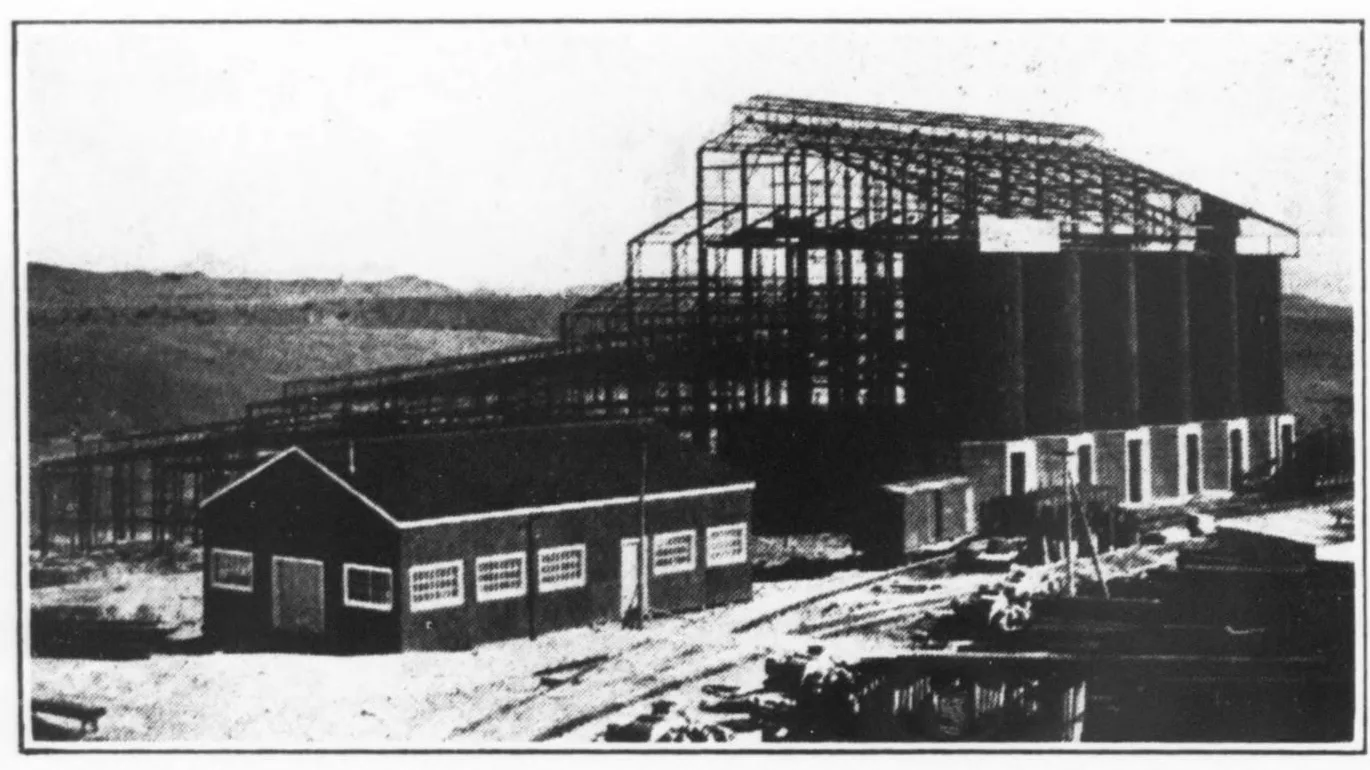
On 3 December 1910 the Engineering and Mining Journal reported that the mill going up at Hurley, nine miles from the mine, was to start at 3,000 tons a day. That was a thousand more than the design Sully described at the end of 1909. The Journal put the company's cash on hand at about $1,000,000. Six weeks later, on 14 January 1911, it reported that the men had finished the foundation and were "erecting the steel structure" of the mill at Hurley.
Sources: Engineering and Mining Journal, 3 December 1910 (vol. 90 no. 23), mining news: New Mexico, 'Chino' (1910-12-03): mining news, New Mexico, 'Chino'; Engineering and Mining Journal, 14 January 1911 (vol. 91 no. 2), mining news: New Mexico, Grant County, 'Chino' (1911-01-14): mining news, New Mexico, Grant County; John M. Sully, manager, Chino Copper Company, "Chino Copper Company, Santa Rita - Hurley: The Story of the Santa Rita del Cobre Grant and Its Development from Discovery to the Present Date", in New Mexico, the Land of Opportunity: Official Data on the Resources and Industries of New Mexico (Panama-California Exposition souvenir, 1915), pp. 144-156
By the fall of 1910, Dannelley said, Cortez Street was laid out with a few houses, a small frame store and a smaller butcher shop. A livery stable and mule barns, he added, were leased to Herb Robinson. A tour map of Hurley issued in 2010 dates the depot to 1910 as well.
Sources: Claude Dannelley (spelled Claud Dannelley / Donnelley within the text), Hurley, New Mexico: Historical Data from 1910-1960. 50 Years of Recorded Memories by Claude Dannelley (transcript of a tape begun July 13, 1960, with a later note of about 1963; 10 pages, distributed by JW Art Gallery, 'The Old Hurley Store') (1960-07-13 (note c. 1963; PDF posted c. 2010)); hurleynm.com / JW Art Gallery, Hurley Street Map (2010), with a numbered list 'Historic Hurley Buildings' (2010 (captured 2011-07-12)): legend 'Historic Hurley Buildings'
Dannelley's memoir places Hurley's first post office on two streets. He said a three-room house on Cortez that first served as the boarding house became the first post office, with Doc Robinson as first postmaster and Howard Boise as second. Elsewhere in the memoir he puts the first post office building on Carrasco, so the street is not certain. The Post Office Department's paperwork of early 1911 names a different man, Perry H. Williams, as the proposed postmaster.
Sources: Claude Dannelley (spelled Claud Dannelley / Donnelley within the text), Hurley, New Mexico: Historical Data from 1910-1960. 50 Years of Recorded Memories by Claude Dannelley (transcript of a tape begun July 13, 1960, with a later note of about 1963; 10 pages, distributed by JW Art Gallery, 'The Old Hurley Store') (1960-07-13 (note c. 1963; PDF posted c. 2010)); Post Office Department, Division of Topography / First Assistant Postmaster General, Post Office Department, Reports of Site Locations, New Mexico: Dona Ana - Lea (microfilm M1126, roll 382): Hurley, Grant County (1911; 1926)
Four hundred people and a proposed postmaster: Hurley, 1911
The federal record of the Hurley post office begins with a printed form. The Post Office Department's report on the site of the proposed office was signed by Perry H. Williams as proposed postmaster and certified by the postmaster at Bayard. On 2 February 1911 the Department's Division of Topography stamped it received.
Dannelley, recording his memories in 1960, remembered Doc Robinson as the first postmaster. The form does not settle the difference. It shows who was put forward and when the paperwork had reached Washington; it gives neither the day the office opened nor the name on the first commission.
Sources: Post Office Department, Division of Topography / First Assistant Postmaster General, Post Office Department, Reports of Site Locations, New Mexico: Dona Ana - Lea (microfilm M1126, roll 382): Hurley, Grant County (1911; 1926); Claude Dannelley (spelled Claud Dannelley / Donnelley within the text), Hurley, New Mexico: Historical Data from 1910-1960. 50 Years of Recorded Memories by Claude Dannelley (transcript of a tape begun July 13, 1960, with a later note of about 1963; 10 pages, distributed by JW Art Gallery, 'The Old Hurley Store') (1960-07-13 (note c. 1963; PDF posted c. 2010))
For the town's first winter, early 1911, the form gives a count. "Total population to be supplied with mail: 400," the form says, where Dannelley had recalled about 200 men at work the fall before. It places the office half a mile east of the Santa Fe track and of Hurley station, with Whitewater creek another half mile to the east. It lists the nearest post offices: Bayard, four and three-quarter miles north; Central, six miles northwest; Whitewater, nine miles south.
Sources: Post Office Department, Division of Topography / First Assistant Postmaster General, Post Office Department, Reports of Site Locations, New Mexico: Dona Ana - Lea (microfilm M1126, roll 382): Hurley, Grant County (1911; 1926): page image 515 ('Location of Proposed Post Office', page 1); Claude Dannelley (spelled Claud Dannelley / Donnelley within the text), Hurley, New Mexico: Historical Data from 1910-1960. 50 Years of Recorded Memories by Claude Dannelley (transcript of a tape begun July 13, 1960, with a later note of about 1963; 10 pages, distributed by JW Art Gallery, 'The Old Hurley Store') (1960-07-13 (note c. 1963; PDF posted c. 2010))
For the site itself the 1911 form gives a survey description: the southwest of the northwest quarter of Section 31, Township 18 South, Range 12 West of the New Mexico principal meridian. The quarter-section entry is handwritten and partly overwritten, and this is what it appears to say. The form calls the place Hurley and nothing else. It records no earlier or alternative name, and the station it measures from was already Hurley.
The first section starts: the Hurley concentrator, October 1911 to November 1912
A concentrator is a mill that separates the copper-bearing mineral in crushed ore from the waste rock, so that only a small, rich fraction, the concentrate, has to be shipped to a smelter. Chino's concentrator at Hurley was built in sections, which came into use one after another from October 1911 to November 1912.
A larger mill was in prospect, by a newspaper report, before any section ran. On 9 August 1911 the El Paso Herald reported that the company's bond issue was fully subscribed and would bring in $2,400,000. That was enough, the paper said, to pay its debts and enlarge the Hurley concentrator from 3,000 to 5,000 tons a day.6
Sources differ on the day the first section started in October 1911. Dannelley gave 19 October; the Engineering and Mining Journal of 4 May 1912, summarizing the company's report, gave 16 October. Dannelley said foremen were sent from the Utah Copper Company to start it, and that the house on Romero where they lived was later nicknamed the Mormon Temple.1
Sources: Claude Dannelley (spelled Claud Dannelley / Donnelley within the text), Hurley, New Mexico: Historical Data from 1910-1960. 50 Years of Recorded Memories by Claude Dannelley (transcript of a tape begun July 13, 1960, with a later note of about 1963; 10 pages, distributed by JW Art Gallery, 'The Old Hurley Store') (1960-07-13 (note c. 1963; PDF posted c. 2010)); Walter Harvey Weed (ed.), The Mines Handbook (vol. XII, 1916), entry "Chino Copper Co.", pp. 368-370: p. 369
By 28 November 1912, thirteen months after the first section started, the Mines Handbook records ore running through the fifth and last section. The mill designed at the end of 1909 for 2,000 tons then had a nominal capacity of 5,000 tons a day.1, 6
Sources: Walter Harvey Weed (ed.), The Mines Handbook (vol. XII, 1916), entry "Chino Copper Co.", pp. 368-370: p. 369; John M. Sully, manager, Chino Copper Company, "Chino Copper Company, Santa Rita - Hurley: The Story of the Santa Rita del Cobre Grant and Its Development from Discovery to the Present Date", in New Mexico, the Land of Opportunity: Official Data on the Resources and Industries of New Mexico (Panama-California Exposition souvenir, 1915), pp. 144-156
From ore train to concentrate car: the Hurley mill, 1916 and 1922
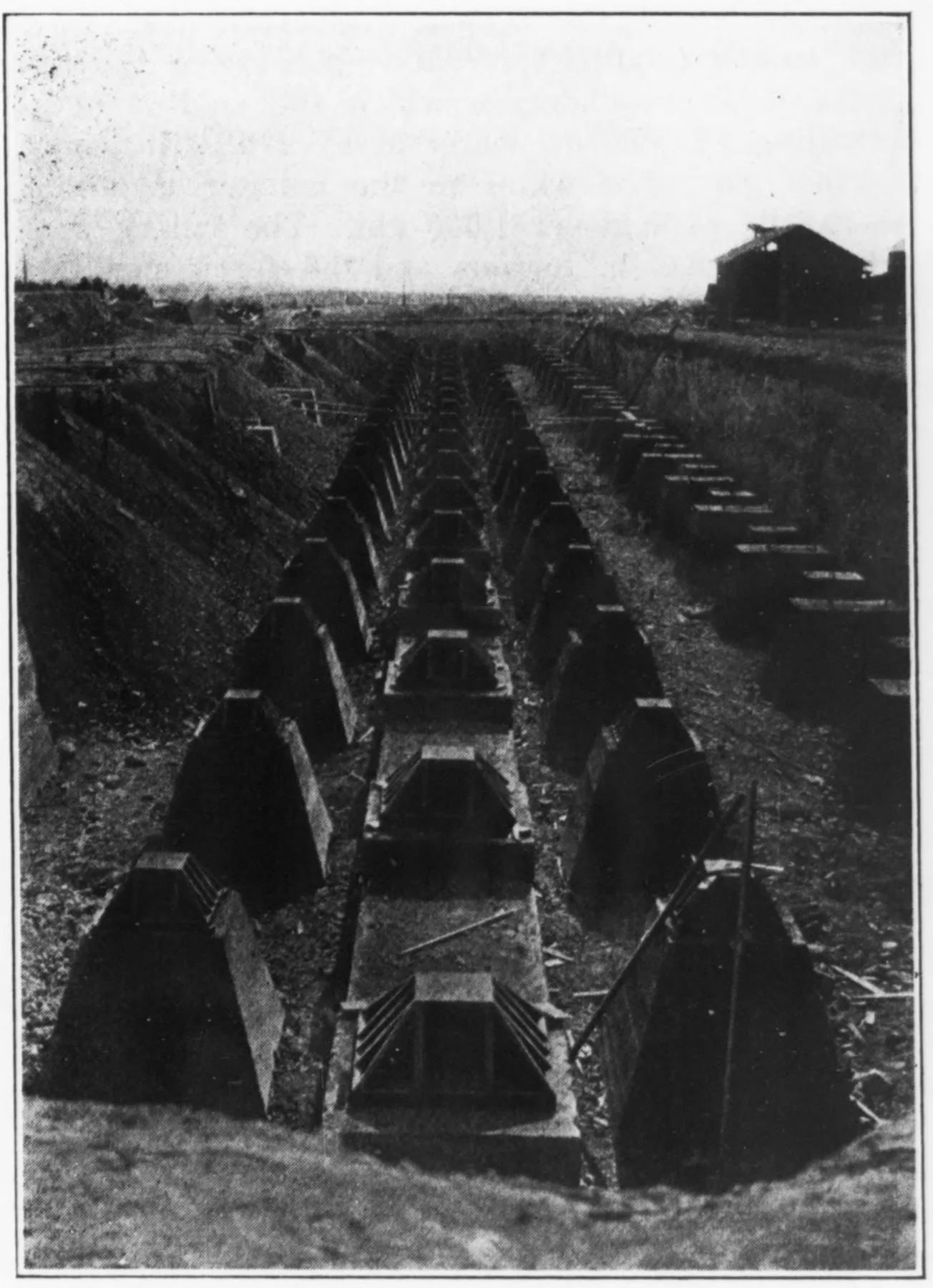
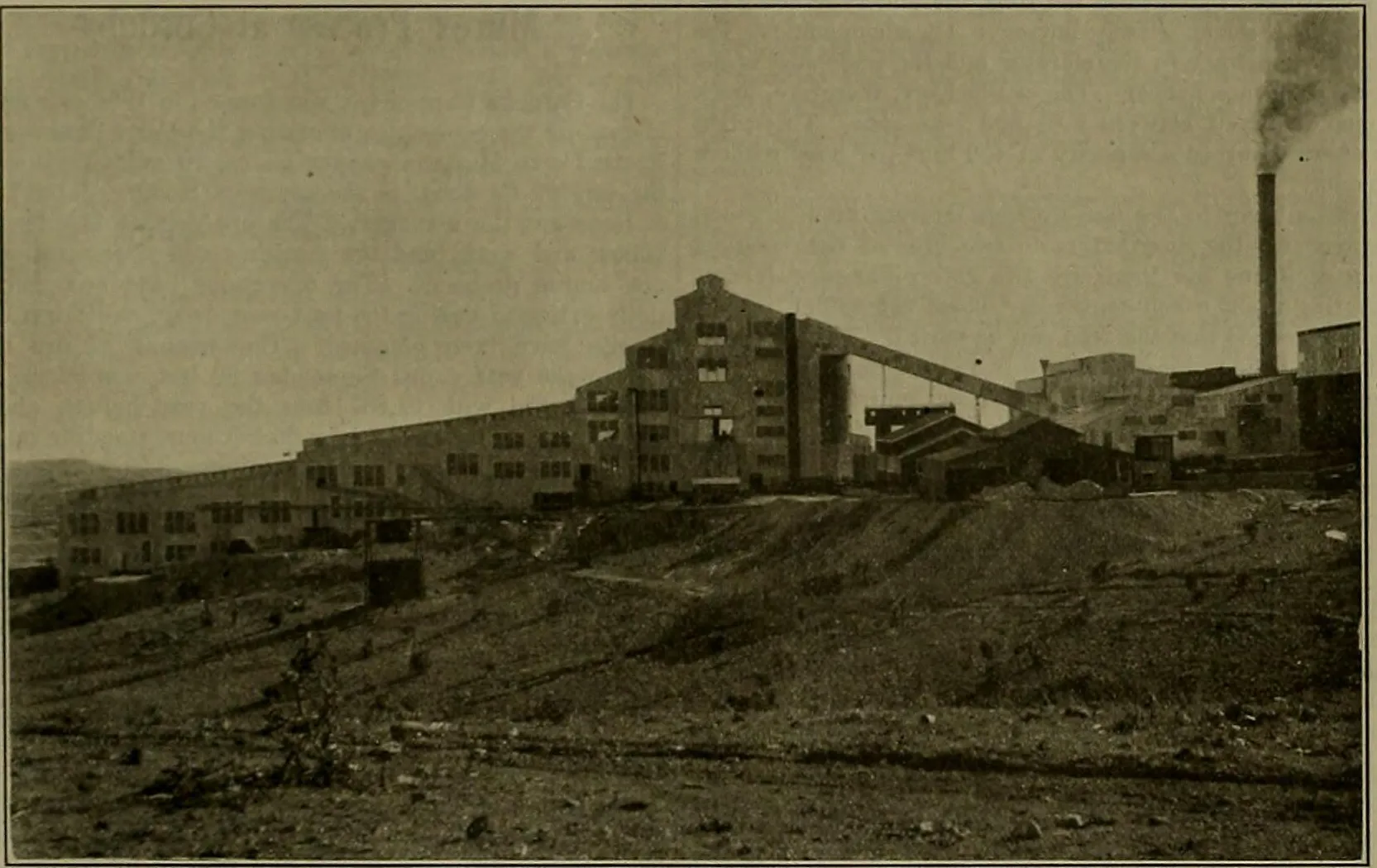
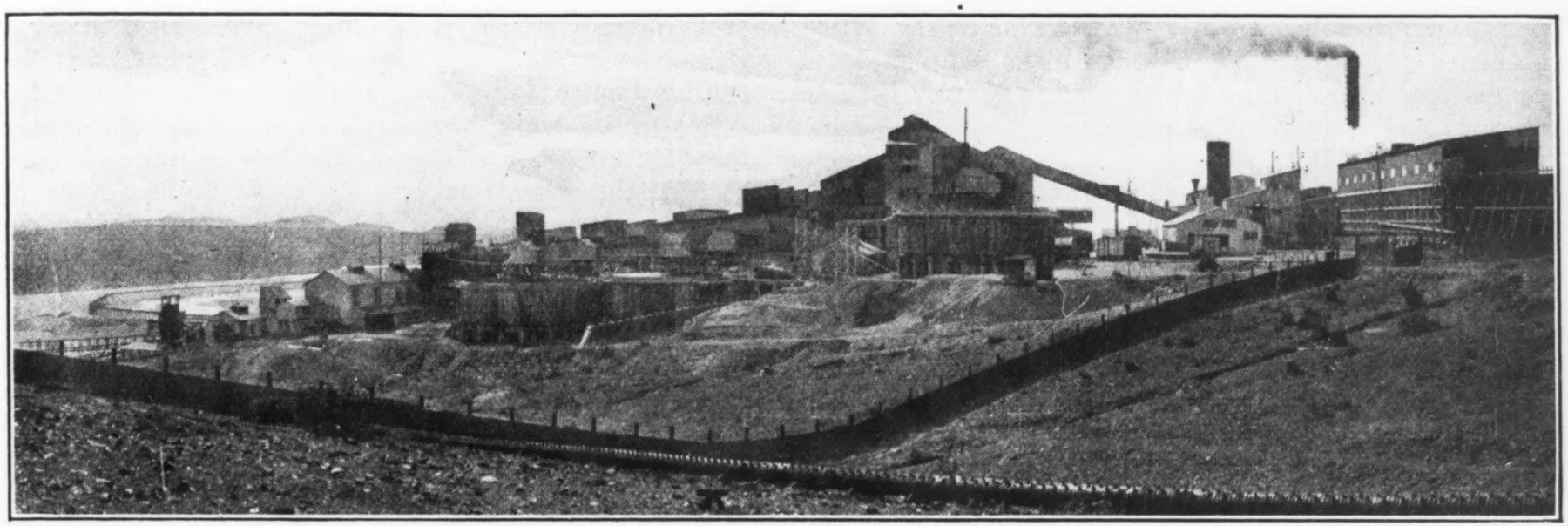
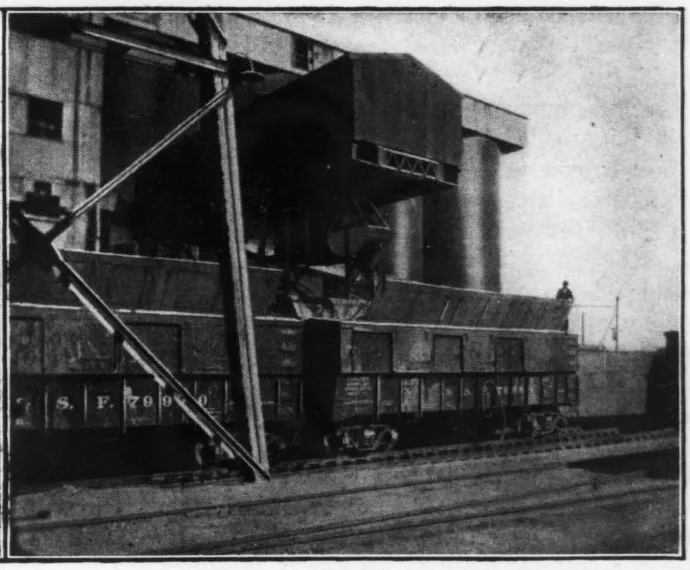
T. A. Rickard visited Hurley in 1922 and described the plant in the Engineering and Mining Journal-Press of 5 January 1924. Ore from Santa Rita was carried to Hurley by the Santa Fe. It reached the mill in trains of twenty-eight bottom-dump cars, each rated at fifty tons and loaded to fifty-five. The trains were split into sets of seven for the three unloading tracks, and the ore dropped into bins holding 12,000 and 6,000 tons. The mill itself was a steel building on concrete foundations, sheathed in galvanized iron. It was divided into seven sections, each 50 feet wide and 341 feet long.7
Sources: T. A. Rickard, "The Chino Enterprise - V: Concentrating the Ore at Hurley and Smelting at El Paso", Engineering and Mining Journal-Press, vol. 117 no. 1 (5 January 1924), pp. 13 ff. (1924-01-05): p. 13; p. 14; T. A. Rickard, The Chino Enterprise—V: Concentrating the Ore at Hurley and Smelting at El Paso, Engineering and Mining Journal-Press vol. 117 no. 1, pp. 13-16 (1924-01-05): p. 13; p. 13, 'Construction and Equipment of the Mill'
The Mines Handbook of 1916 gives the measure of the early mill. It concentrated the ore 15 to 1, so that fifteen tons of ore left one ton of concentrate, and it recovered 66.6 percent of the copper. A third of the copper in the ore was not recovered. By Rickard's visit the average recovery was 79 percent, under mill superintendent J. T. Shimmin.
Sources: Walter Harvey Weed (ed.), The Mines Handbook (vol. XII, 1916), entry "Chino Copper Co.", pp. 368-370: p. 370; T. A. Rickard, "The Chino Enterprise - V: Concentrating the Ore at Hurley and Smelting at El Paso", Engineering and Mining Journal-Press, vol. 117 no. 1 (5 January 1924), pp. 13 ff. (1924-01-05): p. 14; T. A. Rickard, The Chino Enterprise—V: Concentrating the Ore at Hurley and Smelting at El Paso, Engineering and Mining Journal-Press vol. 117 no. 1, pp. 13-16 (1924-01-05): p. 14
Nothing was smelted at Hurley in these years. In 1922, as Rickard described it, drained table concentrate was lifted by gantry crane into railroad cars, and the mixed concentrate went out still holding about 17 percent water, bound for the smelter at El Paso. Chino's concentrates were treated there under a long-term contract until March 1939.8
Sources: T. A. Rickard, "The Chino Enterprise - V: Concentrating the Ore at Hurley and Smelting at El Paso", Engineering and Mining Journal-Press, vol. 117 no. 1 (5 January 1924), pp. 13 ff. (1924-01-05): pp. 13-14; T. A. Rickard, The Chino Enterprise—V: Concentrating the Ore at Hurley and Smelting at El Paso, Engineering and Mining Journal-Press vol. 117 no. 1, pp. 13-16 (1924-01-05): p. 14
Flotation and the sixth and seventh sections: Hurley, 1914 to 1924
Flotation came to the Hurley mill in its first decade. In this process finely ground ore is stirred in water so that the mineral particles cling to air bubbles and rise as a froth that can be skimmed off. Rickard dated its introduction at Hurley to 1916. He said that, together with added equipment for fine grinding and for tables, it doubled the capacity of a plant whose sections had each been designed for 1,000 tons a day.
Sources: T. A. Rickard, "The Chino Enterprise - V: Concentrating the Ore at Hurley and Smelting at El Paso", Engineering and Mining Journal-Press, vol. 117 no. 1 (5 January 1924), pp. 13 ff. (1924-01-05): p. 14; T. A. Rickard, The Chino Enterprise—V: Concentrating the Ore at Hurley and Smelting at El Paso, Engineering and Mining Journal-Press vol. 117 no. 1, pp. 13-16 (1924-01-05): p. 14
Two sources give different years for it. Rickard gives 1916; a Mining History Association tour guide gives 1914.9
Two more sections were added in 1918 and 1919, bringing the Hurley concentrator to the seven Rickard saw. The seventh was standing as 1919 opened, to judge by the Engineering and Mining Journal of 4 January 1919. It reported primary flotation being tried in section seven of the mill. The same report said the assistant mill superintendent had left to manage a mine at Hanover.10
Sources: T. A. Rickard, The Chino Enterprise—V: Concentrating the Ore at Hurley and Smelting at El Paso, Engineering and Mining Journal-Press vol. 117 no. 1, pp. 13-16 (1924-01-05): p. 13, 'Construction and Equipment of the Mill'; Engineering and Mining Journal, 4 January 1919 (vol. 107 no. 1), personals and mining news: New Mexico (1919-01-04): mining news, New Mexico, 'Chino Copper (Hurley)'
Rickard's article of January 1924 describes recent experiments at the Hurley mill. To recover copper from oxidized ore, the mill was trying sponge iron, made in a muffle furnace from magnetite pulled out of the concentrate and from Gallup coal, to precipitate the metal.
A spring, three draws and a dam built of tailings: water for Hurley, 1909 to 1936
Chino arranged the Hurley mill's water before its foundations were laid. The Mines Handbook of 1916 says the primary supply came from the Apache Tejo spring south of Hurley and from the underflow of the Whitewater, Cameron Creek and Whiskey Creek draws.
Sources: Walter Harvey Weed (ed.), The Mines Handbook (vol. XII, 1916), entry "Chino Copper Co.", pp. 368-370: p. 370; John M. Sully, manager, Chino Copper Company, "Chino Copper Company, Santa Rita - Hurley: The Story of the Santa Rita del Cobre Grant and Its Development from Discovery to the Present Date", in New Mexico, the Land of Opportunity: Official Data on the Resources and Industries of New Mexico (Panama-California Exposition souvenir, 1915), pp. 144-156
The spring's distance is given two ways. The handbook puts it about three and a quarter miles from Hurley; Sully and a 1930 Bureau of Mines circular say four.11
Sources: Walter Harvey Weed (ed.), The Mines Handbook (vol. XII, 1916), entry "Chino Copper Co.", pp. 368-370: p. 370; John M. Sully, manager, Chino Copper Company, "Chino Copper Company, Santa Rita - Hurley: The Story of the Santa Rita del Cobre Grant and Its Development from Discovery to the Present Date", in New Mexico, the Land of Opportunity: Official Data on the Resources and Industries of New Mexico (Panama-California Exposition souvenir, 1915), pp. 144-156
Below the mill the company stored water. The handbook describes a dam built out of mill tailings, the ground rock left after the copper mineral is taken out, holding a reservoir with a storage area of nearly 3,000 acre-feet. Ralph Emerson Twitchell's 1917 history of New Mexico, in a biography of mill superintendent W. H. Janney, says the flood waters that supplied the concentrator at certain seasons were stored in Lake Janney, named in his honor.
Sources: Walter Harvey Weed (ed.), The Mines Handbook (vol. XII, 1916), entry "Chino Copper Co.", pp. 368-370: p. 370; Ralph Emerson Twitchell (ed.), The Leading Facts of New Mexican History, vol. III (Torch Press, 1917), Grant County biographies: vol. III, p. 271, biography of W. H. Janney
By 1930 the main supply came from three wells at the Apache Tejo station, the deepest 2,445 feet, with more water from stations at the Bolton Ranch, the B Ranch, Whiskey Creek and Cameron Creek. The supply served the towns as well as the mill. A National Labor Relations Board decision of 1940 calls the Apache pumping plant the main source of water for Hurley and Santa Rita; smaller pumps replaced it early in 1936.11
Coal, power and a precinct of nearly three thousand: Hurley, 1915 to 1930
Hurley also made the enterprise's electricity. Writing for the 1915 Panama-California Exposition, Sully reckoned that the company paid more than $600,000 a year for New Mexico coal, burned in the power plant at Hurley and in the shovels and locomotives. He put its wages at about $2,000,000 a year, and reckoned that about 10,000 people in the state depended on Chino. The 2010 tour map dates the Chino general offices in Hurley to 1915. A 1930 description of the plant lists three Allis-Chalmers turbo-generators of 7,500, 6,000 and 2,000 kilowatts. Fired with slack coal from the Gallup fields, they sent power at 24,000 volts to the mine at Santa Rita.12, 13
Sources: John M. Sully, manager, Chino Copper Company, "Chino Copper Company, Santa Rita - Hurley: The Story of the Santa Rita del Cobre Grant and Its Development from Discovery to the Present Date", in New Mexico, the Land of Opportunity: Official Data on the Resources and Industries of New Mexico (Panama-California Exposition souvenir, 1915), pp. 144-156; hurleynm.com / JW Art Gallery, Hurley Street Map (2010), with a numbered list 'Historic Hurley Buildings' (2010 (captured 2011-07-12)): legend 'Historic Hurley Buildings'
The 1920 census shows what a decade had done to an abandoned sidetrack. Hurley precinct had 2,959 people. The Silver City precinct, the town included, counted 2,977. In 1921 the state business directory credited Hurley's neighborhood with 6,000 people and listed C. W. Fraser as the Santa Fe's railroad and express agent there.14, 15
Sources: New Mexico State Business Directory (Gazetteer Publishing & Printing Co., Denver, 1921), "Hurley", pp. 294-295: p. 294; John M. Sully, manager, Chino Copper Company, "Chino Copper Company, Santa Rita - Hurley: The Story of the Santa Rita del Cobre Grant and Its Development from Discovery to the Present Date", in New Mexico, the Land of Opportunity: Official Data on the Resources and Industries of New Mexico (Panama-California Exposition souvenir, 1915), pp. 144-156

The Hurley mill rebuilt, 1923 to 1925
Rickard came to Hurley in 1922, the year after a steep fall in the enterprise's output. On 13 January 1922 the Artesia Advocate printed a U.S. Geological Survey review of New Mexico mining in 1921. The review gave Chino's copper production as 46,088,609 pounds in 1920 and, counting later shipments, about 9.1 million pounds for all of 1921, roughly a fifth of the year before.
Sources: Artesia Advocate, 13 January 1922, p. 3 (U.S. Geological Survey review of New Mexico mining in 1921) (1922-01-13): p. 3 (mining review); T. A. Rickard, "The Chino Enterprise - V: Concentrating the Ore at Hurley and Smelting at El Paso", Engineering and Mining Journal-Press, vol. 117 no. 1 (5 January 1924), pp. 13 ff. (1924-01-05): p. 14
A rebuilding begun in 1923 and finished in 1925 changed the plant Rickard had seen in 1922. It took out the Chilean mills, the older grinding machines, and put in ball mills. It installed pneumatic flotation machines of a pattern called the Chino type.16
In the Mining Congress Journal of June 1929 an engineer at another Southwestern copper plant wrote about the Symons cone crusher, a machine for breaking ore. The only one running in his district at the time he described, he wrote, had been a seven-foot machine installed by the Nevada Consolidated Copper Company, Chino Mines, at its concentrator at Hurley. He credited the company with a generous distribution of the data from its operation.
A Bureau of Mines circular of 1930 records the result. The Hurley concentrator, by then a plant of the Nevada Consolidated Copper Company, could treat 13,500 tons of ore a day, nearly seven times the figure in the design of 1909. It recovered about 84 percent of the copper, where the mill of 1916 had recovered two-thirds.17
Sources: John M. Sully, manager, Chino Copper Company, "Chino Copper Company, Santa Rita - Hurley: The Story of the Santa Rita del Cobre Grant and Its Development from Discovery to the Present Date", in New Mexico, the Land of Opportunity: Official Data on the Resources and Industries of New Mexico (Panama-California Exposition souvenir, 1915), pp. 144-156; Walter Harvey Weed (ed.), The Mines Handbook (vol. XII, 1916), entry "Chino Copper Co.", pp. 368-370: p. 370
Read more on Salars.net
Part 2 of 9 of the series Hurley, New Mexico: the mill and smelter town.
Sources
- Thorne dates the organization of the Chino Copper Co. to June 1909, says it was linked to Utah Copper's backers, had steam shovels at work by fall 1910, and milled its first ore at Hurley a year later. Mining practice at the Chino mines, Nevada Consolidated Copper Co., Santa Rita, N. Mex. (U.S. Bureau of Mines Information Circular 6412), p. 3 (page image checked). View source ↗ (documented)
- According to David F. Myrick's New Mexico's Railroads (rev. ed. 1990), as excerpted on UtahRails.net, in 1891 an independent group opened the 14-mile Silver City and Northern Rail Road from Whitewater through Hurley to San Jose, a station just east of present-day Hanover Junction. Kennecott Chino Mines Division (railroad history compilation, quoting David F. Myrick, New Mexico's Railroads, 1990, pp. 185-192), utahrails.net/bingham/kcc-chino.php, Myrick excerpt (Myrick pp. 185-192). View source ↗ (reported)
- The El Paso Herald reported in July 1910 that Chino's mill would stand on the 'B ranch', bought from the Victoria Land and Cattle Co. for its water, a mile from Hurley station, where the company had platted a company-controlled townsite. El Paso Herald, 18 July 1910, p. 5 (Chino Copper Co. item), p. 5 (OCR checked). View source ↗ (reported)
- The same July 1910 report said a branch of the Santa Rita Store Co. had opened at the Hurley mill site and the grade for a branch railway to the mill was nearly finished. El Paso Herald, 18 July 1910, p. 5 (Chino Copper Co. item), p. 5 (OCR checked). View source ↗ (reported)
- Chino's steam shovels started in September 1910, Hurley mill construction began in October 1910, and by December 1912 drilling had proved about 90 million tons of 1.8 percent ore. Geology of the Santa Rita Mining Area, New Mexico (USGS Bulletin 859), USGS Bulletin 859, p. 9. View source ↗ (reported)
- The El Paso Herald reported on 9 August 1911 that Chino Copper's bond issue was fully subscribed and would bring in $2,400,000, enough to pay off the company's debts and enlarge the Hurley concentrator from 3,000 to 5,000 tons a day. El Paso Herald, 9 August 1911, p. 12 ('Chino Copper Bond Issue Is Reported Subscribed'), p. 12 (OCR checked). View source ↗ (reported)
- Ore from the Santa Rita pit was weighed on railroad scales at the mine and carried to the Hurley concentrator by the Atchison, Topeka & Santa Fe. Information Circular 6394: Milling Methods at the Hurley Plant of the Nevada Consolidated Copper Co., Hurley, New Mexico, IC 6394, Metallurgical calculations, p. 13-14. View source ↗ (documented)
- Chino's concentrates were smelted under a long-term contract at ASARCO's El Paso smelter until March 1939; after that all went to Kennecott's own Hurley smelter, fed by a natural-gas pipeline brought from Deming in 1939. Information Circular 7837: Open-Pit Mining Methods and Practices at the Chino Mines Division, Kennecott Copper Corp., Grant County, N. Mex., IC 7837, History of district, p. 7. View source ↗ (documented)
- Chino's first concentrator was built at Hurley in 1911, with flotation added in 1914; the Hurley smelter began production in 1939. L. Michael Kaas, Silver City historical tour guide, Mining History Association (c. 2011, inferred), Kaas, Santa Rita section. View source ↗ (reported)
- Two sections were added to the Hurley concentrator in 1918 and 1919, bringing it to seven sections. Information Circular 6394: Milling Methods at the Hurley Plant of the Nevada Consolidated Copper Co., Hurley, New Mexico, IC 6394, Brief history of concentrator operations, p. 2. View source ↗ (documented)
- Hurley's main water supply in 1930 came from three wells at the Apache Tejo station, four miles south of the concentrator, the deepest 2,445 feet; other water came from the Bolton Ranch, 'B' Ranch, Whiskey Creek and Cameron Creek stations. Information Circular 6394: Milling Methods at the Hurley Plant of the Nevada Consolidated Copper Co., Hurley, New Mexico, IC 6394, Water supply, p. 14. View source ↗ (documented)
- The Hurley plant generated its own power with three Allis-Chalmers turbo-generators (7,500, 6,000 and 2,000 kilowatts) and sent it at 24,000 volts to the mine at Santa Rita. Information Circular 6394: Milling Methods at the Hurley Plant of the Nevada Consolidated Copper Co., Hurley, New Mexico, IC 6394, Power, pp. 1-2. View source ↗ (documented)
- The Hurley power plant burned slack coal brought from the Gallup coal fields of northwestern New Mexico. Information Circular 6394: Milling Methods at the Hurley Plant of the Nevada Consolidated Copper Co., Hurley, New Mexico, IC 6394, Power, p. 2. View source ↗ (documented)
- In 1920 the Silver City precinct, including the town, counted 2,977 people, while Hurley precinct already had 2,959. Fourteenth Census (1920), Vol. 1, Table 53: Population of counties by minor civil divisions 1920, 1910 and 1900, New Mexico, Table 53, Grant County, p. 526 (page image). View source ↗ (documented)
- The 1921 state business directory credited Hurley's neighborhood with 6,000 people and listed farming, stock raising and mining as its industries. New Mexico State Business Directory (Gazetteer Publishing & Printing Co., Denver), New Mexico State Business Directory 1921, 'Hurley'. View source ↗ (reported)
- A rebuilding of the Hurley mill begun in 1923 replaced Chilean mills with ball mills and installed 'Chino-type' pneumatic flotation machines, and was finished in 1925. Information Circular 6394: Milling Methods at the Hurley Plant of the Nevada Consolidated Copper Co., Hurley, New Mexico, IC 6394, Brief history of concentrator operations, p. 3. View source ↗ (documented)
- In early 1930 the Hurley concentrator of the Nevada Consolidated Copper Co. had a daily capacity of 13,500 tons of ore and recovered about 84 percent of the copper. Information Circular 6394: Milling Methods at the Hurley Plant of the Nevada Consolidated Copper Co., Hurley, New Mexico, IC 6394, Introduction, p. 1. View source ↗ (documented)
"Documented" means the source is a record of the time or a direct survey; "reported" means a later account or secondary history, attributed in the text.
Cite this page: “A siding and a mill: how Hurley began.” Grant County Atlas, Salars.net, first published 15 November 2026, revised 16 November 2026. https://atlas.salars.net/stories/hurley/a-siding-and-a-mill
Discussion
What would you add or question? Comments are reviewed before they appear.
Loading comments…