From 1910 the Chino Copper Company built and ran Hurley as the town for its concentrator, supplying the houses, water, store, schools and club. Life there followed the mill: Claude Dannelley, recalling it in 1960, dated shutdowns to 1921 and 1934, and in 1939 a smelter began production and, the Mining Congress Journal reported, new company houses were under way.
A red iron office and a payroll in silver dollars: Hurley, 1910 to 1912
Claude Dannelley, a longtime Hurley resident who recorded his memories of the town on tape in July 1960, remembered the first company office as a small red building of corrugated iron behind the store, near the underpass. It had two rooms, he said. One was for Dave Boise, the chief mill clerk and paymaster, and the other for the company physician, Dr. F. N. Carrier of Santa Rita.
LaMoine Langston, in his 1977 history of New Mexico Masonry, writes of what appears to be the same red sheet-iron building. By day, he writes, it was the Chino Copper Company's general office, holding the cashier's office, the security office, the doctor's office and the morgue. In 1911 and 1912, by his account, a Masonic club met there, and from that club Hurley Lodge No. 55 grew.
The office served a mill town. Hurley was where the Chino Copper Company put its concentrator, the mill that concentrated the copper ore dug at Santa Rita; the railroad historian David F. Myrick gives the rail haul between them as nine miles. In July 1910 the El Paso Herald reported that the company had platted a townsite under its control at Hurley and that a branch of the Santa Rita Store Co. was open at the mill site. A Geological Survey bulletin dates the start of mill construction to that October. Dannelley recalled that in the winter of 1910 only six families with teenage children lived in Hurley. There was no electricity, he said, and there were no telephones or phonographs, only coal oil lamps, lanterns and wood-burning stoves.1, 2, 3, 4, 5
Pay arrived by automobile, as Dannelley remembered it. Two weeks' wages, he recalled, were made up at Santa Rita in silver dollars and change and sealed in envelopes bearing each man's name. On the 10th and 25th of every month the general manager, John M. Sully, brought them to Hurley with Jim Blair, the Chino chief of police. Sully's EMF Studebaker, he said, was the only car at that time.
Dannelley told of an attempt on that payroll. On 10 August 1911, he said, robbers stopped Sully's car two miles north of Hurley, took the occupants' pocket cash, rings and watches, and ordered them to drive on. The payroll, he added, was not aboard. By his account the pursuit ended with five dead in Lincoln County, a figure that rests on his recollection. He kept the robbers' names off the tape out of respect for their relatives.
John M. Sully, general manager, of Hurley: a career from 1888 to 1923
John M. Sully, the man Dannelley remembered bringing the payroll from Santa Rita, had come to Chino by a long road. In 1924 his Massachusetts Institute of Technology class of 1888 published a record that carries his entry, under the name John Murchison Sully. It runs from Butte copper in 1888 and 1889 through water works, Georgia coal and a company railroad to mines at Joplin and in California. From 1895 to 1900 he was general superintendent of the Chickamauga Coal & Iron Co. and the Chickamauga and Durham Railway. He listed himself as general manager of the Chino Copper Co. and gave his address as Hurley. In 1918 he wrote that his work for the past ten years had been "entirely in connection with the Chino Copper Company."
Sources: M.I.T. Class of 1888, Class Record of '88, Massachusetts Institute of Technology (Concord, N.H., 1924), entry 'John Murchison Sully', pp. 121-122: p. 122; p. 121; Claude Dannelley (spelled Claud Dannelley / Donnelley within the text), Hurley, New Mexico: Historical Data from 1910-1960. 50 Years of Recorded Memories by Claude Dannelley (transcript of a tape begun July 13, 1960, with a later note of about 1963; 10 pages, distributed by JW Art Gallery, 'The Old Hurley Store') (1960-07-13 (note c. 1963; PDF posted c. 2010))
Sully's Hurley address followed him into public life. In September 1916 the Portales Valley News reported that the governor had named John M. Sully of Hurley among New Mexico's delegates to the American Mining Congress convention in Chicago that November. By 1923, Sully wrote in the class record, he was a regent of the New Mexico School of Mines at Socorro, a director of the Grant County Chamber of Commerce and governor of the state chapter of the American Mining Congress.
Sources: Portales Valley News, 15 September 1916, p. 3 (Western Newspaper Union state news) (1916-09-15): p. 3, state news column; M.I.T. Class of 1888, Class Record of '88, Massachusetts Institute of Technology (Concord, N.H., 1924), entry 'John Murchison Sully', pp. 121-122: pp. 121-122
Sully's Studebaker, the only car Dannelley remembered from the first payroll runs, soon had company. In January 1914 the Weekly Optic printed a tally from the Secretary of State's office of the first 250 automobiles registered in New Mexico that year. Three were credited to Hurley, as many as to Las Vegas, Alamogordo, Gallup, Fierro and Aztec, and Santa Rita had five. The paper put the whole state at about 2,000 cars.
Sources: Weekly Optic and Live Stock Grower, 24 January 1914, p. 7 (state automobile registrations by town) (1914-01-24): p. 7 (automobile registration story); Claude Dannelley (spelled Claud Dannelley / Donnelley within the text), Hurley, New Mexico: Historical Data from 1910-1960. 50 Years of Recorded Memories by Claude Dannelley (transcript of a tape begun July 13, 1960, with a later note of about 1963; 10 pages, distributed by JW Art Gallery, 'The Old Hurley Store') (1960-07-13 (note c. 1963; PDF posted c. 2010))
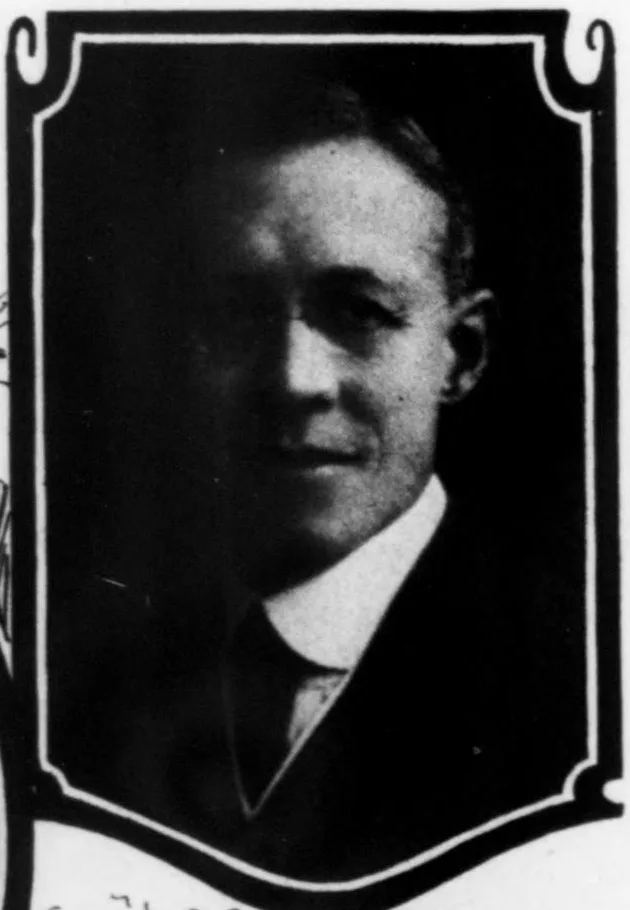
Box houses, Tent Row and a waiting list: Hurley, 1911 to 1920
In June 1911 the Engineering and Mining Journal reported the company pushing work on its 3,000-ton concentrator at Hurley and putting up new houses for employees. The early company houses Dannelley described were box houses of native lumber, lined with building paper and burlap, finished with lath battens, painted green or brown, and heated by wood or coal stoves. The construction superintendent, P. H. "Buck" Williams, lived in a three-room house on the corner where the fire station stood in 1960, he said. The first fifteen company houses went to Chino staff, by his account. After that, employees applied and were housed in order, and Dannelley remembered as many as 300 names on the waiting list at times.
Sources: Engineering and Mining Journal, 24 June 1911 (vol. 91 no. 25), mining news: New Mexico, Grant County, 'Chino' (1911-06-24): mining news, New Mexico, Grant County, 'Chino'; Claude Dannelley (spelled Claud Dannelley / Donnelley within the text), Hurley, New Mexico: Historical Data from 1910-1960. 50 Years of Recorded Memories by Claude Dannelley (transcript of a tape begun July 13, 1960, with a later note of about 1963; 10 pages, distributed by JW Art Gallery, 'The Old Hurley Store') (1960-07-13 (note c. 1963; PDF posted c. 2010))
For the rest of Hurley's workers, Dannelley recalled, there were boarding houses and tents. The main boarding house opened in 1911 under a lease to Charles Fox, and Chino built a double row of forty boxed and floored tents, called Tent Row, mostly as bachelors' quarters. Privately owned tents and shacks stood on A and B streets in North Hurley, he said, and three private boarding houses operated north of the tracks. His parents kept one of them and averaged 80 boarders a day.
Sully, in an account of the company published in 1915, described its houses at Santa Rita and Hurley as comfortable, lit by electricity, supplied with water and connected to sewers. He did not say who lived in them. The historian Ellen R. Baker quotes the passage in her 2007 book On Strike and on Film. She writes that the comfortable houses were mostly for Anglos, her term for the white employees, and that the company leased land to Mexican workers instead of housing them.
Sources: John M. Sully, manager, Chino Copper Company, "Chino Copper Company, Santa Rita - Hurley: The Story of the Santa Rita del Cobre Grant and Its Development from Discovery to the Present Date", in New Mexico, the Land of Opportunity: Official Data on the Resources and Industries of New Mexico (Panama-California Exposition souvenir, 1915), pp. 144-156; Ellen R. Baker, On Strike and on Film: Mexican American Families and Blacklisted Filmmakers in Cold War America (University of North Carolina Press, 2007), ch. 2, "Grant County's Mining District": ch. 2; ch. 2, text at note 88
The terms of such an arrangement are on record for Santa Rita in a later period. Terry Humble, speaking in an oral history interview about a house built there after 1954, said the company would let people build on company property for a ground rent of 50 cents a month.
Stove wood, as Dannelley recalled it, came into Hurley on burros, packed by woodcutters who sold it at a dollar a load. The company gave away old mine timbers sorted out at the Hurley crusher, he said, until a dynamite cap hidden in the wood blew a stove through the roof of a non-company house across the tracks.
Water, repairs and policing were company work. The Town of Hurley's 40-year water plan, amended in 2009, says that in the company town the mining company produced, disinfected and piped the drinking water. The town's sewage went into the mill's tailings slurry, the watery waste of the concentrator, so that the water could be recovered for the plant. In a 1942 decision the National Labor Relations Board found that company electricians, plumbers and carpenters maintained the Hurley townsite as well as the plant, and that company deputies policed both.
Sources: Engineers Inc. for the Town of Hurley, Town of Hurley 40 Year Water Plan (amended April 2009) (2009-04-10): Section 1 Introduction, Page 1 (PDF p. 13); National Labor Relations Board, Matter of Kennecott Copper Corporation, Nevada Consolidated Copper Corporation and Brotherhood of Railroad Trainmen et al., 40 N.L.R.B. 986 (decided 29 Apr. 1942) (1942-04-29): 40 N.L.R.B. at 1000
Policing Hurley could turn deadly, a newspaper report of 1917 suggests. A Santa Fe dispatch of 21 June 1917, printed in the Weekly Optic, reported two killings at what it called "the mining camp of Hurley." In one, a special officer shot and killed a man he had arrested for drunkenness; the report said the officer acted in self-defense. The second man was shot and killed just after drawing his pay, and the report did not say by whom.
Three sources from 1916 to 1920 give the size of Hurley. In 1916 the Mines Handbook described the settlement as the mill and its accessory buildings together with an office building, store, school, shops and dwellings, and gave the town about 3,500 people. Ralph Emerson Twitchell's history, published in 1917, credited it with 3,200. The 1920 census counted 2,959 in Hurley precinct, eighteen fewer than in the Silver City precinct.6
Sources: Walter Harvey Weed (ed.), The Mines Handbook (vol. XII, 1916), entry "Chino Copper Co.", pp. 368-370: p. 370; Ralph Emerson Twitchell (ed.), The Leading Facts of New Mexican History, vol. III (Torch Press, 1917), Grant County biographies: vol. III, pp. 261-262, biography of S. J. Hanks
In 1917 and 1918, Dannelley said, company carpenters put up a street of prefabricated California-style bungalows, and the street was named Patio.
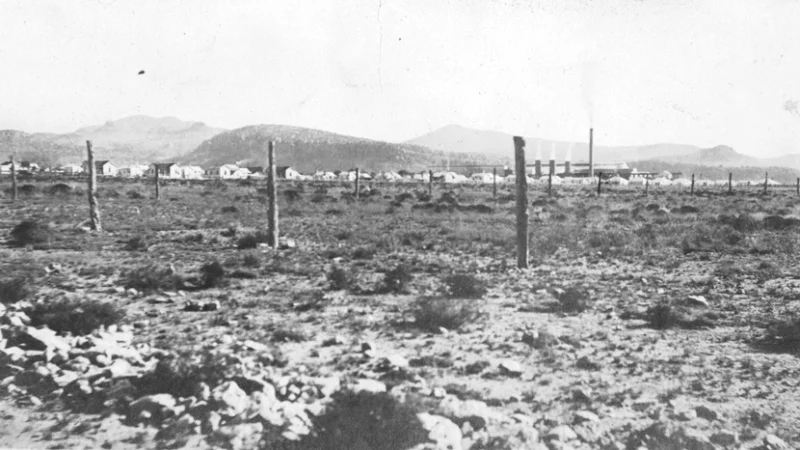
The store beside the tracks: Hurley, 1912 to 1946
Dannelley recalled that the first company store in Hurley was a frame building, used while a permanent one went up next to it. The new brick store on Cortez Street opened in 1913, he said, along with a new meat market and general office. He remembered that lightning struck a crew laying brick on the upper story of the general office and killed one of the men.
On the brick store the accounts differ by a year. The state tourism department's page on Hurley and the Hurley community website both say the brick building was added beside the wooden store in 1912. Dannelley put the opening of the new brick store in 1913. Neither date can be preferred on the evidence of these accounts alone.
Sources: New Mexico Tourism Department, Hurley (New Mexico True visitor page) (undated (read 2026-11-15)): paragraph 3; hurleynm.com (webmasters J. and K. Wade, JW Art Gallery), History of Hurley New Mexico (page of the Hurley community website, with a section 'The Old Hurley Company Store') (captured 2010-07-02): section 'The Old Hurley Company Store'; Claude Dannelley (spelled Claud Dannelley / Donnelley within the text), Hurley, New Mexico: Historical Data from 1910-1960. 50 Years of Recorded Memories by Claude Dannelley (transcript of a tape begun July 13, 1960, with a later note of about 1963; 10 pages, distributed by JW Art Gallery, 'The Old Hurley Store') (1960-07-13 (note c. 1963; PDF posted c. 2010))
The Hurley community website gives the layout of the brick building. The payroll office sat at the back with tools and hardware above it, and the rest, under tin ceilings sixteen feet high, was a department store. Trains passed within ten feet of the back of the building, the site says. Freight came off them through a steel door beside the tracks, slid down a cement chute into the basement, and rose into the store on a large elevator pulled by hand.
By Dannelley's account the Santa Rita Store Company ran the company stores in both Santa Rita and Hurley, and the 1921 state business directory lists it at Hurley. That directory lists private businesses in the town as well: two general merchants, a hotel, a bakery, a tailor, a barber, a shoemaker, a confectioner, a motor transit line and a theatre. It does not say where in the settlement they traded.
Sources: Claude Dannelley (spelled Claud Dannelley / Donnelley within the text), Hurley, New Mexico: Historical Data from 1910-1960. 50 Years of Recorded Memories by Claude Dannelley (transcript of a tape begun July 13, 1960, with a later note of about 1963; 10 pages, distributed by JW Art Gallery, 'The Old Hurley Store') (1960-07-13 (note c. 1963; PDF posted c. 2010)); New Mexico State Business Directory (Gazetteer Publishing & Printing Co., Denver, 1921), "Hurley", pp. 294-295: p. 294
Whether Hurley's men had to trade at the company store is answered from the company's side. T. A. Rickard, who visited Chino in May 1922 and wrote about it in the Engineering and Mining Journal-Press, said the men were not required to board with the company or to trade at its store. Sully had written in 1915 that every concession in the two camps was "subject to the approval and oversight of the company."
Sources: T. A. Rickard, "The Chino Enterprise - IV", Engineering and Mining Journal-Press, vol. 116 no. 26 (29 December 1923), pp. 1113-1121 (1923-12-29): p. 1121; John M. Sully, manager, Chino Copper Company, "Chino Copper Company, Santa Rita - Hurley: The Story of the Santa Rita del Cobre Grant and Its Development from Discovery to the Present Date", in New Mexico, the Land of Opportunity: Official Data on the Resources and Industries of New Mexico (Panama-California Exposition souvenir, 1915), pp. 144-156
In a 1940 decision the National Labor Relations Board found that the Santa Rita Store Corporation bought about $340,000 of supplies and merchandise a year and sold practically all of it to company employees. Its officers and directors also held positions with the mining company, the Board found. Dannelley recalled that Frank Lea, resident manager at Hurley from 1946, later bought the businesses with associates and changed the name to Hurley Stores, Inc.
Sources: National Labor Relations Board, Matter of Nevada Consolidated Copper Corporation and International Union of Mine, Mill and Smelter Workers, 26 N.L.R.B. 1182 (decided 24 Aug. 1940) (1940-08-24): 26 N.L.R.B. at 1188; Claude Dannelley (spelled Claud Dannelley / Donnelley within the text), Hurley, New Mexico: Historical Data from 1910-1960. 50 Years of Recorded Memories by Claude Dannelley (transcript of a tape begun July 13, 1960, with a later note of about 1963; 10 pages, distributed by JW Art Gallery, 'The Old Hurley Store') (1960-07-13 (note c. 1963; PDF posted c. 2010))
Doctors, typhoid and the autumn of 1918: Hurley, 1913 to 1944
At first, Dannelley recalled, Dr. Carrier came over from Santa Rita to Hurley by buggy. Hurley's first doctor, he said, was Dr. Hanks, a young man just out of college, who was later promoted to chief surgeon and then moved back to Hurley as company doctor until he retired in 1944.
The Chino general hospital was at Santa Rita, Sully wrote in 1915, and its staff supervised sanitation in both camps. Employees paid toward it every month, $1.75 for married men and $1.50 for single men by Rickard's report of 1922, and the company made up the deficit.
Sources: John M. Sully, manager, Chino Copper Company, "Chino Copper Company, Santa Rita - Hurley: The Story of the Santa Rita del Cobre Grant and Its Development from Discovery to the Present Date", in New Mexico, the Land of Opportunity: Official Data on the Resources and Industries of New Mexico (Panama-California Exposition souvenir, 1915), pp. 144-156; T. A. Rickard, "The Chino Enterprise - IV", Engineering and Mining Journal-Press, vol. 116 no. 26 (29 December 1923), pp. 1113-1121 (1923-12-29): p. 1121
In August 1913, Dannelley recalled, five Chino employees living at one of the private boarding houses north of the tracks came down with typhoid, and one died. The authorities closed the house, hauled it out to the B ranch, soaked it in coal oil and burned it, and ordered the owners to leave town.
Around 1917, Dannelley said, when a typhoid epidemic was feared, Chino built a one-room steam-cabinet plant inside the Hurley mill fence. It was called the dipping vat. The medical department put job applicants, transients and floaters suspected of carrying the disease through it.
The influenza epidemic reached Hurley in October 1918 and lasted, by Dannelley's account, into December. In October 1918, the historian Stephen Fox writes, Hurley, Fort Bayard and Santa Rita sent supplies to Mogollon. Cots filled the unfinished Chino Club, Dannelley said, and volunteers nursed the sick. The company store stocked caskets and set up a morgue in the old red barn behind it, and the company supplied grave diggers. During the epidemic came what he remembered as the biggest snowstorm ever to hit Hurley, eighteen inches. In Dannelley's words, "the little cemetery by the ball park was filling fast."7
A three-room school, a Trost high school and two churches: Hurley, 1913 to 1952
Hurley's first school, Dannelley said, was a three-room house that in 1960 still stood as the middle building of the grade school grounds. Its first four teachers, he said, were Mary Lee, Mrs. Bliss, Hurtah Mulholland and Pearl Bernard. Baker writes that Chino owned the schools in its two towns and paid the teachers.
Sources: Claude Dannelley (spelled Claud Dannelley / Donnelley within the text), Hurley, New Mexico: Historical Data from 1910-1960. 50 Years of Recorded Memories by Claude Dannelley (transcript of a tape begun July 13, 1960, with a later note of about 1963; 10 pages, distributed by JW Art Gallery, 'The Old Hurley Store') (1960-07-13 (note c. 1963; PDF posted c. 2010)); Ellen R. Baker, On Strike and on Film: Mexican American Families and Blacklisted Filmmakers in Cold War America (University of North Carolina Press, 2007), ch. 2, "Grant County's Mining District": ch. 2
A new high school opened in Hurley in September 1924, by Dannelley's dates. The design came from Trost & Trost of El Paso, the firm of the architect Henry C. Trost: a two-story, T-shaped building with wood siding, planned with ten classrooms and a very large gymnasium-auditorium. The 1990 survey record of the building says it was probably designed as a community center as well as a school. By May 1930 Hurley High School had a chapter of the National Honor Society, one of five then listed for New Mexico.
Sources: Claude Dannelley (spelled Claud Dannelley / Donnelley within the text), Hurley, New Mexico: Historical Data from 1910-1960. 50 Years of Recorded Memories by Claude Dannelley (transcript of a tape begun July 13, 1960, with a later note of about 1963; 10 pages, distributed by JW Art Gallery, 'The Old Hurley Store') (1960-07-13 (note c. 1963; PDF posted c. 2010)); Lloyd C. and June F. Engelbrecht, for the El Paso Public Library (1990); Henry C. Trost Historical Organization, Hurley – High School (building record) (1990 (web page current 2026)): building record, 'Remarks'; Bulletin of the Department of Secondary-School Principals of the National Education Association, no. 31 (May 1930), list of National Honor Society chapters (1930-05): chapter list, New Mexico section (search snippet)
The schools were not the same for every child, Baker writes. In her account the schools of Hurley, Santa Rita and Silver City were segregated through the third grade. Drawing on interviews with former residents, among them Alice Sandoval, she adds that Hurley High School and the Santa Rita schools kept separate bathrooms and drinking fountains for Mexican and Anglo students, even though the classrooms at Hurley High School were integrated.
Two dates are given for the Hurley Community Church. Dannelley dated its opening to March 1917 and said the first wedding there, that year, was that of Agnes Sully, the general manager's daughter. A street map of historic buildings published in Hurley in 2010 gives the church the date 1913 instead. By 1925 a biographical sketch in Charles F. Coan's history of New Mexico could describe a man who had gone to work for Chino in October 1911 as a member of the Union Church at Hurley.
Sources: Claude Dannelley (spelled Claud Dannelley / Donnelley within the text), Hurley, New Mexico: Historical Data from 1910-1960. 50 Years of Recorded Memories by Claude Dannelley (transcript of a tape begun July 13, 1960, with a later note of about 1963; 10 pages, distributed by JW Art Gallery, 'The Old Hurley Store') (1960-07-13 (note c. 1963; PDF posted c. 2010)); Charles F. Coan, A History of New Mexico, vol. II (American Historical Society, 1925), biography of William Wallace Dedman, pp. 372-374: vol. II, p. 374; Charles F. Coan, A History of New Mexico, vol. II (American Historical Society, 1925), biography of William Wallace Dedman, pp. 372-374: vol. II, p. 374
Three accounts date Hurley's Catholic church differently. Dannelley said the first one was built slowly by volunteer adobe makers in North Hurley, then replaced by a large adobe church on Cortez Street that served until 1942, when contract craftsmen built a new one. The 2010 map says the adobe church was built in 1914 and rebuilt in 1942. The Town of Hurley's 2023 comprehensive plan, crediting the Silver City Daily Press, gives a third account: a first church built in 1916 on land given by the company, and the present one finished in April 1952. Dannelley and the map agree on 1942; the plan's years are 1916 and 1952.
Sources: Claude Dannelley (spelled Claud Dannelley / Donnelley within the text), Hurley, New Mexico: Historical Data from 1910-1960. 50 Years of Recorded Memories by Claude Dannelley (transcript of a tape begun July 13, 1960, with a later note of about 1963; 10 pages, distributed by JW Art Gallery, 'The Old Hurley Store') (1960-07-13 (note c. 1963; PDF posted c. 2010)); hurleynm.com / JW Art Gallery, Hurley Street Map (2010), with a numbered list 'Historic Hurley Buildings' (2010 (captured 2011-07-12)): legend item 3; Town of Hurley / Southwest New Mexico Council of Governments, Town of Hurley Comprehensive Plan (2023) (2023-06-13): History, p. 10
Toward the new Catholic church, the 2023 plan says, Kennecott withheld a $6 monthly donation from employees who were parishioners, and children contributed 30 cents a week.
A directory of New Mexico's churches compiled in 1940 by the Historical Records Survey of the Work Projects Administration shows both Hurley congregations as they stood that year. The Protestant one appears as Union Congregational Church, under the Rev. George Kirtley, grouped with the Community Congregational Church at Santa Rita. The Catholic parish is listed as Divine Infant Jesus Church, in the Diocese of El Paso, with the Rev. James Canyellas as administrator and missions at Bayard, Dwyer and Sherman.
The picture show, the Chino Club and Old Mulligan: Hurley, 1911 to 1949
Dannelley remembered Hurley's first picture show, about 1911 or 1912, as an open-air theater of corrugated iron with a dirt floor and wooden benches. Lee Gooding, the village tailor, ran it, he said, and a ticket to the silent films cost 15 cents. Chino built a new theater at First and Cortez in 1915, he said. Under Eddie Ward, a former Copper League ballplayer, it became the Tejo Theater.
By Dannelley's account the open-air theater stood where the Chino Club was later built. He gave the club's dedication as 2 February 1919, with an elected board of directors and membership at first for male Chino employees only. A bowling alley and a library were added later, he said, and wives were admitted. Rickard wrote in 1922 that the company had given the building, furniture and equipment and supplied water and light, while members paid dues of a dollar a month. A 1986 catalog of New Mexico trade tokens lists aluminum pieces stamped for the Chino Club of Hurley, good for 5 cents in trade.
Sources: Claude Dannelley (spelled Claud Dannelley / Donnelley within the text), Hurley, New Mexico: Historical Data from 1910-1960. 50 Years of Recorded Memories by Claude Dannelley (transcript of a tape begun July 13, 1960, with a later note of about 1963; 10 pages, distributed by JW Art Gallery, 'The Old Hurley Store') (1960-07-13 (note c. 1963; PDF posted c. 2010)); T. A. Rickard, "The Chino Enterprise - IV", Engineering and Mining Journal-Press, vol. 116 no. 26 (29 December 1923), pp. 1113-1121 (1923-12-29): p. 1121; (compiler not identified in the search record), Interim Listing of New Mexico Trade Tokens (1986), Hurley listings: Hurley listings
Membership had another limit, by Bronstein's account, one that Dannelley's tape does not mention. In the New Mexico Historical Review in 2012, Bronstein writes that white workers in Hurley and Santa Rita could use the well-equipped Chino club while Mexican American workers had only a smaller one called the Casino.8
Jan Thomas, whose father became an electrician at the Hurley smelter during World War II, remembered the club as the employees' recreation center, a place to play pool, bowl or buy a snack. He was sent there at about five years old, he recalled, with ten pennies for his father's cigarettes.
The Masonic Hall opened on 6 March 1919, Dannelley said, with its ground floor rented for a barber shop, the post office and a sweet shop. When Silver City was host to the state's Masonic Grand Lodge in February 1925, the Artesia Advocate reported, the lodges of Santa Rita, Hurley, Fort Bayard and Tyrone helped entertain the visitors.
Sources: Claude Dannelley (spelled Claud Dannelley / Donnelley within the text), Hurley, New Mexico: Historical Data from 1910-1960. 50 Years of Recorded Memories by Claude Dannelley (transcript of a tape begun July 13, 1960, with a later note of about 1963; 10 pages, distributed by JW Art Gallery, 'The Old Hurley Store') (1960-07-13 (note c. 1963; PDF posted c. 2010)); Artesia Advocate, 26 February 1925, p. 2: "Silver City Host to Grand Lodge of Masons of State" (1925-02-26): p. 2
For dances, Dannelley recalled, the only hall in Hurley big enough was the boarding house known as Old Mulligan. There, on 7 February 1939, the town's first square dance club was organized with Dannelley as president. It grew from 21 members to 84 and lasted until 1949.
The ballpark at the edge of town: Hurley, 1911 to 1917
Baseball came early to Hurley, by Dannelley's account. The first players, in 1911, were mostly the company's civil engineers, he said, and the first diamond lay at what was then the edge of town. When that ground was needed for more houses, a new diamond and grandstand were built south of town, where the park still stood in 1960. In 1915 a two-day rodeo, barbecue and ball game at the park, paid for by public subscription and donations from Chino, drew a crowd Dannelley estimated at 8,000.
Lynn E. Bevill, in a 1988 history of the Copper League, writes that as early as 1913 major-league scouts were coming to watch weekend games among Silver City, Hurley, Santa Rita, Fort Bayard and Tyrone.
By 1914, by one newspaper's report, the camps were signing their teams before spring. That February the Silver City Independent reported on a baseball meeting, in an item the Weekly Optic reprinted. To its knowledge, the paper said, Hurley and Santa Rita had already signed very strong teams for the coming season, and El Paso was sure to follow. The meeting's view, as reported, was that players should receive a straight salary, with no split of the gate receipts.
Visiting engineers met the company's hospitality at the Hurley mill in 1916, by a trade journal's report. When the American Institute of Mining Engineers toured Chino that September, the Engineering and Mining Journal reported that Sully ran a real bar at Santa Rita for guests arriving from Arizona, which was dry. At the Hurley mill, the journal joked, "Sully's Second Free Thirst Quencher" was met, along with souvenir bottles of layered concentrates.
Dannelley remembered what appears to be the same excursion but placed it in 1917. In his account eight Pullman cars of mining engineers and their wives stopped at Hurley for a free dance beside the assay office. The journal printed its report in October 1916, within weeks of the visit; Dannelley spoke in 1960.
Sources: Claude Dannelley (spelled Claud Dannelley / Donnelley within the text), Hurley, New Mexico: Historical Data from 1910-1960. 50 Years of Recorded Memories by Claude Dannelley (transcript of a tape begun July 13, 1960, with a later note of about 1963; 10 pages, distributed by JW Art Gallery, 'The Old Hurley Store') (1960-07-13 (note c. 1963; PDF posted c. 2010)); Engineering and Mining Journal staff, Institute Meeting in Arizona (report of the 113th meeting of the American Institute of Mining Engineers, with a visit to Santa Rita and Hurley), Engineering and Mining Journal vol. 102 no. 16 (1916-10-14): 'Entertainment and Instruction at Santa Rita' section
Chick Gandil and the Chino Twins: Hurley and Santa Rita, 1925 to 1927
Dannelley remembered the years when Chino's Hurley and Santa Rita teams fielded professionals who had been banned from organized baseball in the East, and he named Chick Gandil among them. Bevill's history supplies the detail. In the Copper League period, Bevill writes, Santa Rita and Hurley combined to field one team, called Chino and nicknamed the Twins.
Sources: Claude Dannelley (spelled Claud Dannelley / Donnelley within the text), Hurley, New Mexico: Historical Data from 1910-1960. 50 Years of Recorded Memories by Claude Dannelley (transcript of a tape begun July 13, 1960, with a later note of about 1963; 10 pages, distributed by JW Art Gallery, 'The Old Hurley Store') (1960-07-13 (note c. 1963; PDF posted c. 2010)); Lynn E. Bevill, Outlaw Baseball Players in the Copper League: 1925-1927, Chapter I, Background (1988): Chapter I, text before note 59
Bevill's dates for the combined team do not agree with each other. He gives the period as 1925 to 1927, though his season chapters show Chino entering the league only in 1926.
Sources: Lynn E. Bevill, Outlaw Baseball Players in the Copper League: 1925-1927, Chapter I, Background (1988): Chapter I, text before note 59; Lynn E. Bevill, Outlaw Baseball Players in the Copper League: 1925-1927, Chapter III, The 1926 Season (1988): Chapter III, text before note 101
On 20 February 1926, Bevill writes, Chino's directors met those of El Paso, Juarez and Douglas at El Paso to form that year's league. In Bevill's words, "Unanimous approval was quickly given for the unlimited use of outlaw players." Each team's salaries were capped at $2,250 a month.
Money came from the mine, by Bevill's account. He writes that the company was said to put $1,500 a month toward the ball club's payroll and to keep a dormitory just for the athletes. His conclusion is that the club received monthly payments from the mining company, which also gave players jobs in the off season.
Sources: Lynn E. Bevill, Outlaw Baseball Players in the Copper League: 1925-1927, Chapter I, Background (1988): Chapter I, text at notes 59-60; Lynn E. Bevill, Outlaw Baseball Players in the Copper League: 1925-1927, Chapter VI, Conclusion (1988): Chapter VI
Chino's first half of the 1926 season went badly all the same, 13 wins against 23 losses by Bevill's figures. That year Fort Bayard released its first baseman, Gandil, one of the banned Black Sox, and within a week the struggling Chino team had signed him. Later it made him manager. Under Gandil the Twins went 18-12 in the second half and finished third overall at 31-35.
League games were played at Hurley, and Bevill tells of one in 1926. The Douglas team, riding a truck to meet the Twins there, broke down eight miles south of town, and the players walked in and played without rest.
In the winter of 1926 to 1927, Bevill writes, Gandil held a job with the Chino mines. On 7 January 1927 he testified before Commissioner Landis in Chicago, and on 6 March the club reorganized with Gandil again as manager.
Chino won the second half of the 1927 season with 21 wins and 10 losses, which Bevill credits to Gandil having built a team of local and regional players without other well-known or outlaw names. Then, just before the playoff with Fort Bayard, Gandil resigned and left the area. Johnny Meanor, a local player, took over as manager. On the final Sunday, in El Paso, the Twins beat Fort Bayard twice, 3 to 1 and 4 to 2, to take the Copper League championship.
One of the 1927 pitchers came from Midland, Texas, according to a paper there. In October 1927 the Midland Reporter reported that a local man named Munns was back from Hurley, where he had been pitching for the Chino Copper League team. Munns had managed the Midland Colts in the early part of the season. He had, the paper said, pitched eight straight wins against the Fort Bayard team and won four in the championship games at the end of the season.
Bevill writes that the Twins declined with the fortunes of Santa Rita and Hurley in the Depression, though a core of players came back whenever the mines reopened.
Two shutdowns and a hundred copper roofs: Hurley, 1921 to 1940
Two sources date the first complete shutdown at Hurley to 1921. Dannelley put it in April 1921 and the restart in April 1922, and a Silver City dispatch of 11 May 1921 in the Albuquerque Morning Journal referred to the company's recent complete shutdown at Santa Rita and Hurley. Chino, Dannelley said, let its employees stay in their houses rent free until they found work elsewhere or operations resumed, and gave them fuel and medical care.9
John M. Sully died on 15 July 1933, by Dannelley's record. That year Kennecott took over the physical assets of the Nevada Consolidated Copper Company, by then the owner of the property, and created the Nevada Consolidated Copper Corporation to operate Chino. In September 1933 the Engineering and Mining Journal reported that R. B. Tempest, the assistant general manager, had been named acting general manager. A federal appeals court decision of 1941 dates his appointment as general manager to 1 January 1934; he held the post until his death in May 1938. In November 1938 the journal named Horace Moses, Chino's mine superintendent in 1916, as general manager.
Sources: Claude Dannelley (spelled Claud Dannelley / Donnelley within the text), Hurley, New Mexico: Historical Data from 1910-1960. 50 Years of Recorded Memories by Claude Dannelley (transcript of a tape begun July 13, 1960, with a later note of about 1963; 10 pages, distributed by JW Art Gallery, 'The Old Hurley Store') (1960-07-13 (note c. 1963; PDF posted c. 2010)); U.S. Court of Appeals for the Tenth Circuit (Phillips, J.; Bratton, J., dissenting), Nevada Consolidated Copper Corp. v. National Labor Relations Board, 122 F.2d 587 (10th Cir., decided 27 Aug. 1941) (1941-08-27): ¶7 (122 F.2d at 589); ¶9 (122 F.2d at 589); Lynn E. Bevill, Outlaw Baseball Players in the Copper League: 1925-1927, Chapter I, Background (1988): Chapter I, text at notes 59-60; Engineering and Mining Journal, September 1933 (vol. 134 no. 9), personal notes (1933-09): personal notes; Engineering and Mining Journal, vol. 139 no. 11 (November 1938), New Mexico news: "Copper Mines at Santa Rita Reopened" (1938-11): New Mexico news section; Walter Harvey Weed (ed.), The Mines Handbook (vol. XII, 1916), entry "Chino Copper Co.", pp. 368-370: p. 368
The second shutdown, which began in 1934, went further, by Dannelley's account and the labor board's. Dannelley recalled that the power plant itself was shut in January 1935, that vacant houses were boarded up, and that the company began selling others to be moved away. That, he said, is when Bayard and Mimsville started to grow. Hurley, he said, was almost deserted, the highways full of people moving on.
The National Labor Relations Board found in 1940 that the company had made no effort to keep up the vacated dwellings at Santa Rita and Hurley. Water and light were often cut off, and at least half the houses that remained were left to the weather. "Both communities took on the appearance of ghost mining towns," the Board wrote. Chino reopened in January 1937.10
One Hurley worker's statement of about late 1942 traces his record at the plant through both shutdowns. He was a 46-year-old oiler, and the statement survives as an unsigned copy in the files of the federal Committee on Fair Employment Practice. He had started at the Hurley plant in 1912 at the tailings dam, he said, and worked through the labor department, the roll floors, the crusher and concentrate loading. After the reopening, which he placed in 1936, he went back to the oiling department and was made head oiler at $5.55 a shift. The Anglo who held the job before him, he said, had been paid $6.80.
Rebuilding followed. In 1939 a smelter began production at Hurley, taking over the smelting of Chino's concentrates from a plant in El Paso. In June of that year the Mining Congress Journal reported work well advanced on 100 new houses for employees at the mill and 37 more at the smelter. The mill houses had copper roofs, hot and cold water and modern bathrooms, the journal said. It did not say which employees would get them.2, 11
Counts of Hurley's houses differ between editions of the WPA guide to New Mexico. The first edition, published in 1940, describes Hurley as a company village of 125 company houses and does not mention the smelter; the revised edition of 1962 gives 468. The 1940 census counted 2,386 people in Hurley precinct.12, 13
Wartime and the last company years: Hurley, 1942 to 1958
On 31 December 1942 the Nevada Consolidated Copper Corporation was dissolved, and the next day the Santa Rita mine and the Hurley plant became the Chino Mines Division of Kennecott Copper Corporation. Wartime additions in 1942 and 1943 raised the mill's capacity to 20,000 tons a day. A company letter of 12 April 1943 names Horace Moses as general manager, F. C. Green as superintendent of mills, E. A. Slover as smelter superintendent and D. W. Boise as plant comptroller. Boise was the Dave Boise whom Dannelley remembered as paymaster in the red iron office more than thirty years earlier.14
Sources: Don Strack (compiler), Kennecott Chino Mines Division (UtahRails.net) (2013-04-15): Overview; Committee on Fair Employment Practice, Region X (Dallas), Kennecott Copper 10BN155 (FEPC closed case file, Region X; includes Final Disposition Report of July 11, 1944 and Field Examiner L. Virgil Williams's memorandum of December 1, 1943 on the Nevada Consolidated Copper Corporation case) (1943-12-01 to 1944-07-12); Claude Dannelley (spelled Claud Dannelley / Donnelley within the text), Hurley, New Mexico: Historical Data from 1910-1960. 50 Years of Recorded Memories by Claude Dannelley (transcript of a tape begun July 13, 1960, with a later note of about 1963; 10 pages, distributed by JW Art Gallery, 'The Old Hurley Store') (1960-07-13 (note c. 1963; PDF posted c. 2010))
A newspaper account of Moses's career has him starting at the bottom. When he announced for state treasurer in February 1956, an Associated Press report in the Artesia Advocate said he had moved to Silver City as a child and been educated in Grant County schools. He had joined the company in 1909, the report said, and worked his way from miner to general manager of the Chino division at Santa Rita and Hurley. The report called his 1909 employer Kennecott; the company then was Chino Copper.
Jan Thomas's memoir of his 1940s childhood in Hurley shows the war as a small boy met it. When the family ran out of ration stamps, he recalled, the 1928 Model A Ford his father had managed to buy stayed home. Early on 16 July 1945 he and his brother were woken by two booms. The story given out that day, he writes, was that a dynamite magazine at the Santa Rita mine had blown up, and the mine workers in his family knew it was false. The booms were the Trinity test.
Thomas remembered Hurley celebrating Japan's surrender with flags and horns in the streets and a bonfire at the baseball park, where an effigy of a Japanese soldier was burned.
Building went on through the 1940s, as Dannelley listed it: a swimming pool at the Chino Club; a recreation building beside the Community Church, replacing Old Mulligan; and a new jail and police office. He also listed a floodlit football stadium and softball field, and an entrance gate with a cactus garden at the west end of Cortez Street. The gate was named Goodrich Park for W. H. Goodrich, whom he identified as general manager. Non-employees, he said, were told to leave company houses to make room for employees, and that is when railroad men began building their own houses on Railroad Avenue near the depot.
Nelson L. Haggerson, in a 1993 autobiography, describes south Hurley before Kennecott sold the houses as a model of neat, well-kept company houses with paved streets and chain-link fences. In his memory, rank had an address. Company officials lived along Chino Boulevard on the east side, and when someone said they lived there, he writes, "you knew they were company officials."
In 1950 the census counted 2,079 people in Hurley, an unincorporated place, and about 1,000 people worked at the Hurley plants and offices that year.15, 16
In the early 1950s, Dannelley recalled, the Chino staff mess closed as an eating place and the old mess hall became company offices. The store dormitory, once the teachers had been moved out of it, was remodeled into a restaurant, the Copper Café. Eddie Ward, he said, ran the Tejo Theater until 1955, when it was sold to John W. Galbraith along with the townsite. It was resold, and in 1958 it was torn down and hauled to Deming.
Read more on Salars.net
Part 3 of 9 of the series Hurley, New Mexico: the mill and smelter town.
Sources
- Chino's steam shovels started in September 1910, Hurley mill construction began in October 1910, and by December 1912 drilling had proved about 90 million tons of 1.8 percent ore. Geology of the Santa Rita Mining Area, New Mexico (USGS Bulletin 859), USGS Bulletin 859, p. 9. View source ↗ (reported)
- Chino's first concentrator was built at Hurley in 1911, with flotation added in 1914; the Hurley smelter began production in 1939. L. Michael Kaas, Silver City historical tour guide, Mining History Association (c. 2011, inferred), Kaas, Santa Rita section. View source ↗ (reported)
- According to Myrick (as excerpted on UtahRails.net), Chino's early pit motive power was 21 H. K. Porter 0-4-0T locomotives, seven of 50 tons and fourteen of 45 1/2 tons; ore cars were delivered to the Santa Fe interchange at Santa Rita for the nine-mile haul to the Hurley concentrator. Kennecott Chino Mines Division (railroad history compilation, quoting David F. Myrick, New Mexico's Railroads, 1990, pp. 185-192), utahrails.net/bingham/kcc-chino.php, Myrick excerpt. View source ↗ (reported)
- The El Paso Herald reported in July 1910 that Chino's mill would stand on the 'B ranch', bought from the Victoria Land and Cattle Co. for its water, a mile from Hurley station, where the company had platted a company-controlled townsite. El Paso Herald, 18 July 1910, p. 5 (Chino Copper Co. item), p. 5 (OCR checked). View source ↗ (reported)
- The same July 1910 report said a branch of the Santa Rita Store Co. had opened at the Hurley mill site and the grade for a branch railway to the mill was nearly finished. El Paso Herald, 18 July 1910, p. 5 (Chino Copper Co. item), p. 5 (OCR checked). View source ↗ (reported)
- In 1920 the Silver City precinct, including the town, counted 2,977 people, while Hurley precinct already had 2,959. Fourteenth Census (1920), Vol. 1, Table 53: Population of counties by minor civil divisions 1920, 1910 and 1900, New Mexico, Table 53, Grant County, p. 526 (page image). View source ↗ (documented)
- According to Stephen Fox (Desert Exposure, 2021), eleven more women went to Mogollon from Tyrone and six from Santa Rita, and Fort Bayard, Santa Rita and Hurley sent supplies. The Spread of a Disease (part one), desertexposure.com "The Spread of a Disease," Part One, Stephen Fox, March 1, 2021. View source ↗ (reported)
- Bronstein reports that companies later absorbed by Kennecott kept company housing and a company store in Santa Rita, and that white workers in Hurley and Santa Rita could use the well-equipped Chino club while Mexican American workers had only the smaller 'Casino'. The Toll Extracted: Workers and Safety in Southern New Mexico Mining, New Mexico Historical Review 87:4 (2012), Bronstein, NMHR 87:4 (2012), p. 426. View source ↗ (reported)
- A Silver City dispatch of 11 May 1921 in the Albuquerque Morning Journal said that anyone doubting whether the Chino Copper Company would resume operations after its recent complete shutdown at Santa Rita and Hurley should have those doubts removed by the company's 1920 annual report. Albuquerque Morning Journal, May 12, 1921, page 7: Silver City item on the Chino Copper Company shutdown, Albuquerque Morning Journal, May 12, 1921, p. 7, 'Chino's Ore Reserves Exceed 105,000,000 Tons; Mines Here May Open This Year' (Silver City, May 11). View source ↗ (reported)
- When Chino reopened in January 1937, the crushing plant was moved from Santa Rita to Hurley and molybdenum was recovered as a byproduct for the first time; mill capacity rose from 15,000 to 17,500 tons a day. Information Circular 7837: Open-Pit Mining Methods and Practices at the Chino Mines Division, Kennecott Copper Corp., Grant County, N. Mex., IC 7837, History of district, p. 7. View source ↗ (documented)
- Chino's concentrates were smelted under a long-term contract at ASARCO's El Paso smelter until March 1939; after that all went to Kennecott's own Hurley smelter, fed by a natural-gas pipeline brought from Deming in 1939. Information Circular 7837: Open-Pit Mining Methods and Practices at the Chino Mines Division, Kennecott Copper Corp., Grant County, N. Mex., IC 7837, History of district, p. 7. View source ↗ (documented)
- The 1962 revised WPA guide described Hurley as a company village owned by the 'Chino Mine Division' of Kennecott Copper, with 468 company houses and the concentration mill for the Santa Rita mine. New Mexico: A Guide to the Colorful State, Writers' Program (WPA), new and completely revised edition (New York: Hastings House, 1962; first published 1940), Tour 18, New Mexico: A Guide to the Colorful State (1962 rev.), Tour 18, p. 416. View source ↗ (reported)
- In 1940 Santa Rita precinct had 2,948 people, Hurley 2,386, Hanover 970 and Fierro 586, while Tyrone precinct had 165 (the 1920 Tyrone precinct, with different boundaries, had 4,064). Sixteenth Census (1940), Population Vol. 1, Number of Inhabitants, New Mexico, Table 4: Population of counties by minor civil divisions 1920 to 1940, Table 4, Grant County, p. 698 (page image). View source ↗ (documented)
- Wartime additions in 1942-43 raised the Hurley mill to 20,000 tons a day, and work in 1945-48 raised it to 22,500 tons. Information Circular 7837: Open-Pit Mining Methods and Practices at the Chino Mines Division, Kennecott Copper Corp., Grant County, N. Mex., IC 7837, History of district, p. 7. View source ↗ (documented)
- In 1950 the unincorporated copper towns of Santa Rita (2,135) and Hurley (2,079) were among New Mexico's places of 1,000 or more, as were Bayard (2,119) and Central (1,511). 1950 Census of Population, Vol. II, Characteristics of the Population, Part 31: New Mexico, chapter A, Number of Inhabitants, 1950 Census NM ch. A, Table 7 (all incorporated places and unincorporated places of 1,000 or more). View source ↗ (documented)
- In 1950 the Chino mine was the largest single mining enterprise in New Mexico, with about 800 men at the mine, 1,000 at the Hurley plants and offices, and 200 more at the company hospital and other company-supported work. Minerals Yearbook 1950, Minerals Yearbook 1950, New Mexico chapter, Mining industry. View source ↗ (documented)
"Documented" means the source is a record of the time or a direct survey; "reported" means a later account or secondary history, attributed in the text.
Cite this page: “The company town: Hurley from the 1910s to the 1950s.” Grant County Atlas, Salars.net, first published 15 November 2026, revised 16 November 2026. https://atlas.salars.net/stories/hurley/the-company-town
Discussion
What would you add or question? Comments are reviewed before they appear.
Loading comments…