By the resident Claude Dannelley's record, Kennecott sold Hurley's townsite on 1 December 1955, most residents bought their houses and the town elected its first government in 1956; at Chino unions struck repeatedly until, the Albuquerque Journal reported, workers decertified Local 890's successor in 2014.
The rumor nobody believed: Hurley in 1955
In 1955, as Claude Dannelley remembered it, a rumor went around Hurley that the company meant to sell the townsite. Dannelley, a longtime resident, recorded his memories of the town on tape in July 1960. By his account Hurley had been company owned and maintained from 1909 to 1955, forty-six years, and people could not credit the rumor: "It was just not believed to be possible!"
There was a good deal to sell. James B. Allen, in his study of western company towns, gives 468 houses for Hurley at its peak. A revised state guide, first compiled by the Writers' Program, gives the same number and adds a reduction and power plant and several stores. In 1950 the census found 2,079 people in Hurley and listed it among New Mexico's unincorporated places of 1,000 or more. About 1,000 people worked that year at the Hurley plants and offices of the Chino mine, then the largest single mining enterprise in the state. Kennecott's Chino Mines Division kept its general offices in the town.1, 2, 3, 4, 5
Company ownership, as Dannelley described it, reached into policing and the courts. Hurley's first justice of the peace, he recalled, was the chief mill clerk, Dave Boise. Across the tracks stood the second jail, a four-cell building that held the police headquarters, the justice court and a gun room where the company kept a machine gun, rifles and ammunition. Hurley's first elections after statehood, he said, were held in that building. In 1950 the census still classed Hurley as unincorporated, a place with no town government.3
A state commission hears a Hurley housing complaint, 1954
In October 1954, a little more than a year before the date Dannelley gave for the sale, the question of who could live in which company house in Hurley went before a state commission. An Associated Press report from Santa Fe, printed on 13 October 1954, said that New Mexico's Fair Employment Practices Commission had set a formal hearing at Silver City for 18 October. The case was a Chino employee's complaint that Kennecott had refused to let him occupy a company house in a certain area. As the AP later summarized the complaint, the company would not let employees of Spanish-American or Mexican-American descent, the AP's terms, live in company houses in parts of the Hurley housing project.
Sources: Artesia Advocate / Associated Press, Artesia Advocate, 13 October 1954, p. 1: "Fair Employment Commission Sets Formal Hearing" (AP, Santa Fe) (1954-10-13): p. 1, 'Fair Employment Commission Sets Formal Hearing'; Artesia Advocate / Associated Press, Artesia Advocate, 8 November 1954, p. 4: "Copper Mine Is Ordered to End Discrimination" (AP, Albuquerque) (1954-11-08): p. 4, same story; Claude Dannelley (spelled Claud Dannelley / Donnelley within the text), Hurley, New Mexico: Historical Data from 1910-1960. 50 Years of Recorded Memories by Claude Dannelley (transcript of a tape begun July 13, 1960, with a later note of about 1963; 10 pages, distributed by JW Art Gallery, 'The Old Hurley Store') (1960-07-13 (note c. 1963; PDF posted c. 2010))
In a story printed on 19 October, the AP reported from Silver City that the case had been heard there on Monday 18 October. The employee, the report said, charged that he had been denied a company house in an Anglo part of South Hurley, Anglo being the local word for non-Hispanic white residents. A Kennecott official described him as Spanish-American, that official's term. By a later AP report, the man himself said he was of Mexican descent. A decision, the AP said, was expected the following week.
Sources: Artesia Advocate / Associated Press, Artesia Advocate, 19 October 1954, p. 2: "Decision Readied In Discriminatory Housing Charge" (AP, Silver City); p. 3 sports (1954-10-19): p. 2, 'Decision Readied In Discriminatory Housing Charge'; Artesia Advocate / Associated Press, Artesia Advocate, 12 November 1954, p. 1: "FEPC Ruling to Aid Mine's Ban On Segregation" (AP, Silver City) (1954-11-12): p. 1, 'FEPC Ruling to Aid Mine's Ban On Segregation'
By 8 November 1954 the ruling was in the newspapers. An AP story from Albuquerque printed that day gave no date for the order. It reported that the commission had ordered Kennecott's Chino Mines Division at Hurley to eliminate the alleged segregation. By that report, the commission also said the firm separated employees in payroll lines and maintained separate washrooms. A second AP report, from Silver City and printed on 12 November, placed the ruling in the week before and gave its terms. Kennecott, the commission recommended, should make housing in its Hurley housing project available to the employee who had complained. It ordered the company to cease and desist from what it described as other instances of segregation at Chino. The report does not list them.
Sources: Artesia Advocate / Associated Press, Artesia Advocate, 8 November 1954, p. 4: "Copper Mine Is Ordered to End Discrimination" (AP, Albuquerque) (1954-11-08): p. 4, 'Copper Mine Is Ordered to End Discrimination'; Artesia Advocate / Associated Press, Artesia Advocate, 12 November 1954, p. 1: "FEPC Ruling to Aid Mine's Ban On Segregation" (AP, Silver City) (1954-11-12): p. 1, 'FEPC Ruling to Aid Mine's Ban On Segregation'; p. 1, same story
W. H. Goodrich, Chino's general manager, answered in the AP report of 12 November. Kennecott, he said, had felt that "the best way to eliminate traces of segregation was to do it slowly" and without hard feelings. He said the practice had begun nearly fifty years earlier. Set beside Dannelley's dates, that span reaches back to about the town's beginning: Dannelley dated company ownership of Hurley from 1909, forty-five years before the ruling.
Sources: Artesia Advocate / Associated Press, Artesia Advocate, 12 November 1954, p. 1: "FEPC Ruling to Aid Mine's Ban On Segregation" (AP, Silver City) (1954-11-12): p. 1, same story; Claude Dannelley (spelled Claud Dannelley / Donnelley within the text), Hurley, New Mexico: Historical Data from 1910-1960. 50 Years of Recorded Memories by Claude Dannelley (transcript of a tape begun July 13, 1960, with a later note of about 1963; 10 pages, distributed by JW Art Gallery, 'The Old Hurley Store') (1960-07-13 (note c. 1963; PDF posted c. 2010))
A month later Goodrich was still Chino's general manager, the Artesia Advocate reported. On 14 December 1954 the paper said that he had named a new assistant superintendent for the mill at Hurley, a man who had joined Chino in 1937 as a flotation operator. By Dannelley's date, the townsite was sold about thirteen months after the newspapers reported the ruling.
Sources: Artesia Advocate, 14 December 1954, p. 4 (appointment of assistant mill superintendent at Hurley) (1954-12-14): p. 4, 'Thayer Is Named Mill Foreman'; Claude Dannelley (spelled Claud Dannelley / Donnelley within the text), Hurley, New Mexico: Historical Data from 1910-1960. 50 Years of Recorded Memories by Claude Dannelley (transcript of a tape begun July 13, 1960, with a later note of about 1963; 10 pages, distributed by JW Art Gallery, 'The Old Hurley Store') (1960-07-13 (note c. 1963; PDF posted c. 2010))
Three stoppages in twelve months at Hurley and Santa Rita, 1954 and 1955
Hurley's housing hearing of October 1954 fell between strikes at Chino. The Associated Press reported from Silver City on 16 August 1954 that pickets of Mine-Mill, the Mine, Mill and Smelter Workers union, had formed at Kennecott's Chino Mines Division after talks broke down in Salt Lake City. Only one sign hung at the gate of the Hurley works that morning, and it read "Mine Mill on Strike". Chino officials told the press that everything was quiet and peaceful. Five weeks later, on 20 September, the AP reported Kennecott's announcement that it was hiring between 250 and 300 new men as its Hurley and Santa Rita properties went back to a seven-day week.
Sources: Artesia Advocate / Associated Press, Artesia Advocate, 16 August 1954, p. 2: "Pickets Reported At Silver City Copper Mine" (AP) (1954-08-16): p. 2, 'Pickets Reported At Silver City Copper Mine'; Artesia Advocate / Associated Press, Artesia Advocate, 16 August 1954, p. 2: "Pickets Reported At Silver City Copper Mine" (AP) (1954-08-16): p. 2, same story; Artesia Advocate / Associated Press, Artesia Advocate, 20 September 1954, p. 1: "Kennecott Copper Hiring 300 Men" (AP) (1954-09-20): p. 1, 'Kennecott Copper Hiring 300 Men'
A walkout followed in March 1955, by the report of the Daily Worker of New York, the Communist Party's daily and a paper sympathetic to Mine-Mill. The paper reported from Hurley on 8 March that 2,500 workers of the Chino Mines Division had struck. They had walked out, it said, in support of a sit-down protest by a group of workers against a foreman. Machinists, other metal trades members and the railroad brotherhoods, it said, were respecting Mine-Mill's picket lines. That figure of 2,500 is the paper's own.
On 30 June 1955 the AP reported last-minute negotiations to head off a strike at Santa Rita and Hurley. They failed. By the AP's account from Silver City, picket lines went up at both places at 6 a.m. on 1 July. At 7:30 the graveyard shift filed out, and only office, utility, management and emergency workers were let through. There was no hint of violence, the AP reported. Five months later to the day, by Dannelley's date, the townsite was sold.
Sources: Artesia Advocate / Associated Press, Artesia Advocate, 30 June 1955, p. 1: "Industry Faces Midnight Strike" (AP) (1955-06-30): p. 1, Silver City item under the headline 'Nation's Steel Industry Faces Midnight Strike'; Artesia Advocate / Associated Press, Artesia Advocate, 1 July 1955, p. 1: "Hurley, Santa Rita Mines Shut Down By Strike" (AP, Silver City) (1955-07-01): p. 1, 'Hurley, Santa Rita Mines Shut Down By Strike'; p. 1, same story; Claude Dannelley (spelled Claud Dannelley / Donnelley within the text), Hurley, New Mexico: Historical Data from 1910-1960. 50 Years of Recorded Memories by Claude Dannelley (transcript of a tape begun July 13, 1960, with a later note of about 1963; 10 pages, distributed by JW Art Gallery, 'The Old Hurley Store') (1960-07-13 (note c. 1963; PDF posted c. 2010))
The schools change first: Hurley and Bayard, 1954 to 1963
In Dannelley's telling, the first move toward the sale of Hurley came in the schools. It was the consolidation of the Cobre schools and the closing of the north-side schools, the separate schools that had served North Hurley; their buildings were sold or given away and moved. A list of accredited secondary schools published in July 1955 shows the consolidation made. It names a four-year Cobre Consolidated High School at Hurley, with Nelson Haggerson as principal.
Sources: Claude Dannelley (spelled Claud Dannelley / Donnelley within the text), Hurley, New Mexico: Historical Data from 1910-1960. 50 Years of Recorded Memories by Claude Dannelley (transcript of a tape begun July 13, 1960, with a later note of about 1963; 10 pages, distributed by JW Art Gallery, 'The Old Hurley Store') (1960-07-13 (note c. 1963; PDF posted c. 2010)); North Central Association of Colleges and Secondary Schools, North Central Association Quarterly, vol. 30 no. 1 (July 1955): list of accredited secondary schools and member principals (1955-07): list of members, New Mexico; and accredited schools list, New Mexico
Two memoirs date the new high school differently. Dannelley recalled that Cobre High School in Bayard opened on 5 September 1955 and was dedicated on 5 November, at a cost he put at more than $900,000. Haggerson's memoir gives a later year: it says Hurley High School was torn down after Cobre High School opened in 1957. The record here does not settle which year is right.
Sources: Claude Dannelley (spelled Claud Dannelley / Donnelley within the text), Hurley, New Mexico: Historical Data from 1910-1960. 50 Years of Recorded Memories by Claude Dannelley (transcript of a tape begun July 13, 1960, with a later note of about 1963; 10 pages, distributed by JW Art Gallery, 'The Old Hurley Store') (1960-07-13 (note c. 1963; PDF posted c. 2010)); Lloyd C. and June F. Engelbrecht, for the El Paso Public Library (1990), "Hurley - High School" (building record, Henry C. Trost Historical Organization): building record, "Remarks"
On the football field the Cobre name was in use by the autumn of 1954. In mid-September 1954 an AP roundup reported that Hurley had run up the biggest score in the state the week before, a 41-0 win over Socorro, and counted Hurley among the powerhouse teams of its conference. A roundup printed on 19 October 1954 called the District 3A team "Cobre of Hurley" and had it tied with Alamogordo for second place. Another, printed on 30 September 1955, still used that name for a game at Western in Silver City. That was more than three weeks after the date Dannelley gave for the opening of the school in Bayard.
Sources: Artesia Advocate / Associated Press, Artesia Advocate, 14 September 1954, p. 3 (AP high school football roundup, 'A Conference') (1954-09-14): p. 3, AP 'A Conference' roundup; Artesia Advocate / Associated Press, Artesia Advocate, 19 October 1954, p. 2: "Decision Readied In Discriminatory Housing Charge" (AP, Silver City); p. 3 sports (1954-10-19): p. 3, sports roundup (District 3A); Artesia Advocate / Associated Press, Artesia Advocate, 30 September 1955, p. 3 (AP high school football roundup) (1955-09-30): p. 3, AP football roundup; Claude Dannelley (spelled Claud Dannelley / Donnelley within the text), Hurley, New Mexico: Historical Data from 1910-1960. 50 Years of Recorded Memories by Claude Dannelley (transcript of a tape begun July 13, 1960, with a later note of about 1963; 10 pages, distributed by JW Art Gallery, 'The Old Hurley Store') (1960-07-13 (note c. 1963; PDF posted c. 2010))
Undated plans survive for a Hurley high school. Drawn by the El Paso architects Trost & Trost, they show a two-story, T-shaped building with ten classrooms, manual training and home economics rooms among them, and a very large gymnasium-auditorium. Lloyd and June Engelbrecht, who catalogued the drawings in 1990, judged that the building was probably meant to serve as a community center as well.
Dannelley recalled what consolidation did to one Hurley building. A brick teacherage, a residence for teachers put up on Cortez in 1938, lost its single teachers when the schools were consolidated, and in 1957 it was remodeled to take the company's general offices from Chino Boulevard. A later note added to his memoir says a new elementary school opened for the fall term of 1963 behind the old junior high building. According to the note, the three old grade school buildings were to be sold and dismantled.
A bookseller's description of Jerry Boswell's Hurley memoir, Smeltertown Shenanigans, calls the Hurley of the 1950s and 1960s "a company-owned, racially segregated, and smelter-dominated town". Carmen B. Salaiz Esqueda Abalos, interviewed in Hurley in 2004 for the Voces Oral History Center, gave one account of what that meant inside a classroom. After the war, the story drawn from her interview says, she confronted a teacher over the way some Anglo children kept treating her daughter at school. "You are no better than I am," she recalled telling the teacher. By her account the teacher answered with sympathy and frustration. The story does not name the school.
Sources: Jerry Boswell (book); bookseller description, Smeltertown Shenanigans (publisher's description of a Hurley memoir) (book undated on the page): product description; Story by Kenneth Cantu; interview by Brenda Sendejo, Carmen B. Salaiz Esqueda Abalos (Voces Oral History Center story, from an interview recorded in Hurley, N.M.) (interview 2004-07-15): story text
Ramon Marquez, who was born in the Mexican American neighborhood of Santa Rita, remembered the Hurley high school more kindly than the schools before it. In an undated oral history interview recorded by Kelli Lycke, he said he went to high school in Hurley because that was where the high school was, and that he got along with the white students there. Grade school was different, in his words: "gradeschool was worse with the discrimination". The interview does not say in what years he attended.
Kennecott sells its towns in four states, Hurley among them, 1955
The rumor was true, and Hurley was only part of the sale. Mining Engineering, a trade journal, reported in its January 1956 issue that Kennecott Copper had sold its company townsites in four western states to John W. Galbreath & Co., an independent real estate firm of Columbus, Ohio. It put the housing and utilities at about $5 million and gave the purpose as letting employees buy their houses. The Mining Congress Journal, in its May 1956 issue, attributed the announcement to C. D. Michaelson, general manager of Kennecott's Western Mining Divisions. Kennecott, Michaelson said, would give up its role as landlord and encourage its employees to own their homes.
Sources: Mining Engineering (AIME), Kennecott Sells Community Townsites in Four Western States to an Independent Realtor (news item), Mining Engineering vol. 8 no. 1 (1956-01): news section, 'Kennecott Sells Community Townsites'; Mining Congress Journal (American Mining Congress), Kennecott townsites sale (news item), Mining Congress Journal vol. 42 (1956): Mining Congress Journal, May 1956, news item "Kennecott Sells Housing" (about p. 94)
Eleven communities were affected, by the Mining Congress Journal's list: Hurley and Santa Rita in New Mexico; McGill, Ruth and New Ruth in Nevada; Copperton, Garfield, Magna and Arthur in Utah; and Ray and Hayden in Arizona.
In the same months Kennecott was advertising what Chino was worth to New Mexico. A Chino Mines Division advertisement printed in the Artesia Advocate on 28 November 1955 said four specialists were assigned to safety full time. It claimed an accident rate of one in a hundred among men in about 300 different jobs. Another, on 26 March 1956, claimed that the division's 2,500 jobs resulted in 7,500 more, a total of 10,000 New Mexicans.
Sources: Kennecott Copper Corporation, Chino Mines Division (advertiser), Artesia Advocate, 28 November 1955, p. 3: Kennecott Chino Mines Division advertisement (safety) (1955-11-28): p. 3, Kennecott advertisement; Kennecott Copper Corporation, Chino Mines Division (advertiser), Artesia Advocate, 26 March 1956, p. 3: Kennecott Chino Mines Division advertisement (jobs) (1956-03-26): p. 3, Kennecott advertisement
Dannelley recorded the Hurley figures. The townsite, he said, was sold to John W. Galbreath on 1 December 1955 for $1,688,430, and the deal required $1,406.25 in revenue stamps. His tape's transcript prints the price with a period where the second comma belongs. Mining Engineering drew a distinction between the two Chino towns. The Hurley houses, it reported, were to be sold outright to Kennecott employees by the Galbreath company. Some of the houses in Santa Rita, the mine town beside the open pit, were to be sold for removal to new sites.
Sources: Claude Dannelley (spelled Claud Dannelley / Donnelley within the text), Hurley, New Mexico: Historical Data from 1910-1960. 50 Years of Recorded Memories by Claude Dannelley (transcript of a tape begun July 13, 1960, with a later note of about 1963; 10 pages, distributed by JW Art Gallery, 'The Old Hurley Store') (1960-07-13 (note c. 1963; PDF posted c. 2010)); Mining Engineering (AIME), Kennecott Sells Community Townsites in Four Western States to an Independent Realtor (news item), Mining Engineering vol. 8 no. 1 (1956-01): news section
Some of the Santa Rita houses that were moved came to Hurley, by one local historian's estimate. Terry Humble, who was born in Santa Rita and raised there, gave that estimate from memory in an undated oral history interview recorded about 2022. The mine town, he said, had probably 600 houses, and the big exodus came between 1960 and 1970. A friend, he said, had seen his father cry only once, on receiving the letter that told the family to move out. Humble put 30 or 40 of the moved houses in Hurley, more than 60 in Bayard, probably 50 in Silver City and quite a number in Santa Clara.
Sources: Kelli Lycke, interviewer; Terrence Humble, narrator, Terry Humble interview (Santa Rita oral history transcript) (undated (about 2022; reunions paused 'because of the COVID')); Mining Engineering (AIME), Kennecott Sells Community Townsites in Four Western States to an Independent Realtor (news item), Mining Engineering vol. 8 no. 1 (1956-01): news section
Buying the house you lived in: Hurley, 1955 and 1956
Sales of the Hurley houses, Mining Engineering reported, were not expected to start until after the first of the year, 1956. Kennecott officials, by the journal's account, expected Galbreath to need about six months to finish the whole program. Dannelley recalled how the buying went. Residents were offered first preference on the houses they occupied, and most of them bought, some for cash and some on long terms. The first house sold, he said, was a three-room one. His memoir does not give the prices of individual houses. Hurley's comprehensive plan of 2023 gives the same starting point, saying the housing units began passing to residents around 1955.
Sources: Mining Engineering (AIME), Kennecott Sells Community Townsites in Four Western States to an Independent Realtor (news item), Mining Engineering vol. 8 no. 1 (1956-01): news section; Claude Dannelley (spelled Claud Dannelley / Donnelley within the text), Hurley, New Mexico: Historical Data from 1910-1960. 50 Years of Recorded Memories by Claude Dannelley (transcript of a tape begun July 13, 1960, with a later note of about 1963; 10 pages, distributed by JW Art Gallery, 'The Old Hurley Store') (1960-07-13 (note c. 1963; PDF posted c. 2010)); Town of Hurley / Southwest New Mexico Council of Governments, Town of Hurley Comprehensive Plan (2023) (2023-06-13): Housing Profile
What was not a house was handed over, by Dannelley's account, to whoever used it. The Community Church received its building, recreation hall, parsonage and land. The Chino Club and its land went to the club. All the recreation facilities went to the town of Hurley, and most of the stadium floodlights went to Cobre High School. Mining Engineering had reported the intention in general terms: land that Kennecott leased to churches and schools would be deeded to those institutions.
Sources: Claude Dannelley (spelled Claud Dannelley / Donnelley within the text), Hurley, New Mexico: Historical Data from 1910-1960. 50 Years of Recorded Memories by Claude Dannelley (transcript of a tape begun July 13, 1960, with a later note of about 1963; 10 pages, distributed by JW Art Gallery, 'The Old Hurley Store') (1960-07-13 (note c. 1963; PDF posted c. 2010)); Mining Engineering (AIME), Kennecott Sells Community Townsites in Four Western States to an Independent Realtor (news item), Mining Engineering vol. 8 no. 1 (1956-01): news section
Before the sale the Chino Club had been for white workers, by one historian's account. Bronstein, writing in the New Mexico Historical Review in 2012, reports that white workers in Hurley and Santa Rita could use the well-equipped Chino club while Mexican American workers had only the smaller Casino.6
Hurley's utilities changed hands as well. Under the plan reported at the time of the sale, the Galbreath company was to take over and operate the utilities in Santa Rita and Hurley. Dannelley recalled that after the sale Community Public Service took over the town's power and light. Mountain States Telephone and Telegraph Company, he said, began running lines to install telephones, something people had wanted for years.
Sources: Mining Engineering (AIME), Kennecott Sells Community Townsites in Four Western States to an Independent Realtor (news item), Mining Engineering vol. 8 no. 1 (1956-01): news section; Claude Dannelley (spelled Claud Dannelley / Donnelley within the text), Hurley, New Mexico: Historical Data from 1910-1960. 50 Years of Recorded Memories by Claude Dannelley (transcript of a tape begun July 13, 1960, with a later note of about 1963; 10 pages, distributed by JW Art Gallery, 'The Old Hurley Store') (1960-07-13 (note c. 1963; PDF posted c. 2010))
An incorporated town, and three records of when: Hurley, 1956 to 1960
A government for Hurley followed the sale of its houses, by Dannelley's account. He said many townspeople were skeptical of incorporating and found the change hard to adjust to. He dated the first municipal election to 14 August 1956. The first mayor, he said, was a company carpenter, David A. Byington. W. H. (Shorty) Smith, Allard Bartlett, Richard Elvira and Chris Pena sat as councilmen, and J. E. Byrne was the first town clerk.
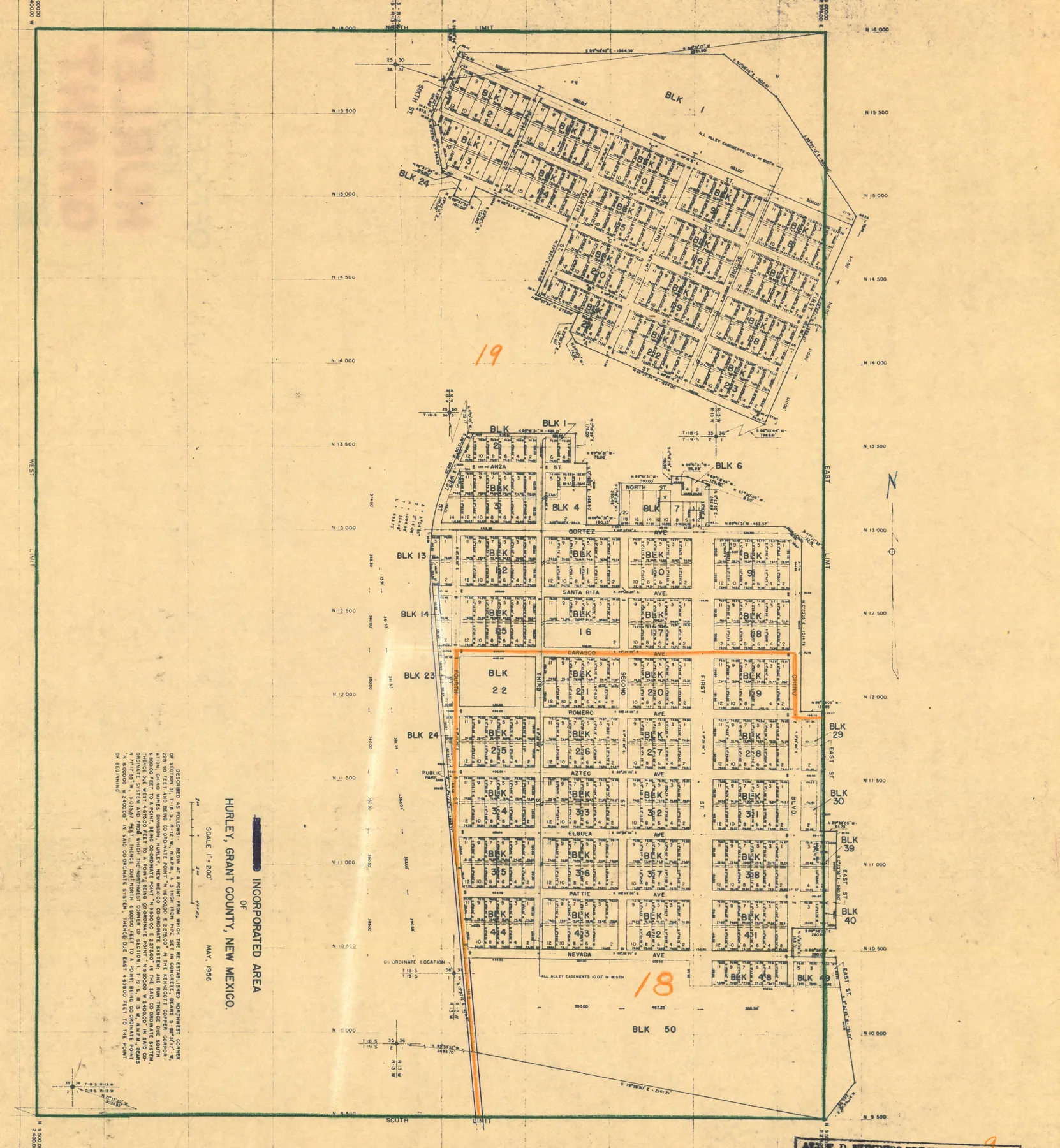
Three records bear on when Hurley became a town, and they do not agree exactly. Dannelley gives the date of the first election, 14 August 1956, after the December 1955 sale. A plat that the Census Bureau later used as a base map is titled Incorporated Area of Hurley, Grant County, New Mexico, and dated May 1956. It shows that an incorporated area had been drawn three months before the election he describes. The 1960 census, for its part, reported that Hurley had been incorporated as a town since 1950. Read as a year, that disagrees with the other two. Read as meaning only that incorporation came after the 1950 count, which listed Hurley as unincorporated, it does not. Nothing in the census statement settles which is meant, and none of the three records is the act of incorporation itself.7, 3
Sources: Claude Dannelley (spelled Claud Dannelley / Donnelley within the text), Hurley, New Mexico: Historical Data from 1910-1960. 50 Years of Recorded Memories by Claude Dannelley (transcript of a tape begun July 13, 1960, with a later note of about 1963; 10 pages, distributed by JW Art Gallery, 'The Old Hurley Store') (1960-07-13 (note c. 1963; PDF posted c. 2010)); Bureau of the Census, Geography Division (annotations); base plat of the incorporated area, May 1956, 1960 Census Enumeration District Maps - New Mexico - Grant County - Hurley - ED 9-18 and 9-19 (base map titled 'Incorporated Area of Hurley, Grant County, New Mexico. May, 1956', scale 1 inch = 200 feet) (1956-05 (base); 1960 (census annotations))
After incorporation, as Dannelley described it, the new town of Hurley took up ordinary duties. Company police, he recalled, were moved to the plant, and the town hired one deputy for days and one for nights. Company and town ran the fire department jointly. Hurley built change rooms at the swimming pool beside the Chino Club, and Little League teams were organized in 1959. Dannelley recorded one change on the company's side as well: the company store and market were remodeled and held a grand opening in May 1960.
For the 1960 census the Census Bureau split Hurley into two enumeration districts, the areas assigned to single census takers. One covered the south part of the main grid and the other the rest, including the northern block. A census worker pencilled an estimate of 2,000 people on the map. Census takers counted 1,851 in Hurley town, in a county of 18,700; the Hurley census division as a whole held 2,182. Ten years earlier the unincorporated place had been counted at 2,079.8, 9, 3
Local 890 and the long strikes at Chino, 1947 to 1968
At the Chino works Kennecott dealt with unions. The historian Ellen R. Baker writes that in 1947 the five Mine-Mill locals in Grant County, Hurley's Local 69 among them, amalgamated into a single district union, Local 890. In a 2014 article the journal La Jicarita quoted a Kennecott statement to Local 890 members from the mid-1950s. In it the company said it refused to bargain with unions whose officers had not filed the non-Communist affidavits required by the federal labor law of 1947. La Jicarita gives no citation for the statement and no exact year. Juan Chacon, who according to the Albuquerque Journal served several terms as the local's president between 1953 and 1974, often spoke for the union.
Sources: Ellen R. Baker, On Strike and on Film: Mexican American Families and Blacklisted Filmmakers in Cold War America (University of North Carolina Press, 2007), ch. 2, "Grant County's Mining District": ch. 2; David Correia, La Jicarita (reposted by Portside), Freeport-McMoRan Destroys Famous "Salt of the Earth" Labor Union (2014-10-21): para. on Clinton Jencks and Kennecott; Olivier Uyttebrouck, Albuquerque Journal (reposted by Portside), End of the line for Chino's storied union (2014-10-23): mid-article
An information circular on the Chino Mines Division described the terms of work in 1957: straight wages and salaries, with no leasing, contract or bonus systems, and fringe benefits that Kennecott valued at almost $1,000 per employee a year. Bronstein reports that from 1957 Kennecott required hard hats, safety goggles and reinforced-toe boots and ran safety contests at the Hurley smelter and the mine, with turkeys, hams or green stamps for prizes. A death at the Hurley smelter in June 1961 brought a confrontation, by Bronstein's account. Chacon loudly confronted the state mine inspector, William Hays, at the investigation and sought to introduce evidence that the company had ignored workers' complaints about unsafe machinery.5, 10, 11
In 1959 a strike at Chino drew a document from the company's side. The trade paper Advertising Age reported on 26 October 1959 that Chinorama, the company magazine edited by Harold E. Cooley, had devoted its August-September issue to the dispute. As the trade paper quoted it, the magazine told its readers: "The wage-producing machinery of Chino is idle." A strike called by the Mine-Mill union had made it so, the issue said, and it spoke for management. It carried very few pictures, and none of employees producing copper, because no copper had come out of the Santa Rita mine for more than five weeks. Its lead article, by the same report, said the company disliked strikes but accepted that a union had the right to strike as a lawful means of pressing its bargaining demands.
At 143 days, the 1959 strike stood as the record at Chino until an industrywide copper strike began on 15 July 1967. That strike, the Bureau of Mines recorded, affected about 1,200 Kennecott employees in Grant County. The pit stopped. Supervisors kept one part of the works going, the plant that recovered copper by leaching the mine dumps, and stockpiled what it produced. On 4 December 1967 the strike equaled the 1959 record. It ran on until Chino resumed work in March 1968 after 259 days, which the Bureau's yearbook called "the longest strike in the history of the mine".
Sources: U.S. Bureau of Mines, Minerals Yearbook 1967, vol. III, The Mineral Industry of New Mexico (1968): copper section, Kennecott Chino; copper section; U.S. Bureau of Mines, Minerals Yearbook 1968, vol. III, The Mineral Industry of New Mexico (1969): copper section
Later newspaper accounts give the length of the 1967-68 strike differently. The Albuquerque Journal in 2014 called it a nine-month strike, and La Jicarita a six-month one. By the Bureau's count of 259 days, it lasted about eight and a half months.
Sources: Olivier Uyttebrouck, Albuquerque Journal (reposted by Portside), End of the line for Chino's storied union (2014-10-23): mid-article; U.S. Bureau of Mines, Minerals Yearbook 1968, vol. III, The Mineral Industry of New Mexico (1969): copper section
Losses from the 1967-68 strike fell on the whole district. The Bureau of Mines, repeating a Denver Post report of 2 April 1968, put it at more than $18 million for the Silver City area. That was about $73,000 a day in wages, taxes and the money Kennecott normally spent on supplies and services. Terry Humble, who started work as a mechanic in 1967, told the Albuquerque Journal that at least ten unions were active at Grant County's two copper mines that year. In 1968, with work resumed, Chino Mines employed nearly 1,500 people. Chino reported two lost-time injuries in about 2.3 million man-hours across the division, the Hurley reduction plant included.
Sources: U.S. Bureau of Mines, Minerals Yearbook 1968, vol. III, The Mineral Industry of New Mexico (1969): copper section; Olivier Uyttebrouck, Albuquerque Journal (reposted by Portside), End of the line for Chino's storied union (2014-10-23): mid-article
The town and the company in court: Hurley, 1972 to 1980
In 1972, sixteen years after the election Dannelley described, the Town of Hurley found itself across a courtroom from Kennecott. On 17 May 1972 the town, through its elected officials, signed a memorandum of agreement with the company to issue industrial revenue bonds. They were to pay for pollution-control facilities for the company's copper operation next to the town, and the facilities would then be leased to Kennecott. That was the year the company started a $21 million air-pollution control program at the Hurley smelter. Hurley then formally refused to go ahead, solely on the ground that it lacked the legal and constitutional authority, and Kennecott sued for a declaratory judgment. The district court ruled for the company. On 16 March 1973 the state Supreme Court affirmed, holding the financing a proper public purpose.12, 13
Sources: Claude Dannelley (spelled Claud Dannelley / Donnelley within the text), Hurley, New Mexico: Historical Data from 1910-1960. 50 Years of Recorded Memories by Claude Dannelley (transcript of a tape begun July 13, 1960, with a later note of about 1963; 10 pages, distributed by JW Art Gallery, 'The Old Hurley Store') (1960-07-13 (note c. 1963; PDF posted c. 2010)); Supreme Court of New Mexico (McManus, C.J.), Kennecott Copper Corp. v. Town of Hurley, 1973-NMSC-032, 84 N.M. 743, 507 P.2d 1074 (1973-03-16): quoted district court finding 3, 84 N.M. at 745; finding 5; disposition at paragraph 3 ('Affirmed')
As uncontested facts, the district court had found that a principal portion of Kennecott's mining and refining complex lay adjacent to the town of Hurley. The operation, it found, contributed substantially to the economic welfare of the citizens of Grant County and Hurley. Under the 1972 agreement the bonds were to be repaid entirely by Kennecott's rent. Hurley's council itself came up in the 1973 decision: some of the town councilmen were Kennecott employees. Even if that produced a conflict of interests, the decision says, "this does not invalidate their official action". Hurley's first mayor, by Dannelley's account, had been a company carpenter.14
Sources: Supreme Court of New Mexico (McManus, C.J.), Kennecott Copper Corp. v. Town of Hurley, 1973-NMSC-032, 84 N.M. 743, 507 P.2d 1074 (1973-03-16): quoted district court finding 3, 84 N.M. at 745; conclusion 6, 84 N.M. at 746; Claude Dannelley (spelled Claud Dannelley / Donnelley within the text), Hurley, New Mexico: Historical Data from 1910-1960. 50 Years of Recorded Memories by Claude Dannelley (transcript of a tape begun July 13, 1960, with a later note of about 1963; 10 pages, distributed by JW Art Gallery, 'The Old Hurley Store') (1960-07-13 (note c. 1963; PDF posted c. 2010))
A second case, from 1978, concerned the town's boundary. On 15 December 1978 the New Mexico Municipal Boundary Commission denied Hurley's request to annex land. Copies of the order reached the Grant County clerk and the town on 21 December. Hurley did not seek district court review until 1 February 1979, and the appeal was dismissed as filed outside the thirty-day limit. In July 1980 the state Supreme Court upheld the dismissal, noting that the town had actual notice of the order about 21 December.15
In 1975, the Bureau of Mines recorded, a weak copper market led Kennecott to shut Chino and the Hurley smelter for four weeks from 27 June as compulsory vacation. It laid off 250 employees and cut the work week from seven days to five. Hurley's mercantile store closed in the same decade, by one account. A page on Hurley by the New Mexico Tourism Department says the brick building of 1912 on Cortez Avenue housed the payroll department and the mercantile store, and that the store stayed open until the mid-1970s. The page names no source.
Sources: U.S. Bureau of Mines, Minerals Yearbook 1975, vol. II, The Mineral Industry of New Mexico (1977): copper section; New Mexico Tourism Department, Hurley (New Mexico True tourism page) (n.d. (accessed 2026-11-15)): para. 2
A shutdown, a new owner and a pay cut: Hurley and Chino, 1980 to 1987
The 1980 copper strike stopped Chino's production from 1 July to 8 September. In 1982 the stoppage was the company's doing. Kennecott shut Chino's concentrator, the mill that separates copper minerals from crushed ore, in March, the Hurley smelter in May and stripping in the pit in June. The Bureau of Mines called it the company's first closure for slack demand since the Depression. That September Kennecott announced a $100 million modernization of the smelter. Rebuilt, and by then part of a Kennecott-Mitsubishi partnership called Chino Mines, the smelter became operational late in 1984.16, 17, 18
In January 1984 the National Institute for Occupational Safety and Health surveyed the Hurley smelter, at the request of the Steelworkers union after a smelter worker died of lung cancer. It found most exposures below the standards. It measured lead at up to 0.06 milligrams per cubic metre and sulfur dioxide above the institute's recommended limit, and concluded that there was a potential health hazard from both. The blood lead and urinary arsenic of the workers tested were within normal limits.
On 13 August 1985, the state Employment Security Department's Labor Market Review recorded, a major breakdown at the Chino concentrator forced the layoff of about 430 of Chino's 940 workers.
A pay cut followed in 1986. On 15 July Kennecott's unions voted 1,809 to 592 to ratify a four-year contract that cut wages by $3.22 an hour, to $10.55, and benefits by $2.22 an hour. That was a cut of nearly a quarter in the hourly wage. The tally appears to cover Kennecott's unions as a whole, not Chino alone. Phelps Dodge, which took over Chino, said it would honor the terms, and in 1987 it finished a $14 million upgrade of the Hurley smelter.19
The votes that ended the union, and the town that stayed: Chino and Hurley, 1991 to 2020
Decertification is a vote by which workers end a union's standing as their bargaining representative. At Grant County's copper mines, as Terry Humble told it, the craft unions went first. He told the Albuquerque Journal that from 1991 the members of the machinists, carpenters, boilermakers and other trades voted one after another to decertify. The union descended from Local 890 held. It survived, the Journal reported, five decertification elections between 1993 and 2004, usually by about two to one; in 1998 the vote to keep it was 333 to 172. By the Journal's figures, Local 890 had 560 members in 1996.
Layoffs came in 2008, by KRWG's reports. In November 2008 KRWG reported that Freeport-McMoRan had laid off almost 100 workers at Chino the week before, blaming falling copper prices. On 3 December it reported that about 600 employees would be laid off at the mine in February 2009. Humble said union membership dwindled to a couple of dozen during the closure of 2008-09. Production resumed in 2011, according to L. Michael Kaas's tour guide for the Mining History Association.20
Sources: Evan Woodward, KRWG, Freeport McMoran Announces Layoffs in Grant County (2008-11-18): introduction; Evan Woodward, KRWG, 600 Layoffs Ahead at Grant County's Chino Mine (2008-12-03): introduction; Olivier Uyttebrouck, Albuquerque Journal (reposted by Portside), End of the line for Chino's storied union (2014-10-23): mid-article
In mid-August 2014, La Jicarita reported, a recently hired employee circulated a petition and gathered signatures from more than 30 percent of the bargaining unit, which triggered a vote. Workers at the Chino mine, the Albuquerque Journal reported, voted 236 to 83 to decertify United Steelworkers Local 9424-3, the successor of Mine-Mill Local 890. Its membership, by the Journal's count, was 343 when it was decertified.
Sources: David Correia, La Jicarita (reposted by Portside), Freeport-McMoRan Destroys Famous "Salt of the Earth" Labor Union (2014-10-21): para. 3; Olivier Uyttebrouck, Albuquerque Journal (reposted by Portside), End of the line for Chino's storied union (2014-10-23): para. 3; mid-article
The two papers date the vote differently. The Albuquerque Journal gives 18 September 2014; La Jicarita says the election was scheduled for 17 and 18 September.
Sources: Olivier Uyttebrouck, Albuquerque Journal (reposted by Portside), End of the line for Chino's storied union (2014-10-23): para. 3; David Correia, La Jicarita (reposted by Portside), Freeport-McMoRan Destroys Famous "Salt of the Earth" Labor Union (2014-10-21): para. 3
La Jicarita quoted what Guadalupe Cano, the granddaughter of a Mine-Mill leader, told the Silver City Daily Press about the vote. She was horrified by it, she said, and glad her grandfather had not lived to see it. She could not believe that "after all of these generations of people fighting for this union" it was all gone.
In 2020 the town government that, by Dannelley's account, many townspeople had been skeptical of in 1956 was still in place. At the 2020 census Hurley was one of Grant County's four incorporated municipalities, with Silver City, Bayard and Santa Clara. It counted 1,256 people and 629 housing units.21, 22
Sources: Claude Dannelley (spelled Claud Dannelley / Donnelley within the text), Hurley, New Mexico: Historical Data from 1910-1960. 50 Years of Recorded Memories by Claude Dannelley (transcript of a tape begun July 13, 1960, with a later note of about 1963; 10 pages, distributed by JW Art Gallery, 'The Old Hurley Store') (1960-07-13 (note c. 1963; PDF posted c. 2010)); Town of Hurley / Southwest New Mexico Council of Governments, Town of Hurley Comprehensive Plan (2023) (2023-06-13): Housing Profile
Part 6 of 9 of the series Hurley, New Mexico: the mill and smelter town.
Sources
- The 1962 revised WPA guide described Hurley as a company village owned by the 'Chino Mine Division' of Kennecott Copper, with 468 company houses and the concentration mill for the Santa Rita mine. New Mexico: A Guide to the Colorful State, Writers' Program (WPA), new and completely revised edition (New York: Hastings House, 1962; first published 1940), Tour 18, New Mexico: A Guide to the Colorful State (1962 rev.), Tour 18, p. 416. View source ↗ (reported)
- The 1962 guide described Hurley as 468 company houses, a reduction and power plant and several stores; it was completely occupied until the Santa Rita mine closed in 1934, work resumed when the mine reopened, and the 1950 census showed 2,079 people. New Mexico: A Guide to the Colorful State, Writers' Program (WPA), new and completely revised edition (New York: Hastings House, 1962; first published 1940), Tour 18, archive.org newmexicoaguidet027633mbp (New Mexico: A Guide to the Colorful State, new completely revised edition, Aug. 1962), Tour 18, p. 415. View source ↗ (reported)
- In 1950 the unincorporated copper towns of Santa Rita (2,135) and Hurley (2,079) were among New Mexico's places of 1,000 or more, as were Bayard (2,119) and Central (1,511). 1950 Census of Population, Vol. II, Characteristics of the Population, Part 31: New Mexico, chapter A, Number of Inhabitants, 1950 Census NM ch. A, Table 7 (all incorporated places and unincorporated places of 1,000 or more). View source ↗ (documented)
- In 1950 the Chino mine was the largest single mining enterprise in New Mexico, with about 800 men at the mine, 1,000 at the Hurley plants and offices, and 200 more at the company hospital and other company-supported work. Minerals Yearbook 1950, Minerals Yearbook 1950, New Mexico chapter, Mining industry. View source ↗ (documented)
- Chino ran on straight wages and salaries with no leasing, contract or bonus systems, and Kennecott valued its fringe benefits at almost $1,000 per employee a year; the division's general offices were at Hurley. Information Circular 7837: Open-Pit Mining Methods and Practices at the Chino Mines Division, Kennecott Copper Corp., Grant County, N. Mex., IC 7837, Wage, contract, leasing, and bonus systems; Organization. View source ↗ (documented)
- Bronstein reports that companies later absorbed by Kennecott kept company housing and a company store in Santa Rita, and that white workers in Hurley and Santa Rita could use the well-equipped Chino club while Mexican American workers had only the smaller 'Casino'. The Toll Extracted: Workers and Safety in Southern New Mexico Mining, New Mexico Historical Review 87:4 (2012), Bronstein, NMHR 87:4 (2012), p. 426. View source ↗ (reported)
- The 1960 census reported that Hurley had been incorporated as a town since 1950; it counted 1,851 people in Hurley town. 1960 Census of Population, Vol. 1, Part 33 New Mexico, Number of Inhabitants, Table 7: Population of counties by census county divisions, 1960, 37745099v1p33ch2.pdf PDF page 10, printed p. 33-9, Table 7 footnote 7; Hurley town 1,851 on p. 33-8 (PDF page 9). View source ↗ (documented)
- In 1960, when Grant County had 18,700 people, Silver City town had 6,972, Bayard village 2,327, Central town 1,075 and Hurley town 1,851. 1960 Census of Population, Vol. 1, Part 33 New Mexico, Number of Inhabitants, Table 7: Population of counties by census county divisions, 1960, Table 7, p. 33-8 (PDF page 9) and continuation. View source ↗ (documented)
- The 1960 census divided Grant County into seven census county divisions: Bayard-Santa Rita (5,043), Central (1,460), Hurley (2,182), Mimbres (1,153), Pinos Altos (1,206), Silver City (6,972) and Tyrone (684). 1960 Census of Population, Vol. 1, Part 33 New Mexico, Number of Inhabitants, Table 7: Population of counties by census county divisions, 1960, Table 7, p. 33-8 (both columns). View source ↗ (documented)
- Kennecott required hard hats, safety goggles and reinforced-toe boots from 1957 and ran safety contests at the Hurley smelter and Chino mine, with prizes of turkeys, hams or green stamps. The Toll Extracted: Workers and Safety in Southern New Mexico Mining, New Mexico Historical Review 87:4 (2012), p. 435. View source ↗ (reported)
- After a June 1961 death at Kennecott's Hurley smelter, Local 890 president Juan Chacon loudly confronted state mine inspector William Hays at the investigation and sought to introduce evidence that the company had ignored workers' complaints about unsafe machinery. The Toll Extracted: Workers and Safety in Southern New Mexico Mining, New Mexico Historical Review 87:4 (2012), pp. 439-440. View source ↗ (reported)
- In May 1972 the Town of Hurley agreed to issue industrial revenue bonds to acquire pollution-control facilities for Kennecott's copper operation adjacent to the town, to be leased to Kennecott; when the town balked over its authority, Kennecott sued, and in 1973 the Supreme Court affirmed a judgment holding the financing a proper public purpose. Kennecott Copper Corp. v. Town of Hurley, 84 N.M. 743, static.case.law nm/84/cases/0743-01.json, district court findings 3-4 and conclusion 2; 'Affirmed', March 16, 1973. View source ↗ (documented)
- Kennecott started a $21 million air-pollution control program at the Hurley smelter in 1972, including a 600-ton-a-day acid plant. Minerals Yearbook 1972, vol. 2, Area Reports: Domestic, Minerals Yearbook 1972 vol. 2, Copper, p. 485. View source ↗ (documented)
- The district court in the Hurley bond case found, as uncontested facts, that Kennecott operated a large copper mining and refining complex in Grant County, a principal portion of which lay adjacent to the Town of Hurley, and that the operation contributed substantially to the economic welfare of the citizens of Grant County and Hurley. Kennecott Copper Corp. v. Town of Hurley, 84 N.M. 743, Kennecott Copper Corp. v. Town of Hurley, 84 N.M. 743 (1973), district court findings of uncontested facts 1-2 as quoted in the opinion. View source ↗ (documented)
- On December 15, 1978 the New Mexico Municipal Boundary Commission denied the Town of Hurley's request to annex land. Copies reached the Grant County clerk and the town on December 21, 1978, and Hurley did not seek district court review until February 1, 1979. In July 1980 the state Supreme Court upheld dismissal of the appeal as filed outside the 30-day limit, noting the town had actual notice of the order about December 21. Town of Hurley v. New Mexico Municipal Boundary Commission, 94 N.M. 606, Town of Hurley v. N.M. Municipal Boundary Commission, 94 N.M. 606 (decided 1980-07-23), opinion by Felter, J.. View source ↗ (documented)
- In 1982 Kennecott shut Chino's concentrator in March, its Hurley smelter in May and pit stripping in June, its first closure for slack demand since the Depression, and Phelps Dodge shut Tyrone in mid-April. Minerals Yearbook 1982, vol. 2, Area Reports: Domestic, Minerals Yearbook 1982 vol. 2, New Mexico chapter, Copper. View source ↗ (documented)
- In September 1982 Kennecott announced a $100 million modernization of the Hurley smelter, replacing its reverberatory furnace with an INCO oxygen flash furnace. Minerals Yearbook 1982, vol. 2, Area Reports: Domestic, Minerals Yearbook 1982 vol. 2, Copper. View source ↗ (documented)
- Kennecott's modernization program at Chino Mines (a Kennecott-Mitsubishi partnership) was completed in 1984: a new concentrator, rated in 1983 at 37,500 tons of copper ore a day, had become fully operational in 1983, and the rebuilt Hurley smelter became operational in late 1984. Minerals Yearbook 1984, vol. 2, Area Reports: Domestic, Minerals Yearbook 1984 vol. 2, New Mexico chapter, pp. 412-413 (djvu text, before the '413' page marker). View source ↗ (documented)
- After taking over Chino, Phelps Dodge began a $55 million SX-EW plant there in 1987 and finished a $14 million upgrade of the Hurley flash smelter, rated at 25 million pounds of anode copper a month. Minerals Yearbook 1987, vol. 2, Area Reports: Domestic, Minerals Yearbook 1987 vol. 2, Copper. View source ↗ (documented)
- The Hurley smelter was modernized in 1985 and closed in 2002; in 2010 Kaas described the Chino pit as 1,500 feet deep and 1.5 miles across, with production resumed in 2011 after a 2008 shutdown. L. Michael Kaas, Silver City historical tour guide, Mining History Association (c. 2011, inferred), Kaas, Santa Rita section. View source ↗ (reported)
- The 2020 census counted 9,704 people in Silver City, out of 28,185 in Grant County; nearby Bayard had 2,116, Santa Clara 1,637 and Hurley 1,256. State of New Mexico 2020 Official Census Population (Legislative Handbook), NM Legislature, 2020 Official Census Population, page 1, Grant County block. View source ↗ (documented)
- At the 2020 census 13,472 of Grant County's 28,185 people lived outside its four incorporated municipalities (Silver City, Bayard, Santa Clara and Hurley). State of New Mexico 2020 Official Census Population (Legislative Handbook), official_census_population_20.pdf p. 1, Grant column. View source ↗ (documented)
"Documented" means the source is a record of the time or a direct survey; "reported" means a later account or secondary history, attributed in the text.
Cite this page: “A town of its own: the house sale, incorporation and the strikes.” Grant County Atlas, Salars.net, first published 15 November 2026, revised 16 November 2026. https://atlas.salars.net/stories/hurley/a-town-of-its-own
Discussion
What would you add or question? Comments are reviewed before they appear.
Loading comments…