Fort Bayard’s hospital passed from the Army to the Public Health Service in 1920 and to the Veterans Bureau in 1922, the 2002 historic district nomination says, and stayed part of local life: by Lynn Bevill’s account, its Copper League team won the 1926 championship over El Paso.
A hospital with a team to follow: Fort Bayard, 1920–1922
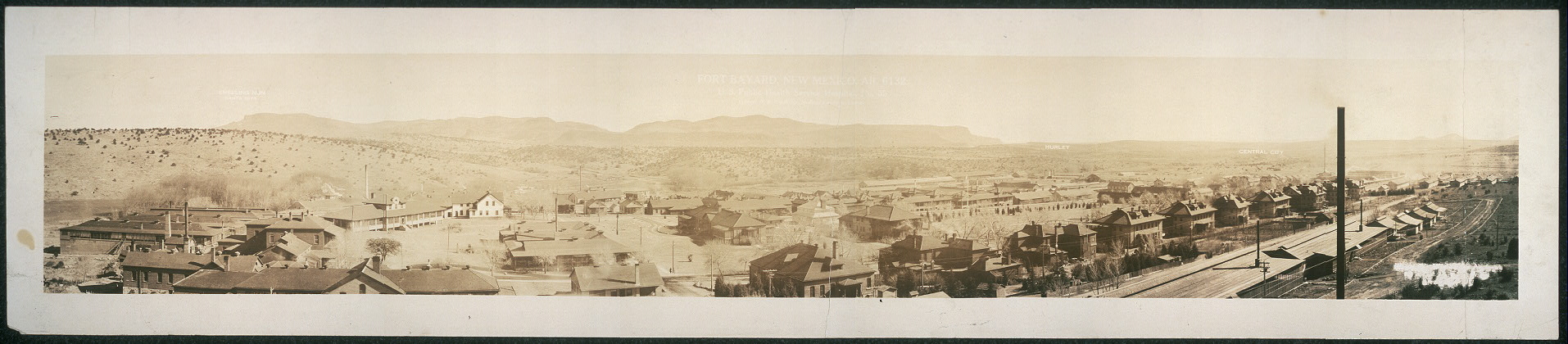
A wide photograph labeled U.S. Public Health Service Hospital No. 55 catches Fort Bayard between administrative eras. Its Library of Congress catalog record dates it to 1920–1922. Buildings surround open ground, and Central City is labeled in the distance. A national institution occupied the foreground; a neighboring community remained in view beyond it.
Sources: Library of Congress, Hospital No. 55 panorama, 1920–1922, item 2007664272
In 1920, the 2002 National Register nomination for the historic district says, the Army transferred Fort Bayard’s hospital to the Public Health Service, and the Veterans Bureau took charge in 1922. A large new hospital followed. A change of agency did not remove Fort Bayard from local life. Patients, employees, suppliers, and visitors still came to the grounds. In the middle of the decade, a baseball team gave people across the mining district another reason to follow the place.
Sources: Fort Bayard Historic District National Register nomination (2002), section 8, pp. 23–39
Baseball before the famous names: Fort Bayard in 1904
Fort Bayard’s baseball story, on the evidence of one college newspaper, reaches back before the Copper League’s celebrated outlaws. A 1904 issue of The New Mexico Collegian reported that Claude Randall had played with the Fort Bayard team in El Paso on the nineteenth and twentieth, then left school to play regularly with the club. Its brief campus item gives no contract terms or score. It does show a named player moving from college life into a Fort Bayard team more than twenty years before the 1926 championship.
Set beside the 1926 roster in Lynn Bevill’s history, that 1904 notice puts the later celebrities in proportion. Fort Bayard’s hospital community had a baseball presence beyond its grounds two decades earlier. In the Copper League years, particular players, crowds, and financial pressures entered a local sporting history that was underway.
Sources: The New Mexico Collegian, vol. 13, no. 6, cataloged March 1904, p. 16; New Mexico State University Library; Lynn Bevill, The Outlaw Baseball League, chapter III, The 1926 Season, with contemporary newspaper references
The Veterans and the Copper League: Fort Bayard’s 1926 season
Lynn Bevill’s newspaper-based history places Chick Gandil at first base and Jimmie O’Connell in the outfield for Fort Bayard in 1926. Lefty Williams pitched for the club during that season, Bevill writes. Players excluded from organized baseball could still draw spectators in the Copper League. Their presence made a hospital town part of a sporting world extending across southern New Mexico and Arizona.
By Bevill’s account, Fort Bayard won the 1926 championship series against El Paso, three games to one. He records two high-scoring victories, a defeat, and a final 3–2 win. That narrow deciding game gives the Veterans’ season a particular ending: a team and a result, not simply a connection with baseball scandal.
Each name needs to stay attached to its season. In his chapter on 1926, Bevill discusses reports of a possible appearance by Joe Jackson, but does not establish that Jackson played a Copper League game. A visit, a workout, and a place in an official lineup are different claims. Fort Bayard’s documented players provide plenty of history without adding an unproved appearance.
Winning games, paying bills: Fort Bayard and Chino, 1927
For 1927, Bevill identifies O’Connell and Williams with Fort Bayard. Gandil managed Chino that year. Fort Bayard’s Veterans won nineteen games and lost eight in the first half, he writes. Chino recovered to take the second half, setting up a playoff between neighboring teams. Gandil left just before that series; Bevill’s account does not establish why.
Sources: Lynn Bevill, The Outlaw Baseball League, chapter V, The 1927 Season
In his chapter on 1927, Bevill reproduces the El Paso Times’ criticism of rising expenses and an unenforced salary limit. On that newspaper evidence, competitive success did not settle the Copper League’s finances. Crowds, subscriptions, travel, and players’ pay had to fit together. That newspaper record tells two stories at once: the pleasure of following a winning club and the difficulty of sustaining regional professional sport.
Sources: Lynn Bevill, The Outlaw Baseball League, chapter V, The 1927 Season
At Fort Bayard, a baseball history and a hospital history answer different questions about one set of grounds. A box score from 1926 or 1927 can show who played and who won. It cannot show how a particular patient felt about the games or whether everyone could attend. Those experiences would require letters, diaries, or interviews. What the sporting record of those seasons establishes is a public institution with a life beyond its wards.
Sources: Lynn Bevill, The Outlaw Baseball League, chapter III, The 1926 Season, with contemporary newspaper references; Lynn Bevill, The Outlaw Baseball League, chapter V, The 1927 Season
War work on the grounds: German prisoners at Fort Bayard, 1943–1945
During World War II, the 2002 historic district nomination says, German prisoners of war from the Lordsburg camp worked at Fort Bayard. It describes as many as one hundred men assigned between 1943 and 1945 to such tasks as hospital assistance, construction, and gardening during a shortage of civilian workers. They were another population living and working under institutional authority, in circumstances very different from those of the patients.
Sources: Fort Bayard Historic District National Register nomination (2002), section 8, pp. 23–39
From 1943 to 1945, that assignment joined two wartime institutions: the prisoner-of-war camp at Lordsburg and the veterans’ hospital at Fort Bayard, short of labor. The nomination records the work more fully than the workers’ experiences. Camp records and personal papers would be needed to recover how the prisoners and hospital staff understood that encounter.
Sources: Fort Bayard Historic District National Register nomination (2002), section 8, pp. 23–39
Care moves, the buildings remain: Fort Bayard, mid-1960s to 2010
Federal veterans’ care at Fort Bayard ended in the mid-1960s, by the historic district nomination’s account, and New Mexico continued using the site for long-term health care. Those final years of the old hospital belong to a state institution, not to an Army garrison. A 2013 legislative fiscal report says the Department of Health vacated the old building in September 2010 after a replacement facility had been built.
Sources: Fort Bayard Historic District National Register nomination (2002), section 8, pp. 23–39; Legislative Finance Committee, fiscal impact report for HB 102, January 30, 2013, pp. 1–3
At Fort Bayard, “the hospital closed” has more than one meaning. Federal operation ended in the mid-1960s and the state left the old building in 2010, decades apart. Meanwhile, the cemetery and surrounding historic structures kept separate responsibilities and custodians.
Continue with the cemetery and the people remembered there
Sources: Fort Bayard Historic District National Register nomination (2002), section 8, pp. 23–39; Legislative Finance Committee, fiscal impact report for HB 102, January 30, 2013, pp. 1–3
Read more on Salars.net
Part 6 of 9 of the series Fort Bayard, New Mexico: soldiers, patients, and a changing place.
Cite this page: “Hospital No. 55 and Fort Bayard’s baseball years.” Grant County Atlas, Salars.net, first published 14 November 2026, revised 16 November 2026. https://atlas.salars.net/stories/fort-bayard/veterans-and-baseball
Discussion
What would you add or question? Comments are reviewed before they appear.
Loading comments…