Black soldiers of the 125th United States Colored Infantry established Fort Bayard in 1866, and Ninth Cavalry troopers from the post fought in the Apache campaigns of 1877 and 1879. The National Park Service’s accounts of Clinton Greaves, Thomas Boyne and Cathay Williams follow their lives well beyond the post and its memorials.
Names behind the regiments: Black soldiers at Fort Bayard, 1866 to 1876
Black soldiers of the 125th United States Colored Infantry established Fort Bayard in 1866, the 2002 National Register nomination says. Later Black regular Army units served there, among them the Ninth Cavalry, which the National Park Service says moved from Texas to Fort Bayard in 1876. Keeping those units and their dates distinct makes room for individual careers. Men remembered together as Buffalo Soldiers did not arrive at one moment or share one experience of the post.1, 2
For Black men after slavery, Army service offered wages and a continuing occupation, within an Army that separated soldiers by race. It placed Black troops, too, in campaigns against Indigenous peoples resisting removal and confinement. The histories of emancipation and dispossession met at Fort Bayard; neither makes the other disappear.
Sources: National Park Service, Clinton Greaves; National Park Service, Thomas Boyne; Fort Sill Apache Tribe, Our Ancestors, Victorio and Nana entries
Clinton Greaves: service and an opening in the line, Florida Mountains, 1877
Clinton Greaves, the National Park Service says, was born enslaved in Virginia and enlisted in 1872. In January 1877 he left Fort Bayard with Lieutenant Henry H. Wright, other Ninth Cavalry troopers, and Navajo scouts. In the Florida Mountains an attempt to secure an Apache surrender led to close fighting. There, in the Park Service’s account, Greaves opened a way through the encirclement so his companions could escape.
Sources: National Park Service, Clinton Greaves
Greaves received the Medal of Honor in June 1879. His career continued well beyond that action: he later served at Columbus Barracks in Ohio, retired as a sergeant in 1893, and remained there in civilian Quartermaster Department work. He died in 1906 and was buried in Columbus. Fort Bayard’s memorial honors a connection to the post; it does not mark his grave.
Thomas Boyne and the length of a career: Fort Bayard, 1875 to 1896
Thomas Boyne, according to the National Park Service, had served in artillery and infantry before transferring to the Ninth Cavalry in 1875. When the regiment moved from Texas to Fort Bayard in 1876, he had years of military experience. During the 1879 campaign against Victorio, he took part in repeated engagements and helped rescue Lieutenant Henry H. Wright after the officer’s horse fell on him. Boyne’s Medal of Honor followed in 1882.2
Sources: National Park Service, Thomas Boyne
Boyne’s later years, as the Park Service tells them, complicate a story told only through decorations. Winter patrols in Indian Territory brought severe frostbite. He reenlisted, but declining health eventually led to a medical discharge. Boyne died at the Soldiers’ Home in Washington in 1896. His life links service in the field with the institutions that cared for men whose bodies could no longer sustain it.
Sources: National Park Service, Thomas Boyne
Cathay Williams at the post hospital: Fort Bayard, 1868
Another service record, as the National Park Service presents it, leads to the Fort Bayard hospital in 1868. Cathay Williams enlisted under the name William Cathay in the Thirty-eighth Infantry. Following postings that included Fort Union and Fort Cummings, Company A reached Fort Bayard in June 1868. Repeated illness preceded a disability discharge later that year. The Park Service distinguishes the official medical wording from the account that Williams’s sex had been discovered.
Sources: Fort Union National Monument, The Strange Case of Private William Cathay
The Park Service cites an 1876 newspaper interview. In it, Williams explained a desire to earn a living independently. No authenticated photograph is known in the Park Service’s account; the drawing on its page is a modern illustration. Williams’s death date and burial place remain unresolved there.
Sources: Fort Union National Monument, The Strange Case of Private William Cathay
Allen Allensworth and the soldiers’ school: Fort Bayard, 1889
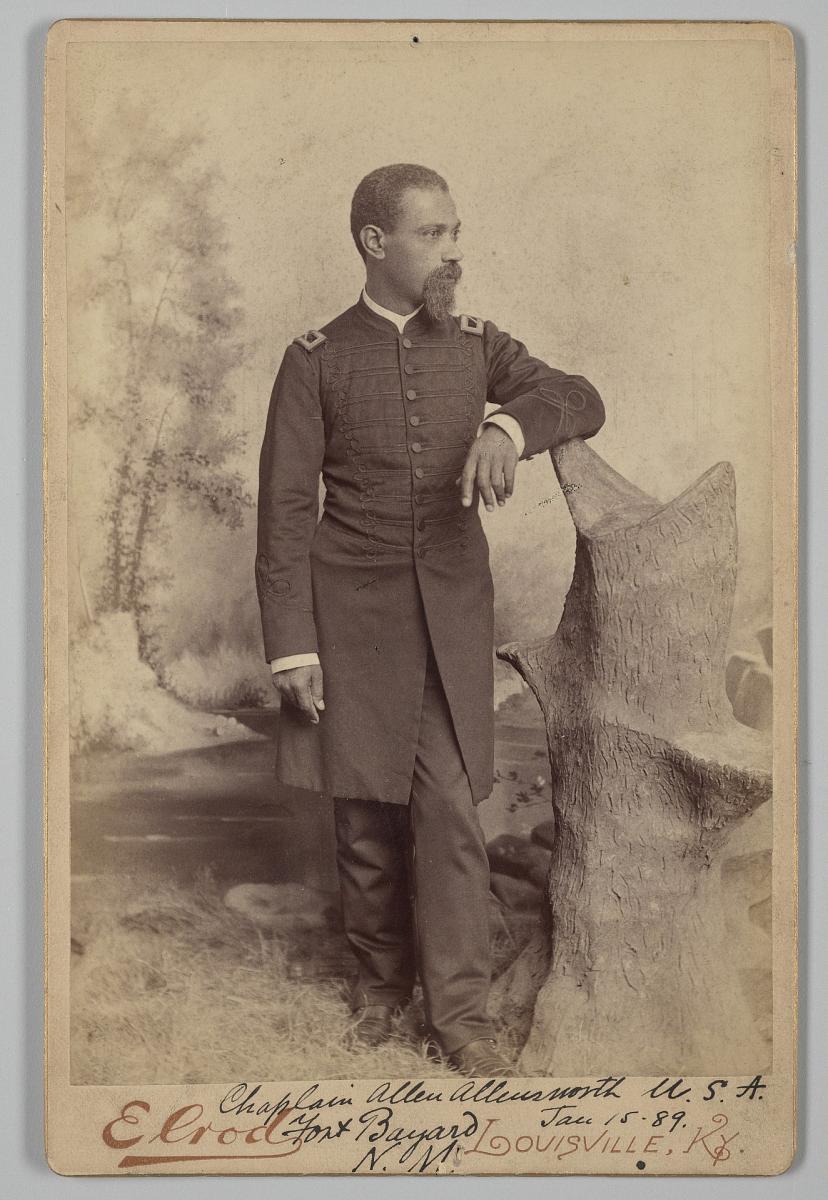
Allen Allensworth’s portrait offers another way into Fort Bayard’s history. In the Smithsonian’s cabinet card, the chaplain stands in uniform beside a studio prop, with a painted landscape behind him. An inscription beneath the photograph identifies Fort Bayard and 15 January 1889. The museum attributes the photograph to Walter L. Elrod. Here is a named man whose daily work included sermons, lessons, and finding the means to deliver both.
Charles Alexander’s 1914 biography describes an education program that Allensworth developed before coming to Fort Bayard and continued there. It linked instruction to soldiers’ duties and prospects for promotion, with courses suited to privates and noncommissioned officers as well as provision for children. Allensworth, Alexander writes, prepared men to teach and bought instructional charts from his own funds. A school required an organization behind it: teachers, materials, classes, and support from officers who controlled the men’s time.
Alexander’s biography reproduces a War Department letter dated 31 March 1891. That letter quotes an inspection made at Fort Bayard on 26 March 1889. As quoted, the inspection records four teachers assigned and 118 men booked for school, while Allensworth was training the teachers and organizing classes. Those figures measure enrollment and preparation; they do not say that 118 men had completed a course. Within a book otherwise written to celebrate its subject, the inspector’s praise gives the educational work a contemporary documentary trace.
For the men at Fort Bayard in 1889, as Alexander’s book presents the school, Army service included the chance to learn as well as the obligation to drill and campaign. That school adds an occupation to the familiar portrait of the Buffalo Soldier: an enlisted man could be a student, and some became teachers for their fellow soldiers.
One ward does not describe the whole Army: Fort Bayard, 1868 to 1877
Fort Bayard’s 1870 inspection recorded a hospital detail that can easily be overread: its single ward served both white and Black patients. That report kept separate sickness tables by race for 1868 and 1869. A shared twelve-bed room is evidence about that building and its use. It does not establish equal treatment across the post or an integrated Army.3
Sources: Surgeon General’s Office, A Report on Barracks and Hospitals (1870), pp. 240–241
Nor were all the Indigenous people in these military records on one side, as the National Park Service’s accounts of Greaves and Boyne show. Both identify Navajo scouts accompanying the cavalry, including the party that left Fort Bayard in January 1877. Naming them keeps the campaign from being reduced to two undifferentiated groups. Their service and the Warm Springs Apache effort to remain at home belong to the same history without being the same experience.
Sources: National Park Service, Clinton Greaves; National Park Service, Thomas Boyne; Fort Sill Apache Tribe, Our Ancestors, Victorio and Nana entries
Greaves, Boyne, and Williams each lived a life that traveled farther than Fort Bayard’s boundaries. Their link to the post is military service and, in Williams’s case, its small hospital. Following those connections gives the memorial landscape names, occupations, and unfinished questions rather than a single representative soldier.
Read more on Salars.net
Part 3 of 9 of the series Fort Bayard, New Mexico: soldiers, patients, and a changing place.
Sources
- The 2002 National Register nomination names the founders of Fort Bayard as Company B, 125th United States Colored Infantry, under Lt. James M. Kerr, acting on a recommendation by Maj. Nelson H. Davis to General Carleton. Fort Bayard Historic District, National Register nomination, npgallery NRHP 02000726 nomination (online PDF text identical to local extract), Section 8, p. 23. View source ↗ (documented)
- The National Park Service says the 9th Cavalry was moved from Texas to Fort Bayard in 1876. Thomas Boyne (People), https://www.nps.gov/people/thomas-boyne.htm, para. 2. View source ↗ (reported)
- The 1870 report noted that Fort Bayard's single twelve-bed hospital ward served 'alike' white and Black patients, and it kept separate sick tables for white and colored troops for 1868-1869. A Report on Barracks and Hospitals, with Descriptions of Military Posts (Circular No. 4, Surgeon General's Office), Circular No. 4, 1870, p. 241. View source ↗ (documented)
"Documented" means the source is a record of the time or a direct survey; "reported" means a later account or secondary history, attributed in the text.
Cite this page: “Fort Bayard’s Buffalo Soldiers: the lives behind the memorials.” Grant County Atlas, Salars.net, first published 14 November 2026, revised 16 November 2026. https://atlas.salars.net/stories/fort-bayard/buffalo-soldiers
Discussion
What would you add or question? Comments are reviewed before they appear.
Loading comments…