After the War Department authorized a tuberculosis sanatorium at Fort Bayard in 1899, the Army treated patients there with outdoor living and rest, and its count to 30 June 1902 recorded 431 discharges and 105 deaths while separating clinical outcomes among those discharged.
A nurse’s piano fund: Fort Bayard, as told in 1918
The nurses at Fort Bayard wanted a piano, Mrs. E. C. Hamill wrote in the American Journal of Nursing in May 1918. They agreed to pay toward one monthly, then devised fines for slang, soiling the tablecloth, and talking about hospital work at meals. By the time their chief nurse described the scheme to Washington, she wrote, they had collected about thirty dollars. The Surgeon General sent money for the instrument and suggested using their savings to improve the nurses’ home.1
Hamill’s 1918 recollection of dishes, rugs, pictures, and music belongs beside the clinical reports. Long-term care at Fort Bayard required people to live at the institution as well as work in it. Its nurses were trying to make room in their day for something beyond the wards.
The landscape in a nurse’s album: Fort Bayard in the 1910s
Nurses at Fort Bayard left a photographic record, although the people who assembled it have not been identified. New Mexico State University preserves two small photographic albums, accompanied by seven additional black-and-white prints, associated with nurses at the hospital in the 1910s. One page in the first album carries a landscape photograph captioned “Twin Sister Peaks.” Low hills and scrub fill the view. The camera has turned away from the wards toward the surrounding country.
The photograph’s exact date is uncertain. The university library catalogs that page as 1910, while the collection’s broader description uses the 1910s. Neither supplies a named photographer or proves the exact day the shutter opened. Seen alongside Hamill’s account of furnishing the nurses’ home at Fort Bayard, the album enlarges the record of their lives beyond the duties listed in an annual report. Readers can examine the complete mounted print and its handwritten caption in the library’s viewer.
The hospital takes over the post: Fort Bayard, 1875 to 1903
In August 1899 the War Department authorized the tuberculosis sanatorium at Fort Bayard, and Major Daniel M. Appel arrived that October. The military-to-medical transition extended into early 1900 as the last cavalry detachment left. Existing buildings acquired new uses while the medical institution expanded around them.2
Climate was part of the hospital’s treatment rationale, but it had not always received the same medical verdict. In the 1875 post inspection, William J. Wilson wrote that the tuberculosis cases he had observed at Fort Bayard had worsened. He thought only very early disease might benefit from this or any climate. Reading his report beside the later hospital’s reputation prevents a change in medical opinion from disappearing into a simple story of a cure waiting to be discovered.3
In his report on 1903, Fort Bayard’s commanding officer describes treatment as hygienic and climatic. Patients spent substantial time outdoors, with activity and rest adjusted to their condition. These were historical practices, before modern antibiotic treatment. Doctors’ reports explain what they attempted; their confidence in the setting is not proof that altitude cured tuberculosis.4, 5
What the daily routine required: Fort Bayard, about 1909 to 1918
Hamill’s 1918 account describes weighing patients at Fort Bayard regularly and deciding whether they were well enough to move into tents or barracks with more freedom. Frail patients, she wrote, could have an indoor and an outdoor bed. Rest followed breakfast and the physician’s visit, and another period of rest followed the midday meal. Weather, beds, food, observation, and movement between spaces formed a single routine.6
Care at Fort Bayard depended on small repeated acts of sanitation, in Hamill’s 1918 account. Patients carried paper sputum cups, deposited used cups in containers around the porches, and the cups were collected and burned. Food was prepared and offered throughout the day. Her description of milk, butter, eggs, and between-meal snacks shows how much labor the treatment demanded from kitchens and attendants.7
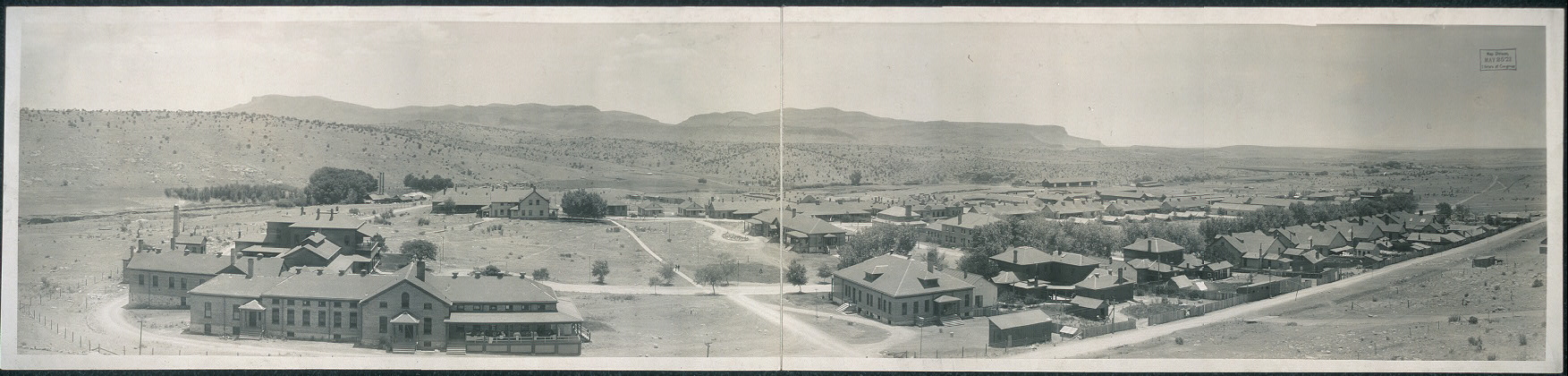
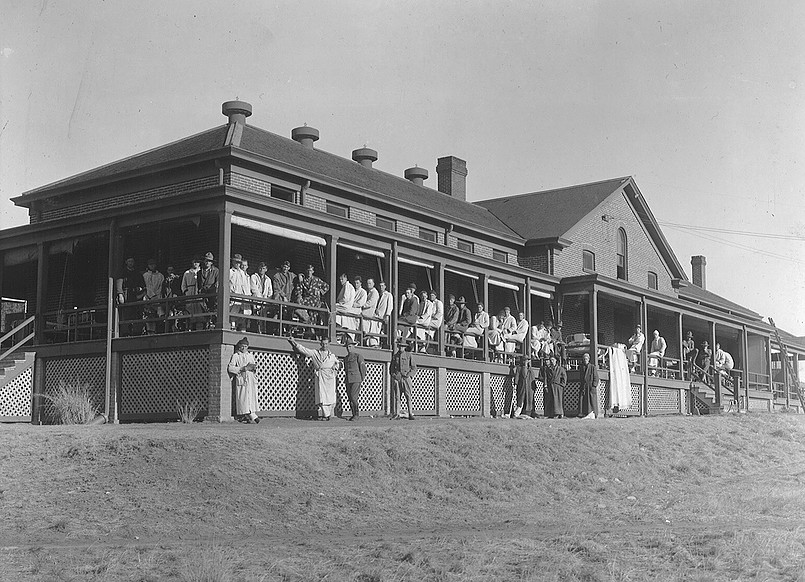
Photographs make the arrangement tangible. A Library of Congress panorama of about 1909 shows Fort Bayard’s buildings spread around an open central ground. A closer group photograph, reproduced by the Albuquerque Historical Society, shows people seated along hospital porches, with others standing below. That photograph’s date has not been independently established here, so it illustrates the porch setting without being used to date a particular phase of construction or treatment.
Sources: Library of Congress, Fort Bayard panorama, approximately 1909; Albuquerque Historical Society, hospital photograph; supplied date discussed in the picture collection
A patient’s welcome home could wait: Fort Bayard and South Carolina, 1909 to 1913
In June 1909, a Fort Bayard chaplain tried to manage something the hospital could not prescribe from a distance: the welcome a patient would receive at home. South Carolina congressman George S. Legaré was preparing to return from treatment. On 23 June The Manning Times reprinted a letter from Chaplain C. C. Bateman, dated at Fort Bayard on 14 June, under the hopeful heading “George Legare Getting Well.”
In the 1909 letter, Bateman praised Legaré as a patient, then asked his Charleston friends for restraint. He feared that political demands, social engagements, and crowded rooms would undo the benefit of his stay at Fort Bayard. A man could look stronger than he was, Bateman wrote. The kindness he requested was several quiet months, with friends taking care of ordinary necessities while letting the returning congressman rest. Hospital care had reached its limit at the gate; recovery would depend on what other people expected of him afterward.
Bateman’s 1909 letter records hope, not a final medical outcome. In a memorial address, Senator Charles E. Townsend later recalled Legaré returning from Fort Bayard so improved that his friends thought he had overcome the disease, then resuming congressional work and spending vacations at his mountain home in South Carolina. Legaré died in 1913. Read together, the newspaper and the memorial preserve the uncertainty hidden by a cheerful announcement that a patient was coming home.
Sources: George S. Legaré: Memorial Addresses (1914), Senator Charles E. Townsend’s address, pp. 65–66; The Manning Times, June 23, 1909, p. 5, “George Legare Getting Well,” reprinting Chaplain C. C. Bateman’s June 14 letter
Ward Pershing’s treatment record: Fort Bayard, 1905 to 1909
Captain Ward B. Pershing, younger brother of John J. Pershing, entered Fort Bayard’s hospital in May 1905. Archivist Cody White’s 2017 study of his file distinguishes the 2 May admission shown in treatment records and the post return from a conflicting date on one history form. Those records followed his weight, lungs, treatment, and leave rather than supplying one uncomplicated verdict on recovery.
As White reconstructed it from the archived file, Pershing’s weight increased at Fort Bayard, but the disease remained active. He left for a Denver sanatorium in November 1905, later retired from the Army, and died in Colorado in 1909 at thirty-five. That course makes the limits of any single improvement clear: gaining weight did not mean the infection had been overcome.
Counting cases without claiming cures: Fort Bayard, 1899 to 1912
From the Fort Bayard hospital’s opening in October 1899 through 30 June 1902, the Surgeon General’s report counts 686 admitted tuberculosis cases. It records 431 discharged, 105 deaths, and 150 still present. Those categories add up, but “discharged” did not mean “cured.” The report separates clinical outcomes within the discharged group and warns that patients arrived at different stages of disease.8, 9
According to the 1902 report, the Army sent patients to Fort Bayard regardless of how advanced their illness was or whether they wanted to come. Other sanatoria could select more favorable cases. Comparing their raw totals would therefore mix different patient populations. That warning came from the institution itself and deserves to travel with its numbers.9
In 1912, a decade after that count, Fort Bayard’s commanding officer reported overcrowding in accommodation for patients who could walk about. Some were placed in an old wooden barrack considered unsuitable. A new well and a dam for irrigating additional land improved the institution’s supply system, yet did not solve the shortage of appropriate wards. Land, water, food, and beds were different resources, each with a separate limit.10, 11
Bushnell’s nursery makes the news: Fort Bayard, 1915
A small notice in the El Paso Morning Times of 17 April 1915 gives Fort Bayard’s hospital commander, George E. Bushnell, an occupation beyond medicine. Its Southwestern Progress column reported that he had a nursery of nearly a thousand giant sequoias grown from seed, some approaching fifteen feet in height. The paper presented the planting as a botanical success. Those are the newspaper’s figures; the notice does not establish how many trees survived or identify any tree standing on the grounds today.
The setting matters. On the same 1915 page, news of mining investment, farms, roads, and public works places the hospital within a region being built and cultivated. Read beside those items, Bushnell’s nursery appears to have been news because it suggested what could be grown there. For a reader following Fort Bayard only through military orders and patient totals, that brief column opens a different view of the grounds: someone was raising trees while the institution treated the sick.
War brings more patients: Fort Bayard, 1918
World War I enlarged the problem at Fort Bayard. The Army’s hospital history gives 467 patients on 1 January 1918 and 1,536 on 1 December. New wards, converted quarters, and tents were opened as the population rose. Even construction could lag behind arrivals. Locally, the hospital’s national role showed as a continuing effort to find places for people to sleep and receive care.
Hamill’s piano story belongs inside that larger history. A hospital depended on buildings and appropriations, but also on people who could remain at their work over time. Fort Bayard’s nurses furnished a home; patients lived through long and uncertain courses of illness; kitchens and maintenance crews sustained the institution around them. Its next administrative name would be Hospital No. 55.
Continue with the veterans’ hospital and Copper League years
Read more on Salars.net
Part 5 of 9 of the series Fort Bayard, New Mexico: soldiers, patients, and a changing place.
Sources
- Hamill recalled that the nurses at the isolated post, ten miles from Silver City, had their own home, and that when they fined each other for slang and "shop" talk to pay for a piano, the Surgeon General sent a check for it. The Fort Bayard Hospital for Tuberculosis, AJN 18 (1918), p. 666-667. View source ↗ (reported)
- A War Department order of August 28, 1899 authorized the Army sanatorium; Major Daniel M. Appel arrived October 3, 1899, and the last 9th Cavalry detachment left the discontinued post on January 12, 1900. Fort Bayard Historic District, National Register nomination, npgallery NRHP 02000726 nomination (online PDF text identical to local extract), Section 8, p. 29. View source ↗ (documented)
- In 1875 Fort Bayard's surgeon judged the local climate unfavorable for bronchitis and wrote that tuberculosis cases he had seen there had all worsened, a contrast with the post's later reputation as a sanatorium. A Report on the Hygiene of the United States Army, with Descriptions of Military Posts (Circular No. 8, Surgeon General's Office), Circular No. 8, 1875, pp. 246-247 (corrected OCR reading). View source ↗ (documented)
- The commanding officer's report on 1903 says sleeping outdoors in framed, floored tents and on glassed porches was encouraged and sometimes ordered, and that a solarium completed "last March" (apparently March 1903) had been of great advantage to patients. Report of the Surgeon-General of the Army to the Secretary of War (bound volume containing the reports for fiscal 1902 and calendar 1903), Report of the Surgeon-General of the Army, fiscal year ending June 30, 1904 (same bound volume), commanding officer's report on Fort Bayard for 1903, p. 122. View source ↗ (documented)
- Treatment at Fort Bayard in 1903 was 'simply hygienic and climatic': all able patients stayed outdoors by day, and they were sorted into four classes, with feverish walking cases quartered in tents and made to rest three hours a day. Report of the Surgeon-General of the Army to the Secretary of War (bound volume containing the reports for fiscal 1902 and calendar 1903), Report of the Surgeon-General, FY ending June 30, 1904 (same bound volume), Fort Bayard commanding officer's report, "Treatment", p. 122. View source ↗ (documented)
- A nurse writing in 1918 described Fort Bayard, at 6,300 feet, as a large tuberculosis hospital for the Army, the Navy and the Soldiers' Homes, with women nurses serving alongside male nurses and feeble patients given two beds, one outdoors. The Fort Bayard Hospital for Tuberculosis, American Journal of Nursing 18 (1918), p. 665 (archive.org jstor-3405862). View source ↗ (reported)
- Hamill recalled that patients carried paper sputum cups that were collected from cans on the porches and burned, and that they were encouraged to eat eggs, milk and butter freely, some taking eight to twelve raw eggs a day. The Fort Bayard Hospital for Tuberculosis, AJN 18 (1918), p. 666. View source ↗ (reported)
- From its opening on October 3, 1899 to June 30, 1902 the Fort Bayard hospital admitted 686 tuberculosis cases: 431 were discharged, 105 died, and 150 remained. Report of the Surgeon-General of the Army to the Secretary of War (bound volume containing the reports for fiscal 1902 and calendar 1903), Report of the Surgeon-General of the Army, fiscal year ending June 30, 1902 (archive.org reportsurgeonge01offigoog), p. 70. View source ↗ (documented)
- The Surgeon General noted that, unlike sanatoria that ordinarily admitted only about a quarter of the cases they examined, the Army sent patients to Fort Bayard regardless of how far their disease had gone or whether they wished to go; 62 had come back after discharge with their disease much advanced. Report of the Surgeon-General of the Army to the Secretary of War (bound volume containing the reports for fiscal 1902 and calendar 1903), Report of the Surgeon-General of the Army, fiscal year ending June 30, 1902 (archive.org reportsurgeonge01offigoog), p. 70. View source ↗ (documented)
- In 1912 the hospital dug a new electrically pumped well and built a small concrete dam on Cameron Creek about half a mile below the post to irrigate about ten acres; 928 cases were treated that year. Report of the Surgeon-General of the Army to the Secretary of War (bound volume containing the reports for 1911, 1912 and 1913), archive.org reportofsurgeon1912unit (bound Surgeon General reports for fiscal years ended June 30, 1912, 1913 and 1914); FY1913 report, "General Hospital, Fort Bayard", p. 143. View source ↗ (documented)
- The commanding officer reported in 1912 that rising numbers of Soldiers' Home beneficiaries had overcrowded the wards, forcing some patients into an old wooden barrack, 'ward 5', that was unsuited to the purpose. Report of the Surgeon-General of the Army to the Secretary of War (bound volume containing the reports for 1911, 1912 and 1913), archive.org reportofsurgeon1912unit (bound Surgeon General reports for fiscal years ended June 30, 1912, 1913 and 1914); FY1913 report, p. 143. View source ↗ (documented)
"Documented" means the source is a record of the time or a direct survey; "reported" means a later account or secondary history, attributed in the text.
Cite this page: “Fort Bayard’s tuberculosis hospital: patients, nurses, and the limits of climate.” Grant County Atlas, Salars.net, first published 14 November 2026, revised 16 November 2026. https://atlas.salars.net/stories/fort-bayard/tuberculosis-hospital
Discussion
What would you add or question? Comments are reviewed before they appear.
Loading comments…