Congress designated the Fort Bayard Historic District a National Historic Landmark on 19 March 2004 and left its administration with New Mexico; recognition establishes significance, but upkeep still takes money: state agencies estimated roughly $500,000 a year in costs for the empty hospital, a 2013 legislative fiscal report says.
Which Fort Bayard survives: Doctors’ Row, 1908–1911, and Officers’ Row in 1917
A visitor can look at a row of old houses and assume that the frontier garrison lived in them. At Fort Bayard, the museum’s account gives a more specific answer: the houses on Doctors’ Row were built between 1908 and 1911 for the Army tuberculosis hospital’s physicians. Their appearance belongs to the medical institution that succeeded the active military post.
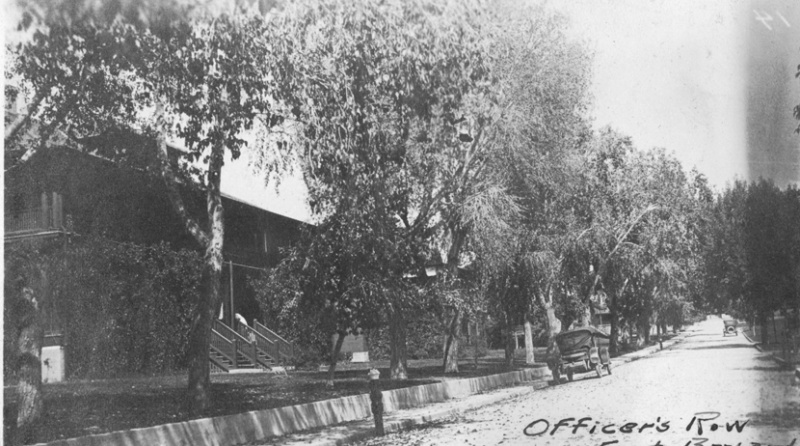
An October 1917 photograph cataloged as Officers’ Row shows porches and a tree-lined road. Preserved in Lorain H. Cunningham’s album at the Truman Library, it records those surroundings during the hospital years. Cunningham owned the album; the photographer is not identified. Its date helps place the buildings without turning a military-sounding street name into a construction date.
Sources: Harry S. Truman Library & Museum, Officers’ Row, October 1917, photograph 2007-806
Fort Bayard’s earliest log huts, its hospital houses of 1908 to 1911, and a modern medical center belong to different answers to the problem of shelter and care. Preserving the whole history requires explaining those changes, including structures that have disappeared. An empty space in a historic photograph comparison can be as consequential as a surviving façade.
What the 2004 designation did: Fort Bayard National Historic Landmark
Congress designated the Fort Bayard Historic District a National Historic Landmark by Public Law 108–209, approved 19 March 2004, and kept administration with the State of New Mexico. The act authorized the Secretary of the Interior to provide assistance and enter cooperative agreements for interpretation and preservation. National recognition did not turn the grounds into a newly staffed national park.1, 2
Sources: Fort Bayard National Historic Landmark Act, Public Law 108–209, approved March 19, 2004
For Fort Bayard after 2004, the distinction was practical. Recognition establishes significance, while repairing a roof, staffing a museum, maintaining utilities, or finding a new use still requires organizations, money, and work. An authorization to assist, such as the 2004 act gave, is not evidence that every proposed project was funded or completed.
Sources: Fort Bayard National Historic Landmark Act, Public Law 108–209, approved March 19, 2004
The cost of an empty hospital: Fort Bayard in 2013
A Legislative Finance Committee report of 30 January 2013 captures the problem at Fort Bayard after patients left the old hospital. State agencies described a vacant building of about 145,000 square feet and estimated roughly $500,000 a year in maintenance, utilities, and vandalism-related costs. That report concerned a proposed demolition appropriation. Its figures were estimates supporting a legislative decision, not an audited account of later savings.
Sources: Legislative Finance Committee, fiscal impact report for HB 102, January 30, 2013, pp. 1–3
In 2013 the committee’s report distinguished the large hospital from other historic buildings that local government and nonprofit groups hoped to reuse. That raises a recurring preservation question: which structures can support a workable new purpose, and what continuing costs follow each choice. Keeping a building standing and securing its long-term use are related, but they are not interchangeable.
Sources: Legislative Finance Committee, fiscal impact report for HB 102, January 30, 2013, pp. 1–3
Recording a hospital before demolition: Fort Bayard’s 1922 infirmary, 2014–2015
Another kind of preservation record, held by the Library of Congress, is a detailed survey of Fort Bayard’s old hospital prepared when it faced demolition. Karen Van Citters’s report for the Historic American Buildings Survey identifies the 2014 agreement that required the documentation. It describes a 1922 infirmary of about 145,000 square feet, erected by a crew of five hundred in seven months, within a complex that supplied its own water, utilities, ice, and farm products. That scale helps explain why the institution needed much more than doctors and beds.
Sources: Karen Van Citters, Fort Bayard Hospital, Infirmary Group, HABS NM-229, historical report, pp. 3–4
Martin Stupich photographed the building in 2015. His photographic record follows those practical systems into its rooms. Its caption list identifies sterilizers, a three-bed ward, a day room, patients’ dining space, a kitchen, a bakery, and cold-storage rooms. One image records an overhead track for moving meat; others document painted murals. A linked PDF supplies the captions and plans keyed to the camera positions; the individual photographs are cataloged separately. Together, those descriptions locate clinical spaces, food production, and decoration within the altered building of 2015.
Van Citters’s report and Stupich’s photographs preserve information that a distant panorama cannot supply: how rooms connected, what equipment remained, and how the hospital supported daily life. They are linked here as records of that building at a particular stage, the photographs dated 2015. They should not be used as a guide to rooms available to visit now.
Sources: Karen Van Citters, Fort Bayard Hospital, Infirmary Group, HABS NM-229, historical report, pp. 3–4; Library of Congress, HABS NM-229, caption index and photograph-location plans; Martin Stupich, 2015, photographs 20–33
Interpretation is work too: Fort Bayard’s museum and archive in 2026
Fort Bayard’s Historic Preservation Society operates its museum in the Commanding Doctor’s house and maintains an archive in the Santa Clara armory. Its current notices describe exhibit reinstallation and plans to use Building 53 for additional collection, office, and exhibition space. Those ordinary tasks—cataloging, moving, repairing, and explaining—are part of keeping the history available.
Museum and archive serve different purposes. A museum visit introduces people and objects; an archive appointment can pursue a particular question. Neither should be assumed to hold every record created by the post or hospital. For opening arrangements, current exhibits, and research appointments, use the society’s current information, checked for this article on 14 November 2026.
A proposed future, not a list of open attractions: Fort Bayard’s draft plan, as checked in November 2026
When this article checked its website on 14 November 2026, the Fort Bayard Revitalization Plan presented a draft master plan following several design alternatives. It organizes ideas around the historic core, access, landscape, and possible new uses. Its published concepts include a pedestrian connection through the grounds, arts and trades activity, lodging, and reuse of the steam plant. These are planning proposals, not announcements that those businesses or facilities are operating.
Sources: Fort Bayard Revitalization Plan, Draft Master Plan Design; checked November 14, 2026
For a reader in 2026, the Fort Bayard plan’s value is to show the choices under discussion. A new use can support the expense of a historic building, while changing traffic, public access, or the relationship between structures. Its draft provides a basis for asking what would be retained, who would use it, and how the work would be sustained. Drawing a possible future does not settle those questions.
Sources: Fort Bayard Revitalization Plan, Draft Master Plan Design; checked November 14, 2026
For now, Fort Bayard’s historical photographs, among them the Officers’ Row view of October 1917, offer a useful starting point: compare the open ground, the building rows, and the different institutional names. Then read the museum’s interpretation and current planning material with those earlier arrangements in mind. Fort Bayard has repeatedly changed its work; understanding the changes makes its surviving fabric more legible.
Explore the historical picture collection
Sources: Harry S. Truman Library & Museum, Officers’ Row, October 1917, photograph 2007-806
Read more on Salars.net
Part 8 of 9 of the series Fort Bayard, New Mexico: soldiers, patients, and a changing place.
Sources
- Congress designated the Fort Bayard Historic District a National Historic Landmark by the Fort Bayard National Historic Landmark Act, Public Law 108-209, approved March 19, 2004, leaving its administration with the State of New Mexico. Public Law 108-209, Fort Bayard National Historic Landmark Act (H.R. 2059), 118 Stat. 562, govinfo PLAW-108publ209, Sec. 1(b), 118 Stat. 562. View source ↗ (documented)
- The act lets the Interior Secretary make cooperative agreements to protect Fort Bayard's historic resources and provide interpretation, but nothing affecting Fort Bayard State Hospital without the State's agreement. Public Law 108-209, Fort Bayard National Historic Landmark Act (H.R. 2059), 118 Stat. 562, PL 108-209, Sec. 1(d). View source ↗ (documented)
"Documented" means the source is a record of the time or a direct survey; "reported" means a later account or secondary history, attributed in the text.
Cite this page: “Preserving Fort Bayard: buildings, work, and possible futures.” Grant County Atlas, Salars.net, first published 14 November 2026, revised 16 November 2026. https://atlas.salars.net/stories/fort-bayard/preserving-fort-bayard
Discussion
What would you add or question? Comments are reviewed before they appear.
Loading comments…