Frances Boyd's 1894 memoir, Ephriam Goodale's 1883 diary and an 1889 Enterprise report describe household life at Fort Bayard in the 1870s and 1880s: adobe quarters, savings from cows and chickens, a diphtheria quarantine, amateur theatricals and contract firewood.
The household balance sheet: Fort Bayard in the 1870s
Frances Boyd remembered Fort Bayard as the place where her household finally got out of debt. In her account, milk, butter, eggs, and careful management made the difference. In her 1894 memoir, she wrote that she could set aside fifty dollars a month and clear the family’s debts in two years. For an officer’s family accustomed to expensive moves, an unusually long stay made household improvements worth attempting.1
In the early 1870s, as Boyd recalled, her husband, Lieutenant Orsemus Boyd of the Eighth Cavalry, was sent to Fort Bayard to help build officers’ quarters. That assignment brought a family into a workplace still under construction. Her account follows both kinds of work: the government’s effort to erect houses and the family’s effort to make one of them a home.2
A year among unfinished houses: officers’ quarters at Fort Bayard, 1870s
In her 1894 memoir, Boyd described arriving at Fort Bayard to find stone foundations for the new houses and miserable temporary cabins behind them. Earth excavated in front of the dwellings was mixed with water, shaped in wooden molds, and dried as adobe bricks. Mexican workmen built the quarters, she wrote. She recalled living amid the work for about a year, with pits that made moving outside after dark hazardous.3
Her irritation at the builders comes wrapped in the ethnic assumptions of her time. Those judgments are hers. What Boyd’s 1894 memoir describes of the material process is more useful: at Fort Bayard soil became walls, and digging the building material left holes beside the houses. Construction altered the ground the families had to cross each day.
Temporary shelter at Fort Bayard, as Boyd remembered it, offered little protection when rain came. She recalled water entering the cabins and roofs falling on two occasions. Her later happiness at the post did not erase that first difficult year. Her 1894 memoir moves between discomfort and satisfaction because both belonged to one posting.4
Once the Boyds were settled, Frances Boyd wrote, the household’s animals and food production helped turn stability into savings. There was a practical reason not to accumulate too much: orders could send the regiment elsewhere. After three years at Fort Bayard, the Eighth Cavalry moved toward Texas to exchange stations with the Ninth, and the Boyds spent Christmas Day 1875 in camp. A settled home remained subject to a military timetable.1, 5
Fuel by the cord and hay by the ton: Fort Bayard, 1870s and 1889
On 28 June 1889 the Silver City Enterprise reported that A. J. Cornell had won a contract to deliver 2,500 cords of wood to the government at Fort Bayard at $3.19 a cord. A later compilation of the newspaper, This Is Silver City, preserves the item. Multiplying its stated quantity by its stated rate gives a contract value of $7,975, before any costs or adjustments. That is a calculation from the notice, not evidence of Cornell’s profit. The notice does not identify all the workers or the wood’s precise origin. Read for what a contract of that size implies, it connected government spending with cutting, hauling, teams, and delivery, and it gives scale to the repetitive task of keeping the post supplied: cooking and heating demanded material brought in continually, rather than a one-time investment when the buildings went up.6
Stored supplies at Fort Bayard could disappear in a night, as Frances Boyd remembered it. She recalled a fire that consumed what she described as the post’s entire winter hay supply, six hundred tons. She believed it was deliberately set, but her 1894 memoir does not establish the culprit. The consequence she emphasized was immediate: summer’s work had been lost when the season for cutting replacements had passed.7
A diary’s difficult January: Fort Bayard, 1883
Ephriam Goodale’s diary opens 1883 with a family catastrophe at Fort Bayard. One household at the post had lost four children to diphtheria, he wrote. Those left in the family were moved into a tent, the house and furnishings burned, and school stopped. Goodale left the children unnamed in this entry.8
Sources: Ephriam Goodale’s diary, New Mexico Historical Review 25 (1950), pp. 298–303
On 31 January 1883 Goodale recorded amateur theatricals in Company K’s barracks. Officers and women of the post performed Lending a Lover, followed by a gathering in the hop room. Read together, the two entries do not cancel each other: disease precautions and organized entertainment occupied one small community within a single month.9
Sources: Ephriam Goodale’s diary, New Mexico Historical Review 25 (1950), pp. 298–303
These accounts describe different positions within Fort Bayard’s community. Boyd writes from an officer’s household; Goodale notices officers’ social gatherings; William J. Wilson’s Fort Bayard report in the Army’s 1875 Report on the Hygiene of the United States Army records laundresses’ poor quarters. Taken together, they reveal a post with unequal housing and shared practical dependencies. A comfortable evening required food, fuel, maintained rooms, and work that the guest list rarely named.
A chapel furnished one chair at a time: Fort Bayard, 1888 to 1889
In 1888, according to Charles Alexander’s biography of Allen Allensworth, the Fort Bayard chapel occupied a ward in an abandoned hospital. On Sundays, chairs had to be borrowed from a neighboring building. Allensworth applied for four months’ leave to raise money for chairs on a lecture tour. The War Department rejected the leave but ordered the quartermaster’s department to supply the furniture. Since the chairs were what the tour was meant to pay for, the refusal still met the request’s purpose: the congregation’s seating had become an Army responsibility.
Sources: Charles Alexander, Battles and Victories of Allen Allensworth (1914), pp. 268–269, 273–274
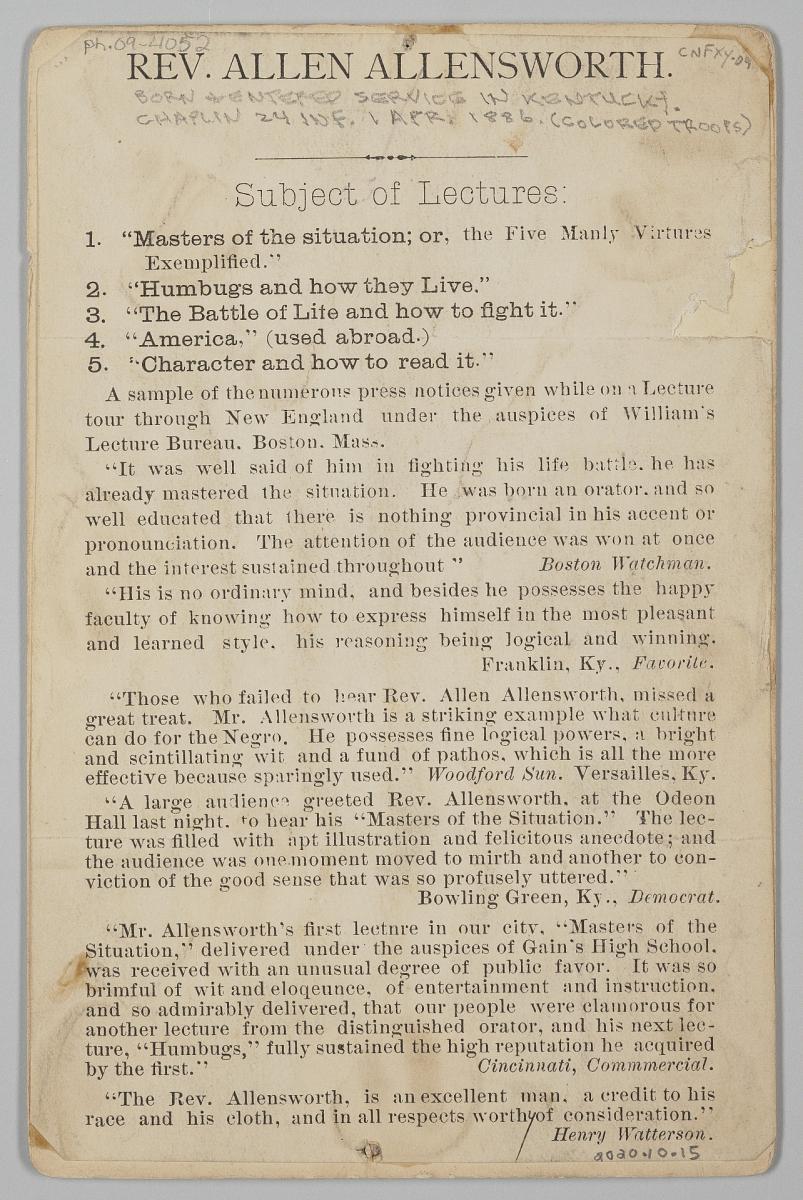
Other improvements, Alexander writes, came from Allensworth’s pay. He bought a stereopticon, a lantern that projected pictures, and slides to illustrate sermons, including themes from Pilgrim’s Progress. He arranged literary entertainments supported by voluntary contributions. The reverse of his surviving cabinet card, which the Smithsonian dates to 15 January 1889, advertises lectures on character, life’s struggles, and humbugs, alongside favorable press notices. It is a compact record of his public speaking career; it does not establish that every advertised lecture was delivered at Fort Bayard.
Sources: Charles Alexander, Battles and Victories of Allen Allensworth (1914), pp. 268–269, 273–274; Smithsonian National Museum of African American History and Culture, cabinet card of Chaplain Allen Allensworth, January 15, 1889, object 2020.10.15
Allensworth’s work crossed denominational lines, as Alexander tells it in his 1914 biography. A Catholic civilian employee asked the Baptist chaplain to arrange his child’s baptism. Allensworth went to Silver City, contacted a priest, and arranged the ceremony at his quarters. The account then describes arrangements with a Methodist minister for other families. These are episodes reported by an admiring biographer. Their practical detail still shows that a family’s religious life at Fort Bayard could depend on a chaplain making the journey into town and bringing the right person back.
Sources: Charles Alexander, Battles and Victories of Allen Allensworth (1914), pp. 268–269, 273–274
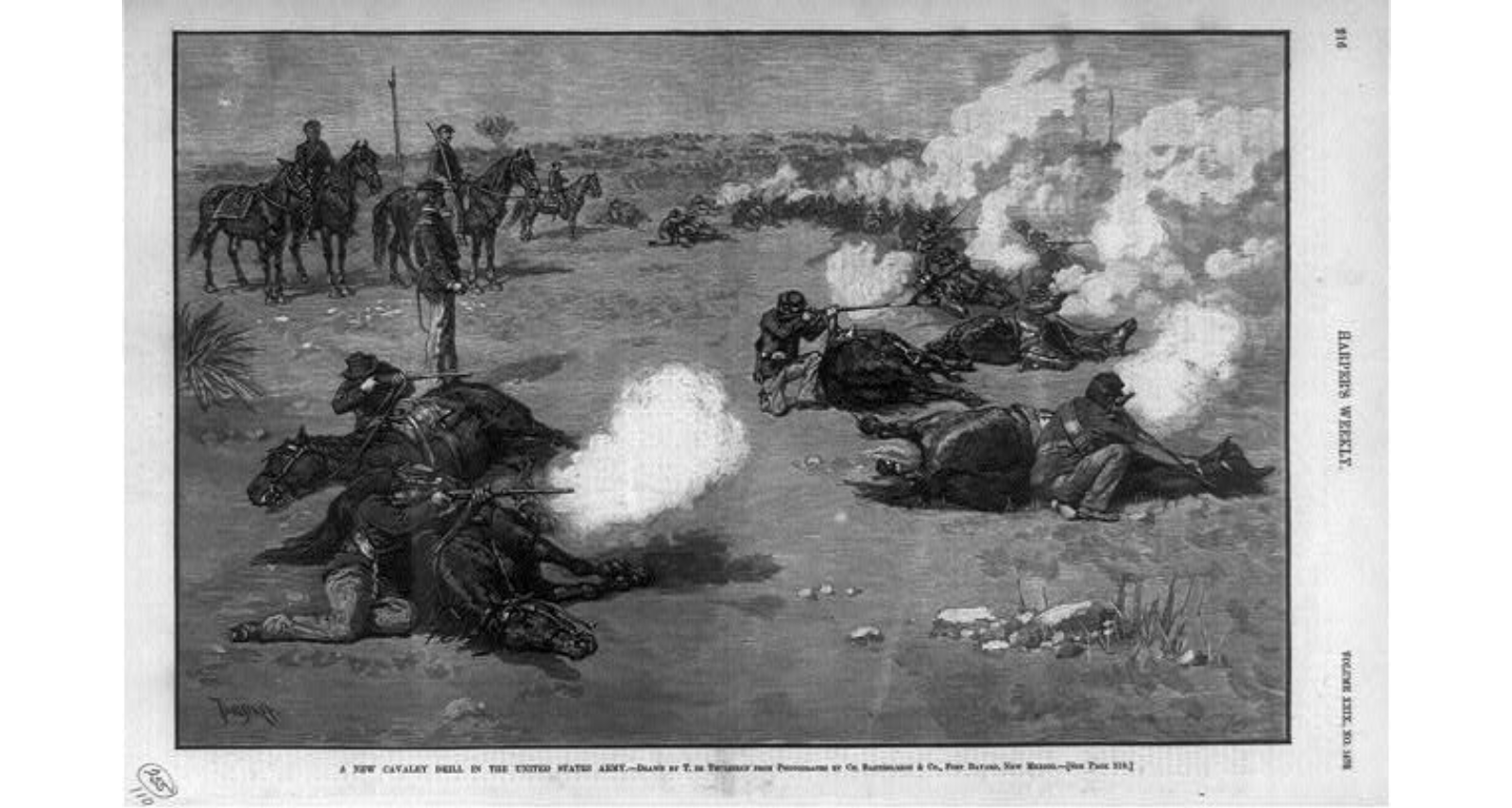
A drill becomes a newspaper picture: Fort Bayard, 1885
Fort Bayard could reach readers far beyond Grant County. On 4 April 1885, Harper’s Weekly published A New Cavalry Drill in the United States Army. The engraving shows Sixth Cavalry soldiers firing over horses lying on the ground. Its printed credit identifies T. de Thulstrup’s drawing as based on photographs by Ch. Barthelmess & Co. of Fort Bayard.
Harper’s engraving records a published representation of training, not a battle photograph. Its orderly line of men and animals contrasts with the domestic and supply problems described elsewhere. Together they show how much of Fort Bayard’s life lay outside combat: practicing, building, washing, feeding, teaching, and arranging an evening’s entertainment.
Continue with the work of the tuberculosis hospital
Read more on Salars.net
Part 4 of 9 of the series Fort Bayard, New Mexico: soldiers, patients, and a changing place.
Sources
- Boyd said that by careful housekeeping at Fort Bayard, with two cows and many chickens, she saved fifty dollars a month and in two years cleared the family's debts. Cavalry Life in Tent and Field, Boyd 1894, ch. XVI, p. 236-237. View source ↗ (reported)
- Frances Boyd recalled that her husband, Lt. Orsemus Boyd of the 8th Cavalry, was ordered from Fort Union to Fort Bayard to build the officers' quarters, at a post then thought 'a most undesirable locality' because no officers' houses existed; the ambulance trip took eighteen days in midwinter. Cavalry Life in Tent and Field, Boyd, Cavalry Life in Tent and Field (1894), archive.org cavalrylifeinten00boyd, ch. XIV, p. 211-213. View source ↗ (reported)
- Boyd wrote that the new officers' quarters were built of adobe bricks made from earth dug in front of the houses and dried in wooden molds, by Mexican workmen, and took about a year to finish. Cavalry Life in Tent and Field, Boyd, Cavalry Life in Tent and Field (1894), archive.org cavalrylifeinten00boyd, ch. XV, p. 220-221. View source ↗ (reported)
- Boyd recalled that until the new quarters were finished the officers lived in floorless log cabins with straw-thatched mud roofs; summer storms washed straight through the houses, and she remembered two occasions when a roof fell in. Cavalry Life in Tent and Field, Boyd 1894, ch. XV, p. 221-222. View source ↗ (reported)
- After three years at Fort Bayard the 8th Cavalry was ordered to march into Texas and exchange stations with the 9th Cavalry; the Boyds spent Christmas Day in camp and crossed the flooded Rio Grande on a rope ferry. Cavalry Life in Tent and Field, Boyd 1894, ch. XVII, p. 244-245. View source ↗ (reported)
- The Enterprise reported (28 June 1889) that A. J. Cornell had the contract to deliver 2,500 cords of wood to the government at Fort Bayard at $3.19 a cord. This is Silver City, New Mexico, 1888-1890 (compilation of Silver City Enterprise items), "From the June 28, 1889, Issue of The Enterprise" section, This is Silver City, New Mexico, 1888-1890 (archive.org/details/silvercity1888; IA full text checked). View source ↗ (reported)
- Boyd recorded two fires at Fort Bayard she believed were set: one in shavings in her unfinished double house, and a few weeks later the post's whole winter hay supply of six hundred tons. Cavalry Life in Tent and Field, Boyd 1894, ch. XVII, p. 242. View source ↗ (reported)
- Ephriam Goodale's diary for New Year's Day 1883 records that one family at Fort Bayard had lost four children to diphtheria; the rest of the family were ordered into a tent, their house and furniture burned, and the school stopped. New Mexico Historical Review, vol. 25 (1950): 'Frederick E. Phelps: A Soldier's Memoirs', ed. Frank D. Reeve (Jan., Apr., July 1950) and 'A Civilian at Old Fort Bayard 1881-1883', ed. Roy Goodale (Oct. 1950), NMHR 25:4, p. 302, Jan. 1, 1883. View source ↗ (reported)
- Goodale's diary records amateur theatricals at Company K barracks on January 31, 1883: officers and young women of the post (Capt. Eskridge, Miss Royall, Miss Martin, Lt. Martin, Mr. Mizner and others) played 'Lending a Lover', which 'went off splendidly', followed by a full house at the hop room. New Mexico Historical Review, vol. 25 (1950): 'Frederick E. Phelps: A Soldier's Memoirs', ed. Frank D. Reeve (Jan., Apr., July 1950) and 'A Civilian at Old Fort Bayard 1881-1883', ed. Roy Goodale (Oct. 1950), NMHR 25:4, p. 302, Jan. 31, 1883. View source ↗ (reported)
"Documented" means the source is a record of the time or a direct survey; "reported" means a later account or secondary history, attributed in the text.
Cite this page: “Keeping Fort Bayard fed, warm, and connected.” Grant County Atlas, Salars.net, first published 14 November 2026, revised 16 November 2026. https://atlas.salars.net/stories/fort-bayard/households-and-post-life
Discussion
What would you add or question? Comments are reviewed before they appear.
Loading comments…