The Kneeling Nun is a column of Kneeling Nun Tuff standing in front of a cliff above the Chino open pit at Santa Rita, called the Kneeling Virgin in an 1872 geologist's notes and the Kneeling Nun in an 1882 newspaper. Neal W. Ackerly's 1998 documentary study concluded that none of its many legends has a documented historical basis.
A column of tuff in front of its cliff at Santa Rita
Above Santa Rita, in Grant County, a column of rock stands a short distance in front of a high escarpment of the same rock. H. L. Jicha Jr. described it that way in 1954, in a summary kept by the U.S. Geological Survey, and called it a famous landmark. Its rock is welded rhyolite tuff, a stone made of volcanic ash that fused as it settled. A state highway marker on NM 152 calls the Kneeling Nun the most famous landmark of the Black Range country, named for its resemblance to a nun kneeling in prayer before a great altar.
Sources: U.S. Geological Survey, National Geologic Map Database, Geolex - Kneeling Nun (unit summary and significant publications) (page modified 2026): Significant Publications: Jicha 1954 summary; Significant Publications: Jicha, H.L., Jr., 1954, NMBMMR Bulletin 37 (summary); New Mexico Historic Preservation Division (erected), Kneeling Nun (state highway marker) (photographed 2004-09-28): inscription
Robert W. Eveleth and Glenn R. Osburn, writing in New Mexico Geology in August 1985, explained how the figure stands. Both the "nun" and the lesser-known "altar" are large columns formed by cooling joints, the cracks that open in welded tuff as it cools. A 1984 photograph by Eveleth shows these megacolumns beside the cliffs, with the immense boulder field that seismic activity and weathering produced around them. The two authors suggested that the columns still stand because they are rooted in the talus, the broken rock below the cliff, "much like fenceposts." They speculated that the nun is moving slowly downslope with it.
Eveleth and Osburn wrote that the figure had stayed virtually unchanged through the 20th century, despite daily blasting at the Chino mine. They mused that the altar, now slightly separated from the cliff, might one day move downslope and become a new nun as the present one erodes. Shari A. Kelley of the New Mexico Bureau of Geology and Mineral Resources, in a geologic tour of the Chino mine, explains the spire as a landslide block of Kneeling Nun Tuff. Her tour says concern has been expressed about its stability as mining moves to the southeast.1
Sources: Robert W. Eveleth and Glenn R. Osburn, New Mexico Geology v.7 n.3 pp.56-58, The Kneeling Nun, Santa Rita, New Mexico (1985-08): p. 56, 'A look into the future'; p. 58; Shari A. Kelley, New Mexico Bureau of Geology and Mineral Resources, Chino Mine (Geologic Tour: Landmarks) (undated (accessed 2026-11-16)): Introduction; Regional Setting
From flow rhyolite to Kneeling Nun Tuff, 1916 to 1985
Sidney Paige of the Geological Survey used the Kneeling Nun as a reference point when he mapped the Silver City quadrangle for his 1916 folio, and he described its rock as a flow rhyolite, a lava. Before 1950, Wolfgang E. Elston and two colleagues wrote in 1975, the rock was generally taken for a thick lava flow. Eugene Callaghan recognized it as a welded tuff and showed this in 1950 to F. J. Kuellmer, H. L. Jicha and W. E. Elston. Jicha named the unit the Kneeling Nun rhyolite tuff in 1954, after the rock monument overlooking Santa Rita. In 1967 W. P. Pratt shortened the name to Kneeling Nun Tuff, because the rock is not everywhere a rhyolite.
Sources: Sidney Paige, USGS, Description of the Silver City quadrangle, New Mexico (Geologic Atlas Folio 199) (1916): Igneous rocks, 'Masses east of Santa Rita'; U.S. Geological Survey, National Geologic Map Database, Geolex - Kneeling Nun (unit summary and significant publications) (page modified 2026); Wolfgang E. Elston, William R. Seager, Russell E. Clemons; NMGS Guidebook 26, pp.283-292, Emory Cauldron, Black Range, New Mexico, source of the Kneeling Nun Tuff (1975): p. 283, Previous Work
Elston, William R. Seager and Russell E. Clemons proposed in 1975 that the tuff came from a large cauldron, a collapsed volcanic center, in the southern Black Range. They named it the Emory cauldron, after Emory Pass and Lt. W. H. Emory, and estimated the tuff at no less than 900 cubic kilometers in volume, and perhaps twice that. Eveleth and Osburn put about 400 feet of it in the Santa Rita area, about 9 miles from the nearest part of the cauldron vent. A 1964 Survey map of the Santa Rita quadrangle gave the unit a thickness of 200 to 600 feet.
Sources: Wolfgang E. Elston, William R. Seager, Russell E. Clemons; NMGS Guidebook 26, pp.283-292, Emory Cauldron, Black Range, New Mexico, source of the Kneeling Nun Tuff (1975): p. 283, Introduction; pp. 283 and 286 (sentence runs across figure pages 284-285), 'The Cauldron Model' section; Robert W. Eveleth and Glenn R. Osburn, New Mexico Geology v.7 n.3 pp.56-58, The Kneeling Nun, Santa Rita, New Mexico (1985-08): p. 56, 'Birth of the nun'; U.S. Geological Survey, National Geologic Map Database, Geolex - Kneeling Nun (unit summary and significant publications) (page modified 2026): Significant Publications: Hernon, Jones and Moore 1964, GQ-306
Published ages for the tuff differ by source. A 1970 Survey map of the Fort Bayard quadrangle reported a potassium-argon age, measured from the decay of potassium in the rock, of 33.4 million years, and moved the formation from the Miocene to the Oligocene. Eveleth and Osburn wrote in 1985 that it formed about 34 million years ago. Kelley's Bureau tour gives 34.9 million years. A Freeport-McMoRan panel at the mine overlook calls the Kneeling Nun about 35 million years old.
Sources: U.S. Geological Survey, National Geologic Map Database, Geolex - Kneeling Nun (unit summary and significant publications) (page modified 2026): Significant Publications: Jones, Moore and Pratt 1970, GQ-865; Robert W. Eveleth and Glenn R. Osburn, New Mexico Geology v.7 n.3 pp.56-58, The Kneeling Nun, Santa Rita, New Mexico (1985-08): p. 56, 'Birth of the nun'; Shari A. Kelley, New Mexico Bureau of Geology and Mineral Resources, Geologic Tour: Chino Mine (undated web page (cites 2008 work)): Geologic History, A More Detailed History, final paras; Freeport-McMoRan Copper & Gold, Reclaiming the Land (marker, Santa Rita mine overlook) (photographed 2014-06-06): inscription, 'The Kneeling Nun'
First descriptions, early names and a fall, 1851 to 1914
The column was described before anyone recorded a name for it. John Russell Bartlett, writing of 1851, described a detached column of rock on the bluff above the Copper Mines without naming it or recording any legend. According to Neal W. Ackerly, whose 1998 documentary study was prepared for Chino Mines Co., Seth Eastman's 1853 painting "Bufa del Cobra, Rocky Mountains" depicts the monolith. Ackerly found no name for it in documents before about 1867, and concluded that the name Kneeling Nun arose between 1865 and 1872.2, 3, 4
In 1872 the geologist N. H. Winchell examined the Santa Rita mine. His notes described the cliff behind the town as a wall 500 to 800 feet high, visible from the Burro Mountains twenty miles off. At its northwest end, he wrote, stands a column known as the Kneeling Virgin, for "the resemblance it bears to a draped female figure kneeling before an altar." Raymond's federal report for 1874 used that name. T. A. Rickard showed in 1923 that Raymond was quoting Winchell. Eveleth and Osburn wrote that a Wheeler Survey map of southwestern New Mexico gave a third name, the Kneeling Jesus.5
Sources: T. A. Rickard, Engineering and Mining Journal-Press v.116 n.18, The Chino Enterprise - I (1923-11-03): p.756 (djvu text); p.756, quoting Winchell via Raymond 1874; Robert W. Eveleth and Glenn R. Osburn, New Mexico Geology v.7 n.3 pp.56-58, The Kneeling Nun, Santa Rita, New Mexico (1985-08): Figure 2 caption (map from Wheeler, Outline map of part of southwestern New Mexico)
On 18 March 1882 the Las Vegas Daily Gazette reported that Sim, a stage driver, called the monolith the Kneeling Jesus and doffed his hat every time he passed it. "Its real name is the Kneeling Nun," the Gazette added. In her 1894 memoir Cavalry Life in Tent and Field, Boyd recalled her years at Fort Bayard in the early 1870s. She wrote that the fallen rock on the Santa Rita ridge facing the post was called the kneeling nun and had a story attached to it.6
Whether the figure has lost height since then is a question the sources answer differently. The Silver City Enterprise reported on 26 June 1885 that about thirty feet of the Kneeling Nun had fallen. Eveleth and Osburn wrote that the Sonoran earthquake of 3 May 1887 severely shook the area, but no damage to the figure was noted; they knew of no photographs or sketches from before 1885 to compare. On 1 May 1914, by contrast, the Deming Graphic reported that the pillar had stood upwards of 75 feet until the 1887 earthquake shattered it and left about half standing. In a 1937 WPA write-up, an unnamed narrator recalled the Kneeling Nun of 1849 standing as high as the main cliff.7, 8
Sources: Robert W. Eveleth and Glenn R. Osburn, New Mexico Geology v.7 n.3 pp.56-58, The Kneeling Nun, Santa Rita, New Mexico (1985-08): p. 56, 'A look into the future'; Deming Graphic, May 1, 1914, p.8 (Chino Copper Co. improvements) (1914-05-01): p.8 (OCR)
A legend in many versions, 1873 to about 2022
No version of the Kneeling Nun legend has a documented historical basis, Ackerly concluded. One story says an Apache told Carrasco that a peculiar rock formation marked the copper mine, and that Carrasco named the monolith; Ackerly found no documentary evidence for either part. The earliest printed telling he found is an editor's note to John Wood's poem in the Silver City paper Mining Life of 20 September 1873. That note calls the rock Santa Rita and says a convent nun condemned to death had her soul banished into it.9, 10, 11
Poems and newspapers of the 1880s and 1890s gave the nun a name and a broken vow. Frank Camblos's 1881 verse in the Grant County Herald sets the tale in the time of Cortés. Sister Rita, a Carmelite from Valencia imprisoned for breaking her vow, is turned to stone after an earthquake destroys the mission. In the Las Vegas Daily Gazette version of 1882, Rita is beaten in her cell, prays to be turned to stone, and is carried onto the cliff by a perjured monk as a storm destroys the mission. Harry Burgess's 1899 poem has Sister Rita and a young monk break their vows; she prays to be made rock, and the monk falls to his death.12, 13
Walter Foote Sellers's poem "The Legend of the Kneeling Nun", first published in 1909, introduced Sister Teresa, a mission teacher who nursed and loved Diego the Soldier. She was expelled and turned to rock before an altar that grew into a mountain overnight. The Deming Graphic reprinted the poem in January 1919 and July 1920, opening "This is the tale as they tell it." In 1917 El Nuevo Mexicano reported that Rev. Arthur M. Baker of Las Cruces was writing a novel set against the legend. Rickard, in 1923, insisted on the name Kneeling Nun, not Virgin, and told of a nun who eloped with a Spanish officer and turned to stone when he left her.14
Sources: Deming Graphic, July 20, 1920, p.5, 'The Legend of the Kneeling Nun' (by Walter Foote Sellers) (1920-07-20): p.5 (OCR); El Nuevo Mexicano (Santa Fe), October 18, 1917, p.7, 'Las Cruces Minister Pleases Congregation' (1917-10-18): p.7, 'Las Cruces Minister Pleases Congregation'; T. A. Rickard, Engineering and Mining Journal-Press v.116 n.18, The Chino Enterprise - I (1923-11-03): p.758 (djvu text)
Mildred Jordan, a WPA collector, wrote down a Coronado-era telling in 1936, in which Sister Rita nursed a wounded soldier and an earthquake left only her figure. In 1940 a play by Mrs. John Cowman, written for the Coronado Exposition, was removed from consideration; the Exposition's Assistant Supervisor called it historically incorrect. Ricardo Muñoz's 1984 version makes Teresa a Santa Rita wife who prays to stop her husband and sons from a revenge killing, and is turned to stone in a flood. Terry Humble, in an oral history interview with Kelli Lycke recorded about 2022, told of a convent nun who nursed a wounded Spanish soldier and was banished, then turned to stone by lightning. "She paid the price, and now she's taking care of us," he said.15, 16, 17
The open pit and the town it replaced, 1914 to 2002
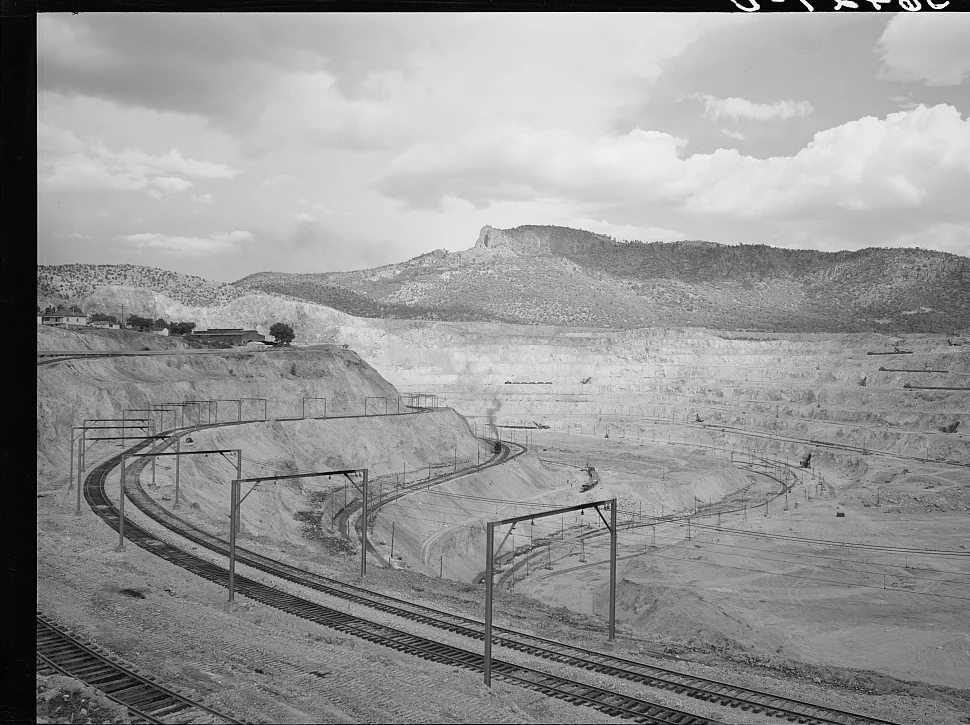
On 1 May 1914 the Deming Graphic predicted that the Kneeling Nun, standing amid the Chino Copper Company's richest copper holdings, "will soon be obliterated" by the digging. Kelley's Bureau tour places the mine in a northwest-trending fault block known locally as the Santa Rita Range or the Cobre (Copper) Mountains. Its ore lies around the 58-million-year-old Santa Rita granodiorite stock, a body of once-molten rock that cooled underground. Russell Lee photographed the pit for the Farm Security Administration in May 1940, and his caption card calls it the "Largest open pit copper mine in the world at Santa Rita, New Mexico."
Sources: Deming Graphic, May 1, 1914, p.8 (Chino Copper Co. improvements) (1914-05-01): p.8 (OCR, 'Kneel ing Nun'); Shari A. Kelley, New Mexico Bureau of Geology and Mineral Resources, Geologic Tour: Chino Mine (undated web page (cites 2008 work)): Regional Setting; Russell Lee, photographer, U.S. Farm Security Administration/Office of War Information, Largest open pit copper mine in the world at Santa Rita, New Mexico ... (1940): LOC caption card, LC-USF34-036427-D
A plaque at the Santa Rita shrine says the Kennecott Copper Corp. notified residents in 1960 that they had to vacate by 1970 because of mining expansion. The Center for Land Use Interpretation says the town was moved to make way for the mine, and that the Kneeling Nun looms above the open pit. Terry Humble wrote in 2002 that the town under the Kneeling Nun had disappeared. Its site, he wrote, was a pit a mile and a half across and 1,600 feet deep, then owned by Phelps Dodge. Kelley's tour gives the pit as about 1.75 miles across and 1,350 feet deep.
Sources: Kelli R. Lycke Martin, Xchanges v.15 n.1, The Shrine of Chino Mine: Extraction Rhetoric and Public Memory in Southern New Mexico (2020 (Spring)): p. 3, Figure 1 (plaque transcription); Center for Land Use Interpretation, Santa Rita Mine, New Mexico (Land Use Database) (undated): Land Use Database entry; Terry Humble (donated 3 April 2002; typed by C. W. Barnum), NM AHGP Grant County, Santa Rita History and Santa Rita Cemetery #3 (2002 (field observations dated 1998)): Santa Rita History, para. 7; Shari A. Kelley, New Mexico Bureau of Geology and Mineral Resources, Geologic Tour: Chino Mine (undated web page (cites 2008 work)): Introduction, para. 1
The overlook, the Santa Rita shrine and the byway vista
Visitors cannot enter the active Chino mine, New Mexico Magazine told readers in 2015, but they can pull into the Santa Rita Overlook viewing area off NM 152, which has interpretive signs. Kelley's tour places the overlook on the south side of NM 152 east of Hanover. From there, the tour says, Kneeling Nun Tuff forms the reddish-brown cliff on the skyline, while the Kneeling Nun at its base is "hard to see from this vantage point." A Freeport-McMoRan panel at the overlook, titled Reclaiming the Land, says the formation has been the source of many legends for generations. A 2015 National Geographic itinerary called the Phelps Dodge Santa Rita Copper Mine "an immense hole in the earth."
Sources: Andrew Collins, New Mexico Magazine, 25 Reasons to Love Silver City (2015-02-17 (updated 2025-05-08)): Section 6, 'King Copper'; Shari A. Kelley, New Mexico Bureau of Geology and Mineral Resources, Geologic Tour: Chino Mine (undated web page (cites 2008 work)): Introduction, para. 1; Figure 2 caption; Freeport-McMoRan Copper & Gold, Reclaiming the Land (marker, Santa Rita mine overlook) (photographed 2014-06-06): inscription, 'The Kneeling Nun'; National Geographic Travel, Mountain Spirits Scenic Byway road trip (2015-06-24): Route description
The Santa Rita Shrine stands at the intersection of NM 152 and NM 356, and its plaque says the former town lay one mile east. In 2018 the Silver City Daily Press reported on what became of the church when the town was abandoned in the 1960s. Its religious artifacts went to other area parishes, many to Central, or Santa Clara, and the statue of St. Rita was given to the people of Santa Rita with a small plot overlooking the mine. The plaque credits Angel Alvarado and Moy Gonzales with asking Kennecott for land so the statue could be brought back. Kelli R. Lycke Martin wrote in 2020 that the statue waited out the demolition in El Paso until the shrine was dedicated on 28 August 1967.
Sources: Kelli R. Lycke Martin, Xchanges v.15 n.1, The Shrine of Chino Mine: Extraction Rhetoric and Public Memory in Southern New Mexico (2020 (Spring)): p. 2-3, Figure 1 (plaque transcription); p. 1 'Just at the intersection of New Mexico highways 152 and 356'; p. 3, Figure 1 (plaque transcription); p. 9; Christine Steele, Silver City Daily Press, Vandals strike Santa Rita Shrine (2018-10-03): para. 6
Lycke Martin described the shrine as it stood before the vandalism of October 2018. Its statue stood in an adobe niche overlooking a memorial to Grant County veterans, and sixteen benches engraved with community members' names faced the pit. Willie Andazola, who was present during the strikes as a child and later joined the union, was one of the Santa Ritans who maintained the shrine, she wrote. In her account the view is one of the most beautiful in southern New Mexico, if one can forget that it is "the scar which marks where a whole town was torn from the Earth."
The Geronimo Trail Scenic Byway's corridor plan lists a Kneeling Nun Vista at mile marker 22.5, a view to the west in which the landmark rises in the middle of the mountains. The plan calls the formation a major landmark for Native American tribes, early explorers and settlers. Its driving guide suggests a brief stop to view the Kneeling Nun on the drive from Emory Pass to San Lorenzo.
Sources: Geronimo Trail Scenic Byway, Inc., Geronimo Trail National Scenic Byway Corridor Management Plan: Scenic and Historic Features (byway inventory) (undated): PDF p.5, 'Scenic Highlights & Natural Features'; America's Byways / Geronimo Trail Scenic Byway, Inc., Geronimo Trail Scenic Byway (byways.org 'print n go' guide) (undated): Itinerary section; Stop 5: 'Ten miles beyond the Kneeling Nun vista is the village of San Lorenzo.'
Fort Bayard and its national cemetery
Fort Bayard, the Army post Boyd remembered, turns up often in early accounts of the Kneeling Nun. In June 1910 a travel letter in the Santa Fe New Mexican described a morning carriage drive from Silver City toward the mount of the Kneeling Nun, to Fort Bayard nine miles away. On 26 October 1922 the Albuquerque Morning Journal announced a planned visit by Pershing to Fort Bayard, where he had served as a young cavalry lieutenant. The white house on the hill where he had lived, the Journal said, was pointed out to newcomers along with the Kneeling Nun and the Twin Sisters, natural formations in the mountains.6
Sources: Santa Fe New Mexican, June 10, 1910, p.7 (travel letter on Deming and Silver City) (1910-06-10): p.7 (OCR); Albuquerque Morning Journal, October 26, 1922, p.1 (Pershing visit to Fort Bayard) (1922-10-26): p.1 (OCR)
Fort Bayard National Cemetery began as the post cemetery. The Department of Veterans Affairs dates its first positively identified burial to Sergeant David H. Boyd, Company M, 3rd U.S. Cavalry, on 10 October 1866; one burial recorded as Unknown came before it. In 1973 the cemetery became part of the National Cemetery System, when its administration passed from the Department of the Army to the Veterans Administration. It was placed on the National Register of Historic Places on 7 July 2002, the VA says.
Among the soldiers buried there, the VA lists two Medal of Honor recipients. Sgt. Alonzo Bowman of Company D, 6th U.S. Cavalry, received it for actions at Cibicu Creek, Arizona Territory, on 30 August 1881. Sgt. John Schnitzer of the 4th Cavalry received it for Horseshoe Canyon in 1882. Among the most important civilians buried at Fort Bayard, the VA names Walter Foote Sellers, author of the poem it calls "The Kneeling Nun."
Read more on Salars.net
Part 2 of 9 of the series More places to visit around Silver City.
Sources
- Landslide block of tuff above the Chino Mine. Chino Mine, Regional Setting, paragraph beginning Figure 3. View source ↗ (documented)
- Bartlett (1851) noted that the peak above the Copper Mines had been given the name Ben Moore, and described a detached column of rock on the bluff - the formation later called the Kneeling Nun - without naming it or recording any legend. Personal Narrative of Explorations and Incidents in Texas, New Mexico, California, Sonora, and Chihuahua, vol. 1, vol. 1, p. 232. View source ↗ (documented)
- Seth Eastman's 1853 painting titled 'Bufa del Cobra [sic], Rocky Mountains' depicts the monolith now called the Kneeling Nun; Ackerly reproduced it on his report's cover. A History of the Kneeling Nun: Evidence from Documentary Sources, 'Early Historical Records: Negative Evidence'; RISD Museum object 47.112.3. View source ↗ (reported)
- Ackerly (1998) found no name for the monolith in documents before about 1867 and concluded the name 'Kneeling Nun' arose between 1865 and 1872. A History of the Kneeling Nun: Evidence from Documentary Sources, 'Summary', points 1 and 2a. View source ↗ (reported)
- Raymond's 1874 federal report called the monolith the 'Kneeling Virgin', likening it to a draped female figure before an altar. A History of the Kneeling Nun: Evidence from Documentary Sources, quoting Raymond 1874:337. View source ↗ (reported)
- Recalling her years at Fort Bayard in the early 1870s, Boyd wrote that the fallen rock on the Santa Rita ridge facing the post 'was called the kneeling nun' and already had a story attached to it. Cavalry Life in Tent and Field, Boyd, Cavalry Life in Tent and Field (1894), archive.org cavalrylifeinten00boyd, ch. XV, p. 217. View source ↗ (reported)
- The Silver City Enterprise reported on 26 June 1885 that about thirty feet of the Kneeling Nun had fallen. Eveleth and Osburn note the area was severely shaken by the 3 May 1887 Sonoran earthquake but state that no damage to the Kneeling Nun was noted. The Kneeling Nun, Santa Rita, New Mexico, 'A look into the future', quoting Silver City Enterprise, June 26, 1885 (pp. 56-57). View source ↗ (reported)
- An unnamed narrator in a 1937 WPA write-up recalled passing through the Santa Rita copper country in 1849, finding no Mexicans there because Apaches had driven them out, and that the Kneeling Nun then stood as high as the main cliff. [Grant Co. in 1849], loc.gov/item/wpalh001323, image 2 (typed p. 2). View source ↗ (reported)
- In 1912 the Silver City Enterprise, reprinting the 1873 poem, said the verse was based on 'the legend which has been handed down by the conquistadores'; Ackerly quotes this without directly assessing it, but his summary concludes that no Kneeling Nun legend has a documented historical basis and that the monolith was unnamed through about 1867. A History of the Kneeling Nun: Evidence from Documentary Sources, quoting Silver City Enterprise, 23 Aug. 1912. View source ↗ (reported)
- Legend (unsupported by documents) says an Apache told Carrasco that a peculiar rock formation marked the mine, and that Carrasco named the monolith the Kneeling Nun; Ackerly found no documentary evidence for either. A History of the Kneeling Nun: Evidence from Documentary Sources, 'Early Historical Records: Negative Evidence'. View source ↗ (reported)
- Earliest printed telling found: an editor's note to John Wood's poem in the Silver City paper Mining Life, 20 September 1873, calls the rock 'Santa Rita' and says a convent nun condemned to death had her soul banished into it. A History of the Kneeling Nun: Evidence from Documentary Sources, 'Late Nineteenth Century Descriptions', editor's note to J.W. (John Wood) poem 'Santa Rita', Mining Life 20 Sept. 1873 (as reprinted SCE 23 Aug. 1912). View source ↗ (reported)
- Frank Camblos's 1881 verse 'Legend of the Kneeling Nun' (Grant County Herald, 28 May 1881) sets the tale in the time of Cortés: a Carmelite Sister Rita from Valencia, imprisoned for breaking her vow, is turned to stone after an earthquake destroys the mission. A History of the Kneeling Nun: Evidence from Documentary Sources, 'Summary', point 3b; Appendix B (originally New Southwest and Grant County Herald, 28 May 1881; reprinted SCE 30 July 1909). View source ↗ (reported)
- Harry Burgess's 1899 poem 'The Kneeling Nun' sets the story 'in the days of Spain's great glory': Sister Rita and a young monk break their vows; she prays to be made rock and the monk falls to his death. A History of the Kneeling Nun: Evidence from Documentary Sources, 'Summary', point 3c; poem extract 'In the days of Spain's great glory' in 'Early Twentieth Century' section. View source ↗ (reported)
- Walter Sellers's poem 'The Legend of the Kneeling Nun' (1909; reprinted 1911, 1922, 1929) introduced Sister Teresa, a mission teacher who nursed and loved 'Diego the Soldier', was expelled, and was turned to rock before an altar that grew into a mountain overnight. A History of the Kneeling Nun: Evidence from Documentary Sources, 'Summary', point 3d (labelled 'Walter Sellers-1929'); text: published 1909, reprinted SCE 3 Feb. 1911, Mountain Breeze 11 Aug. 1922, New Mexico Magazine 1929; Appendix E. View source ↗ (reported)
- WPA collector Mildred Jordan (1936) recorded a Coronado-era version: monks and nuns built a monastery at Santa Rita, Sister Rita nursed a wounded Coronado soldier, was condemned, prayed to become stone, and an earthquake left only her figure; the town was 'supposed to have been named' from it. A History of the Kneeling Nun: Evidence from Documentary Sources, quoting Jordan 1936:1 (WPA Writer's Project), 'Alternate Forms of the Kneeling Nun Legend'. View source ↗ (reported)
- A play, 'The Kneeling Nun: A Vindication', written by Mrs. John Cowman in 1940 for the Coronado Exposition, was removed from consideration as 'historically incorrect' in the words of the Exposition's Assistant Supervisor. A History of the Kneeling Nun: Evidence from Documentary Sources, 'Alternate Forms of the Kneeling Nun Legend'. View source ↗ (reported)
- Ricardo Muñoz's 1984 version makes Teresa a Santa Rita wife who prays to stop her husband and sons from a revenge killing and is turned to stone during a flood - a plot close to the life of St. Rita of Cascia. A History of the Kneeling Nun: Evidence from Documentary Sources, quoting Muñoz 1984:1-2. View source ↗ (reported)
"Documented" means the source is a record of the time or a direct survey; "reported" means a later account or secondary history, attributed in the text.
Cite this page: “The Kneeling Nun and the Santa Rita pit.” Grant County Atlas, Salars.net, first published 19 November 2026. https://atlas.salars.net/stories/area-attractions/the-kneeling-nun-and-the-santa-rita-pit
Discussion
What would you add or question? Comments are reviewed before they appear.
Loading comments…