The 1976 National Register nomination credits an 1880 fire ordinance with preserving the architecture of Silver City's old downtown, now one of four districts under the town's historic overlay. Silver City MainStreet, dated to 1985 by its own profile and to 1986 by the town, coordinated the Silco Theater's renovation, the town says.
One brick house on original Main Street, 1885 and 1895
The red brick O. S. Warren house in Silver City was completed in 1885 and overlooks the Big Ditch. In the account of the 1976 nomination of the Silver City Historic District, it is the only structure on original Main Street to survive the flood of 1895. Its authors, Sylvia Cook of the State Planning Office and John O. Baxter of the State Records Center and Archives, drew the district around about twenty-three acres. It takes in what they called the earliest Anglo residential area and the part of the business section that withstood the 1895 flood.
After that flood, the nomination says, Elizabeth Warren took the contract to shore up the sides of the Big Ditch, a project the WPA finished in the 1930s. Warren started a contracting business, the nomination says, and it laid most of the concrete sidewalks in Silver City.
A fire ordinance of 1880 and a National Register listing in 1978
Cook and Baxter credited a town law of 1880 with preserving the district's architecture. That fire ordinance required any building in the downtown area to be built of stone, brick, iron or concrete, with a roof covered with slate, tile or metal.
Silver City's downtown went on the New Mexico State Register of Cultural Properties on 31 July 1970. Cook and Baxter dated their National Register nomination 17 January 1976, and the district was entered on 23 May 1978. They wrote as businesses were moving to the edge of town. Their stated hope was that the district would "rejuvenate interest in the original business and residential section" and prevent further deterioration.
Downtown buildings in the 1976 nomination
Sheridan Row sits at the northeast corner of Texas and Yankie streets. The nomination describes it as a plastered, brick-faced adobe dating from about 1880, and says it originally housed both homes and businesses of Silver City's Chinese community. At Arizona and Broadway, local businessman George Bell put up the Bell Block in two phases, in 1897 and 1906. Shops filled its ground floor, and a large ballroom took up the second floor.
In 1917 the American National Bank built a Classical Revival building fronted by a high pedimented portico. When the nomination was written, Silver City's municipal offices occupied it. At the north end of Broadway stands the Grant County Courthouse, built in 1930 from plans by Albuquerque architect George M. Williamson and W. Miles Brittelle. Its lobby murals of southwest New Mexico scenes are by Santa Fe painter Theodore Van Soelen, part of a 1930s WPA artists' program.
Among the district's churches, the nomination describes St. Vincent de Paul Roman Catholic Church, an adobe building dating from 1874. In 1907 twin towers replaced its original central tower. The cornerstone of the red brick Episcopal Church of the Good Shepherd was laid on 10 July 1892. Two more churches carry dates in the nomination: the Presbyterian Church of 1886 and the Sixth Street Baptist Church of 1900.
The North Addition and Chihuahua Hill, listed in 1983 and 1984
Susan M. Berry, assistant curator at the Silver City Museum, wrote the nomination for the Silver City North Addition Historic District, dated 10 August 1981. It covers about 36 acres north of College Avenue, roughly bounded by the Big Ditch, College Avenue, and Chloride and 13th streets. Its significant dates run from 1882 to 1914, and the district was listed on 17 February 1983.
Two North Addition blocks were originally the town cemetery, Berry wrote. Its first burial, of town founder Capt. John Bullard, took place in 1871. An 1876 territorial law banned cemeteries inside towns. In 1881 John A. Miller agreed with the town council to remove the bodies at his own expense, in return for the land. The exhumations, in her account, apparently took place after that agreement.
Drusilla Claridge, assistant surveyor at the Silver City Museum, wrote the Chihuahua Hill Historic District nomination, dated 14 September 1982; the district was listed on 23 January 1984. Chihuahua Hill, she wrote, appeared on the earliest surveys of Silver City as "South Addition." On the hill the houses came first. Texas, Sonora, Bremen and Bullard streets are all blocked by houses that stood there before the streets. A chapel known as La Capilla stood at the summit of the hill until 1915. Claridge described it as a prominent landmark and gathering place for the neighborhood for many years.
A boundary increase in 2013 and the town's overlay of four districts
The downtown district grew on 25 September 2013, when the National Register published a boundary increase to the Silver City Historic District. The National Park Service's record describes the added area as roughly bounded by College Avenue, the Big Ditch, San Vicente and Black. It lists the area's significant years as 1916, 1917 and 1927.
Silver City protects four districts through its Historic Overlay Zoning District, as they are registered with the state Historic Preservation Division. A 2024 town page names them as the Silver City Historic District, the Black's Addition Historic District, the Chihuahua Hill Historic District and the North Addition Historic District. Preserving the surviving historic character of those four districts is one of the purposes the page gives for the overlay.
MainStreet, the Silco Theater and the arts district, 1985 to 2024
Two sources give different starting years for Silver City MainStreet. Its nonprofit profile on ShareNM says it has been revitalizing the economy of the downtown district since 1985. The Town of Silver City says the Silver City MainStreet Project was established in 1986 to promote downtown revitalization and historic preservation.
Sources: ShareNM / Silver City MainStreet, Silver City MainStreet Project (ShareNM nonprofit profile) (accessed 2026-11-19): Organization profile; Silver City MainStreet (Town of Silver City) (2022-12-04 (archived)): Silver City MainStreet page
A town case study follows one MainStreet project, the Silco Theater at 311 North Bullard Street. The theater was built in 1923, the town says, and had more recently been redesigned and used as retail space. It closed for renovation in January 2014. MainStreet coordinated the work to return the theater to its look after a 1940 renovation, and its ShareNM profile counts the restored Silco among its work.
Sources: Town of Silver City, Case Study: Silco Theater Renovation Project (2023-09-26 (archived)): Case study page; ShareNM / Silver City MainStreet, Silver City MainStreet Project (ShareNM nonprofit profile) (accessed 2026-11-19): Organization profile
That profile also calls MainStreet a collaborating organization in the state-designated Silver City Arts & Cultural District. On its MainStreet page the town lists what the historic downtown offers visitors: art galleries and antique stores, entertainment, historic lodging, restaurants and coffeehouses, and retail and gift shops.
Sources: ShareNM / Silver City MainStreet, Silver City MainStreet Project (ShareNM nonprofit profile) (accessed 2026-11-19): Organization profile; Silver City MainStreet (Town of Silver City) (2022-12-04 (archived)): Features
The town's page on the Arts and Cultural District Cultural Plan, a plan the town endorses, describes a change in who lives in town. Silver City changed as extractive industries declined, the page says. One of the most noticeable changes has been the growing number of residents whose lives and pursuits place them among "creative field professionals."
Silver City in postcards and photographs, 1936 to 2017
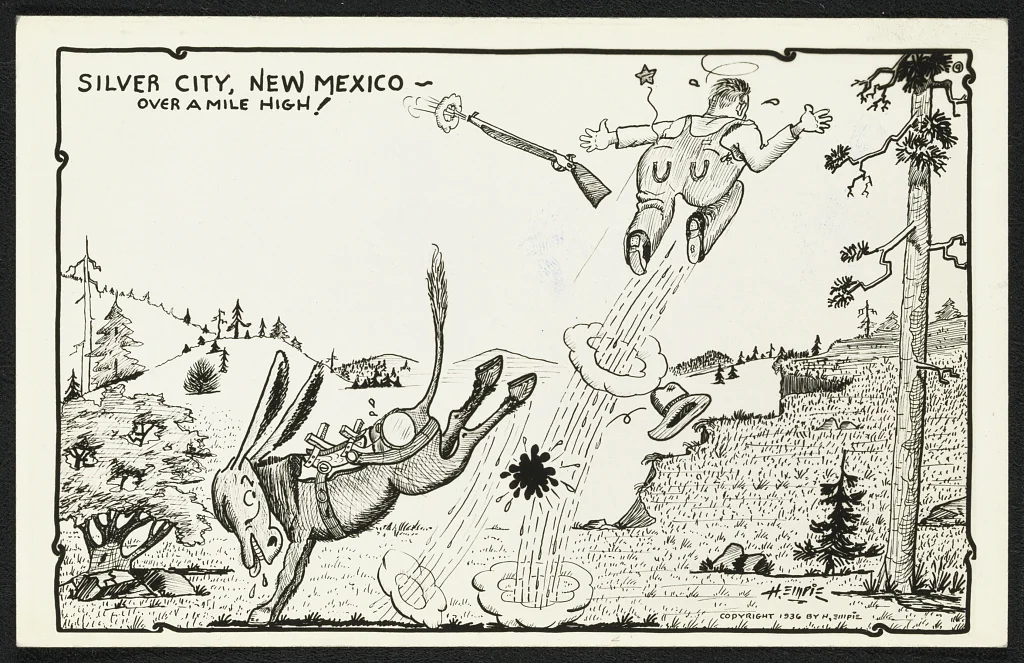
In 1936 H. Empie copyrighted a postcard titled Silver City, New Mexico, Over a mile high! The Library of Congress catalogs it under the subject of donkeys. In May 1940 Russell Lee, photographing for the Farm Security Administration, made a picture captioned Entrance to Silver City Fire Department. Its caption does not name the building.
Sources: H. Empie (copyright claimant), Silver City, New Mexico, Over a mile high! (1936): LOC record 2025670343; Russell Lee (FSA/OWI), Entrance to Silver City Fire Department. Silver City, New Mexico (1940-05): LOC record 2017786661
In 1991 the photographer John Margolies photographed two Silver City buildings. One picture shows the Gila Theater on Bullard Street. Another, captioned as a diagonal view on Copper Street, shows the Grant County Courthouse of 1930. A photograph taken on 3 April 2009 by AllenS shows Silver City's City Hall, which the photographer's caption places at 101 West Broadway. On 13 March 2017 Jon Roanhaus photographed the North Addition district in the 900 block of West Street, according to the photograph's caption.
Sources: John Margolies, Gila Theater, Bullard Street, Silver City, New Mexico; Grant County Courthouse, diagonal, Silver City (1991): LOC record 2017703143; John Margolies, Gila Theater, Bullard Street, Silver City, New Mexico; Grant County Courthouse, diagonal, Silver City (1991): LOC record 2017706039; AllenS, Silver City New Mexico City Hall.jpg (2009-04-03): Commons file description; Jon Roanhaus, Silver City North Addition HD NRHP 83001620 Grant County, NM.jpg (2017-03-13): Commons file description
The Pinos Altos Opera House, built in 1969
Pinos Altos has a National Register district of its own. Its nomination was written in 1982 by Susan Berry of the Silver City Museum, and the district was listed on 21 May 1984 according to the National Park Service's catalog. Berry wrote that the Pinos Altos Opera House was built in 1969 in the style of a Victorian frontier theater, using materials from old buildings.
The building's sign, Berry wrote, had confused more than one visitor. It reads "Est. the late '60's." The New Mexico Bureau of Mines was among those misled. In a 1980 travel guide, the Bureau included a photograph of the opera house describing it as built in the late 1860s.
Read more on Salars.net
Part 6 of 9 of the series More places to visit around Silver City.
Cite this page: “Historic districts and Main Street.” Grant County Atlas, Salars.net, first published 19 November 2026. https://atlas.salars.net/stories/area-attractions/historic-districts-and-main-street
Discussion
What would you add or question? Comments are reviewed before they appear.
Loading comments…