A bronze plaque about three miles beyond Pinos Altos on NM 15 overlooks the canyon where, the Forest Service says, Ben Lilly's cabin stood; it honors a hunter who, from 1911, killed lions and bears in New Mexico and Arizona for stockmen and the Biological Survey. Sources disagree on when the plaque went up and on where Lilly died on 17 December 1936.
A bronze plaque above Bear Canyon on NM 15
About three miles beyond Pinos Altos on NM Highway 15, the Gila National Forest keeps an observation point that looks over Bear Canyon and the Pinos Altos Range. The site memorializes Ben Lilly, whose cabin stood in the canyon below. Parking lies on the east side of the highway and the overlook on the west, reached by a short footpath. The Silver City Ranger District manages it, and the Forest Service gives its elevation as 6,750 feet. It is a day-use site with no overnight use, no restrooms and no potable water. Its page calls Lilly a notorious big game hunter, houndsman and mountain man. It repeats a story that he was the scourge of lions and bears, "even killing one rogue black bear with his Bowie knife."
Valerie Norton, a hiker who went on 30 May 2019, found a sign post at a hairpin turn. A path with concrete water bars led her up a small concrete stairway to a small bronze memorial, she wrote. Beside it the view looks down Cherry Creek, in her account, where the Forest Service names Bear Canyon. Leslie Patten, a writer who visited in 2025, described the plaque set against a large boulder at the overlook, with a lion and a bear on either side of Lilly's likeness.
Sources: Valerie Norton, Ben Lilly memorial (hiking blog post) (2019-05-30 (written 2019-06-13)): Blog post body, middle; Blog post body, near end; Leslie Patten, The Infamous Ben Lily (2025-03-03): Photo caption; USDA Forest Service, Gila National Forest, Ben Lilly Memorial (recreation site page) (last updated 2025-04-04): Site description paragraph
Accounts of who put the plaque up agree, but its date is given two ways. The Boone and Crockett Club writes that Lilly's friends erected a bronze plaque in the Gila National Forest, a portrait of him with a lion on one side and a bear on the other. Duncan Dobie, writing for Sporting Classics Daily in 2019, dates it to 1947 and says his friends erected it on Bear Creek, in Pinos Altos. The Forest Service places the memorial about three miles beyond Pinos Altos, overlooking Bear Canyon. Patten says instead that friends who knew him put it up in the 1930s.
Sources: PJ DelHomme, Boone and Crockett Club, Adventures from the Archives - Ben Lilly's Black Bear (accessed 2026-11-19): Section 'From Swamps to the Southwest'; Duncan Dobie, Sporting Classics Daily, The Last Days of Ben Lilly (2019-09-23): Final paragraph; Leslie Patten, The Infamous Ben Lily (2025-03-03): Post body; USDA Forest Service, Gila National Forest, Ben Lilly Memorial (recreation site page) (last updated 2025-04-04): Site description paragraph; Getting There, Directions
Another Forest Service site carries his name. Ben Lilly Pond is a man-made pond with an earthen berm and a primitive concrete spillway, about 12 miles north of Silver City and west of NM 15. In September 2020 the Forest Service proposed fencing it and controlling parking, to protect it from livestock and wildlife, public use and vehicles. The project page now lists that plan as cancelled. In 2025 Patten walked to what locals call Ben Lilly Pond, by a turn-off from Highway 15 before the memorial, and found it completely dry.
Sources: USDA Forest Service, Gila National Forest, Ben Lilly Pond Enhancement and Watershed Stabilization Project (last updated 2022-09-14); Leslie Patten, The Infamous Ben Lily (2025-03-03): Post body
From Alabama to the Louisiana canebrakes, 1856-1906
Kelby Ouchley's 64 Parishes encyclopedia entry says Benjamin Vernon Lilly, one of seven children, was born in Wilcox County, Alabama, in the winter of 1856. His father, Albert, a blacksmith, soon moved the family to Kemper County, Mississippi. J. Frank Dobie, writing in Arizona Highways in September 1943, gave the same state and year and wrote that Lilly came to maturity in Louisiana. His uncle Vernon Lilly, a Morehouse Parish planter, found him working as a blacksmith in Memphis and offered him a job and eventually his estate.
Sources: Kelby Ouchley, Louisiana Endowment for the Humanities, Ben Lilly (64 Parishes encyclopedia entry) (2013-07-23 (updated 2016-04-18)): Section 'Early Life', para. 1; J. Frank Dobie, 'Ben Lilly of the Mountains', Arizona Highways, September 1943 (1943-09): Opening sentence
Lilly married in 1880 and again in 1891, and the second marriage produced three children; the family lived on the outskirts of Mer Rouge. In 1901 he signed his property over to his wife and children and left to live as a hunter of large predators. In 1904 the U.S. Bureau of Biological Survey hired him to collect mammals and birds for the national museum. From Louisiana he shipped it a cougar, five black bears, seven red wolves and two ivory-billed woodpeckers. In 1906 he left for the Big Thicket of east Texas, where his bear killing drew a president's notice.
Roosevelt's bear hunt on Tensas Bayou, October 1907
Theodore Roosevelt told the hunt himself in the 1908 new edition of Outdoor Pastimes of an American Hunter. He wrote that he spent a fortnight in October 1907 in the canebrakes of northern Louisiana, with his first camp on Tensas Bayou. The morning after they reached camp, he wrote, the hunter Ben Lilley joined them, having come on foot through the woods with his two dogs. Roosevelt described him as "a spare, full-bearded man, with wild, gentle, blue eyes" who had killed over 120 bears. Lilly, then over fifty, never hunted or worked on Sunday, Roosevelt added.
In Roosevelt's account the hunt's success was owed to two planters from Mississippi, Clive and Harley Metcalf, and their pack under Holt Collier. Roosevelt shot his bear, a she-bear of 202 pounds, while waiting with Clive Metcalf. Ouchley tells the kill another way. His entry says that on Lilly's advice the party moved to Bear Lake in Madison Parish, where Roosevelt killed his bear with Lilly as coach.
Sources: Theodore Roosevelt, Outdoor Pastimes of an American Hunter (new edition), chapter 'In the Louisiana Canebrakes' (1908): pp. 366 and 377-378 ('This was a big she-bear, very lean, and weighing two hundred and two pounds.'); Kelby Ouchley, Louisiana Endowment for the Humanities, Ben Lilly (64 Parishes encyclopedia entry) (2013-07-23 (updated 2016-04-18)): Section 'The Hunter', para. 3
The day Lilly reached the camp is also given two ways. In a letter headed Camp on Tensas Bayou, 6 October 1907, Roosevelt told his daughter Ethel that Ben Lily had just joined them. "He literally lives in the woods," Roosevelt wrote. Ouchley writes that Roosevelt summoned Lilly from Texas by telegram as chief guide. In his account Lilly arrived at the camp on the Tensas River in East Carroll Parish on 5 October 1907.
Sources: Theodore Roosevelt's Letters to His Children (ed. J. B. Bishop) (1919): Letter 'Camp on Tenesas Bayou, Oct. 6, 1907', p. 209; Kelby Ouchley, Louisiana Endowment for the Humanities, Ben Lilly (64 Parishes encyclopedia entry) (2013-07-23 (updated 2016-04-18)): Section 'The Hunter', para. 3
Into Mexico, New Mexico and Arizona, 1908-1913
Lilly went into Mexico in 1908, J. Frank Dobie wrote, and for three years hunted bears there and supplied venison and bear grease to mining camps. In 1911, aged fifty-five, he crossed into New Mexico and began, Dobie wrote, the western career that made him famous. Vernon Bailey of the Biological Survey wrote in his 1931 Mammals of New Mexico that on 10 March 1911 Lilly started a grizzly in the Animas Mountains of southwestern New Mexico. Lilly followed that bear south through the San Luis Mountains into Chihuahua, across into Sonora and back into Chihuahua before killing it, Bailey wrote. Its skull, collected by Lilly, was the only specimen Bailey could use for the grizzlies of that corner of New Mexico.
Sources: J. Frank Dobie, 'Ben Lilly of the Mountains', Arizona Highways, September 1943 (1943-09): Opening paragraph; Vernon Bailey, U.S. Bureau of Biological Survey, Mammals of New Mexico (North American Fauna No. 53) (1931): p. 361 (Ursus nelsoni account)
In 1912, Dobie wrote, Lilly moved to Clifton, Arizona, with five hounds and five burros. He took a job in the Apache National Forest as guard-trapper at $75 a month. Stockmen organized to pay him bounties, Dobie wrote, and he estimated that along the Arizona-New Mexico line Lilly averaged perhaps fifty lions and bears a year, at up to fifty dollars a scalp. Bears were protected by law as game, Dobie wrote, but to Lilly every bear looked like a proven stock-killer. God, Lilly believed, had created him to kill the killers.
By his own account, which Dobie printed, Lilly trailed a wounded grizzly for three days in deep snow in the White Mountains of Arizona. He killed it at close range on 3 April 1913. C. Hart Merriam's 1918 review of the grizzly and big brown bears describes Ursus apache, the Apache grizzly, from a type specimen, the animal the name rests on, in the U.S. National Museum's Biological Survey collection. B. V. Lilly collected that specimen, No. 212436, on 3 April 1913 at Whorton Creek, a few miles west of Blue, Arizona. That is the same date and area as the kill Lilly described.
Sources: J. Frank Dobie, 'Ben Lilly of the Mountains', Arizona Highways, September 1943 (1943-09): Paragraph before Lilly's quoted narrative; C. Hart Merriam, U.S. Bureau of Biological Survey, Review of the grizzly and big brown bears of North America (North American Fauna No. 41) (1918): p. 84, Ursus apache account
A government hunter, 1916-1921
Sources differ on how steadily Lilly worked for the Biological Survey after 1916. J. Frank Dobie wrote that in 1916 he began working for it on and off, for about four years, mixing those spells with bounty hunting. The Survey paid him $100 a month, Dobie wrote, above regular trappers' pay. Duncan Dobie's 2019 article for Sporting Classics Daily says instead that the Survey employed Lilly full-time from 1916 to 1920.
Sources: J. Frank Dobie, 'Ben Lilly of the Mountains', Arizona Highways, September 1943 (1943-09): Fifth paragraph; Duncan Dobie, Sporting Classics Daily, The Last Days of Ben Lilly (2019-09-23): Biographical section
J. Frank Dobie told, on the word of Ed Steele, how Lilly came to resign. Washington answered one of his reports by telling him to quit cold-trailing and hunt hot trails, and Lilly resigned. By 1918, Dobie wrote, Lilly was hunting far to the east in the Black Range overlooking the Rio Grande. He also hunted the Sangre de Cristo range above Santa Fe and above Taos, into Colorado.
Newspapers in Washington and Albuquerque wrote about his work in 1919. In June the Washington Evening Star described him as a Survey professional hunter, sixty-five years old, who had collected specimens after guiding Roosevelt. In July the Albuquerque Morning Journal reprinted an item from the Boston Post. The Post called Lilly, at 65, the leader of the government's 300 hunters and trappers. In the last six years, it said, he had killed 167 mountain lions and 65 bears.
Sources: Evening Star (Washington, D.C.), Sunday magazine p. 72, item on Benjamin V. Lilly (1919-06-01): Sunday magazine item on 'Benjamin V. Lilly, champion lion hunter' (OCR); 'Old Man Ben Lilly' (reprinted from the Boston Post), Albuquerque Morning Journal, p. 7 (1919-07-28): Editorial page item 'Old Man Ben Lilly' (OCR)
In October 1919 the Morning Journal reported Lilly arriving for a Survey hunt on lions and bears in the Sangre de Cristo range, a veteran "whose headquarters now are in Silver City." In November it reported that J. S. Ligon of the Biological Survey directed the hunt, in Colfax and Mora counties. Lilly, F. M. Greear and T. J. McMullin and their dogs were assisting. In July 1920 the paper reported what it called the Survey's most thoroughly organized hunt yet, in the Black Range, with six hunters and more than thirty hounds. Lilly was struck on the shoulder in Black Canyon, it said, when he stabbed a dying bear to save his dogs.
Sources: 'Famous lion hunter arrives to assist in killing big game', Albuquerque Morning Journal, p. 1 (1919-10-15): Front page, 'Famous lion hunter arrives' (OCR); 'Predatory animal war being carried on with vigor in two counties', Albuquerque Morning Journal, p. 5 (1919-11-05): p. 5, 'Predatory animal war' (OCR); 'Four mountain lions and nine bear killed by Biological Survey expedition in Black Range', Albuquerque Morning Journal, p. 8 (1920-07-05): p. 8 (OCR)
A Spanish-language paper in Santa Fe, El Nuevo Mexicano, reported in June 1921 on the state hunting party and its dogs. In that report the state game warden, Mr. Gable, cited Ben Lilly of Silver City as a hunter who ran only one dog at a time, chained to his waist, and followed the bear that way.
The G O S Ranch and the death of 17 December 1936
From 1920, the Boone and Crockett Club writes, the nearest thing Lilly had to a home was the GOS Ranch just northeast of Silver City. He hunted along the Gila River so often that Lilly Park, between the West and Middle Forks, bears his name, the club says. J. Frank Dobie wrote that Victor Culberson kept Lilly on the G O S Ranch to hunt predators and to add to the ranch's picturesqueness.
Sources: PJ DelHomme, Boone and Crockett Club, Adventures from the Archives - Ben Lilly's Black Bear (accessed 2026-11-19): Section after the grizzly story; J. Frank Dobie, 'Ben Lilly of the Mountains', Arizona Highways, September 1943 (1943-09): Later section on his talk
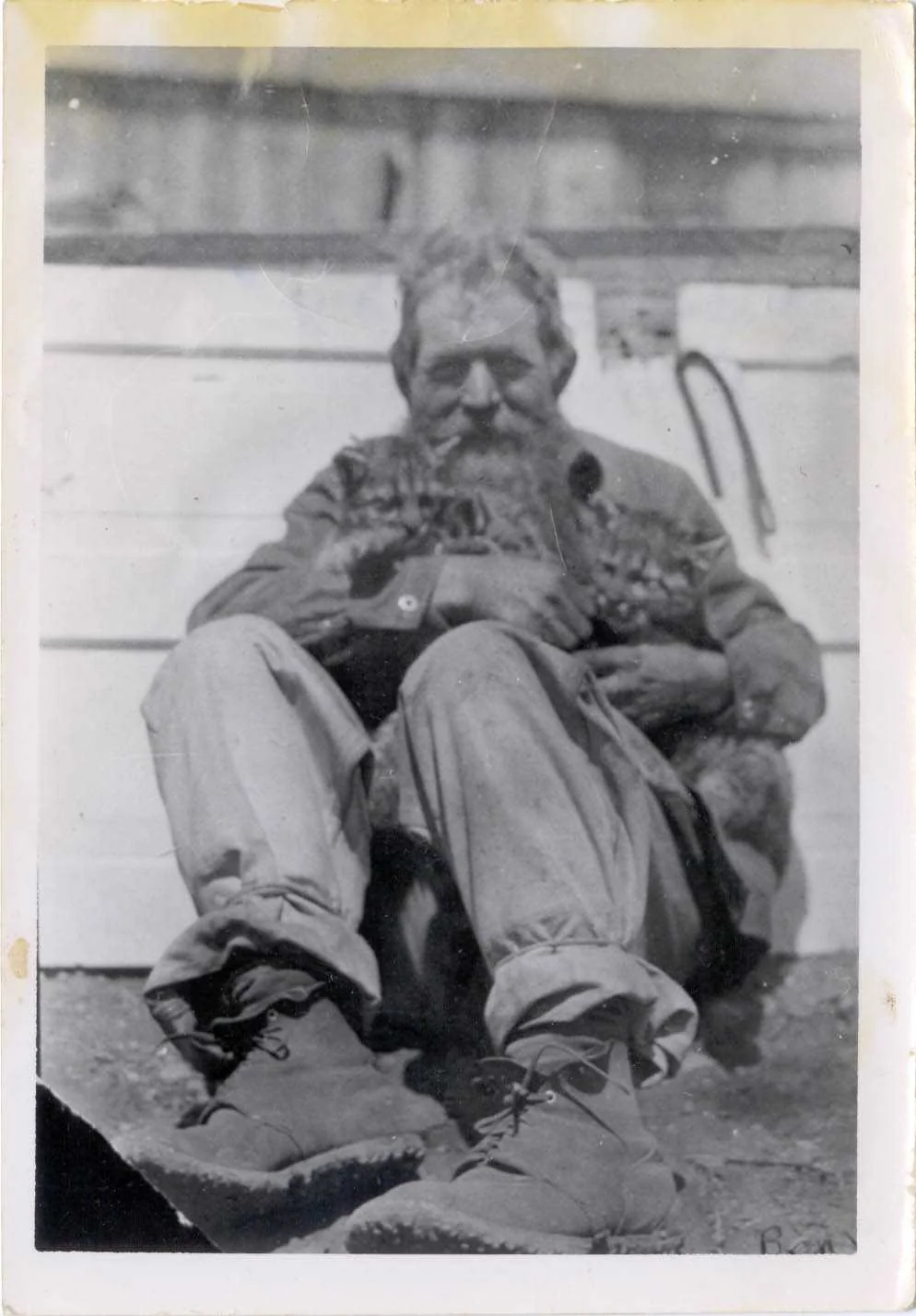
A photograph shared by the Gila National Forest shows the aged Lilly holding two young mountain lions; J. Frank Dobie wrote that Lilly raised young lions to study their habits. In December 1934 the Washington Evening Star ran an article by Gene Day introducing Lilly, about 80, who was "spending his sunset years on the G. O. S. Ranch." Day gave Lilly's official record as 600 mountain lion scalps. Day said he had pieced the story together from friends. Counts of what Lilly killed vary with the source. Aaron Robert Woodard, writing for HistoryNet in 2023, says Lilly reported 55 mountain lions and a dozen bears in federal service. Some sources, Woodard adds, estimate he killed as many as 1,000 lions in his lifetime.
Sources: J. Frank Dobie, 'Ben Lilly of the Mountains', Arizona Highways, September 1943 (1943-09): Later section on his habits; Gila National Forest (Flickr account), uploaded to Wikimedia Commons by AlbertHerring, Ben Lilly (8725962615).jpg (Flickr upload 2013-05-10): Commons file page; Author: Gila National Forest; Source: Flickr 8725962615; Gene Day / Evening Star, 'Old chap has killed 600 lions' by Gene Day, Evening Star (Washington, D.C.), Sunday p. 91 (1934-12-09): Gene Day article, opening paragraph; Gene Day article, middle; Aaron Robert Woodard, HistoryNet (first in Wild West magazine), He May Have Been the Greatest Big-Game Hunter You've Never Heard Of (2023-05-26): Article body
Frank C. Hibben recalled in Outdoor Life in May 1948 that he found Lilly, then about eighty, at a ranch near Silver City and went on one last hunt with him. Two years later, Hibben wrote, Lilly died in "the poorhouse on Silver Creek." Other sources give the place differently. The 64 Parishes entry says he died at a ranch in Grant County on 17 December 1936, near the age of eighty. Duncan Dobie also puts his death that day on a ranch near Silver City.
Sources: Frank C. Hibben, 'Last of the Mountain Men' (Outdoor Life, May 1948), reprinted online as 'Hunting Cougars with Ben Lilly, the Last of the Mountain Men' (1948-05 (online 2023-03-13)): Opening section; Section 'His Last Hunt'; Kelby Ouchley, Louisiana Endowment for the Humanities, Ben Lilly (64 Parishes encyclopedia entry) (2013-07-23 (updated 2016-04-18)): Section 'The Legend', final para; Duncan Dobie, Sporting Classics Daily, The Last Days of Ben Lilly (2019-09-23): Final paragraph
Woodard writes that when Lilly needed full-time care he was sent to a county farm. He died of natural causes on 17 December 1936 near Silver City, in Woodard's account. A Legends of America tourism page says he spent his final days on a county farm on Big Dry Creek near Pleasanton and died there that day. The Boone and Crockett Club repeats a report that two hours before his death Lilly said he would be better off.
Sources: Aaron Robert Woodard, HistoryNet (first in Wild West magazine), He May Have Been the Greatest Big-Game Hunter You've Never Heard Of (2023-05-26): Final section; Legends of America, Ben Lilly: Bears, Blades & Contradictions (accessed 2026-11-19): Article body, near end; PJ DelHomme, Boone and Crockett Club, Adventures from the Archives - Ben Lilly's Black Bear (accessed 2026-11-19): Section after the grizzly story
Woodard and Duncan Dobie both say Lilly is buried in Memory Lane Cemetery in Silver City. Duncan Dobie gives the tombstone's inscription as Lover of the Great Outdoors. Ouchley gives the epitaph, in what his entry calls the Silver City Cemetery, as "Ben Lilly—Lover of the Great Outdoors." By modern standards, Ouchley wrote in 2013, the inscription contradicts a life of relentless pursuit of apex predators, though it suited the times he lived in.
Sources: Aaron Robert Woodard, HistoryNet (first in Wild West magazine), He May Have Been the Greatest Big-Game Hunter You've Never Heard Of (2023-05-26): Final section; Duncan Dobie, Sporting Classics Daily, The Last Days of Ben Lilly (2019-09-23): Final paragraph; Kelby Ouchley, Louisiana Endowment for the Humanities, Ben Lilly (64 Parishes encyclopedia entry) (2013-07-23 (updated 2016-04-18)): Section 'The Legend', final para
Monuments and later judgments, 1950-2025
The Washington Evening Star counted J. Frank Dobie's book The Ben Lilly Legend, published in 1950, among that year's Americana. Ouchley's entry lists monuments to Lilly in Mer Rouge, Louisiana, and in New Mexico's Gila National Forest, and a Ben Lilly Conservation Area established in Morehouse Parish in 2013. Duncan Dobie repeats the claim that Lilly is credited with killing the last wild grizzly in the Gila Wilderness. The Gila National Forest's 2024 land management plan names Ben Lilly among the figures in the forest's story, with Mangas Coloradas, Geronimo and Aldo Leopold.1
Sources: Evening Star (Washington, D.C.), Dec. 10, 1950, p. 131, year's Americana books review (1950-12-10): Year-end books review (OCR); Kelby Ouchley, Louisiana Endowment for the Humanities, Ben Lilly (64 Parishes encyclopedia entry) (2013-07-23 (updated 2016-04-18)): Section 'The Legend', final paragraph; Duncan Dobie, Sporting Classics Daily, The Last Days of Ben Lilly (2019-09-23): Biographical section
Later writers have weighed the killing itself. Patten, who writes about mountain lions, calls Lilly "one of the most destructive figures in North American wildlife history." In her 2025 account he contributed to the end of the grizzly and the steep reduction of mountain lions and black bears in the Southwest. Some people still revere him as the ultimate hunter, she says. Woodard writes that Lilly never gave up killing large predators. He calls him "for better or worse, a man of his time."
Sources: Leslie Patten, The Infamous Ben Lily (2025-03-03): Post body; Aaron Robert Woodard, HistoryNet (first in Wild West magazine), He May Have Been the Greatest Big-Game Hunter You've Never Heard Of (2023-05-26): Article body
The Boone and Crockett Club writes that "Times have changed since the days of Ben Lilly" and the all-out war on predators. The Louisiana black bear, the subspecies credited to Lilly in the club's records, was listed as threatened in 1992. It was later removed from the list after it recovered.
Read more on Salars.net
Part 7 of 9 of the series More places to visit around Silver City.
Sources
- The plan names the Mogollon and Apache peoples, Spaniards, Mexicans, ranchers, prospectors and miners, and figures such as Mangas Coloradas, Geronimo, Aldo Leopold and Ben Lilly in the forest's story. Gila National Forest Land Management Plan (MB-R3-06-18), fs.usda.gov Gila NF Land Management Plan (July 2024), p. 13 (pdf p. 21). View source ↗ (documented)
"Documented" means the source is a record of the time or a direct survey; "reported" means a later account or secondary history, attributed in the text.
Cite this page: “The Ben Lilly monument.” Grant County Atlas, Salars.net, first published 19 November 2026. https://atlas.salars.net/stories/area-attractions/the-ben-lilly-monument
Discussion
What would you add or question? Comments are reviewed before they appear.
Loading comments…