Santa Rita survives in a shrine dedicated in 1967 and in a community of former residents who, Kelli R. Lycke Martin writes, sometimes call themselves Persons Born in Space. The mine that took the town has kept working under Phelps Dodge and, since 2007, Freeport-McMoRan, with shutdowns in 2008 and 2020.
Persons Born in Space, from the 1970s
Among the papers of the Santa Rita Archives at the Silver City Public Library is a certificate from the Society of Persons Born in Space, made out to a woman born in the Santa Rita Spaceport. Kelli R. Lycke Martin reproduces it in her 2020 study of the shrine at the Chino mine. Former residents of Santa Rita, she writes, sometimes call themselves Persons Born in Space, because the place where they grew up is now an empty space in the middle of the mining pit. Her list of works cited gives the Society's authors as Gilbert R. Moore and Jack Schmitt.
In October 2018 the Silver City Daily Press described the members of the Santa Rita Shrine Committee as all Born in Space, the name used since the town no longer exists. Terry Humble, a former resident, told the interviewer Kelli Lycke about 2022 that the Born in Space group started in the 1970s and had held many reunions since. None had been held for a couple of years, he said, because of COVID. Humble remembered that the Sully school in Santa Rita was used into the early 1970s and torn down in 1981. He bought 15,000 of its bricks, he said, cleaned them, and sold them as souvenirs at reunions for $2 each.
Sources: Christine Steele, Silver City Daily Press, Vandals strike Santa Rita Shrine (2018-10-03): para. 5; Kelli Lycke (interviewer); Terrence 'Terry' Humble (narrator), Oral history interview with Terry Humble by Kelli Lycke, Into Space: Film-book (2023) (about 2022 (narrator says the 1950 census 'just came out', i.e. released April 2022))
Humble had spoken about those gatherings decades earlier. In July 1996 the Silver City Daily Press quoted him, in a passage Martin reprints. He likened Santa Rita days to a family reunion. If the town were still there, he told the paper, the bond between the people born and raised there would probably not be as strong. A Freeport-McMoRan panel at the mine overlook ends on a related note, though in the company's voice: "Today, only memories and photographs remain of this onetime vibrant community."
Sources: Kelli R. Lycke Martin, The Shrine of Chino Mine: Extraction Rhetoric and Public Memory in Southern New Mexico (2020 (Xchanges 15.1, Spring 2020)): page 5, quoting Siegfried 1996, p. 2; Freeport-McMoRan Copper & Gold (erected); transcribed by HMdb, The Companies & People (marker, Santa Rita mine overlook) (marker undated; photographed 2014-06-06): inscription, last line
Harrison Schmitt, born in Santa Rita in 1935
NASA's official biography gives the birth of Harrison Hagan Schmitt as 3 July 1935, in Santa Rita. In June 1965 NASA selected him in Astronaut Group 4 as a scientist-astronaut. A 1972 profile in Caltech's magazine Engineering and Science, titled Our Man on the Moon, described his birthplace as a small town next to one of the largest copper mines in the world. When he was eight, the profile says, the family settled on an 80-acre homestead outside Silver City.
Sources: NASA Lyndon B. Johnson Space Center, Biographical Data: Honorable Harrison H. Schmitt, NASA Astronaut (Former) (undated (after 2019)): Personal Data; NASA Experience; Engineering and Science (Caltech), Our Man on the Moon (1972): pp. 1-2 of PDF
Schmitt's father, the Caltech profile says, had been a mining geologist since the 1920s, and the boy travelled with him through Southwestern mining camps, prospects and surveys of possible ore deposits. His father died at 70 in 1966. Schmitt's 2017 biography, submitted to a congressional committee, says he grew up in Silver City and graduated from Western High School there in 1953. It names his father as the economic geologist Harrison Ashley Schmitt, and says Schmitt began his geological career as his field assistant. He worked in the field for the U.S. Geological Survey in 1953 and 1959, surveying in New Mexico and mapping in Montana.
Sources: Engineering and Science (Caltech), Our Man on the Moon (1972): p. 2 of PDF; Harrison H. Schmitt / U.S. House of Representatives, Honorable Harrison Hagan Schmitt (biography submitted to House Committee on Science, Space and Technology hearing, 16 Feb 2017) (2017-02-16): Personal Data; Education; Experience
Two other public figures are recorded as Santa Rita births. The Baseball Hall of Fame lists Ralph Kiner, inducted in 1975, as born in Santa Rita in 1922; he died at Rancho Mirage, California, in 2014. A White House statement of 1992, nominating Patricia Diaz Dennis, gives her birth as 2 October 1946 in Santa Rita. She had served on the National Labor Relations Board from 1983 to 1986 and as a commissioner of the Federal Communications Commission.
Sources: National Baseball Hall of Fame and Museum, Ralph Kiner (Hall of Famer page) (accessed 2026-11-16): The Basics; George Bush (White House statement), via The American Presidency Project, Nomination of Patricia Diaz Dennis To Be an Assistant Secretary of State (1992-06-19): statement text
The company town in former residents' memories, 1985 to 2022
In June 1985 Paul M. Jones wrote a series called Memories of Santa Rita for the Silver City Daily Press. Martin, who quotes it, says the series ran for several weeks. Jones wrote that the company had "absolute ironclad control over who lived in the town". Anyone who went beyond the limits of the company's idea of decorum, he wrote, was politely but firmly invited to leave.
Humble's memories, recorded about 2022, map the place from the inside. He remembered being born in the hospital on the island, as the spot was called, and growing up on Iron Hill until he joined the service at 18. Santa Rita, he recalled, had no street names at all. Each area had a name instead: the ballpark, Booth Hill, Iron Hill, East Santa Rita, El Espinazo del Diablo, el barrio de la Iglesia. He described a completely self-contained town, with a bowling alley, a pool hall, the company store and shoe shops.
Humble also remembered how the town was divided. East Santa Rita, he said, was often called Mexican town, because the Hispanic families lived there. The company, he said, let families build houses on company land for a ground rent of 50 cents a month. Freeport-McMoRan's overlook panel says only that the company town was heavily shaped and influenced by the Hispanic culture of its miners.
Sources: Kelli Lycke (interviewer); Terrence 'Terry' Humble (narrator), Oral history interview with Terry Humble by Kelli Lycke, Into Space: Film-book (2023) (about 2022 (narrator says the 1950 census 'just came out', i.e. released April 2022)): transcript (PDF export) p. 4; Freeport-McMoRan Copper & Gold (erected); transcribed by HMdb, The Companies & People (marker, Santa Rita mine overlook) (marker undated; photographed 2014-06-06): inscription
In 2003 a survey of former residents by Steinberg gathered written answers that Martin later quoted. One respondent said Santa Rita represents a wonderful community that exists only in collective memory. Another wrote that their ashes would be scattered in Santa Rita. That respondent traced Santa Rita's destroyer to the same source that had supported the families, educated the children, built the churches, supplied recreation, cared for people's health and buried the dead.
The shrine since 1967
A statue of Santa Rita outlasted the town, by Martin's account. She writes that it waited out the demolition in El Paso, Texas, until the shrine was dedicated on 28 August 1967. A plaque at the shrine, whose text Martin reproduces, tells the story through two men. Angel Alvarado and Moy Gonzales, it says, asked Kennecott officials for a section of land, and the statue was brought back with the blessing of the diocesan bishop of El Paso. The plaque, donated by Terraza's Funeral Chapels, places the former town of Santa Rita one mile east of the shrine.
Where the statue waited is told two ways in the same article. Martin's own text says it waited out the demolition in El Paso, Texas. The plaque she quotes says the statue was taken to Central.
The Silver City Daily Press, reporting on 5 October 2018, printed a reader's comment from a granddaughter of Miguel Ojinaga. She wrote that he built the shrine with her uncle, whom she named as Mosies Gonzales, and a few others. A committee member told the paper the shelter began as a rock wall and was later plastered. The paper added that the committee had since put in glass, electricity, lighting and benches.
Martin describes a fenced hillside with the statue in an adobe enclosure, a memorial to Grant County veterans, and sixteen benches serving as pews, each engraved with a different community member's name. The Daily Press reported in 2018 that it also holds a memorial to Santa Rita men killed in Vietnam. Humble placed the shrine at the corner of NM 356 and NM 152, at Hanover. In a written account published in July 2018 by the Salt of the Earth Recovery Project, Willie Andazola proposed a statue honoring the striking women and children there, closer to where the strike took place.
Sources: Kelli R. Lycke Martin, The Shrine of Chino Mine: Extraction Rhetoric and Public Memory in Southern New Mexico (2020 (Xchanges 15.1, Spring 2020)): page 2; Christine Steele, Silver City Daily Press, Vandals strike Santa Rita Shrine (2018-10-03): para. 5; Kelli Lycke (interviewer); Terrence 'Terry' Humble (narrator), Oral history interview with Terry Humble by Kelli Lycke, Into Space: Film-book (2023) (about 2022 (narrator says the 1950 census 'just came out', i.e. released April 2022)): transcript (12-p. PDF export) p. 11; Willie (Guillermo) Andazola; Salt of the Earth Recovery Project, Willie Andazola (written account) (2018-07-27): account, last para
The yearly Mass, and vandals in October 2018
Every year since the dedication, Martin writes, Santa Ritans have come from around the Southwest for a Catholic Mass and a feast at the shrine. They trim the grounds, she writes, clean other commemorative sites and pitch washers and horseshoes in the park nearby. Andazola told the Silver City Daily Press in October 2018: "What keeps us together is the Mass we have every year on May 22." That is when the people still living nearby gather, he said, and lately there had been 30 to 40 of them.
Sources: Kelli R. Lycke Martin, The Shrine of Chino Mine: Extraction Rhetoric and Public Memory in Southern New Mexico (2020 (Xchanges 15.1, Spring 2020)): page 5, citing 'The Shrine of Santa Rita' and Siegfried 1996; Christine Steele, Silver City Daily Press, Vandals strike Santa Rita Shrine (2018-10-03): para. 10
The two dates do not agree. Martin gives 22 March for the Mass, which she calls Santa Rita Day, the anniversary of the saint's death. The Daily Press, quoting Andazola, gives 22 May. Humble, interviewed about 2022, tied the gathering to St. Rita's day in May, though he was unsure whether it fell on the 17th or the 22nd. Two of the three accounts point to May, and Martin's stands alone on March.
Sources: Kelli R. Lycke Martin, The Shrine of Chino Mine: Extraction Rhetoric and Public Memory in Southern New Mexico (2020 (Xchanges 15.1, Spring 2020)): page 5, citing 'The Shrine of Santa Rita' and Siegfried 1996; Christine Steele, Silver City Daily Press, Vandals strike Santa Rita Shrine (2018-10-03): para. 10; Kelli Lycke (interviewer); Terrence 'Terry' Humble (narrator), Oral history interview with Terry Humble by Kelli Lycke, Into Space: Film-book (2023) (about 2022 (narrator says the 1950 census 'just came out', i.e. released April 2022)): transcript (12-p. PDF export) p. 11
Martin dates the attack on the shrine to 2 October 2018. The Silver City Daily Press reported the next day that the irreplaceable 1943 statue of the Virgen de Santa Rita, from the original Catholic church in the vanished town, had been smashed to the ground. The memorial to Santa Rita men killed in Vietnam was damaged as well, according to the paper.
On 5 October the Daily Press reported more. The head of the 1943 statue of St. Rita had been broken into about half a dozen pieces. Grant County Crime Stoppers offered a $1,000 reward. A retired ceramics professor from Western New Mexico University was consulted about repairing the statue, the paper reported.
Sources: Christine Steele, Silver City Daily Press, Reward offered in shrine vandalism (2018-10-05): para. 3
The Kneeling Nun in its documented tellings
Humble told the Kneeling Nun story about 2022 as he had learned it. In his telling, a nun at a convent in Santa Rita nursed a wounded Spanish soldier and broke her vows. She was banished, went up the mountain to pray, and was turned to stone by a bolt of lightning. When the interviewer suggested she was a guardian, Humble agreed: "She paid the price, and now she's taking care of us."
Humble's version shares its core with Walter Sellers's 1909 poem The Legend of the Kneeling Nun, in which a mission teacher, Sister Teresa, nursed and loved Diego the Soldier, was expelled and turned to rock. Ackerly, in a 1998 history of the Kneeling Nun built from documentary sources, found no name for the monolith before about 1867. He concluded that the name arose between 1865 and 1872, and his summary finds no documented historical basis for any Kneeling Nun legend.1, 2, 3
Guides and markers have handled the rock differently. The 1962 revised edition of the WPA guide to New Mexico listed the Kneeling Nun only as a pinnacle landmark visible from the highway at mile 61.2, with no legend. A state highway marker on NM 152 calls it the most famous landmark of the Black Range country, named for its resemblance to a nun kneeling in prayer before a great altar. Freeport-McMoRan's overlook panel calls it a volcanic monolith about 35 million years old and the source of many legends, and says it cannot be seen from the overlook itself.
Sources: Writers' Program of the WPA; revised by Joseph Miller, ed. Henry G. Alsberg, New Mexico: A Guide to the Colorful State (new and completely revised edition), Tour 2 (1962): Tour 2, p. 264; New Mexico Historic Preservation Division (erected), Kneeling Nun (state highway marker) (photographed 2004-09-28): inscription; Freeport-McMoRan Copper & Gold, Reclaiming the Land (marker, Santa Rita mine overlook) (photographed 2014-06-06): inscription, 'The Kneeling Nun'
Shari A. Kelley's geologic tour for the New Mexico Bureau of Geology and Mineral Resources explains the spire as a landslide block of Kneeling Nun Tuff, a volcanic rock erupted 34.9 million years ago. Concern has been expressed about the spire's stability, the tour says, as the modern mining operation moves to the southeast, the side of the pit where the Kneeling Nun stands.4
A second panel at the overlook, The Discovery, gives another story of origins as fact. In 1799, it says, an Apache showed José Manuel Carrasco an outcrop of copper. Ackerly found no documentary evidence for the related legend that an Apache told Carrasco a rock formation marked the mine, or that Carrasco named the monolith.5
What the overlook panels tell visitors
Freeport-McMoRan's sign at the Santa Rita mine overlook, photographed in 2008 and 2014, introduces the pit as the Santa Rita copper mine, one of the oldest mines in North America, part of Chino Operations. Another panel says the mine was named after the small community of Santa Rita once located there, and is often called the Chino Mine. The origin of the name Chino is not clear, that panel says; it is believed to come from a Mexican slang word for quartz.
Sources: Freeport-McMoRan Copper & Gold, Santa Rita Copper Mine (marker) (photographed 2008-09-09 and 2014-06-06): inscription; Freeport-McMoRan Copper & Gold, The Early Mining Years (marker, Santa Rita mine overlook) (photographed 2014-06-06): inscription, 'The Chino Mine - It's All in the Name'
One panel credits John M. Sully, an MIT graduate who examined the property in 1905, and Daniel C. Jackling with the start of the open pit, a mine dug downward from the surface in steps called benches. In time, it says, Santa Rita became one of the four Jackling properties where the techniques of open-pit mining were perfected. A photo caption shows a $14 million electric shovel loading a $2.5 million truck, each dipper of the shovel holding 80 tons of rock.
Sources: Freeport-McMoRan Copper & Gold, Open Pit Mining (marker, Santa Rita mine overlook) (photographed 2014-06-06): inscription; Freeport-McMoRan Copper & Gold, Modern Mining & Processing (marker, Santa Rita mine overlook) (photographed 2014-06-06): marker detail photo 2, 'Modern Mining'
A panel on modern mining says the mine runs around the clock. Ore goes to a concentrator, a mill that separates the copper minerals into a concentrate, which is shipped by rail to a smelter in Arizona. That route yields about 100 million pounds of copper a year, the panel says. About as much again comes from SX-EW, a plant that recovers copper from the solution produced by leaching, the dissolving of copper out of stockpiled rock.
Owners, closures and restarts, 1958 to 2025
Kennecott still ran Chino when the Bureau of Mines reported that its copper output fell from 63,454 tons in 1957 to 54,342 tons in 1958. In 1966 Chino produced 105.3 million pounds of copper from 8.1 million tons of ore, and Kennecott began building a 625-foot smokestack at Hurley beside the existing 500-foot stack. In 1972 the Bureau still described the Chino mine as near Santa Rita. In 1982, the Bureau reported, Kennecott shut Chino's concentrator, the Hurley smelter and stripping in the pit, its first closure for slack demand since the Depression.6, 7
Sources: U.S. Bureau of Mines, Minerals Yearbook 1958, vol. 3, Area Reports: Domestic (The Mineral Industry of New Mexico) (1959): New Mexico chapter, Grant County, p. 651; U.S. Bureau of Mines, Minerals Yearbook 1966, vol. 3, Area Reports: Domestic (1967): New Mexico chapter, Grant County; U.S. Bureau of Mines, Minerals Yearbook 1972, vol. 2, Area Reports: Domestic (1974): New Mexico chapter, Metals
Phelps Dodge bought Kennecott's two-thirds of Chino Mines in November 1986 for $88 million and took over management on 1 January 1987. Its 2006 annual report says it bought the remaining third, held by the Mitsubishi subsidiary Heisei Minerals, on 19 December 2003. The same report records a temporary concentrator shutdown in March 2001 and a full restart of mining for leach material in September 2003. Freeport-McMoRan completed its $26 billion purchase of Phelps Dodge, and with it Chino, on 19 March 2007.8, 9, 10, 11
The overlook's ownership panel gives a different date for the Mitsubishi sale. It says Mitsubishi acquired one-third of Chino in 1980, Phelps Dodge the other two-thirds in 1986, and that Mitsubishi sold its interest in 2004. Phelps Dodge's 2006 filing puts its purchase of that third on 19 December 2003.9
Freeport placed the Chino mine on care-and-maintenance status, idle but maintained, in December 2008, citing market conditions. Mining and milling stopped, while leaching of stockpiles went on. KRWG Public Media reported on 3 December 2008 that Freeport-McMoRan, Grant County's biggest employer, would lay off about 600 employees at Chino in February 2009. Grant County's 2017 comprehensive plan says Chino was shut altogether from 2009 to 2011, and L. Michael Kaas's tour guide for the Mining History Association gives 2011 as the year production resumed.12, 13
Sources: Freeport-McMoRan Copper & Gold Inc., Form 10-K for fiscal year 2009 (2010): Item 1, Non-Operating North America Mines; Evan Woodward, KRWG Public Media, 600 Layoffs Ahead at Grant County's Chino Mine (2008-12-03): story text
Freeport suspended Chino again in April 2020 under plans revised for the COVID-19 pandemic. Reuters reported in May that the company was laying off 825 workers at Chino, shut the month before after three workers tested positive for the coronavirus. "It may now be permanently closed," the report said. A company spokeswoman told Reuters that Freeport was assessing future plans for Chino along with broad cost cuts across the organization.
Sources: Freeport-McMoRan Inc., Form 10-K for fiscal year 2020 (2021): Item 1 and 2, Chino and Tyrone; Freeport-McMoRan to cut molybdenum production at Colorado mine (Reuters, reprinted by Engineering News) (2020-05-06): paragraphs 3-4; paragraph 4, quoting spokeswoman Linda Hayes
Mining restarted at about half capacity, about 100 million pounds of copper a year. Freeport's report for 2020 dates the restart to January 2021; its report for 2021 says first-quarter 2021. Chino produced 175 million pounds of copper in 2019 and 92 million in 2020. Output stood at 141 million pounds in 2023, 133 million in 2024 and 150 million in 2025. By 2025 the fleet was twenty-two 240-tonne haul trucks and three electric shovels, against thirty-five trucks and four shovels in 2020.
Sources: Freeport-McMoRan Inc., Form 10-K for fiscal year 2020 (2021): Item 1 and 2, Chino and Tyrone; Freeport-McMoRan Inc., Form 10-K for fiscal year 2020 (2021): Item 1 and 2, Chino; Freeport-McMoRan Inc., Form 10-K for fiscal year 2021 (2022): Item 1 and 2, Chino; Freeport-McMoRan Inc., Form 10-K for fiscal year 2025 (2026-02-13): Item 1 and 2, Chino and Tyrone; Freeport-McMoRan Inc., Form 10-K for fiscal year 2025 (2026-02-13): Item 1 and 2, Chino
How big the pit is, in four measures
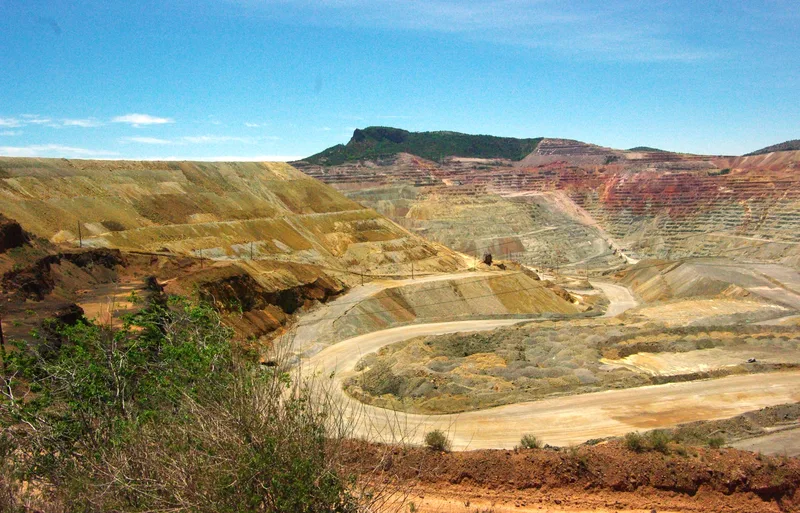
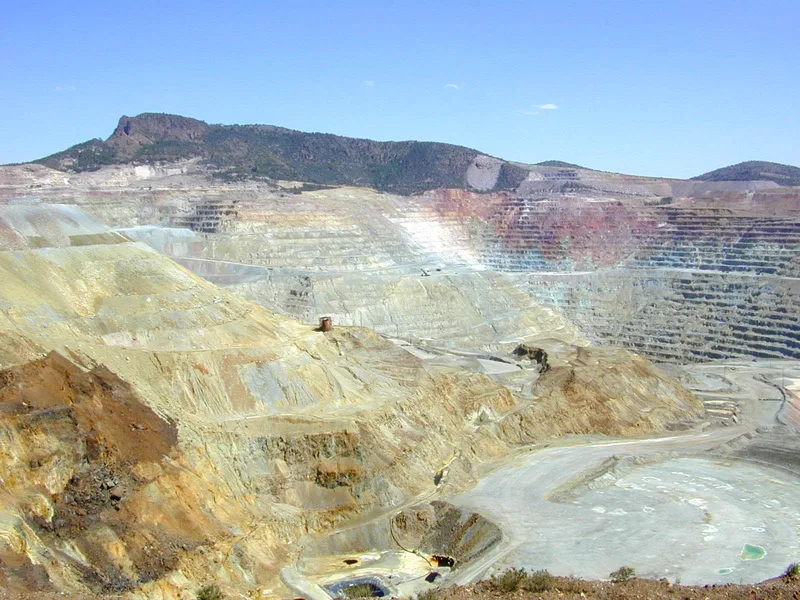
Four sources give the pit's size, and they do not agree. Freeport-McMoRan's overlook panel, photographed in 2014 and undated, says it is more than a mile across and more than 1,600 feet deep, with more than two billion tons moved since 1910. Kaas, writing in 2010, gave 1,500 feet deep and 1.5 miles across. Kelley's tour for the Bureau of Geology gives about 1.75 miles across and 1,350 feet deep. For comparison, Information Circular 7837, a study of mining methods at Chino, described the pit in 1956 and 1957 as roughly circular and about 5,000 feet across.13, 7
Sources: Freeport-McMoRan Copper & Gold, Modern Mining & Processing (marker, Santa Rita mine overlook) (photographed 2014-06-06): inscription; Shari A. Kelley, New Mexico Bureau of Geology and Mineral Resources, Chino Mine (Geologic Tour: Landmarks) (undated (accessed 2026-11-16)): Introduction
Freeport's 2025 annual report gives elevations instead. The highest bench stands 2,250 meters above sea level, and the pit bottom is expected to reach 1,508 meters. That is a planned drop of about 742 meters, or about 2,430 feet, from top bench to bottom, a figure for the finished pit rather than a measurement of the present one. Its 2020 report had put the expected bottom at 1,460 meters. The concentrator is rated at 36,000 tonnes of ore a day, and the SX/EW plant at 150 million pounds a year.
Sources: Freeport-McMoRan Inc., Form 10-K for fiscal year 2025 (2026-02-13): Item 1 and 2, Chino
The Chino operation covered about 132,700 acres in 2025, including 116,300 acres of land Freeport owns outright, up from about 117,300 acres in its 2020 filing. Martin wrote in 2020 that Hanover, New Mexico, watches the mine encroach on its homes. The company, she wrote, had yet to issue evacuation orders there.
Sources: Freeport-McMoRan Inc., Form 10-K for fiscal year 2025 (2026-02-13): Item 1 and 2, Chino; Kelli R. Lycke Martin, The Shrine of Chino Mine: Extraction Rhetoric and Public Memory in Southern New Mexico (2020 (Xchanges 15.1, Spring 2020)): page 6
Reclamation and what will remain
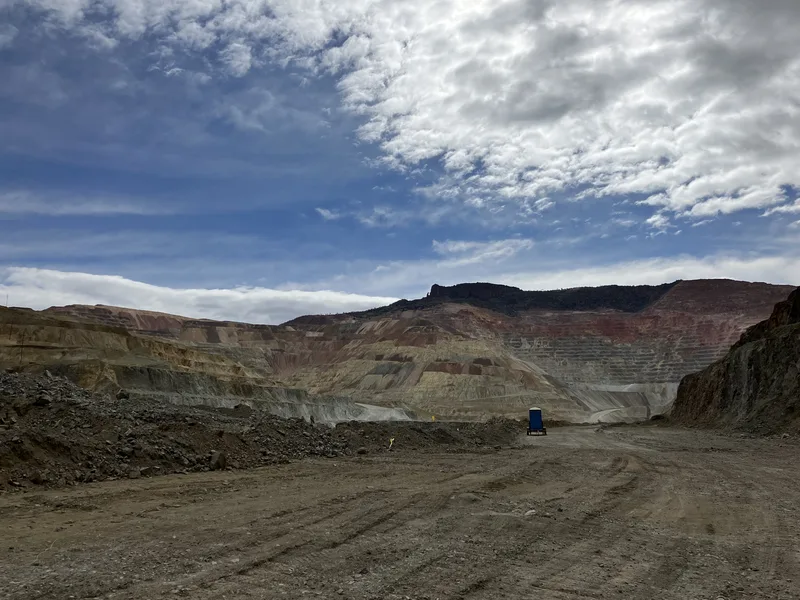
Reclamation, the work of restoring mined land, is required by state law. New Mexico's Mining Act of 1993 requires approved closeout plans for Chino, backed by financial assurance, money guaranteed for the work. A second state law, the Water Quality Act, requires closure plans to prevent groundwater contamination. The overlook's reclamation panel says Freeport-McMoRan began reclamation at part of the site in 2008. At 31 December 2025 Freeport had accrued $573 million for reclamation and closure of its New Mexico operations, and Chino's closure permit was renewed in 2020.14
Sources: Freeport-McMoRan Copper & Gold, Reclaiming the Land (marker, Santa Rita mine overlook) (photographed 2014-06-06): inscription; Freeport-McMoRan Inc., Form 10-K for fiscal year 2025 (2026-02-13): Notes, New Mexico Environmental and Reclamation Programs
The mines also faced claims for damage. A U.S. Department of the Interior letter of 21 August 2003 asserted natural-resource damage claims for releases of hazardous substances at the Chino, Tyrone and Cobre mines. In 2011 New Mexico and the U.S. Fish and Wildlife Service settled with Freeport-McMoRan for $13 million for groundwater damage and $5.5 million for wildlife injuries. Settlement money paid to extend sewer lines in northern Silver City and to replace failing clay sewer lines in Hurley, work completed in 2014.15, 16, 17
Humble credited his tours with saving part of the district's past. He wrote in 2018 that his monthly tours of the mining district helped save the headframes, the towers built over mine shafts, which Freeport had planned to tear down. The tour group was against it, he wrote. The reclamation panel at the overlook says the state Mining Act does not require the removal of all evidence that mining ever occurred. There will always be evidence on these private lands, it says, that this was an active mining district.
Sources: Terry Humble; Salt of the Earth Recovery Project, Terry Humble (written account) (2018-07-27): account; Freeport-McMoRan Copper & Gold, Reclaiming the Land (marker, Santa Rita mine overlook) (photographed 2014-06-06): inscription, 'What Will the Future Bring?'
Read more on Salars.net
Part 8 of 10 of the series Santa Rita, New Mexico: the town the pit took.
Sources
- Walter Sellers's poem 'The Legend of the Kneeling Nun' (1909; reprinted 1911, 1922, 1929) introduced Sister Teresa, a mission teacher who nursed and loved 'Diego the Soldier', was expelled, and was turned to rock before an altar that grew into a mountain overnight. A History of the Kneeling Nun: Evidence from Documentary Sources, 'Summary', point 3d (labelled 'Walter Sellers-1929'); text: published 1909, reprinted SCE 3 Feb. 1911, Mountain Breeze 11 Aug. 1922, New Mexico Magazine 1929; Appendix E. View source ↗ (reported)
- Ackerly (1998) found no name for the monolith in documents before about 1867 and concluded the name 'Kneeling Nun' arose between 1865 and 1872. A History of the Kneeling Nun: Evidence from Documentary Sources, 'Summary', points 1 and 2a. View source ↗ (reported)
- In 1912 the Silver City Enterprise, reprinting the 1873 poem, said the verse was based on 'the legend which has been handed down by the conquistadores'; Ackerly quotes this without directly assessing it, but his summary concludes that no Kneeling Nun legend has a documented historical basis and that the monolith was unnamed through about 1867. A History of the Kneeling Nun: Evidence from Documentary Sources, quoting Silver City Enterprise, 23 Aug. 1912. View source ↗ (reported)
- City of Rocks State Park, in the Mimbres Valley of Grant County, was established in May 1952; its pinnacles are Kneeling Nun Tuff, which erupted from the Emory caldera 34.9 million years ago. City of Rocks State Park (Virtual Geologic Tour), NM Bureau of Geology virtual tour, City of Rocks, home page (intro and geology paragraphs). View source ↗ (reported)
- Legend (unsupported by documents) says an Apache told Carrasco that a peculiar rock formation marked the mine, and that Carrasco named the monolith the Kneeling Nun; Ackerly found no documentary evidence for either. A History of the Kneeling Nun: Evidence from Documentary Sources, 'Early Historical Records: Negative Evidence'. View source ↗ (reported)
- In 1982 Kennecott shut Chino's concentrator in March, its Hurley smelter in May and pit stripping in June, its first closure for slack demand since the Depression, and Phelps Dodge shut Tyrone in mid-April. Minerals Yearbook 1982, vol. 2, Area Reports: Domestic, Minerals Yearbook 1982 vol. 2, New Mexico chapter, Copper. View source ↗ (documented)
- By 1956-57 the Chino pit was roughly circular and about 5,000 feet across; mining had stopped in the north pit, which held storm water used to leach the waste dumps. Information Circular 7837: Open-Pit Mining Methods and Practices at the Chino Mines Division, Kennecott Copper Corp., Grant County, N. Mex., IC 7837, Development and mining, p. 17. View source ↗ (documented)
- Phelps Dodge bought Kennecott's two-thirds of Chino Mines in November 1986 for $88 million, with management passing on January 1, 1987; Kennecott was indemnified against environmental and reclamation obligations from before and after the sale. Minerals Yearbook 1986, vol. 2, Area Reports: Domestic, Minerals Yearbook 1986 vol. 2, New Mexico chapter, Copper. View source ↗ (documented)
- Phelps Dodge acquired the one-third minority interest in Chino held by Heisei Minerals (a Mitsubishi Materials and Mitsubishi Corporation subsidiary) on December 19, 2003, making Chino wholly owned. Phelps Dodge Corporation Form 10-K for fiscal year 2006, PD 10-K 2006, Item 1, New Mexico Mines: Chino; production table footnote (b). View source ↗ (reported)
- Phelps Dodge reported that the Chino concentrator shut temporarily in March 2001, the Hurley smelter closed temporarily in January 2002, mining for leach material fully restarted in September 2003, and milling reached 80 percent of capacity in the third quarter of 2004. Phelps Dodge Corporation Form 10-K for fiscal year 2006, PD 10-K 2006, Item 1, Mining and Sales Production: major changes in operations. View source ↗ (reported)
- Freeport-McMoRan announced on March 19, 2007 that it had completed its $26 billion acquisition of Phelps Dodge, whose properties included the Chino and Tyrone mines. Freeport-McMoRan Copper & Gold Inc. Completes Acquisition of Phelps Dodge Corp. (8-K exhibit 99.1), FCX press release (8-K Ex. 99.1), March 19, 2007, paras. 1-2. View source ↗ (reported)
- The plan noted that Chino was shut altogether from 2009 to 2011 and Tyrone's output fell by half in 2015 with low copper prices, and that other 20th-century mines in the county closed in the 1990s. Grant County Comprehensive Plan (final, June 2017), 2017 plan, p. 96. View source ↗ (documented)
- The Hurley smelter was modernized in 1985 and closed in 2002; in 2010 Kaas described the Chino pit as 1,500 feet deep and 1.5 miles across, with production resumed in 2011 after a 2008 shutdown. L. Michael Kaas, Silver City historical tour guide, Mining History Association (c. 2011, inferred), Kaas, Santa Rita section. View source ↗ (reported)
- Chino, Tyrone and Cobre are regulated under the New Mexico Water Quality Act, which requires closure plans to prevent groundwater contamination, and under the New Mexico Mining Act of 1993, which requires approved closeout (reclamation) plans with financial assurance. Phelps Dodge Corporation Form 10-K for fiscal year 2006, PD 10-K 2006, Significant New Mexico Environmental and Reclamation Programs. View source ↗ (reported)
- A U.S. Department of the Interior letter of August 21, 2003 asserted natural-resource damage claims for releases of hazardous substances at the Chino, Tyrone and Continental (Cobre) mines, and the company signed a cooperative-assessment agreement on July 13, 2004. Phelps Dodge Corporation Form 10-K for fiscal year 2006, PD 10-K 2006, Environmental matters (natural resource damages). View source ↗ (reported)
- New Mexico and the U.S. Fish and Wildlife Service reached settlements with Freeport-McMoRan of $13 million for groundwater damage and $5.5 million for wildlife injuries from releases at the Chino, Cobre and Tyrone mines. Chino, Cobre, and Tyrone Mines (Office of Natural Resources Trustee), NM Office of Natural Resources Trustee, Chino, Cobre and Tyrone Mine Facilities page. View source ↗ (documented)
- Settlement money paid to extend municipal sewer lines to a neighborhood in northern Silver City and to replace failing clay sewer lines in Hurley (completed 2014). Chino, Cobre, and Tyrone Mines (Office of Natural Resources Trustee), ONRT site page, restoration projects ('Silver City North/Blackhawk Sewer Line Extension'; 'Hurley Sewer Line Replacement'). View source ↗ (documented)
"Documented" means the source is a record of the time or a direct survey; "reported" means a later account or secondary history, attributed in the text.
Cite this page: “Santa Rita remembered, and the mine today.” Grant County Atlas, Salars.net, first published 16 November 2026. https://atlas.salars.net/stories/santa-rita/remembered-and-the-mine-today
Discussion
What would you add or question? Comments are reviewed before they appear.
Loading comments…