Between 1909 and 1950 the Chino Copper Company and the companies that followed it, ending with Kennecott, replaced the old underground mines at Santa Rita with a steam-shovel open pit. By the end of 1950 the Bureau of Mines measured that pit at 5,400 feet across; its ore went by rail to the mill at Hurley, where a smelter opened in 1939.
Sully's samples and the Bingham method, 1906-1909
In 1906 J. M. Sully, engineer for the Hermosa Copper Co., began testing whether the Santa Rita copper deposits could be worked by the methods Utah Copper had made prominent at Bingham. Spencer and Paige, authors of a Geological Survey bulletin on the Santa Rita mining area, write that his first investigation took 2,876 samples of 300 to 500 pounds each. After more extensive sampling in 1908, they write, he prepared a report for the owners showing that working the property was practicable.1
Harry A. Thorne, a Chino employee from 1909 and later its mine superintendent, wrote a 1931 Bureau of Mines history of the mines. In it he says the Hermosa company, a General Electric subsidiary, spent about nine months in 1905 and 1906 examining the holdings of the Santa Rita Mining Co., which then owned the mines.2, 3
Sully's proposal was to dig blasted low-grade porphyry ore with steam shovels, steam-powered diggers that loaded broken rock into railroad cars. Christopher J. Huggard and Terrence M. Humble, in their 2012 history of Santa Rita, write that the idea appealed to Daniel C. Jackling, who had used the strategy at Bingham, Utah, from 1906. Boston investor Albert C. Burrage and the New York firm of Hayden, Stone & Company, they write, worked out the 1909 deal that brought money and engineering to the venture. Jackling chaired the board's executive committee.
A new name and a disputed founding date, 1909
A financial advertisement in the New-York Tribune on 30 December 1909 gave a promoter's version of the change. After the death of a Mr. Rogers, the advertisement said, Hayden, Stone & Co. took the advertiser's Santa Rita position off its hands. "They at once changed the name to Chino," it said, with 700,000 shares of $5 par. The 1914 Copper Handbook gives the same $5 shares and a capital of $3,500,000, raised to $4,000,000 in 1911 and $4,500,000 in 1912. Spencer and Paige say the owners organized the Chino Copper Co. after dropping a financing plan devised by Thomas W. Lawson.4
Sources: New-York Tribune (advertiser's text), New-York Tribune, December 30, 1909, page 13 (financial advertisement (signer not legible) on Chino / Santa Rita) (1909-12-30): p. 13, advertisement; Walter Harvey Weed, The Copper Handbook, vol. XI (1912-1913), entry 'Chino Copper Co.', pp. 234-236 (1914): p. 234
Five sources date the company's start differently. Spencer and Paige say it was organized in May 1909, and Thorne says June 1909. The 1922 Mines Handbook dates its incorporation in Maine to 9 June 1909, while the 1914 Copper Handbook says it was organized under Maine law in August 1909. L. Michael Kaas, in a Silver City historical tour guide, puts the company's formation in 1908. He places it after John M. Scully's 1904 insight, as he spells the name, that Santa Rita ores resembled Bingham Canyon's. None of these sources explains why the dates differ.4, 5, 6
Sources: Walter Harvey Weed (ed.), The Mines Handbook, vol. XV (1922), entry 'Chino Copper Co.', pp. 1391-1395, and New Mexico summary: p. 1391, heading of entry (OCR partly garbled); Walter Harvey Weed, The Copper Handbook, vol. XI (1912-1913), entry 'Chino Copper Co.', pp. 234-236 (1914): p. 234
Chino moved quickly on water. The Silver City Enterprise, reprinted by the Deming Graphic on 13 August 1909, reported that the company had taken 30-day options on all the ranches from the Forsythe place at Lone Mountain down to Whitewater. Its purpose, the paper said, was control of their underground water, presumably for milling.
Hayden, Stone's report, printed in the Tribune advertisement, put Chino's reserves on 1 December 1909 at about 7,500,000 tons, proved by underground workings and drilling. Average grade was about 2.4 percent copper as of 1 November. A concentrator for 2,500 tons a day was being planned. A concentrator is a mill that crushes ore and separates the copper minerals from waste rock as a richer product for smelting.
Steam shovels and the stripping at Santa Rita, 1910-1911
Work at Santa Rita changed in the second half of 1910. The El Paso Herald reported on 15 August 1910 that the old Santa Rita concentrator had been closed for good while Chino graded for steam shovels near the Santa Rita depot. Spencer and Paige date the start of the shovels to September 1910 and the start of construction on the Hurley mill to October. Thorne has the shovels at work by the fall of 1910. When part of the old Santa Rita fort was razed that year for a machine shop, he writes, evidence turned up of the Confederates who had briefly held the area in 1862.7, 8, 5, 9, 10
In 1910 and 1911 the Copper Handbook counted five steam shovels "engaged in removing the capping," the rock that lay over the ore. It named the mine's zones: Hearst-Carasco, Romero, Montoya, Santa Rita, Chino, Texas Flat, Whim Hill and Yosemite, with the Romero the first to be opened. Reprinting the Silver City Independent in February 1911, the Albuquerque Morning Journal reported five shovels at work. By its account the Romero ore body had yielded 82,725 tons of ore averaging over 2 percent copper.11
Lessees still worked at Santa Rita in these years, by two accounts. The 1910-1911 handbook said the old Santa Rita dumps held about 150,000 tons of ore that had been unworkable until then. It reported that lessees, miners who worked ground under lease and sold their ore, had mined high-grade chalcocite, a copper mineral, at Whim Hill. L. C. Graton of the Geological Survey wrote in 1910 that, as in the early days, much of the mining at Santa Rita was being done by Mexican lessees.12
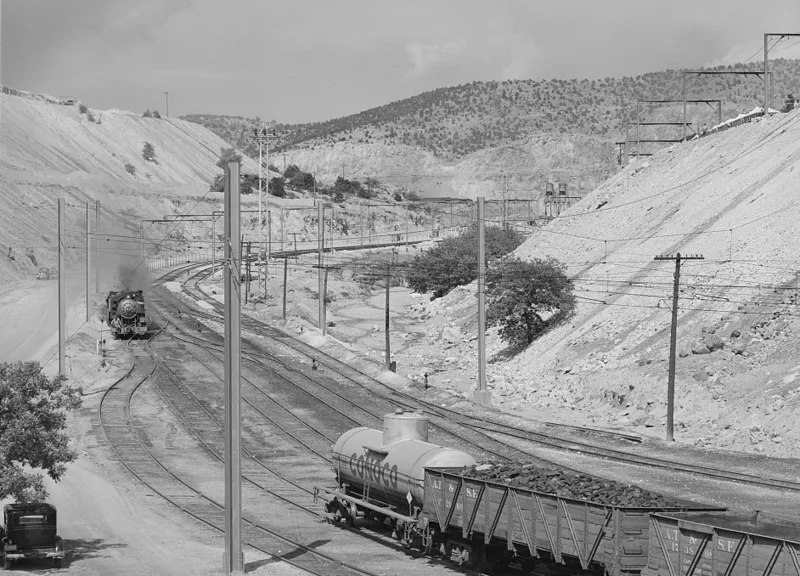
A Silver City dispatch in the El Paso Herald of 2 November 1911 described the workings in detail. Twelve miles of standard-gauge track ran through them, and the company had nine locomotives and 80 cars. Five steam shovels were at work, four Model 91s and a Model 40, and ore was broken with black-powder blasts. Over 600 men, the dispatch said, had been kept stripping the surface while the Hurley concentrator was built. During that stripping 350,000 tons of milling ore had been set aside in stockpiles.
That dispatch also carried the general manager's figures. John M. Sully estimated that 33 million of the 55 million tons blocked out could be taken out with locomotives and cars. Chino's engineers, according to the Herald, figured that shovels and locomotives could mine to about 250 feet deep before inclines would be needed. David F. Myrick, in his 1990 book New Mexico's Railroads, gives Chino's early pit engines as 21 H. K. Porter 0-4-0T locomotives, seven of 50 tons and fourteen of 45 1/2 tons.13
Ten cents a ton to the mill at Hurley, 1910-1912
Chino milled its ore away from Santa Rita. The El Paso Herald reported on 18 July 1910 that the mill would stand on the B ranch, bought from the Victoria Land and Cattle Co. for its water, a mile from Hurley station. There the company had platted a townsite under its control. A branch of the Santa Rita Store Co. had opened at the mill site, the paper said, and the grade for a branch railway to the mill was nearly finished.14, 15
Chino did not build its own railroad. In November 1911 the Herald reported that the Santa Fe railway had given the company a rate of 10 cents a ton on ore from Santa Rita to the concentrator at Hurley. With the Santa Fe supplying cars, the paper said, Chino had no plan for a line of its own. A 1930 Bureau of Mines circular describes the ore weighed on railroad scales at the mine and carried to Hurley by the Atchison, Topeka & Santa Fe. Myrick gives the haul from the Santa Fe interchange at Santa Rita as nine miles; the Bureau of Mines gave it as 10 miles in 1939.16, 13
Sources: El Paso Herald, November 2, 1911, page 8, Mining News: 'Chino Copper Co. Has Already Spent $5,500,000 and Is Just Starting' (Silver City dispatch) (1911-11-02): p. 8; Minerals Yearbook 1939 (U.S. Bureau of Mines), New Mexico chapter and related chapters: New Mexico chapter, Central district
Money came before copper. The Herald reported on 9 August 1911 that a Chino bond issue was fully subscribed and would bring in $2,400,000. That was enough, the paper said, to pay the company's debts and enlarge the Hurley concentrator from 3,000 to 5,000 tons a day. In November the Herald reported that Chino had spent $5,600,000 and "has not yet commenced producing," though its headline gave the figure as $5,500,000. The company then employed over 1,300 men in the mines at Santa Rita and the mills at Hurley, the paper said.17
Production at Hurley built up over a year. According to the 1914 Copper Handbook, the first unit of the mill went into operation in October 1911, and ore was running through the fifth and last section on 28 November 1912. Kaas dates the addition of flotation, a method of separating copper minerals from crushed ore, to 1914. Concentrates went to El Paso, where the American Smelting and Refining Co. had built its copper plant in 1910 to handle Chino concentrates from Santa Rita. By 1920, with that company and Ray Consolidated, Chino owned the Gallup American Coal Co., which supplied coal to its plant.18
Sources: Walter Harvey Weed, The Copper Handbook, vol. XI (1912-1913), entry 'Chino Copper Co.', pp. 234-236 (1914): p. 235; Minerals Yearbook 1936 (U.S. Bureau of Mines), New Mexico chapter and related chapters: Texas chapter, El Paso plants; Walter Harvey Weed, The Mines Handbook, vol. XIV (1920), entry 'Chino Copper Co.', pp. 1237-1240: p. 1237
Output, dividends and the end of the old workings, 1912-1920
In 1912, its first full year of operation, Chino produced 29,237,966 pounds of copper from 1,120,375 tons of ore averaging 2.077 percent copper. The Copper Handbook put the cost at 7.69 cents a pound, without crediting miscellaneous income. Spencer and Paige date large-scale copper mining at Santa Rita to 1912, after about a century of intermittent production that began in 1804.19
By 1 January 1913 Chino counted about 90 million tons of ore averaging slightly over 1.8 percent copper, against about 7.5 million tons in December 1909. The Copper Handbook said about 90 percent of it could be mined by steam shovels in an open pit, a mine worked downward from the surface instead of through shafts and tunnels. That year the pit ran 7 steam shovels, 15 locomotives and about 100 dump cars. Chino owned 131 patented claims, 2,412 acres, at Santa Rita, with title from the Santa Rita Mining Co., since dissolved.8
Sources: Walter Harvey Weed, The Copper Handbook, vol. XI (1912-1913), entry 'Chino Copper Co.', pp. 234-236 (1914): p. 235; p. 234; New-York Tribune (advertiser's text), New-York Tribune, December 30, 1909, page 13 (financial advertisement (signer not legible) on Chino / Santa Rita) (1909-12-30): p. 13
Control sat in New York. In 1914 the Copper Handbook listed Charles M. MacNeill as president and Jackling as vice-president and general manager, with Sully as manager and Horace Moses as mine superintendent; the main office was at 25 Broad Street. The handbook said Chino was closely connected in management and ownership with the Utah Copper Co. and Ray Consolidated Copper Co. Chino paid its first dividend, 75 cents a share, in June 1913.
Chino's best year in this period was 1917, with 79,636,235 pounds of copper from 3,608,100 tons of ore. Dividends rose from $2.25 a share in 1913 to $9.90 in 1917, a total that included a 40-cent Red Cross dividend. Huggard and Humble write that "Profits of nearly $10 million in 1917 alone attracted the attention of the Guggenheims." Output fell to 40.5 million pounds in 1919. Dividends were passed in the last quarter of 1920, and by 1922 they had totaled $29,991,709.
Sources: Walter Harvey Weed (ed.), The Mines Handbook, vol. XV (1922), entry 'Chino Copper Co.', pp. 1391-1395, and New Mexico summary: p. 1395, production table; p. 1393; Walter Harvey Weed, The Mines Handbook, vol. XIII (1918), entry 'Chino Copper Co.', pp. 1217-1219: p. 1217; Christopher J. Huggard and Terrence M. Humble, Santa Rita del Cobre: A Copper Mining Community in New Mexico (University Press of Colorado, 2012), front matter and Introduction (publisher's sample PDF): Introduction, pp. 3-4
The shovels changed the ground itself. In its 1918 and 1920 editions the Mines Handbook reported that the very extensive old underground workings at Santa Rita "have been practically eliminated by the steam-shovel operations." Its 1920 edition listed 10 steam shovels, 21 locomotives and about 24 miles of track in the Santa Rita pits, with a primary crushing plant at the mine. In 1918, Spencer and Paige write, the lands of the Hermosa Copper Co. near Hanover passed to Chino.20
Mining engineers took notice. A Union Associated Press dispatch of September 1916 listed Santa Rita and Hurley, with Douglas, Bisbee, Globe and Phoenix in Arizona, among the places where the American Institute of Mining Engineers planned sessions or inspection visits during its annual convention. The dispatch gave the schedule in advance and does not show that the visits took place.
A shutdown to await a better market, 1921
The 1922 Mines Handbook said Chino suspended operations on 1 April 1921 to await improved market conditions. In its New Mexico summary the handbook blamed that suspension for a 77 percent fall in one year in the value of the state's metal production, which came to $2,685,000 in 1921.
A Silver City dispatch of 11 May 1921, printed the next day in the Albuquerque Morning Journal, addressed doubts about the future. Anyone who doubted that the company would resume after its complete shutdown at Santa Rita and Hurley, it said, should find those doubts removed by the 1920 annual report. According to the dispatch, an ore-reserve calculation begun in 1920 had found by January 1921 that Chino had added over 11,000,000 tons of positive ore. Its headline put total reserves above 105,000,000 tons.21, 22
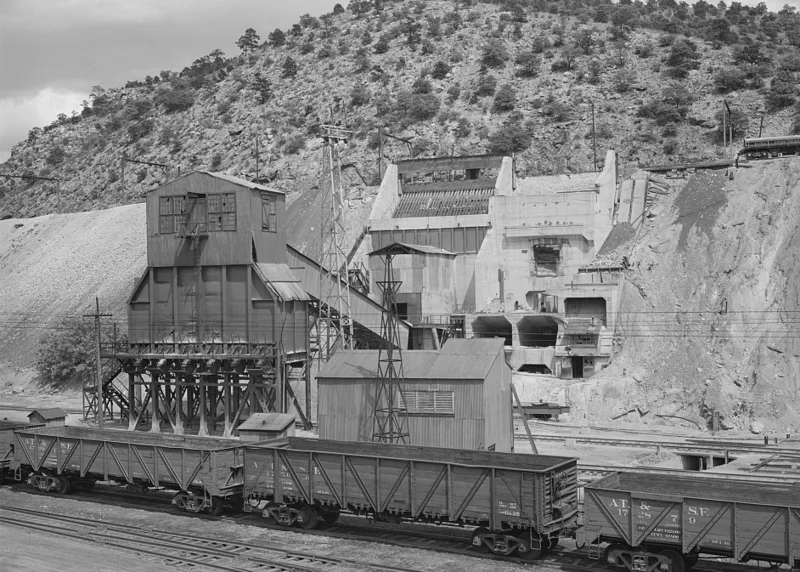
Work on the plant went ahead in the 1920s. A 1930 Bureau of Mines circular on the Hurley mill says a rebuilding begun in 1923 replaced its Chilean mills with ball mills and installed Chino-type pneumatic flotation machines, and was finished in 1925. The Hurley plant made its own power with three Allis-Chalmers turbo-generators and sent it at 24,000 volts to the mine at Santa Rita.23, 24
Ray Consolidated, Nevada Consolidated and Kennecott, 1924-1934
Chino changed hands three times in nine years. The federal appeals court for the Tenth Circuit summarized the chain in a 1941 labor case. For about 15 years before 1924, it wrote, the Chino Copper Company had owned and operated the open pit at Santa Rita and a reduction works at Hurley. Ray Consolidated took the assets in 1924, Nevada Consolidated in 1926 and Kennecott in 1933. That year Kennecott had a new Nevada Consolidated Copper Corporation incorporated to operate the Chino properties.
Three other accounts agree on the order. Thorne says Ray Consolidated absorbed the Chino Copper Co. in 1924 and Nevada Consolidated bought Ray's properties in 1926. Huggard and Humble tie both sales to the Guggenheims, whose Ray Consolidated and Nevada Consolidated bought the Chino operations in 1924 and 1926. Kaas has Chino merging with Nevada Consolidated in 1926 and with Kennecott in 1933.25, 26
By 1930 Thorne reckoned the Santa Rita mines had produced about 1,204,000,000 pounds of copper, including an estimated 41 million pounds before 1845. In 1931, he wrote, the mines paid straight wages and salaries with no bonuses and kept a hospital and medical staff at the mine. In 1933 and 1934 the painter Theodore Van Soelen made a mural called "Chino Mines" for the Grant County Courthouse in Silver City, based on sketches drawn in the Chino pits.27, 28, 29, 30
Management changed with the owners. The 1941 court record gives the death of General Manager Sully, spelled Sulley there, in 1933. R. B. Tempest, assistant to the general manager since 1923, became general manager on 1 January 1934 and served until his death on 7 May 1938. Thorne, with the company since 1909, had been superintendent of the Chino mine since 1920.
Idle from October 1934 to January 1937
Kennecott's first years at Santa Rita ended in a closing. In the 1941 case the company said it had lost two and a half million dollars at Santa Rita and Hurley from 1931 to September 1934. A 20 percent cut ordered by Kennecott's directors, it said, made operation impossible. The Bureau of Mines recorded that Chino had produced 82.40 percent of New Mexico's copper in 1934 until it closed in October, and that it remained idle through 1935.
Sources: U.S. Circuit Court of Appeals, Tenth Circuit (Phillips, J.; Bratton, J., dissenting), Nevada Consol. Copper Corporation v. National Labor Relations Board, 122 F.2d 587 (10th Cir., Aug. 27, 1941), No. 2196 (1941-08-27): para. 7; Minerals Yearbook 1936 (U.S. Bureau of Mines), New Mexico chapter and related chapters: New Mexico chapter, Copper
Hurley depended on the same mine. In its 1962 revised edition, the WPA guide to New Mexico said Hurley had been completely occupied until the Santa Rita mine closed in 1934, and that work resumed when the mine reopened. Kaas gives the same span of idleness, from October 1934 to January 1937.31, 26
Better copper prices in 1936 brought open-cut work at Santa Rita back in January 1937, the Bureau of Mines reported. At first mill units with a total capacity of 8,000 tons a day ran at Hurley, whose full capacity was 15,000. A 1958 Bureau of Mines circular says that with the reopening the crushing plant moved from Santa Rita to Hurley and molybdenum was recovered as a byproduct for the first time. Mill capacity, it says, rose from 15,000 to 17,500 tons a day.32
A smelter at Hurley and a wartime record, 1937-1946
Kennecott rebuilt after the reopening. Huggard and Humble write that after acquiring Chino in 1933 the company invested nearly $10 million to replace worn-out and obsolete equipment and built the Hurley smelter. In April 1937, by the Bureau of Mines account, Kennecott authorized a smelter beside the concentrator at Hurley, estimated at $2,400,000. It was to be ready when the El Paso smelting contract ran out in March 1939.
Sources: Christopher J. Huggard and Terrence M. Humble, Santa Rita del Cobre: A Copper Mining Community in New Mexico (University Press of Colorado, 2012), front matter and Introduction (publisher's sample PDF): Introduction, p. 4; Minerals Yearbook 1938 (U.S. Bureau of Mines), New Mexico chapter and related chapters: New Mexico chapter, Central district (quoting Kennecott's 23rd annual report)
Natural gas reached the power plant at Hurley on 15 August 1937, the Bureau of Mines yearbook for 1938 reported. A 1958 Bureau of Mines circular says the Hurley smelter was fed by a natural-gas pipeline brought from Deming in 1939.33
On 2 May 1939 the new Chino smelter at Hurley opened. The Bureau of Mines called it "an outstanding event," because New Mexico had been without a smelting industry for many years. A smelter melts concentrate down to crude copper. After March 1939, the 1958 circular says, all Chino concentrates went to Kennecott's Hurley smelter instead of El Paso.33, 18
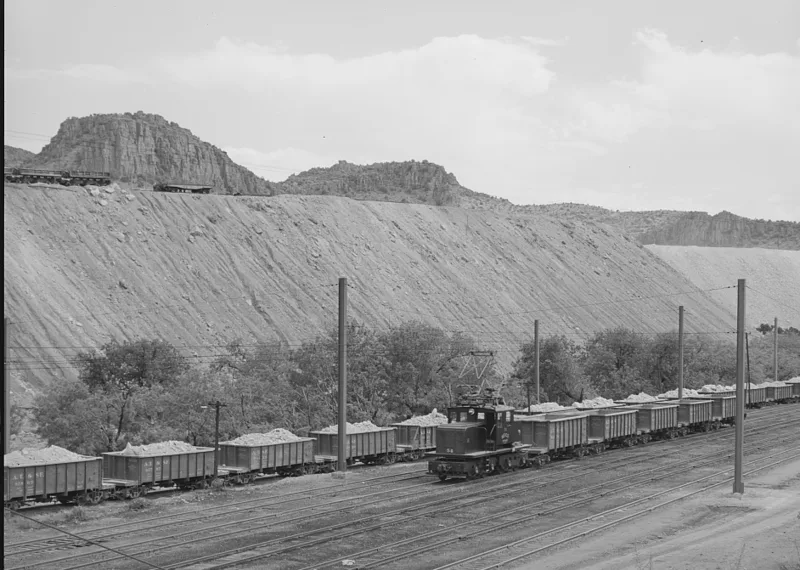
The pit itself was changing power. Production was suspended from 22 June to 15 October 1938 and curtailed for the rest of that year. In 1938 eleven electric shovels were at work in the pit. A power line from Hurley to the Santa Rita mine was finished in 1940, seven electric locomotives arrived, and mine haulage was fully electrified by 1941. Molybdenite, the ore of molybdenum, was recovered as a byproduct from 1937, and from 1939 Chino's molybdenite output exceeded that of the Questa mine.34
Sources: Minerals Yearbook 1939 (U.S. Bureau of Mines), New Mexico chapter and related chapters: New Mexico chapter, Central district (quoting Kennecott's 24th annual report); New Mexico chapter, Central district; Minerals Yearbook 1948 (U.S. Bureau of Mines), New Mexico chapter and related chapters: Molybdenum chapter, New Mexico
War pushed output to records. Chino set a new annual copper record in 1941, and improvements raised the Hurley mill from 17,500 to 20,000 tons a day. Through 1942 it ran the Santa Rita pit and the Hurley mill and smelter over capacity, for the largest output in the operation's history. From May 1942 part of the copper was fire-refined at Hurley. In 1946 the mill ran a six-day week for eight months and a five-day week for four, and output fell below the 1940-1945 years.
Sources: Minerals Yearbook 1941 (U.S. Bureau of Mines), New Mexico chapter and related chapters: New Mexico chapter, Central district; Minerals Yearbook 1942 (U.S. Bureau of Mines), New Mexico chapter and related chapters: New Mexico chapter, Central district; fire-refining in the Copper section; Minerals Yearbook 1946 (U.S. Bureau of Mines), New Mexico chapter and related chapters: New Mexico chapter, Central district
A pit 5,400 feet across, 1948-1950
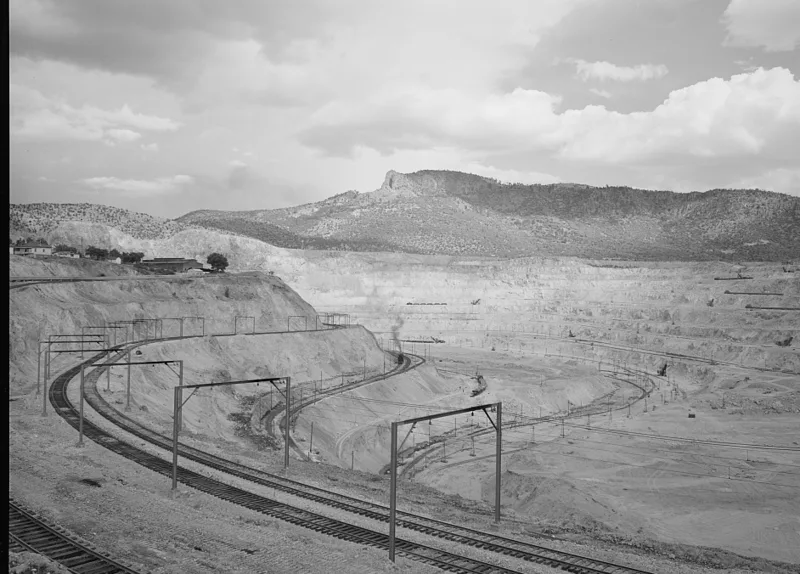
By the end of 1948 the bottom of the pit lay about 400 feet below the surface on the west side and 650 feet on the east. From 1910 through 1948, by the Bureau of Mines count, about 128 million tons of ore and 180 million tons of waste had left the pit by rail. In 1949 there were 11 operating benches, the steps cut into the pit walls.
Kennecott began a major stripping program to expand the pit in 1949 and continued it through 1950. In June 1950 the mine went to a seven-day week. That year the Bureau of Mines called Chino the largest single mining enterprise in New Mexico. It counted about 800 men at the mine, 1,000 at the Hurley plants and offices, and 200 more at the company hospital and other company-supported work.35
Sources: Minerals Yearbook 1950 (U.S. Bureau of Mines), New Mexico chapter and related chapters: Copper chapter; Minerals Yearbook 1950 (U.S. Bureau of Mines), New Mexico chapter and related chapters: New Mexico chapter, Grant County, Central district
At the end of 1950 the pit measured 5,400 feet across at its widest point and 845 feet below its highest rim point. Forty miles of standard-gauge track ran in the pit and on the dumps. The 1950 census counted 2,135 people in the town of Santa Rita.36
Read more on Salars.net
Part 4 of 10 of the series Santa Rita, New Mexico: the town the pit took.
Sources
- In 1906 J. M. Sully, engineer for the Hermosa Copper Co., began studying whether the Santa Rita deposits could be developed by methods then made prominent by Utah Copper at Bingham; that first investigation took 2,876 samples of 300 to 500 pounds each, and after more extensive sampling in 1908 he prepared a report for the owners indicating the practicability of working the property on an extensive scale as a low-grade mine. Geology of the Santa Rita Mining Area, New Mexico (USGS Bulletin 859), USGS Bulletin 859, History of mining, p. 8. View source ↗ (reported)
- From late 1904 the Hermosa Copper Co., a General Electric subsidiary, worked ground outside the Santa Rita basin and in 1905-1906 spent about nine months examining the Santa Rita Mining Co.'s holdings. Mining practice at the Chino mines, Nevada Consolidated Copper Co., Santa Rita, N. Mex. (U.S. Bureau of Mines Information Circular 6412), p. 3 (page image checked). View source ↗ (documented)
- In 1897 Whitney leased the Santa Rita mines to the Hearst estate, and in 1899 he sold them to capitalists tied to Amalgamated Copper, who formed the Santa Rita Mining Co. Mining practice at the Chino mines, Nevada Consolidated Copper Co., Santa Rita, N. Mex. (U.S. Bureau of Mines Information Circular 6412), p. 3 (page image checked). View source ↗ (documented)
- Spencer and Paige say the Chino Copper Co. was organized in May 1909 after the owners dropped a financing plan devised by Thomas W. Lawson. Geology of the Santa Rita Mining Area, New Mexico (USGS Bulletin 859), USGS Bulletin 859, pp. 8-9 (sentence spans the page break into the Production page). View source ↗ (reported)
- Thorne dates the organization of the Chino Copper Co. to June 1909, says it was linked to Utah Copper's backers, had steam shovels at work by fall 1910, and milled its first ore at Hurley a year later. Mining practice at the Chino mines, Nevada Consolidated Copper Co., Santa Rita, N. Mex. (U.S. Bureau of Mines Information Circular 6412), p. 3 (page image checked). View source ↗ (documented)
- The Chino Copper Company was formed in 1908 after John M. Scully's 1904 insight that Santa Rita ores resembled Bingham Canyon's; open-pit mining with steam shovels began in 1910. L. Michael Kaas, Silver City historical tour guide, Mining History Association (c. 2011, inferred), Kaas, Santa Rita section. View source ↗ (reported)
- The El Paso Herald reported in August 1910 that the old Santa Rita concentrator had been closed for good while Chino graded for steam shovels near the Santa Rita depot. El Paso Herald, 15 August 1910, p. 2 (Grant County mining review), p. 2 (OCR checked). View source ↗ (reported)
- Chino's steam shovels started in September 1910, Hurley mill construction began in October 1910, and by December 1912 drilling had proved about 90 million tons of 1.8 percent ore. Geology of the Santa Rita Mining Area, New Mexico (USGS Bulletin 859), USGS Bulletin 859, p. 9. View source ↗ (reported)
- Thorne says Sibley's Confederates briefly held the Santa Rita area in 1862, and that evidence of their occupation turned up in 1910 when part of the old fort was razed for a machine shop. Mining practice at the Chino mines, Nevada Consolidated Copper Co., Santa Rita, N. Mex. (U.S. Bureau of Mines Information Circular 6412), p. 2 (page image checked). View source ↗ (reported)
- 1910. Chino Mine, Introduction, first paragraph. View source ↗ (documented)
- Reprinting the Silver City Independent, the Albuquerque Morning Journal reported in February 1911 that five Chino steam shovels were working at Santa Rita and that the Romero ore body had yielded 82,725 tons of ore averaging over 2 percent copper. Albuquerque Morning Journal, 13 February 1911, p. 5 (reprinting the Silver City Independent on Chino), p. 5 (OCR checked). View source ↗ (reported)
- Graton noted in 1910 that, as in the early days, much of Santa Rita's mining was being done by Mexican lessees. The Ore Deposits of New Mexico (USGS Professional Paper 68), Chloride Flat district and Fleming Camp sections by L. C. Graton, USGS PP 68, p. 306. View source ↗ (reported)
- According to Myrick (as excerpted on UtahRails.net), Chino's early pit motive power was 21 H. K. Porter 0-4-0T locomotives, seven of 50 tons and fourteen of 45 1/2 tons; ore cars were delivered to the Santa Fe interchange at Santa Rita for the nine-mile haul to the Hurley concentrator. Kennecott Chino Mines Division (railroad history compilation, quoting David F. Myrick, New Mexico's Railroads, 1990, pp. 185-192), utahrails.net/bingham/kcc-chino.php, Myrick excerpt. View source ↗ (reported)
- The El Paso Herald reported in July 1910 that Chino's mill would stand on the 'B ranch', bought from the Victoria Land and Cattle Co. for its water, a mile from Hurley station, where the company had platted a company-controlled townsite. El Paso Herald, 18 July 1910, p. 5 (Chino Copper Co. item), p. 5 (OCR checked). View source ↗ (reported)
- The same July 1910 report said a branch of the Santa Rita Store Co. had opened at the Hurley mill site and the grade for a branch railway to the mill was nearly finished. El Paso Herald, 18 July 1910, p. 5 (Chino Copper Co. item), p. 5 (OCR checked). View source ↗ (reported)
- Ore from the Santa Rita pit was weighed on railroad scales at the mine and carried to the Hurley concentrator by the Atchison, Topeka & Santa Fe. Information Circular 6394: Milling Methods at the Hurley Plant of the Nevada Consolidated Copper Co., Hurley, New Mexico, IC 6394, Metallurgical calculations, p. 13-14. View source ↗ (documented)
- The El Paso Herald reported on 9 August 1911 that Chino Copper's bond issue was fully subscribed and would bring in $2,400,000, enough to pay off the company's debts and enlarge the Hurley concentrator from 3,000 to 5,000 tons a day. El Paso Herald, 9 August 1911, p. 12 ('Chino Copper Bond Issue Is Reported Subscribed'), p. 12 (OCR checked). View source ↗ (reported)
- Chino's first concentrator was built at Hurley in 1911, with flotation added in 1914; the Hurley smelter began production in 1939. L. Michael Kaas, Silver City historical tour guide, Mining History Association (c. 2011, inferred), Kaas, Santa Rita section. View source ↗ (reported)
- Spencer and Paige date large-scale copper mining at Santa Rita to 1912, after about a century of intermittent production that began in 1804. Geology of the Santa Rita Mining Area, New Mexico (USGS Bulletin 859), USGS Bulletin 859, Abstract, p. 1. View source ↗ (reported)
- The Hermosa Copper Co., affiliated with General Electric and organized in 1905, sank shafts at eight points and within two years opened nearly 3 miles of underground workings near Hanover, but reportedly blocked out only 25,000 tons of 3 percent copper ore; in 1918 its lands were transferred to the Chino Copper Co. Geology of the Santa Rita Mining Area, New Mexico (USGS Bulletin 859), USGS Bulletin 859, History of mining, p. 8 (footnote 10 cites Copper Handbook vol. 8, 1908). View source ↗ (reported)
- A Silver City dispatch of 11 May 1921 in the Albuquerque Morning Journal said that anyone doubting whether the Chino Copper Company would resume operations after its recent complete shutdown at Santa Rita and Hurley should have those doubts removed by the company's 1920 annual report. Albuquerque Morning Journal, May 12, 1921, page 7: Silver City item on the Chino Copper Company shutdown, Albuquerque Morning Journal, May 12, 1921, p. 7, 'Chino's Ore Reserves Exceed 105,000,000 Tons; Mines Here May Open This Year' (Silver City, May 11). View source ↗ (reported)
- The same 1921 item said that an ore-reserve calculation begun in 1920 found in January 1921 that Chino had added over 11,000,000 tons of positive ore to its reserves, with total reserves (per the headline) exceeding 105,000,000 tons. Albuquerque Morning Journal, May 12, 1921, page 7: Silver City item on the Chino Copper Company shutdown, Albuquerque Morning Journal, May 12, 1921, p. 7. View source ↗ (reported)
- A rebuilding of the Hurley mill begun in 1923 replaced Chilean mills with ball mills and installed 'Chino-type' pneumatic flotation machines, and was finished in 1925. Information Circular 6394: Milling Methods at the Hurley Plant of the Nevada Consolidated Copper Co., Hurley, New Mexico, IC 6394, Brief history of concentrator operations, p. 3. View source ↗ (documented)
- The Hurley plant generated its own power with three Allis-Chalmers turbo-generators (7,500, 6,000 and 2,000 kilowatts) and sent it at 24,000 volts to the mine at Santa Rita. Information Circular 6394: Milling Methods at the Hurley Plant of the Nevada Consolidated Copper Co., Hurley, New Mexico, IC 6394, Power, pp. 1-2. View source ↗ (documented)
- Thorne says Ray Consolidated Copper absorbed the Chino Copper Co. in 1924, and Nevada Consolidated bought Ray Consolidated's properties in 1926. Mining practice at the Chino mines, Nevada Consolidated Copper Co., Santa Rita, N. Mex. (U.S. Bureau of Mines Information Circular 6412), p. 3 (page image checked). View source ↗ (documented)
- Chino merged with Nevada Consolidated in 1926 and with Kennecott in 1933, and the mine was idle from October 1934 to January 1937 during the Depression. L. Michael Kaas, Silver City historical tour guide, Mining History Association (c. 2011, inferred), Kaas, Santa Rita section. View source ↗ (reported)
- Thorne reckons the Santa Rita mines had produced about 1,204,000,000 pounds of copper by 1930, including an estimated 41 million pounds before 1845. Mining practice at the Chino mines, Nevada Consolidated Copper Co., Santa Rita, N. Mex. (U.S. Bureau of Mines Information Circular 6412), p. 4 (page image checked). View source ↗ (reported)
- In 1931 the Chino mines paid straight wages and salaries with no bonuses, and kept a hospital and medical staff at the mine. Mining practice at the Chino mines, Nevada Consolidated Copper Co., Santa Rita, N. Mex. (U.S. Bureau of Mines Information Circular 6412), Wage, contract, and bonus systems (with preceding Safety section). View source ↗ (documented)
- Theodore Van Soelen painted the Grant County Courthouse murals 'Chino Mines' and 'The Round Up' in 1933-1934 under the Public Works of Art Project; the courthouse itself was built in 1929-30 before the New Deal. Grant County Courthouse Murals - Silver City NM (Living New Deal), Living New Deal, 'Grant County Courthouse: Van Soelen Murals', description. View source ↗ (reported)
- Van Soelen based 'Chino Mines' on sketches made in the Chino pits, and 'The Round Up' was shown at the Corcoran Gallery in the national PWAP exhibition of April-May 1934; both were conserved in 2009. Grant County Courthouse Murals - Silver City NM (Living New Deal), Living New Deal, courthouse murals page. View source ↗ (reported)
- The 1962 guide described Hurley as 468 company houses, a reduction and power plant and several stores; it was completely occupied until the Santa Rita mine closed in 1934, work resumed when the mine reopened, and the 1950 census showed 2,079 people. New Mexico: A Guide to the Colorful State, Writers' Program (WPA), new and completely revised edition (New York: Hastings House, 1962; first published 1940), Tour 18, archive.org newmexicoaguidet027633mbp (New Mexico: A Guide to the Colorful State, new completely revised edition, Aug. 1962), Tour 18, p. 415. View source ↗ (reported)
- When Chino reopened in January 1937, the crushing plant was moved from Santa Rita to Hurley and molybdenum was recovered as a byproduct for the first time; mill capacity rose from 15,000 to 17,500 tons a day. Information Circular 7837: Open-Pit Mining Methods and Practices at the Chino Mines Division, Kennecott Copper Corp., Grant County, N. Mex., IC 7837, History of district, p. 7. View source ↗ (documented)
- Chino's concentrates were smelted under a long-term contract at ASARCO's El Paso smelter until March 1939; after that all went to Kennecott's own Hurley smelter, fed by a natural-gas pipeline brought from Deming in 1939. Information Circular 7837: Open-Pit Mining Methods and Practices at the Chino Mines Division, Kennecott Copper Corp., Grant County, N. Mex., IC 7837, History of district, p. 7. View source ↗ (documented)
- A power line from Hurley to the Santa Rita mine was completed in 1940, seven electric locomotives arrived, and mine haulage was fully electrified by 1941. Information Circular 7837: Open-Pit Mining Methods and Practices at the Chino Mines Division, Kennecott Copper Corp., Grant County, N. Mex., IC 7837, History of district, p. 7. View source ↗ (documented)
- In 1950 the Chino mine was the largest single mining enterprise in New Mexico, with about 800 men at the mine, 1,000 at the Hurley plants and offices, and 200 more at the company hospital and other company-supported work. Minerals Yearbook 1950, Minerals Yearbook 1950, New Mexico chapter, Mining industry. View source ↗ (documented)
- In 1950 the unincorporated copper towns of Santa Rita (2,135) and Hurley (2,079) were among New Mexico's places of 1,000 or more, as were Bayard (2,119) and Central (1,511). 1950 Census of Population, Vol. II, Characteristics of the Population, Part 31: New Mexico, chapter A, Number of Inhabitants, 1950 Census NM ch. A, Table 7 (all incorporated places and unincorporated places of 1,000 or more). View source ↗ (documented)
"Documented" means the source is a record of the time or a direct survey; "reported" means a later account or secondary history, attributed in the text.
Cite this page: “Chino and the open pit, 1909 to 1950.” Grant County Atlas, Salars.net, first published 16 November 2026. https://atlas.salars.net/stories/santa-rita/chino-and-the-open-pit-1909-1950
Discussion
What would you add or question? Comments are reviewed before they appear.
Loading comments…