In Ellen R. Baker's account, Mexican families built their own houses on company-leased land in North Hurley while Kennecott's company houses went mostly to Anglos; when Kennecott sold its Hurley townsite, reported in January 1956, and, as James B. Allen writes, Hurley incorporated in 1956, neither Allen nor Mining Engineering says why North Hurley stayed outside the town.
Film crews sent away from North Hurley, March 1953
In March 1953, by one informant's account, the crews making the film Salt of the Earth were turned away from North Hurley. The account survives in an FBI teletype sent from New York on 5 March 1953. According to the informant, the crews had been ordered to leave Central, New Mexico. The teletype went on: "THEY THEN WENT TO NORTH HURLEY, N.M. WITH THE SAME RESULT." From North Hurley, the informant said, the crews tried Bayard.
That New York teletype also described a union meeting that resolved to back the film. At the meeting, the informant said, the union decided to walk off the job to support the picture if necessary. This, the teletype added, would in effect be a strike against Kennecott Copper and possibly other companies in the area. On 4 March 1953 an FBI teletype from Albuquerque had reported plans of another kind. A sound truck was to be used that afternoon in what it called an Americanism parade, held by citizens of Silver City, Bayard, Central and Hurley.
James J. Lorence, in his 1999 history of the film's suppression, writes that when Salt of the Earth played in Silver City, priests in Santa Rita and Hurley urged their parishioners not to see it. His account names Hurley, not North Hurley. None of these reports says who in North Hurley sent the film crews away, or why.
Sources: James J. Lorence, The Suppression of Salt of the Earth: How Hollywood, Big Labor, and Politicians Blacklisted a Movie in Cold War America (1999); Federal Bureau of Investigation, Salt of the Earth Film FBI Files (FBI file 100-20655 and related, released under the JFK Records Act; NW 53065 DocId 34362283) (1953-1954): FBI teletype, New York, 3/5/53; NW 53065 DocId 34362283, p. 80
Houses on leased ground north of the tracks, 1945 to 1949
North Hurley's houses, in Ellen R. Baker's account, were built by the families who lived in them. Baker, in her 2007 history On Strike and On Film, writes that the company built comfortable houses mostly for Anglos. "It leased land instead to Mexicans, who built their own houses" in Santa Rita's Mexican Town and in North Hurley, she writes. Writing of 1954, she describes North Hurley as the place where most Mexican Americans lived.
Baker gives one household's account from the mid-1940s. Virginia Chacón lived in North Hurley with her husband, Juan, who later became president of Local 890 of the International Union of Mine, Mill and Smelter Workers, known as Mine-Mill. Their North Hurley house had no indoor plumbing, as Baker recounts it. Juan made a cistern, and he carried water from Hurley.
Sources: Ellen R. Baker, On Strike and On Film: Mexican American Families and Blacklisted Filmmakers in Cold War America (2007): Baker 2007, passage on housing and living conditions (archive.org full-text search snippet; page not shown); National Labor Relations Board, Kennecott Copper Corporation and International Association of Machinists, Local 1563 (Cases 33-RC-260, 261), 96 NLRB 1423 (1951-11-14): 96 NLRB at 1423 n. 2 and 1424
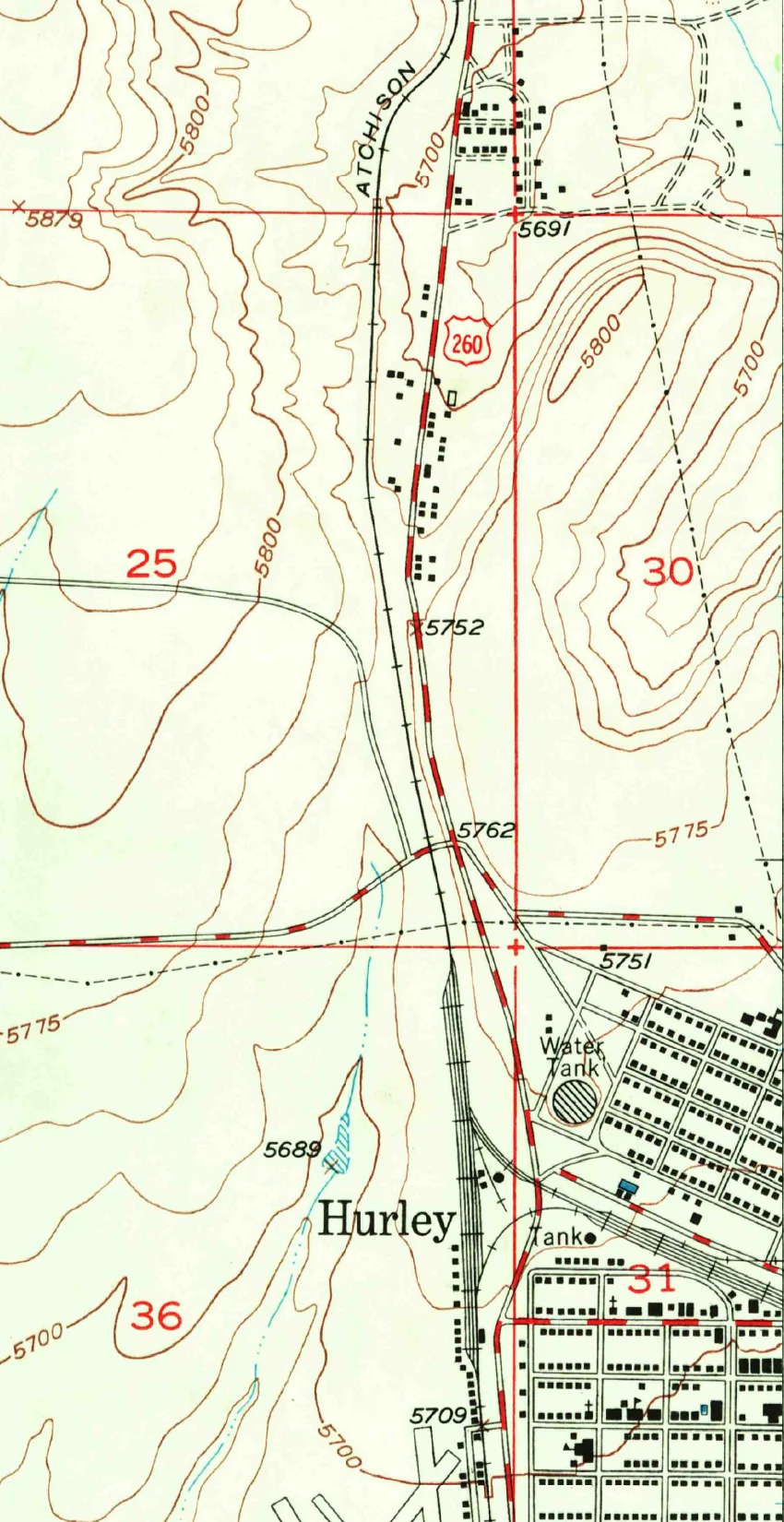
In 1949 the U.S. Geological Survey and the Army Map Service drew the settlement on their Hurley West sheet. It appears as a grid of house blocks on diagonal streets north of the Santa Fe tracks, with a round water tank inside it. On the map the tracks divide it from the rectangular company-town grid to the south. The sheet prints no name for the north-side grid.
The adjoining Hurley East sheet was made from aerial photographs taken in November 1945 and checked in the field in 1948. On it the east end of the grid runs right up to the mill and smelter yards and their rail spurs. There the label Hurley sits beside the plant, with Whitewater Creek just to the east. A few scattered buildings stand north of Hurley along the sheet's west edge near the creek, again without a place name.
Sources: U.S. Geological Survey / Army Map Service, Hurley East, N. Mex., 1:24,000 quadrangle, 1949 (USGS map id 191009): map face, west edge of sheet, sec. 31 T.18S. (read from the scan); U.S. Geological Survey, Hurley East, N. Mex., 7.5-minute quadrangle, 1949 (scan 191009): map face, west edge, sec. 30 T.18S. R.12W. north of 'Hurley'; credit note lower left
Two pay scales and a line at nine o'clock in Hurley
Christopher J. Huggard, in a 1994 essay on copper mining in Grant County between 1900 and 1945, writes that Hurley was segregated, with Anglos living south of the railroad tracks and Hispanics on the north. He quotes Barney Himes, a longtime employee: "One pay scale applied to Anglos," and a lesser one to Spanish-Americans. By 1914, Huggard writes, Chino had hired 1,500 laborers for the Santa Rita mine and the Hurley mill, about half of them Mexican and Mexican American. In his account the Chino company built company housing, ran a company store and provided a company hospital with company doctors at Hurley and Santa Rita. Company police, he writes, ran so-called bad men and union sympathizers out of town.
Deborah Silverton Rosenfelt's commentary on the published screenplay of Salt of the Earth, issued in 1978, gives a Mexican American woman's account of that divide. Rosenfelt introduces Mariana Ramírez, then sixty-seven and captain of the women's picket line in the 1950-52 strike. In Rosenfelt's description, Ramírez was born in a tent because Kennecott provided houses for Anglos only. Rosenfelt then quotes her: "I've been discriminated against all my life."
Ramírez described Hurley as a town with the railroad tracks across it, Anglos on the south side and Mexican Americans on the north. The schools were divided too, she said, one on the north side for Mexican Americans and one on the south side for Anglos. By nine o'clock at night, she recalled, no Mexican could cross the tracks to the south side. She also recalled working as a checker beside an Anglo woman doing the same job. Her co-worker was paid fourteen dollars a week, and Ramírez was paid seven.
Chain-link fences on one side of Hurley
Nelson L. Haggerson, the last principal of Hurley High School, describes the contrast in his 1993 autobiography, From Geronimo's Lookout. "Kennecott tradition and prejudice showed clearly when comparing north and south Hurley," he writes. In his description, south Hurley's company houses all had chain-link fences, and its streets were paved and kept by the company. Haggerson places the company store and meat market on the north side of south Hurley, just south of the railroad and facing the north side across the tracks.
Baker carries the divide into Grant County politics. She writes that those in the county's local political machinery were almost all Anglo through the 1940s. In her account the few exceptions, in one Silver City precinct, in North Hurley, in Fierro and in some towns on the Mimbres River, only proved the rule.
Local 890 at Kennecott's Chino works, 1946 to 1955
Decisions of the National Labor Relations Board (NLRB), the federal agency that rules on which union represents a group of workers, trace Mine-Mill's place at Kennecott's Chino Mines Division. In a decision of 14 November 1951, the board described Local 890 as the local representing what it called the residual production unit there. Local 890 had absorbed the operators' unit in 1946. On 16 June 1952 the board recorded that the division ran a hospital at Santa Rita and a branch dispensary at Hurley, whose workers Local 890 sought to organize.
Sources: National Labor Relations Board, Kennecott Copper Corporation and International Association of Machinists, Local 1563 (Cases 33-RC-260, 261), 96 NLRB 1423 (1951-11-14): 96 NLRB at 1423 n. 2 and 1424; National Labor Relations Board, Kennecott Copper Corporation and International Union of Mine, Mill & Smelter Workers and its Local 890 (Case 33-RC-386), 99 NLRB 748 (1952-06-16): 99 NLRB at 749
A board decision of 31 August 1955 described the works themselves: an open pit copper mine at Santa Rita, and a mill, smelter, refinery and powerplant at Hurley, ten miles away. Bargaining covered both places. James B. Allen, in his 1966 study The Company Town in the American West, gives a picture of Hurley at its peak as a company town. It had 468 houses, a smelter and several stores, he writes, and over 2,000 people in 1950. Allen's figures are for Hurley.
Sources: National Labor Relations Board, Kennecott Copper Corporation, Chino Mines Division and International Union of Operating Engineers, Local 953 (Case 33-RC-523), 114 NLRB 13 (1955-08-31): 114 NLRB at 14; James B. Allen, The Company Town in the American West (1966): Allen 1966: valuation in the text on the Kennecott/Galbreath sale (probably p. 142, note 13); Hurley entry 'Hurley (copper smelter)' in the appendix of towns; page of appendix not pinned
From Hurley High School to Cobre, 1953 to 1958
Haggerson writes that the children of Mimsville, north Hurley and other camps all went to Hurley High School. He writes that Grant County's schools were consolidated during his years as its principal. In his account, schools in the western part of the county went to the Silver City district and those in the east to the new Cobre Consolidated School District. By spring 1954, he writes, the consolidation was complete and bids were let for a new high school.
In Haggerson's telling, the first Cobre High School class graduated on the football field in Hurley in 1955. He gives 5 September 1955 as the day the new Cobre High School opened, with himself as its first principal and the last principal of Hurley High School. In July 1955 the North Central Association, which accredited secondary schools, listed Cobre Consolidated High School at Hurley, with Nelson Haggerson as principal.
Sources: Nelson L. Haggerson, From Geronimo's Lookout: Stories About Growing Up and Living in the Southwest: An Autobiography (1993); North Central Association of Colleges and Secondary Schools, The North Central Association Quarterly, vol. 30 no. 1 (July 1955): membership lists and list of accredited secondary schools, New Mexico (1955-07)
Sources disagree on when and where the new school opened. Haggerson gives two versions in one book: the opening of 5 September 1955, and a passage saying that Cobre High School was built in Bayard in 1957, after which the old Hurley High School was torn down. By 1958 the North Central Association listed Cobre Consolidated High School at Bayard. Its April 1959 table noted that the school had been listed as Hurley until 1956, with accreditation dating from 1924.
Sources: Nelson L. Haggerson, From Geronimo's Lookout: Stories About Growing Up and Living in the Southwest: An Autobiography (1993); The North Central Association Quarterly, vol. 33 no. 4 (April 1959): table of member secondary schools with dates of first accreditation, New Mexico (1959-04): New Mexico table of member schools
Kennecott gives up the landlord's role in Hurley, 1954 to 1957
Baker ties a housing complaint to what came next. She writes that Kennecott lost a 1954 discrimination complaint before the New Mexico Fair Employment Practices Commission. A Mexican American employee had tried to rent a house in what Baker calls Anglo-dominated Hurley, rather than in North Hurley. In her account, the commission ordered the company to stop segregating its housing. Baker writes that the case may have played some role in Kennecott's decision to get out of providing housing and other services.
Mining Engineering reported in January 1956 that Kennecott had sold its community townsites in four states, Hurley and Santa Rita among them, to John W. Galbreath & Co. of Columbus, Ohio. With that sale, the journal reported, "Kennecott will discontinue its role of landlord." Time magazine reported in April 1956 that Kennecott's company houses in four western states had been traded off the previous December for $5,000,000.
Sources: Mining Engineering (AIME), 'Kennecott Sells Community Townsites in Four Western States to an Independent Realtor', Mining Engineering vol. 8 no. 1 (January 1956), p. 15 (1956-01): p. 15; Time magazine, Business: Company Towns, 1956 (1956-04-16): article p. 2
Terms differed between the two New Mexico towns. In Hurley, Mining Engineering reported, Galbreath was to sell Kennecott's houses outright to its employees, starting after the new year and taking about six months. Some Santa Rita houses were to be sold for removal. Galbreath was to take over and run the utilities in Santa Rita and Hurley, and property leased to churches and schools was to be deeded to those institutions. At Santa Rita, Allen writes, the homes but not the property were sold in 1955.
Sources: Mining Engineering (AIME), 'Kennecott Sells Community Townsites in Four Western States to an Independent Realtor', Mining Engineering vol. 8 no. 1 (January 1956), p. 15 (1956-01): p. 15; James B. Allen, The Company Town in the American West (1966): Allen 1966, appendix entry for Santa Rita; page not pinned: archive.org inside.php search returns 403 for this lending item; text seen via archive.org full-text search (fts) snippets
Claude Dannelley, recording his memories of Hurley on tape in 1960, said residents had first preference to buy the houses they occupied, for cash or on long terms, and most of them did. Allen gives the value of the New Mexico part of the sale, Hurley and Santa Rita together, as $1,500,000. Hurley, he writes, was sold with the rest of Kennecott's towns and became an incorporated community in 1956. Neither Allen nor Dannelley says why North Hurley stayed outside the new town.
Sources: Claude Dannelley (spelled Claud Dannelley / Donnelley within the text), Hurley, New Mexico: Historical Data from 1910-1960. 50 Years of Recorded Memories by Claude Dannelley (transcript of a tape begun July 13, 1960, with a later note of about 1963; 10 pages, distributed by JW Art Gallery, 'The Old Hurley Store') (1960-07-13 (note c. 1963; PDF posted c. 2010)); James B. Allen, The Company Town in the American West (1966)
The Mining Congress Journal reported in November 1957 that Kennecott had given away buildings, land and equipment in Santa Rita and Hurley appraised at $1,147,600. Of that sum, $766,900 was property in Hurley. In the journal's account, the largest gift, $509,750, went to the Cobre Consolidated School District, and the next, $316,700, to the Town of Hurley. Community churches, the Hurley Catholic Church, the Chino Clubs and other clubs also received property.
A name on the map and a store in the yearbook, 1958 to 1966
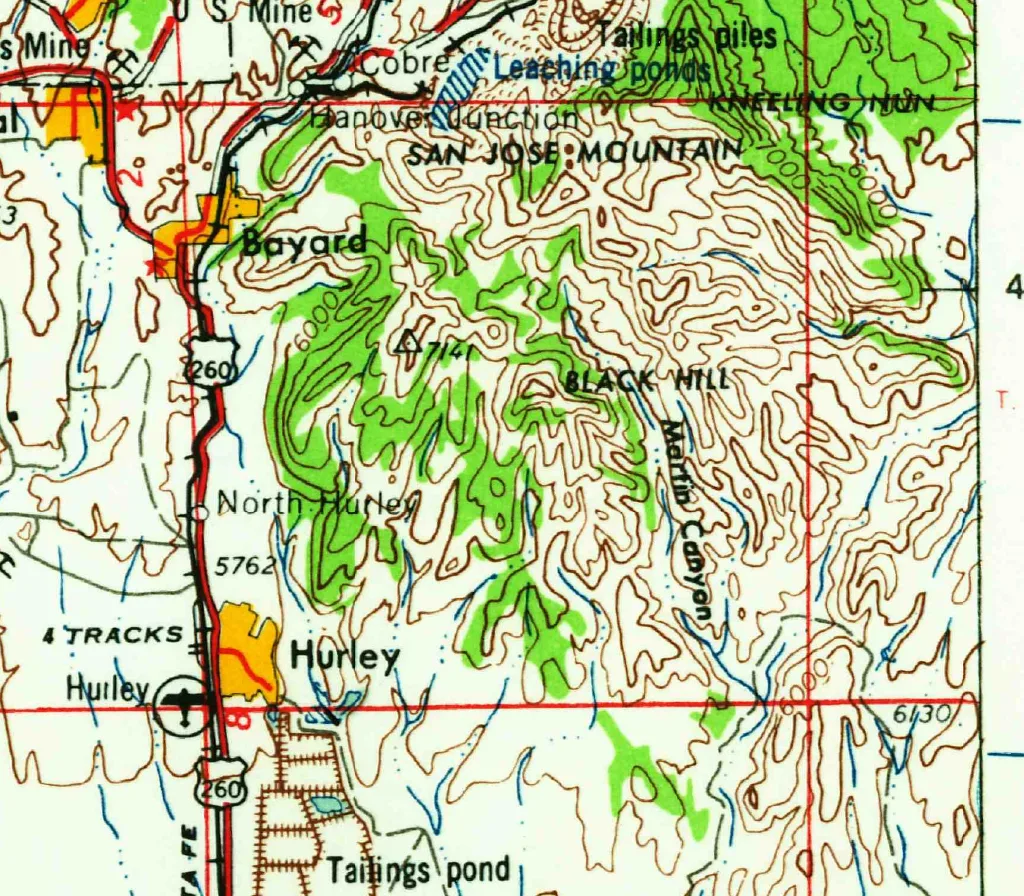
In 1958 a Geological Survey map printed the name North Hurley. That year's edition of the Survey's Silver City sheet, drawn at a scale of 1:250,000 and revised from 1953 aerial photographs, sets the name beside US 260 just north of Hurley. Editions of the same sheet from 1954 and 1962 show the settlement along the highway but do not print the name North Hurley.
Sources: U.S. Geological Survey / Army Map Service, Silver City, New Mexico; Arizona, 1:250,000 (NI 12-12), 1958 edition (USGS map id 193070); planimetry revised from 1953 aerial photography; U.S. Geological Survey / Army Map Service, Silver City, 1:250,000, 1962 edition (USGS map id 193072) and 1954 edition (id 193069) (1954-1962): map face, same area; label 'North Hurley' absent on ids 193069 (1954), 194451 (1954 base, later revision) and 193072 (1962)
Carl W. Scholl's list of Grant County towns, camps, railroad stops and post offices, compiled in 2007 for the NMGenWeb Grant County site, adds a settlement from these years. Scholl lists Littlesville, also called Little Town, as a 1950s settlement north of Hurley. His entry gives that location only and does not use the name North Hurley.
Two geologists wrote of a problem underground. In 1965 Frederick D. Trauger and Gene C. Doty wrote that waste water from mines and ore processing in the Fierro-Hanover-Santa Rita-North Hurley areas had, years earlier, soaked into the alluvial aquifer of the Whitewater Creek valley, the water-bearing stream deposits beneath it. The seepage, in their words, "forced abandonment of many domestic wells."
A year later North Hurley appears in print as a business address. The 1966 yearbook of Cobre High School, The Chieftain, carries an advertisement for the A&B Food Store in North Hurley, telephone 537-2118, offering quality and service. Kennecott advertised in those pages as Kennecott Copper Corporation, Chino Mines Division, Santa Rita, Hurley, New Mexico. The Hurley Stores took a separate advertisement.
Strikes, pollution bonds and a water plan, 1967 to 1976
In a decision of 21 May 1969, the NLRB recorded that the Steelworkers had merged with Mine-Mill in July 1967. By then, the board said, the Hurley production workers were represented by United Steelworkers Local 890. A New Mexico Supreme Court opinion of 1970 sets out what happened that summer. On 14 July 1967 Local 1563 of the International Association of Machinists struck Kennecott's Chino Mines Division at Hurley and Santa Rita. Next day Steelworkers Local 890 and Office Employees Local 62 picketed the Hurley plant and the Santa Rita mine, and the company shut down.
Sources: National Labor Relations Board, Kennecott Copper Corp., Chino Mines Division (Case 28-UC-28), 176 NLRB 96 (1969-05-21): 176 NLRB 96, n. 1, and Order at 97; Supreme Court of New Mexico, Kennecott Copper Corp., Chino Mines Division v. Employment Security Commission, 81 N.M. 532, 469 P.2d 511 (1970) (1970-05-18): 81 N.M. at 532-533
On 16 March 1973 the New Mexico Supreme Court ruled that the Town of Hurley could issue industrial revenue bonds to pay for pollution-control equipment at Kennecott's plant, which lay adjacent to the town. The bonds rested on an agreement of 17 May 1972. In June 1974, Lorence writes in Palomino, his 2013 book on Clinton Jencks and Mexican American unionism, Juan Chacón took Local 890 out in a wildcat strike. Chacón was protesting the international union's unilateral extension of the standing contract on 1 July.
Sources: Supreme Court of New Mexico, Kennecott Copper Corp. v. Town of Hurley, 84 N.M. 743, 507 P.2d 1074 (1973) (1973-03-16): 84 N.M. at 745, district court finding 4 (quoted in the opinion); James J. Lorence, Palomino: Clinton Jencks and Mexican-American Unionism in the American Southwest (2013): Lorence 2013, p. 181 (per index)
Rosenfelt, writing for the 1978 edition of the screenplay, describes Chacón as the film's Ramon Quintero and the president of Local 890 during the filming. He had worked in the Hurley smelter for the past twenty years, she writes, and was again the local's president when she wrote. Baker's account places the Chacóns' house of the mid-1940s in North Hurley.
Sources: Michael Wilson; Deborah Silverton Rosenfelt, Salt of the Earth: Screenplay by Michael Wilson, with commentary by Deborah Silverton Rosenfelt (Old Westbury, N.Y.: Feminist Press, 1978); Ellen R. Baker, On Strike and On Film: Mexican American Families and Blacklisted Filmmakers in Cold War America (2007): Baker 2007, passage on housing and living conditions (archive.org full-text search snippet; page not shown)
Harbridge House prepared a social and economic profile of southwestern New Mexico for the Bureau of Land Management, published in 1978. It counted the Town of Hurley at 1,626 people in 1976 and called Hurley the only exception to the pattern of projected growth among the region's incorporated communities, its population having declined in recent years. Its table projected only 1,650 people by 2000. In a table of water systems for 1976, the profile listed the Hurley water department with a short comment: "planning improvements in North Hurley."
Read more on Salars.net
Part 4 of 7 of the series North Hurley, New Mexico: the other side of the tracks.
Cite this page: “Left outside the town, 1946 to 1977.” Grant County Atlas, Salars.net, first published 19 November 2026. https://atlas.salars.net/stories/north-hurley/left-outside-the-town-1946-1977
Discussion
What would you add or question? Comments are reviewed before they appear.
Loading comments…