In Claude Dannelley's recollection, tents and shacks filled A Street at Hurley in 1910, a street he placed in North Hurley, and about 1911-12 a business strip grew up there on land the Chino Copper Company leased. By 1917 North Hurley had its own school, the Albuquerque Morning Journal reported, and Dannelley said Prohibition closed nearly all its saloons and gambling houses in 1918.
Tents west on A Street, Hurley, 1910
In the fall of 1910, Claude Dannelley recalled, no camping, horses or mules were allowed on the south side of the Santa Fe tracks at Hurley. Dannelley began recording his memories of the town on tape on 13 July 1960. About 200 men were employed at Hurley that fall, he said, and people arrived daily by wagon, buggy and train. In his account the only water for animals and campers came by pipeline from the B ranch, feeding corrals, mule barns and a livery stable.
West on A Street, as far as a little muddy reservoir, the ground filled fast with tents, shacks and camps, Dannelley remembered. Campers carried water from yard hydrants set about every 220 feet. "Camp sites were available to one and all for $1 per month ground rent," he said. He placed A and B streets in North Hurley, the settlement that grew north of the tracks.
Sources: Claude Dannelley (spelled Claud Dannelley / Donnelley within the text), Hurley, New Mexico: Historical Data from 1910-1960. 50 Years of Recorded Memories by Claude Dannelley (transcript of a tape begun July 13, 1960, with a later note of about 1963; 10 pages, distributed by JW Art Gallery, 'The Old Hurley Store') (1960-07-13 (note c. 1963; PDF posted c. 2010)); Claude Dannelley (taped 13 July 1960; transcript posted by hurleynm.com), Hurley, New Mexico: Historical Data from 1910-1960, 50 Years of Recorded Memories by Claude Dannelley (1960-07-13): p. 2; p. 4
Building went on after the shift, by his account. The working day ran from 7 a.m. to 6 p.m., so the men pooled their labor and tools each evening to raise shacks and tents of one or two rooms. Nearly all of that work, Dannelley said, was done by coal-oil lantern and in the early dawn. Hours fell soon afterward: early in 1911 the day was cut to nine hours, he said, and by 1912 to eight.
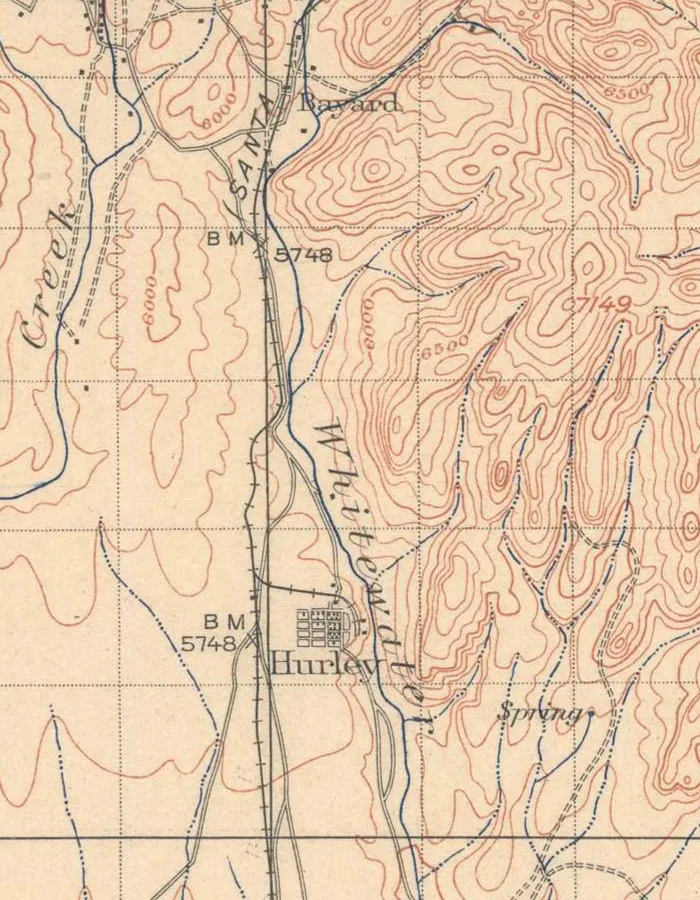
A bench mark, a station and a disputed namesake, 1907 to 1917
Government maps show the ground north of the station before any settlement was drawn there. A U.S. Geological Survey topographic sheet of the Silver City area, surveyed in 1907 and printed in 1909, marks a Hurley bench mark, a surveyed elevation point, with the figure 5748 on the Santa Fe line. Between it and Bayard to the north it shows only the railroad, roads, Whitewater Creek and another bench mark, with no buildings or settlement name. A reprint corrected in November 1914 adds Hurley as a small street grid east of the tracks, with a road curving around it. North toward Bayard that sheet still shows no settlement.
Sources: U.S. Geological Survey, Silver City, N.M., 30-minute (1:125,000) topographic quadrangle, edition of 1909 (surveyed 1907), scan 189426: map face, T.18S. R.12W. near the railroad south of Bayard ('Hurley BM 5748'); credit note lower left; U.S. Geological Survey (E. C. Barnard, geographer in charge; topography by A. B. Searle, J. H. Sinclair, Gilbert Young and Chas. Hartmann Jr.), Silver City Quadrangle, New Mexico: Topography sheet, Geologic Atlas Folio 199 (surveyed 1907; edition of June 1909, reprinted with corrections Nov. 1914) (1914-11); U.S. Geological Survey (S. Paige, folio author; topography surveyed 1907), Silver City folio, New Mexico (Geologic Atlas of the United States, Folio 199), topographic sheet (1916)
Two sources give the stop different names. Carl W. Scholl's 2007 list of Grant County towns gives a railroad stop called Hilltop in the early 1900s, now Hurley, and says the Hurley post office opened on 15 November 1910 at a place that had been Hilltop. The El Paso Herald of 18 July 1910 called the place Hurley station, on the Santa Fe branch from Whitewater to Santa Rita. Neither source explains the other's name. In August 1917 the Albuquerque Morning Journal reported that A. K. Byrne, the Santa Fe's Hurley agent for eight years, had resigned.
Sources: Carl W. Scholl (NMGenWeb Grant County), Grant County Towns (list of towns, post offices, railroad stops and settlements), compiled by Carl W. Scholl, 2007: entry 'Hilltop'; Grant County Towns list, entry 'Hurley'; El Paso Herald, July 18, 1910, page 5 (Chino Copper mill article) (1910-07-18): p. 5; Albuquerque Morning Journal, August 19, 1917, page 12, 'Hurley' column (1917-08-19): p. 12, Hurley column
Sources also differ over the namesake's middle initial. Dannelley said the place was named for a Santa Fe Railway official, J. E. Hurley, when the branch from Whitewater to the Fierro siding was laid to haul ore from the CF&I mines at Fierro, long before Chino acquired the property. On 16 August 1910 the Santa Fe New Mexican reported the death at Carlsbad, in Austria, of James E. Hurley, general manager of the Santa Fe. The El Paso Herald wrote of the late J. E. Hurley on 29 August 1910. On 5 August 1917, however, the Albuquerque Morning Journal reported that the town was named for James M. Hurley, late general manager of the Santa Fe system.
Sources: Hurley, New Mexico: Historical Data from 1910-1960. 50 Years of Recorded Memories by Claude Dannelley (transcript, taped from July 13, 1960, with note of c. 1963; distributed by JW Art Gallery, The Old Hurley Store) (1960-07-13): p. 1; Santa Fe New Mexican, August 16, 1910, page 1, 'James E. Hurley dead at Carlsbad' (1910-08-16): p. 1; El Paso Herald, August 29, 1910, page 11 (railroad news) (1910-08-29): p. 11; Albuquerque Morning Journal, August 5, 1917, page 10 (society section), 'Hurley' column (1917-08-05): p. 10, Hurley column
Chino Copper buys the B ranch and its water, 1910 to 1918
The B ranch, where Dannelley's North Hurley street would later end, already belonged to Chino in July 1910. The El Paso Herald reported on 18 July 1910 that the Chino Copper Company's mill would stand on the B ranch, one mile from Hurley station. Chino had bought the ranch recently from the Victoria Land and Cattle Company "for its valuable location and large water supply", the Herald said. It reported that the company had platted a townsite near the mill, to remain under company control, and had opened a branch of the Santa Rita Store Company there. A spur from Hurley to the mill was nearly graded.
Sources: El Paso Herald, July 18, 1910, page 5 (Chino Copper mill article) (1910-07-18): p. 5; Hurley, New Mexico: Historical Data from 1910-1960. 50 Years of Recorded Memories by Claude Dannelley (transcript, taped from July 13, 1960, with note of c. 1963; distributed by JW Art Gallery, The Old Hurley Store) (1960-07-13): p. 3
Water drew the mill to this spot, the Herald reported. On 20 July 1910 it described a pumping plant going in at Apache springs near Whitewater. Chino was installing it under a contract with the company the Herald now spelled Victorio Land and Cattle, and the paper printed the allowance as 3,000 gallons a day. In June 1911 the Herald reported that grading for the concentrator had begun in July 1910. That November it said the mills were going up at Hurley because water was more plentiful there, with over 1,300 men employed in the Santa Rita mines and the Hurley mills.
Sources: El Paso Herald, July 20, 1910, page 10, 'Chino pumping plant installed near Hurley' (1910-07-20): p. 10; El Paso Herald, June 21, 1911, page 52 (Chino Copper / Santa Rita feature, 'Concentrating Mill') (1911-06-21): p. 52; El Paso Herald, November 2, 1911, page 8 (Chino Copper feature, 'Two New Towns Built') (1911-11-02): p. 8
Chino later bought the springs, the Deming Graphic reported in April 1913. In the paper's words, the company had recently bought the Apache Tejo and Warm Springs from the Victorio Land and Cattle Company. Paige's 1916 Geological Survey folio describes the springs as Chino developed them. Chino had dug a deep pit at the warm springs of Apache Tejo, raising the flow to about 4.5 second-feet, or cubic feet each second. The company pumped that water to the Hurley concentrator.
Sources: Deming Graphic, April 15, 1913, page 1 (Chino Copper mine report) (1913-04-15): p. 1; Sidney Paige (U.S. Geological Survey), Description of the Silver City Quadrangle, New Mexico (Geologic Atlas of the United States, Folio 199) (1916): text.pdf p. 19, Underground water
Chino's land at Hurley appears in the mining handbooks of those years. The Copper Handbook for 1912-13 gives 7,997 acres at Hurley for mill site and water rights, 6,600 owned outright and the rest leased from the state and from individuals. It lists Hurley as the company's mine office. By 1916 the Mines Handbook gives 18,568 acres, 13,800 owned outright and the remainder in process of patent. Its 1918 international edition gives 17,170 acres patented, the rest still in process.
Sources: Walter Harvey Weed (compiler), The Copper Handbook, Vol. XI, 1912-1913 (published 1914), entry 'Chino Copper Co.': p. 235, Chino Copper Co; p. 234, Chino Copper Co; Walter Harvey Weed, The Mines Handbook (The Copper Handbook), Vol. XII (1916), entry 'Chino Copper Co.': Chino Copper Co. entry, New Mexico section; Walter Harvey Weed, The Copper Handbook, International Edition, Vol. XIII (1918), entry 'Chino Copper Co.': Chino Copper Co. entry, New Mexico section
The leased strip in North Hurley, about 1911 to 1912
Meanwhile the company town rose quickly, by newspaper accounts. A year earlier the site had been "a bald prairie", the Santa Fe New Mexican reported on 10 June 1911. Hurley now held over 800 people in some 60 cottages, the paper said. It listed a large general store, a post office building with a news stand and ice cream parlor, a hotel, a meat market, a moving picture show and a saloon.
Sources: Santa Fe New Mexican, June 10, 1911, page 3, 'Hurley' (mining news) (1911-06-10): p. 3, 'Hurley'
North Hurley's commercial street began with a lease, in Dannelley's account. About 1911-12, he said, Chino leased a strip of land in North Hurley, roughly where the Hurley golf course lay when he spoke, and individuals put up their own businesses on it. A street was laid out from the Old Bayard road east to the B ranch. He named the businesses along it, starting with John Byrne's grocery at the west end. Next came a little shoe repair shop, a small jewelry store and the Blue Goose Saloon run by Joe McAllister, with Max Gauding's meat market at the east end, above the later rodeo arena.
Sources: Claude Dannelley (spelled Claud Dannelley / Donnelley within the text), Hurley, New Mexico: Historical Data from 1910-1960. 50 Years of Recorded Memories by Claude Dannelley (transcript of a tape begun July 13, 1960, with a later note of about 1963; 10 pages, distributed by JW Art Gallery, 'The Old Hurley Store') (1960-07-13 (note c. 1963; PDF posted c. 2010)); Claude Dannelley (taped 13 July 1960; transcript posted by hurleynm.com), Hurley, New Mexico: Historical Data from 1910-1960, 50 Years of Recorded Memories by Claude Dannelley (1960-07-13): p. 3; Hurley, New Mexico: Historical Data from 1910-1960. 50 Years of Recorded Memories by Claude Dannelley (transcript, taped from July 13, 1960, with note of c. 1963; distributed by JW Art Gallery, The Old Hurley Store) (1960-07-13): p. 3
Larger establishments followed, as Dannelley remembered it. A large saloon and gambling hall went up there, he said, and beside it a two-story brothel of 25 rooms, with a row of ten one-room adobe rooms nearby, all under one owner. Most of the brawls, shootings and killings of those years broke out in North Hurley, according to Dannelley, and the company kept a large police force, especially during the First World War.
Sources: Claude Dannelley (spelled Claud Dannelley / Donnelley within the text), Hurley, New Mexico: Historical Data from 1910-1960. 50 Years of Recorded Memories by Claude Dannelley (transcript of a tape begun July 13, 1960, with a later note of about 1963; 10 pages, distributed by JW Art Gallery, 'The Old Hurley Store') (1960-07-13 (note c. 1963; PDF posted c. 2010)); Claude Dannelley (taped 13 July 1960; transcript posted by hurleynm.com), Hurley, New Mexico: Historical Data from 1910-1960, 50 Years of Recorded Memories by Claude Dannelley (1960-07-13): p. 3; Hurley, New Mexico: Historical Data from 1910-1960. 50 Years of Recorded Memories by Claude Dannelley (transcript, taped from July 13, 1960, with note of c. 1963; distributed by JW Art Gallery, The Old Hurley Store) (1960-07-13): p. 4
Farther north the land was still empty in 1911, Dannelley said. On 10 August 1911 three masked men held up Chino superintendent John M. Sully and two company officers between Santa Rita and Hurley, the El Paso Herald reported. The robbers expected the payroll but got $150 and three watches. Dannelley placed the holdup two miles north of Hurley, about where the Penjamo Night Club stood in 1960, and said that area was uninhabited at the time.
Sources: El Paso Herald, August 11, 1911, page 1, 'Posse first held prisoners' (1911-08-11): p. 1; Hurley, New Mexico: Historical Data from 1910-1960. 50 Years of Recorded Memories by Claude Dannelley (transcript, taped from July 13, 1960, with note of c. 1963; distributed by JW Art Gallery, The Old Hurley Store) (1960-07-13): p. 3
Boarding houses, Tent Row and the company's waiting list, Hurley, 1910s
Company houses were scarce, by Dannelley's account. Employees applied and were assigned houses in that order as they came free, and at times as many as 300 names stood on the waiting list. Besides the private tents and shacks on A and B streets in North Hurley, he said, Chino built Tent Row, a double row of 40 boxed, floored tents that served mostly as bachelors' quarters. Ellen R. Baker, in her 2007 book On Strike and on Film, writes that Mexican workers built their own houses in Santa Rita's "Mexican Town" and in North Hurley.
Sources: Hurley, New Mexico: Historical Data from 1910-1960. 50 Years of Recorded Memories by Claude Dannelley (transcript, taped from July 13, 1960, with note of c. 1963; distributed by JW Art Gallery, The Old Hurley Store) (1960-07-13): p. 6; Claude Dannelley (spelled Claud Dannelley / Donnelley within the text), Hurley, New Mexico: Historical Data from 1910-1960. 50 Years of Recorded Memories by Claude Dannelley (transcript of a tape begun July 13, 1960, with a later note of about 1963; 10 pages, distributed by JW Art Gallery, 'The Old Hurley Store') (1960-07-13 (note c. 1963; PDF posted c. 2010)); Claude Dannelley (taped 13 July 1960; transcript posted by hurleynm.com), Hurley, New Mexico: Historical Data from 1910-1960, 50 Years of Recorded Memories by Claude Dannelley (1960-07-13): p. 4; Ellen R. Baker, On Strike and on Film: Mexican American Families and Blacklisted Filmmakers in Cold War America (University of North Carolina Press, 2007), ch. 2, "Grant County's Mining District": ch. 2
Boarding houses north of the tracks fed many workers, as Dannelley recalled. He said there were three boarding houses on the north side, one of them kept by his own parents, whose house averaged about 80 boarders a day. In August 1913, he recalled, five Chino employees living at a private boarding house north of the tracks caught typhoid, and one died. The authorities closed the house, hauled it to the B ranch, soaked it in coal oil and burned it, and ordered its owners to leave town. Later, before the influenza epidemic of 1918, Dannelley said, Chino feared typhoid from Mexico and built a plant of steam cabinets known as the dipping vat. All job applicants, transients and floaters suspected of carrying the disease were put through it by the medical department, he said.
Sources: Hurley, New Mexico: Historical Data from 1910-1960. 50 Years of Recorded Memories by Claude Dannelley (transcript, taped from July 13, 1960, with note of c. 1963; distributed by JW Art Gallery, The Old Hurley Store) (1960-07-13): p. 5; p. 7; Claude Dannelley (spelled Claud Dannelley / Donnelley within the text), Hurley, New Mexico: Historical Data from 1910-1960. 50 Years of Recorded Memories by Claude Dannelley (transcript of a tape begun July 13, 1960, with a later note of about 1963; 10 pages, distributed by JW Art Gallery, 'The Old Hurley Store') (1960-07-13 (note c. 1963; PDF posted c. 2010))
Fuel came from the hills and from the mine, in Dannelley's memory. He remembered Mexican wood haulers who packed stove wood into Hurley on burros and sold it for $1.00 a load. Chino gave away old mine timber as fuel, he said, and delivered it free until a hidden dynamite cap blew a kitchen stove through the roof of a non-company shack across the tracks. That accident ended the free deliveries.
Handball, a dance hall and 16 September in North Hurley
Dannelley said that Hurley's two communities were kept apart. He called them Americans and Spanish-Americans. They were not allowed to mix, he said, so the Mexican families' dance hall and handball court stood on B Street in North Hurley. Americans were kept off the north side, and Spanish-Americans off the south side, at night until about 1916, according to his account. Handball, which he called the main Mexican sport, was played by striking a hollow ball with the open palm against a high two-sided adobe wall on B Street. North Hurley also had its own Star Theatre on C Street, he said.
Sources: Claude Dannelley (taped 13 July 1960; transcript posted by hurleynm.com), Hurley, New Mexico: Historical Data from 1910-1960, 50 Years of Recorded Memories by Claude Dannelley (1960-07-13): p. 7; Claude Dannelley (spelled Claud Dannelley / Donnelley within the text), Hurley, New Mexico: Historical Data from 1910-1960. 50 Years of Recorded Memories by Claude Dannelley (transcript of a tape begun July 13, 1960, with a later note of about 1963; 10 pages, distributed by JW Art Gallery, 'The Old Hurley Store') (1960-07-13 (note c. 1963; PDF posted c. 2010))
Mexican Independence Day was an annual affair on the north side, Dannelley recalled. It ran two days and nights, usually on 15 and 16 September, around the north side tennis court, with fireworks, rodeos and ring-tournament races on horseback. A round of dynamite shots fired at 5 a.m. served as the opening salute each year, and Chino supplied the dynamite free of charge, he said.
A school north of the tracks, Hurley, 1914 to 1919
Hurley's first school, Dannelley remembered, opened in a three-room house. The state's directories for 1913 to 1916 list one school district for Hurley. New Mexico's educational directory for 1913-1914 lists it as Grant County district 1-26, with four teachers under Mrs. Aubrey B. Carter. A note at the end of that directory records that Precinct 26 became District No. 4, "known as Hurley". The 1915-1916 directory lists District No. 4 with five teachers under Mrs. A. B. Carter. Neither directory lists a separate North Hurley school.
Sources: Hurley, New Mexico: Historical Data from 1910-1960. 50 Years of Recorded Memories by Claude Dannelley (transcript, taped from July 13, 1960, with note of c. 1963; distributed by JW Art Gallery, The Old Hurley Store) (1960-07-13): p. 5; New Mexico State Department of Education, New Mexico Educational Directory, 1913-1914, 1914-1915 and 1915-1916 (bound together) (1914-01-01)
North Hurley got its own school building in 1917, according to the Albuquerque Morning Journal's Hurley column. On 5 August 1917 the Journal reported that the new school building in North Hurley was practically ready for occupancy. The column hoped that the annex, which was to hold 300 children and employ four teachers, would relieve the "congested condition in the South Hurley schools".
Its opening came late. On 2 September 1917 the Journal reported that the South Hurley public school had opened with 400 pupils, a number to be greatly increased when the North Hurley school opened. That opening was delayed a week because supplies had not arrived. Hurley's schools had twelve teachers that year, five of them new, with Miss Eugenia Herber as assistant principal. On 14 October 1917 the Journal reported that 250 pupils had enrolled at the opening of the new North Hurley school, under Miss Herber, whose name it printed as Huerber.
Sources: Albuquerque Morning Journal, September 2, 1917, page 11, 'Hurley' column (1917-09-02): p. 11, Hurley column; Albuquerque Morning Journal, October 14, 1917, page 11 (society section), 'Hurley' column (1917-10-14): p. 11, Hurley column
Mrs. Carter had built the system from very small beginnings into one occupying five buildings, the Journal's Hurley column reported in January 1918. In 1919 Chino helped the teachers travel, according to the Silver City Enterprise. It reported that the company would charter a Pullman car to carry and lodge the twenty-seven teachers of Hurley and Santa Rita on a trip to Albuquerque. The Journal reprinted the item on 17 November 1919.
Sources: Albuquerque Morning Journal, January 6, 1918, page 5 (seq. 13), 'Hurley' column (1918-01-06): p. 5, Hurley column; Albuquerque Morning Journal, quoting the Silver City Enterprise, Albuquerque Morning Journal, November 17, 1919, page 4, 'Making Easy for Teachers' (reprinted from the Silver City Enterprise) (1919-11-17): p. 4, 'Making Easy for Teachers'
An acquittal, soldiers and the closing of North Hurley's saloons, 1917 to 1918
A killing at Hurley in 1917 reached the state papers. A state news summary in the Western Liberal of 6 July 1917 reported that a special officer had killed a Mexican miner at Hurley. Another Mexican man was then shot dead by unknown parties, the summary said, and several suspects were held. In April 1918 the paper reported that the officer, described as a deputy sheriff and rancher of the Hurley district, had been acquitted of murder after a three-day trial at Silver City.
Sources: Western Liberal / Western Newspaper Union News Service, Western Liberal (Lordsburg), July 6, 1917, page 6 (state news summary, Western Newspaper Union) (1917-07-06): p. 6, state news column; Western Liberal / Western Newspaper Union, Western Liberal (Lordsburg), April 26, 1918, page 2 (state news summary) (1918-04-26): p. 2
Soldiers came to the district during the First World War. Dannelley recalled that during a visit by D. C. Jackling's party in 1917, about 4,000 soldiers from Camp Cody at Deming were camped at Apache Tejo on a practice hike. In October 1917 the Albuquerque Morning Journal reported that two men had been held for trial in federal court, accused of giving liquor to soldiers who had spent the weekend in Hurley. Prohibition in 1918, Dannelley said, closed nearly all the saloons and gambling houses in North Hurley.
Sources: Hurley, New Mexico: Historical Data from 1910-1960. 50 Years of Recorded Memories by Claude Dannelley (transcript, taped from July 13, 1960, with note of c. 1963; distributed by JW Art Gallery, The Old Hurley Store) (1960-07-13): p. 6; Albuquerque Morning Journal, October 21, 1917, page 14, 'Hurley' column (1917-10-21): p. 14, Hurley column; Claude Dannelley (spelled Claud Dannelley / Donnelley within the text), Hurley, New Mexico: Historical Data from 1910-1960. 50 Years of Recorded Memories by Claude Dannelley (transcript of a tape begun July 13, 1960, with a later note of about 1963; 10 pages, distributed by JW Art Gallery, 'The Old Hurley Store') (1960-07-13 (note c. 1963; PDF posted c. 2010)); Claude Dannelley (taped 13 July 1960; transcript posted by hurleynm.com), Hurley, New Mexico: Historical Data from 1910-1960, 50 Years of Recorded Memories by Claude Dannelley (1960-07-13): p. 7
Read more on Salars.net
Part 2 of 7 of the series North Hurley, New Mexico: the other side of the tracks.
Cite this page: “A ranch, a siding and a leased strip, 1910 to 1920.” Grant County Atlas, Salars.net, first published 19 November 2026. https://atlas.salars.net/stories/north-hurley/a-ranch-a-siding-and-a-leased-strip-1910-1920
Discussion
What would you add or question? Comments are reviewed before they appear.
Loading comments…