Between 1883 and 1892 Kingston grew from a camp that a Las Vegas correspondent called a little more than three months old into a town with a bank, brick buildings, a school, a church, stage lines and its own reduction works. The Director of the Mint's report for 1887 said it showed the greatest activity of all New Mexico camps. How many people lived there depends on whose figure is used. A newspaper correspondent estimated one to two thousand in 1883. Springer cites the 1885 territorial census as counting 329 in Kingston and the outlying Danville camp. For 1890 Springer cites the census as counting 633 in Kingston and 816 in the mining district, while the Hillsboro National Register document gives Kingston 816.
Kingston in January 1883, as a Las Vegas correspondent saw it
In letters printed on 4 and 5 January 1883, a correspondent of the Las Vegas Daily Gazette wrote from Kingston, the camp on the Middle Percha. He said the place was only a little more than three months old. Yet it held, in his words, "a population estimated all the way from one to two thousand". Kingston was the supply point for several times that many prospectors, he said, and he passed along its billing as a second Leadville.
Sources: Las Vegas Daily Gazette correspondent, Las Vegas Daily Gazette, 4 and 5 January 1883, p. 2: 'Kingston' letters signed Hamfeler (?) (1883-01-04): p. 2, 'Kingston'; Horatio C. Burchard, Director of the Mint, Report of the Director of the Mint upon the production of the precious metals in the United States during the calendar year 1883 (1884): Grant County, Kingston or Percha district, p. 584
His second letter described one principal street about half a mile long. One- and two-story frame houses stood along it, shaded by large pines that had been left standing, and a footbridge crossed the gully on Main Street. He named some of the people in business there. Chas. Reed's Occidental sold general merchandise and offered beds, and George Close kept the Long Branch saloon and music hall. Judge Wm. Burns, the new justice of the peace, kept a saloon the letter called My Saloon.
By March the first rush had ebbed, in the view of the Black Range, a newspaper published at Robinson. It wrote on 16 March 1883 that Kingston had felt the ebb that follows every rush of people. Still, it called the camp solid, saying the ebb had "left the beach clean". In June the Black Range reported that the Kingston Tribune had issued a pamphlet describing the Percha country, its mineral claims and its resources, and judged it a valuable promoter of emigration to the region.
Sources: The Black Range (Robinson), 16 March 1883, p. 1: 'Lone Star, Kingston and the Range' (1883-03-16): p. 1, 'Lone Star, Kingston and the Range'; The Black Range (Robinson), 8 June 1883, p. 3 (1883-06-08): p. 3
The Superior, the Bullion and the Mint's report for 1883
For 1883 the Report of the Director of the Mint credited Grant County's larger output that year "largely to the energetic development of the Kingston mines". The report, which counted Kingston's mines in Grant County, called it a thriving village on the Middle Percha that owed its growth to the rich discoveries nearby. It counted three camps in the district: North Percha, Middle Percha and South Percha.
Sources: Horatio C. Burchard, Director of the Mint, Report of the Director of the Mint upon the production of the precious metals in the United States during the calendar year 1883 (1884): Chapter IX, New Mexico, opening review, p. 562; Horatio C. Burchard, Director of the Mint, Report of the Director of the Mint upon the production of the precious metals in the United States during the calendar year 1883 (1884): Grant County, Kingston or Percha district, p. 584
In the report's account the Superior was Kingston's most developed mine in 1883. It had seven shafts and inclines, an incline being a shaft sunk at a slant, and its main shaft was about 300 feet deep. A horse whim, a winch turned by a horse, did the hoisting. It had shipped some 250 tons of high-grade ore, and about 1,000 tons of unsorted ore lay on its dump. Ore was being mined and hoisted faster than five ore-sorters could handle it, the report said.
Ore from the neighbouring Bullion went to Denver by the carload. Fifteen carloads reportedly returned nearly $50,000, according to the 1883 report. It estimated the Bullion's production for the year at $100,000, with $15,000 paid in dividends and 15 to 30 men at work. In January 1883 the Lincoln County Leader, at White Oaks, had reported that some 70 tons of very rich ore had gone out from the Bullion, and reported a great strike in the Superior. By June the Kingston Tribune was reporting that the Superior company's new office was rapidly being completed and that a town was springing up at the Bullion and Superior.
Sources: Horatio C. Burchard, Director of the Mint, Report of the Director of the Mint upon the production of the precious metals in the United States during the calendar year 1883 (1884): Kingston or Percha district, p. 585; Lincoln County Leader (White Oaks), 27 January 1883, p. 2 (1883-01-27): p. 2; The Black Range (Robinson), 8 June 1883, p. 3 (1883-06-08): p. 3, Kingston Tribune excerpts
In the 1883 report the Lady Franklin was a 110-foot incline that had struck ore like the Bullion's at 85 feet, with about 10 tons of high-grade ore sacked and estimated at $700 a ton. About 3 miles south of Kingston, in the South Percha camp, the Monaska had an incline nearly 250 feet deep, steam hoisting works and 24 men. Its ore was said to average 236 ounces of silver a ton, and was reported to return $3,000 to $10,000 a carload.
George Townsend Harley, in a 1934 bulletin of the New Mexico Bureau of Mines and Mineral Resources, grouped Kingston's mines by where they lay. He put the Blackeyed Susan, Andy Johnson, Brush Heap, Calamity Jane, Illinois and United States half a mile above town on the Middle Percha. Nearly a mile north he placed the Comstock, Black Colt, Kangaroo, Caledonia, Lady Franklin, Superior and Bullion. Near the monzonite, an igneous rock, oxidation had produced much native silver, Harley wrote, in ore up to 250 ounces a ton and some assaying as high as 1,000 ounces.
Wagons, roads and a smelter for Kingston, 1883 to 1891
Kingston's nearest shipping point in 1883 was Nutt Station, 40 miles away by wagon road, according to the Mint report, which looked to a railroad reaching Hillsborough and perhaps Kingston. Hundreds of tons of lower-grade Bullion ore lay on the dump, waiting for reduction works, a plant to extract the metal, to be built at Kingston. The Iron King's owners, employing eighteen men, were building a 70-ton smelter of the kind used at Leadville, the report said. A smelter melts ore in a furnace to separate its metal. They planned room for three such furnaces, had the foundations nearly done and had contracted for 200,000 bricks.
A wagon road ran from the Gray Eagle camp on the South Percha to Kingston, according to the 1883 Mint report. In June 1883 the Kingston Tribune, in an item the Las Vegas Daily Gazette reprinted on 12 June, reported that the camp's first steam hoisting plant had arrived for the Bush, or Traitor, mine on the South Percha. It added that the Monaska company was building a road from Kingston to Trujillo Creek.
Sources: Horatio C. Burchard, Director of the Mint, Report of the Director of the Mint upon the production of the precious metals in the United States during the calendar year 1883 (1884): Kingston or Percha district, p. 586; Las Vegas Daily Gazette, reprinting the Kingston Tribune, Las Vegas Daily Gazette, 12 June 1883, p. 2: 'Kingston News, from the Tribune' (1883-06-12): p. 2, 'Kingston News'
On 4 April 1885 the Sierra County Advocate, then published at Hillsborough, said the Kingston smelter would start in about three weeks and that ore was being delivered to its dump. It denied a report in the Albuquerque Journal that the smelter had already started. For 1885 the Mint report said more ore was shipped from the Kingston district in wagon trains than from any other district of its size in New Mexico. It named the Illinois, Superior, Brush Heap, Gray Horse, Black Colt, Caledonia, Iron Clad, Monaska and Forest King as producers.
Sources: Sierra County Advocate (then published at Hillsborough), Sierra County Advocate, 4 April 1885, p. 3, 'Personal and Local' (1885-04-04): p. 3, 'Personal and Local'; James P. Kimball, Director of the Mint, Report of the Director of the Mint upon the production of the precious metals in the United States during the calendar year 1885 (1886): New Mexico, Sierra County, p. 172
In 1888, according to the National Register documentation for Hillsboro, Mr. and Mrs. J. W. Orchard, who ran a stage line out of Silver City, bought the line from Lake Valley through Hillsboro to Kingston. In September 1889 the Advocate reported that Charlie West would run the stage and express business at Kingston while Walter Saunders was away. In May 1891 the same paper said that carrying witnesses to the Apex suit at Silver City had taxed the Gause & Orchard stage line and the livery stables of Kingston and Hillsborough to their utmost.
Sources: Corinne P. Sze, Research Services of Santa Fe, Architectural and Historic Resources of Hillsboro, New Mexico, Part 1: Domestic Architecture (NRHP Multiple Property Documentation Form) (1994-09 (received 1995)): Section E, p. 11-12; Sierra County Advocate (published at Hillsborough in these years), Sierra County Advocate, 1889-09-13, p. 3: p. 3; Sierra County Advocate (published at Hillsborough in these years), Sierra County Advocate, 1891-05-22, p. 3: p. 3
The Percha Bank of Kingston, 1883 to 1888
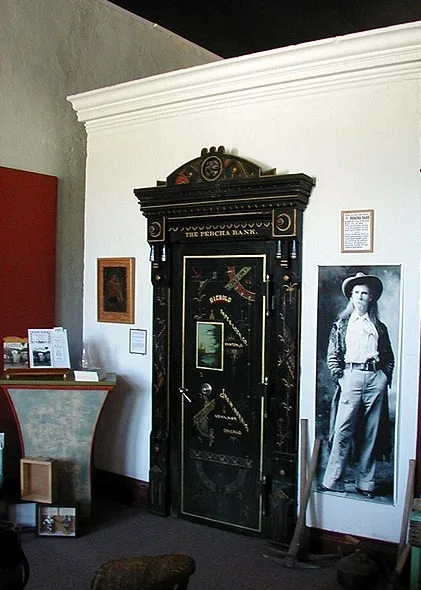
Kingston had a bank by May 1883, when the First National Bank of Las Vegas, whose president was Jefferson Raynolds, listed its correspondent banks in the Las Vegas Daily Gazette. One line read "Percha Bank, Kingston, New Mexico." Melody Groves, writing in Wild West magazine in 2013, described the bank's original vault as an 1885 Diebold. It sits, she wrote, in a brick room within the bank's walls of stone and Kingston brick, two feet thick.
Sources: Las Vegas Daily Gazette, 5 May 1883, p. 3 (San Miguel National Bank correspondents advertisement) (1883-05-05): p. 3, First National Bank of Las Vegas advertisement, correspondents list; Melody Groves, Wild West magazine (HistoryNet), Ghost Towns: Kingston, New Mexico (2013-10 (web 2017-06-14)): web article
By 1887 the bank's name ran through other Kingston business news. In July 1887 the Advocate reported that the Monarch Saloon at Kingston, with its stock and fixtures, had changed hands twice in one day and was understood to belong to the Percha Bank. In August its Kingston column said John W. Zollars, of the Percha Bank, would soon visit his old home in Canton, Ohio. A bank advertisement in January 1888 named Jefferson Reynolds as president and called the bank a depository of the Atchison, Topeka & Santa Fe Railroad. It solicited deposits from mines, miners and businessmen.
Sources: Sierra County Advocate (published at Hillsborough in these years), Sierra County Advocate, 1887-07-15, p. 3: p. 3, Kingston items; Sierra County Advocate (published at Hillsborough in these years), Sierra County Advocate, 1887-08-12, p. 2: p. 2; Sierra County Advocate, 14 January 1888, p. 1 (Percha Bank advertisement) (1888-01-14): p. 1, Percha Bank advertisement
By June 1888 the Percha Bank was advertising in the Advocate that it paid the highest market price for Sierra County warrants, the orders the county issued in place of cash. That same month the Advocate reported that the county commissioners had assessed the Percha Bank on $48,800, the sum it held in trust for the parties to the Grey Eagle mining case.
Sources: Sierra County Advocate (published at Hillsborough in these years), Sierra County Advocate, 1888-06-16, p. 3: p. 3, advertisement; Sierra County Advocate (published at Hillsborough in these years), Sierra County Advocate, 1888-06-16, p. 2: p. 2, county commissioners' proceedings
Claims in dispute, from the Solitaire to the Grey Eagle
Two of the district's mines were tied up in disputes. Work on the Solitaire, in the North Percha camp, had been held back by legal trouble over a double location, one claim staked over another, the 1883 Mint report said. Returns from its high-grade shipments were kept secret. In January 1883 the Gazette's correspondent wrote that little work was going on there, and hinted that Governor Tabor of Colorado could tell why.
Sources: Horatio C. Burchard, Director of the Mint, Report of the Director of the Mint upon the production of the precious metals in the United States during the calendar year 1883 (1884): Kingston or Percha district, p. 586; Las Vegas Daily Gazette correspondent, Las Vegas Daily Gazette, 4 and 5 January 1883, p. 2: 'Kingston' letters signed Hamfeler (?) (1883-01-04): 5 Jan 1883, p. 2
In June 1883 the Kingston Tribune told what happened next, in an item the Las Vegas Daily Gazette reprinted on 17 June. Tabor had held a $100,000 bond on the Solitaire, an option to buy it by a set date. When the bond ran out, the Tribune said, Tabor did not try to renew it and instead jumped the mine, relying on rights bought from Lake Valley claimants. Two brothers then retook possession of the mine, the paper reported.
Litigation had kept the Gray Eagle, on the South Percha, idle for some time, the 1883 Mint report said. The Advocate later spelled it Grey Eagle. A Grey Eagle mining case was before a special master in 1888. In June that year the Advocate reprinted a Silver City Enterprise summary of a draft decision by G. G. Posey, the special master, or master in chancery, a court officer appointed to hear evidence and report. As the Enterprise summarized it, Posey's draft found that the rival parties had made no contract for settlement. It gave the property, the Bismark, which was the claim's old name, to one side, subject to the claims of others.
Sources: Horatio C. Burchard, Director of the Mint, Report of the Director of the Mint upon the production of the precious metals in the United States during the calendar year 1883 (1884): Kingston or Percha district, p. 586; Sierra County Advocate (published at Hillsborough in these years), Sierra County Advocate, 1888-06-16, p. 2: p. 2; p. 2, county commissioners' proceedings
By 1891 the Grey Eagle was being worked under lease. A lessee works a mine for a set term and pays the owner a share of the ore. In May 1891 the Advocate's Kingston News column reported that Barney Martin had taken a six-month lease on the Grey Eagle mine and its dumps. Its ore was to be worked in Kingston's new mill, the paper said.
Apache alarms as the papers reported them, 1885 to 1891
In February 1886 the Sierra County Advocate, published at Hillsborough, reprinted a paragraph from the Las Vegas Optic in order to call it untrue. That paragraph said Captain Fechet's cavalry troop had been stationed at Hillsboro since the previous summer, after the Apaches went on the war path in spring 1885, and had done nothing since. In reply the Advocate said Fechet had constantly sent his troop out after reports of Indians.
In May 1891 the alarm returned in print. That month the Advocate said there was good reason to believe that three or four Apaches had left the San Carlos reservation and were moving about the Black Range. On 2 October 1891 the Silver City Enterprise reprinted a report from the Kingston Shaft. It said a man called only "Kid", evidently the Apache Kid, was thought to be near Victoria's park at the head of the Animas with about eight followers. Ten men of the Tenth Cavalry and five of the Twenty-fourth Infantry had passed through Hillsboro after them.1
School, churches and Chinese residents in Kingston
Kingston's public school appears in the Advocate in February 1885, when the paper reported that the county school fund was divided by the number of children, and that Kingston, counted with 65 school children, received $357.50. A notice in that issue called applicants for teacher to an examination on 10 February at Judge Burns's office, signed by three school directors, among them M. Cosgrove. In May 1887 the Advocate named P. T. McKay as principal, and reported in September 1889 that the school would reopen with Miss Carrie West as teacher.
Sources: Sierra County Advocate (published at Hillsborough in these years), Sierra County Advocate, 1885-02-07, p. 3: p. 3, 'Public Schools'; p. 3, 'Notice to Teachers'; Sierra County Advocate (published at Hillsborough in these years), Sierra County Advocate, 1887-05-13, p. 2: p. 2; Sierra County Advocate (published at Hillsborough in these years), Sierra County Advocate, 1889-09-13, p. 3: p. 3
An editor's note in a later compilation of Silver City Enterprise items says that E. L. Doheny came to Kingston as a young man and taught school between stints in the Kingston mines with Albert Bacon Fall. In October 1891 the Silver City Enterprise reprinted a Kingston Shaft note calling Doheny an old resident of Kingston, now of Silver City. Kingston's schoolhouse, now a museum, dates to about 1891, according to the New Mexico Tourism Department.2, 3
Protestant and Catholic clergy both held services in Kingston. In 1888 the Rev. N. W. Chase wrote a letter for the cornerstone of the Kingston church, as Craig Springer of the Hillsboro Historical Society gives it. In September 1889 the Advocate reported that the Rev. Forrester of Las Cruces would hold an Episcopal service at the Methodist Episcopal church in Kingston. In February 1891 the paper said that the Rev. Thomas Harwood, the Methodist Episcopal superintendent of missions, had held a conference there with Brothers Chase and Owens. In April 1892 it announced Catholic services at Kingston by the Rev. J. Monfort of Hatch, on the 20th and 21st. Members of the Grand Army of the Republic, the Union veterans' organization, established the Kingston cemetery in 1884 and fenced its 10 acres, according to the Hillsboro Historical Society.
Sources: Craig Springer (Hillsboro Historical Society; first posted on Hillsborohistory.blogspot.com, 1 March 2015), Primary Sources and Anecdotes on Kingston's Mythical Past: chronology, 1888 entry; Sierra County Advocate (published at Hillsborough in these years), Sierra County Advocate, 1889-09-13, p. 3: p. 3; Sierra County Advocate (published at Hillsborough in these years), Sierra County Advocate, 1891-02-13, p. 3: p. 3; Sierra County Advocate (published at Hillsborough in these years), Sierra County Advocate, 1892-04-15, p. 3: p. 3, 'Local Notes'; Hillsboro Historical Society (research credited to Barbara Lovell), Kingston New Mexico Cemetery (accessed 2026-11-18): web page, cemetery history section
An Advocate item of February 1885 shows a Chinese community in Kingston by then. It reported that the Chinese New Year was celebrated in Kingston, as elsewhere, with firecrackers and torpedoes. In the fire of 5 June 1890, the Silver City Enterprise reported, the Chinese quarters burned, along with a Chinese store.4
Brick blocks, saloons, paydays and the fire of 1890
In 1887, the Advocate reported, a three-story brick building was going up at Kingston. In July the paper said Barney Martin was gathering material for it, on behalf of Moffatt, Reeves & Martin. By August, the paper said, the walls of the first floor were nearly complete, though that item gave the owners as Hopper, Moffat & Reeves. In May 1887 W. K. McKenzie advertised that he had leased the bar privileges of the Victorio Hotel in Kingston and opened a first-class saloon.
Sources: Sierra County Advocate (published at Hillsborough in these years), Sierra County Advocate, 1887-08-12, p. 2: 15 July 1887 p. 3 and 12 Aug 1887 p. 2, Kingston items; Sierra County Advocate (published at Hillsborough in these years), Sierra County Advocate, 1887-05-20, p. 3: p. 3
A Kingston correspondent wrote to the Advocate in July 1888 that payday at the Enterprise mine on the 11th had put over $6,000 into circulation. Its writer added that a deal on the Virginian mine, so printed, had fallen through, and about thirty men were out of work after it shut down. That Fourth of July, the correspondent wrote, "not a drunk was seen on our streets, nor an arrest made."
Kingston had a fire brigade by September 1889, when the Advocate reported that one Kingston grand juror was excused as a member of it. On 13 June 1890 the Silver City Enterprise reported that a fire on 5 June had destroyed the Templar Building, home of the Knights of Pythias, Masonic and Odd Fellows halls. The same report listed two school houses among the losses.4
In May 1891 the Advocate's Kingston News column reported the baseball season opening with two games on the Sampler Mesa, where the Kingston Kids beat a Hillsborough nine. It said too that only the Brewery, the Monarch and Dawson the druggist had so far taken out licenses under the new law in Kingston. Mr. Marble was the town's postmaster that month, the paper said.
Sources: Sierra County Advocate (published at Hillsborough in these years), Sierra County Advocate, 1891-05-08, p. 3: p. 3, 'Kingston News'; Sierra County Advocate (published at Hillsborough in these years), Sierra County Advocate, 1891-05-22, p. 3: p. 3
Counting Kingston's people, 1883 to 1890
Figures for Kingston's population vary widely by source. In January 1883 the Gazette correspondent's figure was one to two thousand, an estimate for a camp a little more than three months old. Craig Springer, in a 2015 chronology for the Hillsboro Historical Society, cites the 1885 territorial census as counting 329 people in Kingston and the outlying Danville camp. For 1888 he cites a narrative by the Rev. N. W. Chase in The Gospel in All Lands that put Kingston at 1,000. Chase's cornerstone letter of the same year said the town had had 3,000 people a few years earlier, and Springer treats that letter as anecdote.
Sources: Las Vegas Daily Gazette correspondent, Las Vegas Daily Gazette, 4 and 5 January 1883, p. 2: 'Kingston' letters signed Hamfeler (?) (1883-01-04): p. 2, 'Kingston'; Craig Springer (Hillsboro Historical Society; first posted on Hillsborohistory.blogspot.com, 1 March 2015), Primary Sources and Anecdotes on Kingston's Mythical Past: chronology, 1885 entry; chronology, 1888 entry
For 1890 the figure depends on the source. Springer cites the 1890 federal census as recording 633 people in Kingston and 816 in the mining district. Hillsboro's 1994 National Register documentation, citing Carol L. Clark's 1982 thesis at the University of New Mexico, gives Kingston's population in 1890 as 816. Both use the number 816, one for the district and one for the town. Springer also traces how accounts written long after the boom inflated Kingston's early population. Anderson gave 1,800 in 1907 and the El Paso Herald 2,000 in 1913. Hearst's magazine reported 6,000 in 1919, and Black Range Tales gave 7,000 in 1936.
Sources: Craig Springer (Hillsboro Historical Society; first posted on Hillsborohistory.blogspot.com, 1 March 2015), Primary Sources and Anecdotes on Kingston's Mythical Past: chronology, 1890 entry; introduction and chronology, 1907-1936 entries; Corinne P. Sze, Research Services of Santa Fe, Architectural and Historic Resources of Hillsboro, New Mexico, Part 1: Domestic Architecture (NRHP Multiple Property Documentation Form) (1994-09 (received 1995)): Section E, p. 14, note 42 (Clark 1982, 46-47, n. 13)
Ruby silver and the Mint's ranking, 1885 to 1892
Mining men turned toward Kingston in 1885, in the Mint's account. The Mint report's New Mexico chapter for 1885 named Kingston, with Silver City and Socorro, as the centres of attraction for mining men that year. Its account of the Lady Franklin said the mine's ore bodies were not fully shown until late in 1885. After that, for several months, its owners cleared about $100,000 net while spending no more than $15,000 a month. In December 1885 fine bodies of ruby silver ore, a red silver mineral, were developed in the Keystone and Templar mines on the North Percha, about 9 miles from Kingston.
Ruby silver is a point on which the sources disagree. Harley wrote in 1934 that it was said the Gypsy mine, east of Kingston, produced ore worth $200,000 and held the only known ruby silver in the district. Yet the Mint report for 1885 placed ruby silver in the Keystone and Templar. In May 1891 the Advocate reported that the Gypsy had struck rich ore, mostly ruby silver, 100 feet below the creek bed. Harley's Kingston district reached north to North Percha Creek, 6 miles from town, while the Mint placed the Keystone and Templar about 9 miles from Kingston.
Sources: George Townsend Harley, The geology and ore deposits of Sierra County, New Mexico (NMBMMR Bulletin 10) (1934): Mine descriptions, p. 104; Black Range region, p. 66; James P. Kimball, Director of the Mint, Report of the Director of the Mint upon the production of the precious metals in the United States during the calendar year 1885 (1886): New Mexico, Sierra County, p. 172; Sierra County Advocate (published at Hillsborough in these years), Sierra County Advocate, 1891-05-08, p. 3: p. 3, 'Kingston News'
For 1887 the Mint report ranked Kingston first in New Mexico for activity. It said "Kingston, of all the camps in the Territory, shows the greatest activity." Its greatest producers were the Andy Johnson, Bullion, Brush Heap, Black Colt, Comstock, Caledonia, Lady Franklin, Log Cabin and Templar. For 1889 the Mint credited Kingston with $251,000 of the county's silver, behind Lake Valley's $285,000 and ahead of Hermosa's $112,000. Kingston by then had a concentrator, a mill that separates heavy ore minerals from waste rock.
Sources: Report of the Director of the Mint upon the production of the precious metals in the United States during the calendar year 1887 (1888): New Mexico, p. 233; Report of the Director of the Mint upon the production of the precious metals in the United States during the calendar year 1889 (1890): New Mexico (Walter C. Hadley), Sierra County, p. 188
Low-grade ore was the problem Kingston tried to solve in 1891. For 1891 the Mint report said Kingston stood as it had the year before, its people's hopes resting on a new process for treating low-grade ore. That project had since closed, at least for a time. In May 1891 the Advocate reported ore from mines around Kingston being hauled to a new mill, where a Mr. Mead was demonstrating his process by mill-run tests. In October the paper reported a successful run of the new reduction works, with the Brush Heap sampling 200 tons for treatment and a smelting stack still to be blown in, or started up.
Sources: Director of the Mint (New Mexico section by Walter C. Hadley), Report of the Director of the Mint upon the production of the precious metals in the United States during the calendar year 1891 (1892): New Mexico (Walter C. Hadley); Sierra County Advocate (published at Hillsborough in these years), Sierra County Advocate, 1891-05-08, p. 3: p. 3, 'Kingston News'; Sierra County Advocate (published at Hillsborough in these years), Sierra County Advocate, 1891-10-23, p. 3: p. 3
A promotional booklet gives a total for the boom years. Issued in April 1893 for the Sierra County World's Columbian Exposition Committee and written by George E. Robin of Hillsborough, it dated Kingston's first discoveries to 1883. Within a few years, it said, $6,000,000 of surface riches had been taken out. A Geological Survey mineral resources record for the district dates the discovery to 1880 and the first production to 1883.
Sources: George E. Robin, Hillsborough, N.M., Mineral and Other Resources of Sierra County, New Mexico (issued by the Sierra County World's Columbian Exposition Committee, April 30, 1893) (1893-04-30): p. 8, Kingston; USGS MRDS, MRDS record: Kingston District (dep_id 60001672) (n.d.): Economic information; Ownership
For 1892 the Mint report named the Brush Heap, the Gypsy and the Kangaroo as the principal silver producers of the Kingston district. A typhoid epidemic struck Kingston the same year, the Hillsboro Historical Society's cemetery history says. In September 1892, when the Republicans called a Sierra County convention at Hermosa, Kingston, precinct No. 3, was allotted five delegates, as many as Hillsboro and more than Lake Valley's three.
Sources: Report of the Director of the Mint upon the production of the precious metals in the United States during the calendar year 1892 (1893): New Mexico, p. 161; Hillsboro Historical Society (research credited to Barbara Lovell), Kingston New Mexico Cemetery (accessed 2026-11-18): web page, biographical notes on burials; Sierra County Advocate (published at Hillsborough in these years), Sierra County Advocate, 1892-09-16, p. 3: p. 3, 'Call for a Republican County Convention'
Read more on Salars.net
Part 3 of 7 of the series Kingston, New Mexico: a Black Range silver camp.
Sources
- The Enterprise reprinted (October 2, 1891) a Kingston Shaft report that 'Kid' (evidently the Apache Kid) with about eight followers was thought to be near Victoria's park at the head of the Animas, and that ten men of the Tenth cavalry and five of the Twenty-fourth infantry passed through Hillsboro after them. This is Silver City, New Mexico, 1891 (Silver City Enterprise reprint compilation of 1891 issues), This is Silver City, New Mexico, 1891 (IA silvercity1891 full text, line 10853), under heading 'From the October 2, 1891, Issue of The Enterprise'. View source ↗ (reported)
- The compiler's editor's note says Doheny came to Kingston as a young man and taught school between working in the Kingston mines with Albert Bacon Fall, with whom he was later involved in the Teapot Dome scandal. This is Silver City, New Mexico, 1888-1890 (compilation of Silver City Enterprise items), This is Silver City, New Mexico, 1888-1890 (https://archive.org/details/silvercity1888), IA full text lines 14393-14402; under heading "From the June 20, 1890, Issue of The Enterprise"; compiler's caption/note, not Enterprise text. View source ↗ (reported)
- The Enterprise reprinted (October 2, 1891) a Kingston Shaft note calling E. L. Doheny 'an old resident of Kingston, now of Silver City'. This is Silver City, New Mexico, 1891 (Silver City Enterprise reprint compilation of 1891 issues), This is Silver City, New Mexico, 1891 (IA silvercity1891 full text, line 11049), under heading 'From the October 2, 1891, Issue of The Enterprise'. View source ↗ (reported)
- The Enterprise reported (13 June 1890) that the 5 June fire at Kingston destroyed the Templar Building, home of the Knights of Pythias, Masonic and Odd Fellows halls, as well as two school houses and the Chinese quarters with a Chinese store. This is Silver City, New Mexico, 1888-1890 (compilation of Silver City Enterprise items), This is Silver City, New Mexico, 1888-1890 (https://archive.org/details/silvercity1888), IA full text lines 14228-14290; under heading "From the June 13, 1830, Issue of The Enterprise". View source ↗ (reported)
"Documented" means the source is a record of the time or a direct survey; "reported" means a later account or secondary history, attributed in the text.
Cite this page: “The boom camp, 1883 to 1892.” Grant County Atlas, Salars.net, first published 19 November 2026. https://atlas.salars.net/stories/kingston/the-boom-camp-1883-1892
Discussion
What would you add or question? Comments are reviewed before they appear.
Loading comments…