Kingston's main mining period ended with the fall in the price of silver in 1893, George Townsend Harley wrote in 1934. For the next half century the camp lived on small shipments, hopeful companies and the Lady Franklin mine, while floods cut its road and the Forest Service and the highway arrived.
A booklet written before the fall, April 1893
In April 1893 Sierra County's committee for the World's Columbian Exposition at Chicago issued a booklet on the county's mines, written by George E. Robin of Hillsborough and dated 30 April. It appeared just before the silver crash. Its author called Kingston the county's principal mining camp in extent of mineral ground, in total output and in population. Kingston's members on the committee were W. Burns, Wm. Harris, S. Carnahan and J. Moffitt. Ore from the Kingston mines, the booklet said, was on show in the Mines and Mining Building at Chicago, in a display called the Miner's Cabin and in the county's show-cases.
Robin listed thirteen noted Kingston mines, from the Lady Franklin, Comstock and Superior to the Iron King and Miner's Dream, and said each had produced from $20,000 to $1,500,000. He wrote that Kingston ore had averaged more than $100 a ton. According to Robin, Kingston had concentrating works of about 40 tons a day, machinery that separates heavy ore from waste rock, and a smelting furnace of about 50 tons a day. The Percha Bank at Kingston and the Sierra County Bank at Hillsborough, he said, handled the county's banking.
Robin also described the camp's trouble. He wrote that the rich surface ore had soon run out, and that some owners, discouraged when the rich output stopped, had halted work and left their mines idle. The deepest working, he said, was a 500-foot shaft on the Franklin, which belonged to a foreign company and was not being worked. Robin still looked ahead. New working shafts on the Brush Heap, Kangaroo and Gypsy were reaching lower ore bodies, he wrote, and it was expected that "a second wave of prosperity will soon be launched."
Silver falls at Kingston, 1893 and 1894
Kingston's main period of activity ended with the decline in the price of silver in 1893, George Townsend Harley wrote in 1934. Harley surveyed Sierra County for the New Mexico State Bureau of Mines and Mineral Resources. After 1893, he wrote, mining went on only now and then and on a very small scale. Shipments shrank to small lots of high-grade ore and a few carloads of poorer ore. Many of those carloads were valued chiefly as flux, rock that helps other ore melt in a smelter, the furnace works where metal is separated from ore.
Sources: George Townsend Harley, New Mexico State Bureau of Mines and Mineral Resources, The Geology and Ore Deposits of Sierra County, New Mexico (Bulletin 10) (1934 (reprint with 1970s staff list)): p. 102, Production; George Townsend Harley, The geology and ore deposits of Sierra County, New Mexico (NMBMMR Bulletin 10) (1934): Black Range (Kingston) district, Production, p. 102
A federal report for 1894 describes the closing of New Mexico's silver mines. Walter C. Hadley, writing on New Mexico for the Director of the Mint's report on 1894, said that with silver near 60 cents an ounce every strictly silver mine in the territory that had to handle water had closed. Only occasional shipments still came from Georgetown, Kingston, Lake Valley and Hermosa, he wrote.
The Sierra County Advocate reported on Kingston several times that winter. On 19 January 1894 it reported that Col. D. Disinger had moved his business from Kingston to Hillsboro but still had faith in the mountain town. He had just bought the lot next to his old Kingston place of business from Wm. Littlefield, and its buildings had burned in one of the recent fires. The paper called the sale of vacant lots in Kingston "a straw in the wind". On 23 February the Advocate reported another fire alarm on Kingston's Main Street. A later popular account tells of a different kind of burning. Melody Groves, writing in Wild West magazine in October 2013, said that in 1893 Kingston people burned many of the remaining buildings to recover their square handmade nails.
Sources: Sierra County Advocate, January 19, 1894, p. 3 (1894-01-19): p. 3, local column (OCR corrected for readability); Sierra County Advocate, February 23, 1894, p. 3 (1894-02-23): p. 3, local column; Melody Groves, Wild West magazine (HistoryNet), Ghost Towns: Kingston, New Mexico (2013-10 (web 2017-06-14)): web article, decline section
Who left and who stayed, 1896 to 1915
Some Kingston families turned up in Arizona. On 1 May 1896 the Advocate reported that Rev. Chase and his wife, Mr. and Mrs. Barnaby, George Reay and family, and Mrs. M. Kinsey, all of Kingston, were living in Bisbee. Prof. Park was there too, and Mrs. Park would soon follow. Its personal column that day had a lighter Kingston item: Robert Reay, whom it called the famous John Bull of the 16 to 1 dramatic company of Kingston, was serving on the grand jury.
Others stayed. Fayette Alexander Jones, in his 1904 book New Mexico Mines and Minerals, wrote that several old-timers who had come about the time the district was organized in 1881 still lived at Kingston. Among them was Col. A. W. Harris, who with Col. John Logan had been the first to drive a vehicle into the camp, an old ambulance. On 1 October 1915 the Advocate described Harry Macy as a former Kingston boy. It said he had come from Arizona, where grass was scarce, looking for range for 500 head of cattle. New Mexico's state tourism department says on its present-day Kingston page that from thousands of residents just a few hundred remained by the turn of the century.
Sources: Fayette Alexander Jones, New Mexico Mines and Minerals: Being an Epitome of the Early Mining History and Resources of New Mexican Mines (1904): p. 96; Sierra County Advocate, October 1, 1915, p. 3 (1915-10-01): p. 3, local column; New Mexico Tourism Department, Kingston (New Mexico True regional page) (accessed 2026-11-18): web page
Counting the silver, from 1893 to 1989
Jones wrote his Kingston chapter while the camp was nearly idle. Production had declined steadily since the demonetization of silver, he said, until it was "practically nothing at this writing." He still gave Kingston the record of New Mexico in silver production, with an estimated $6,250,000, nearly all silver, from its discovery to 1 January 1904. He also blamed past waste: much money, he wrote, had gone into long tunnels and drifts, horizontal passages, driven at random through solid limestone.
Sources: Fayette Alexander Jones, New Mexico Mines and Minerals: Being an Epitome of the Early Mining History and Resources of New Mexican Mines (1904): p. 98, ch. XIV, Kingston Camp; p. 98; p. 97; Fayette Alexander Jones, New Mexico Mines and Minerals: being an epitome of the early mining history and resources of New Mexican mines (1904): Chapter XIV, Kingston Camp, p. 98
Promoters counted in ounces. A question-and-answer feature in the Advocate on 10 May 1901 said the Kingston mines, among them the Lady Franklin, Black Colt, Bullion, Comstock, Templar and Gray Eagle, had produced over eight million ounces of silver up to 1893. It said the silver sold at an average of 93 cents an ounce, and that profits ran from twenty per cent on the Gray Eagle to eighty and ninety per cent on the Lady Franklin and others.
Three published totals for the district do not agree. Jones gave $6,250,000 to 1 January 1904. Harley, in 1934, added about 3,675 tons shipped after 1910 and gave a total of $6,350,000 to January 1930. Tom G. Lovering and Allen V. Heyl, in a 1989 Geological Survey bulletin, put the district's output at close to $7 million, mostly silver and lead, citing Harley's pages 102 and 103. They also wrote that most activity came before 1895.
Sources: Fayette Alexander Jones, New Mexico Mines and Minerals: Being an Epitome of the Early Mining History and Resources of New Mexican Mines (1904): p. 98; George Townsend Harley, New Mexico State Bureau of Mines and Mineral Resources, The Geology and Ore Deposits of Sierra County, New Mexico (Bulletin 10) (1934 (reprint with 1970s staff list)): pp. 102-103, Production; Tom G. Lovering and Allen V. Heyl, Mineral Belts in Western Sierra County, New Mexico, Suggested by Mining Districts, Geology, and Geochemical Anomalies (USGS Bulletin 1876) (1989): p. 15, Kingston district, Production
Prospects, leases and small companies, 1901 to 1914
The Advocate's promotional feature of 1901 told prospectors that many of Sierra County's mines were open to leasing, and that long and very liberal leases were the rule. A lessee works another owner's mine under such a lease. The same feature reported rich gold and silver telluride ore, in which the metals are combined with tellurium, on one claim on Trujillo Creek, about six miles south of Kingston. Miners and prospectors were going into the new field, it said. That year J. W. Orchard advertised a stage and hack line connecting with trains at Lake Valley for Hillsborough and Kingston.
New names kept appearing. Jones's 1904 list of Kingston's famous producers and leading prospects ran from the Lady Franklin, Brush Heap and Illinois to the Bonanza and the Teddy group, which he said had been located recently. On 30 June 1905 the Advocate reported that the Moffitt Mining & Milling Company would soon begin developing a group of mines at Kingston and had reportedly bought a 50-ton mill. C. H. Gordon, writing up the Survey's 1905 field work, found the nearby Carpenter district hard to reach and without a producing mine. One of its prospects, the Grand View group, lay about 7 miles southwest of Kingston.
Sources: Fayette Alexander Jones, New Mexico Mines and Minerals: being an epitome of the early mining history and resources of New Mexican mines (1904): Chapter XIV, Kingston Camp, p. 98; Fayette Alexander Jones, New Mexico Mines and Minerals: Being an Epitome of the Early Mining History and Resources of New Mexican Mines (1904): p. 98; Sierra County Advocate, June 30, 1905, p. 3 (1905-06-30): p. 3, local column; Waldemar Lindgren, Louis C. Graton and Charles H. Gordon (Georgetown and Lone Mountain sections by L. C. Graton), The ore deposits of New Mexico (USGS Professional Paper 68) (1910): p. 272, 'Carpenter district'
Kingston's old mines looked finished to the Survey. Its 1910 report said of Kingston that "little remains but decayed remnants of...former activity." The 1994 National Register document for Hillsboro quotes those words. Lovering and Heyl wrote in 1989 that all the major mines in the northern and central parts of the district were abandoned and inaccessible when that report was written. As a result, they said, little is known of the rich ores enriched near the surface, which geologists call supergene ores.
Sources: Corinne P. Sze, Research Services of Santa Fe, Architectural and Historic Resources of Hillsboro, New Mexico, Part 1: Domestic Architecture (NRHP Multiple Property Documentation Form) (1994-09 (received 1995)): Section E, p. 14, note 43 (Lindgren 218); Tom G. Lovering and Allen V. Heyl, Mineral Belts in Western Sierra County, New Mexico, Suggested by Mining Districts, Geology, and Geochemical Anomalies (USGS Bulletin 1876) (1989): p. 15, Kingston district, Production
One group of claims went to patent. A 1981 entry in the Survey's Mineral Resources Data System, a national database of mine records, covers the N.Y. group of three claims and 43.467 acres in the Kingston district. It records that the group was patented in 1914, meaning the federal government granted full title to the ground. Its owner from that year was Cony T. Brown. According to the entry, the group lies within the Gila National Forest.
Floods on the Percha, 1904 to 1914
Water cut Kingston off more than once. On 19 August 1904 the Advocate reported that a flood down Percha Creek on 5 August had badly damaged the Kingston road. For several days, the paper said, Kingston people were cut off from wagon traffic, and the road to a sawmill had washed out. Another flood came in July 1905, and two papers reported it. The Las Vegas Daily Optic reported on 25 July 1905 that a big flood had come down South Percha Creek and that a new dike had protected Hillsboro. At Kingston, it said, a barn and another building were washed away, and A. J. Hager's sawmill near the town lost 10,000 feet of lumber.
Sources: Sierra County Advocate, August 19, 1904, p. 3 (1904-08-19): p. 3, local column; Las Vegas Daily Optic (Las Vegas, N.M.), July 25, 1905, p. 6 (1905-07-25): p. 6
The Advocate's account, printed on 28 July 1905, dated the flood to the previous Thursday. In Southwest Gulch near Kingston, it reported, the water ran eight feet deep and carried away the log way and carriage of Hager's sawmill. It reported the Kingston-Hillsboro road badly wrecked, with parts of it above the toll gate said to be impassable for vehicles. Another flood came in 1914. The Hillsboro Historical Society's Kingston cemetery page says a homestead on Percha Creek was washed out in the flood of that year.
Sources: Sierra County Advocate, July 28, 1905, p. 3 (1905-07-28): p. 3, local column; Hillsboro Historical Society (research credited to Barbara Lovell), Kingston New Mexico Cemetery (accessed 2026-11-18): web page, biographical notes on burials
Rangers and a cemetery permit, 1906 to 1914
A diary records one winter crossing to Kingston. A. O. Waha's memorandum, written for Gifford Pinchot in 1940 and printed by the Forest Service in 1989, includes his diary for 11 February 1906. That day Waha and Ranger Bert Goddard had dinner at Teel's place on the Mimbres River just above San Lorenzo. They left at 12 o'clock for Kingston and crossed the Black Range in a blizzard, his diary says.
According to the Hillsboro Historical Society, the Forest Service took possession of the Kingston cemetery, and on 22 July 1908 the Gila National Forest granted a Special Use Permit for it to the Sierra County commissioners. The society says that permit continues today. On 4 December 1914 the Advocate reported that a government telephone line from Fierro to the ranger station near Kingston was likely to be finished that week.
Sources: Hillsboro Historical Society (research credited to Barbara Lovell), Kingston New Mexico Cemetery (accessed 2026-11-18): web page, cemetery history section; Sierra County Advocate (Kingston), December 4, 1914, p. 3 (1914-12-04): p. 3
Keith and the Lady Franklin, 1915 to 1932
A Santa Fe paper reported that the head of the United Fruit Company had taken an interest in the Franklin group. A Hillsboro dispatch printed in El Nuevo Mexicano on 10 August 1916 reported that P. L. Fearn, a mining engineer representing Minor C. Keith of New York, was at Kingston examining the Franklin group. It described Keith as head of the United Fruit Company and owner of the Franklin mine, and said the mine might be reopened.
High prices brought news of a strike. The Western Liberal of Lordsburg reported on 12 October 1917 that a big strike of rich ore had been made on the Lady Franklin group "at the very moment almost when silver went to one dollar an ounce." Such prices, the paper said, promised a revival of silver mining in some of the old camps of Sierra and Socorro counties. Harley's verdict was cooler. Even while high prices lasted during the World War, he wrote, only a moderate amount of ore left the Kingston district, mainly from the Lady Franklin.
Sources: Western Liberal (Lordsburg, N.M.), October 12, 1917, p. 7 (1917-10-12): p. 7, mining news; George Townsend Harley, New Mexico State Bureau of Mines and Mineral Resources, The Geology and Ore Deposits of Sierra County, New Mexico (Bulletin 10) (1934 (reprint with 1970s staff list)): p. 105, Future possibilities
Other mines appear in the news of these years. In October 1915 the Advocate's Kingston column reported considerable activity at the Grand Central group, where the mill would be put in shape to treat its ores. The Columbus Courier reported on 17 October 1919 that the Lady Franklin, Brush Heap and Black Colt mines were among Sierra County's exhibitors at a regional mineral show where the county took second prize. On 21 October 1920 the Clovis News digest reported that Kingston's Virginia mines were getting considerable new machinery.
Sources: Sierra County Advocate (Kingston), October 8, 1915, page 2 (1915-10-08): page 2, 'Kingston' column; Columbus Courier (Columbus, N.M.), October 17, 1919, p. 1 (1919-10-17): p. 1 (OCR: 'finish Heap', 'Ulack Coll', 'Uryan'); The Clovis News (Clovis, N.M.), October 21, 1920, p. 12 (1920-10-21): p. 12, state news digest
Harley's figures show what this activity amounted to. Between 1911 and 1931 Kingston shipped 3,675 tons of ore, largely from the Lady Franklin. He divided the post-1910 output into 590 tons of lead-copper-silver ore, 60 tons of lead-zinc ore, 2,025 tons of silver and silver-gold ore and 1,000 tons of low-grade silver ore carrying manganese. He valued it at about $25 a ton, or $90,000 to $100,000 to January 1930. The Survey's mine record gives 1932 as the Lady Franklin's last year of production. The record reports the mine's workings as a 2,800-foot tunnel joining four shafts, about 1.5 miles northwest of Kingston in Picket Spring Canyon.
Sources: George Townsend Harley, New Mexico State Bureau of Mines and Mineral Resources, The Geology and Ore Deposits of Sierra County, New Mexico (Bulletin 10) (1934 (reprint with 1970s staff list)): pp. 45-46, Production (Kingston figure on p. 46); p. 103, Production; pp. 102-103, Production; U.S. Geological Survey, Mineral Resources Data System; reporter David Menzie, NMBMMR, 1981, MRDS record: Lady Franklin Mine (dep_id 10087430, MRDS D006859) (1981 (record)): Workings; Economic information (Year of last production 1932)
A geologist at Kingston, 1931 to 1934
Harley began his field work in July 1931 and found the Kingston mines closed to him. The workings of the district, he wrote, "are largely caved and could not be entered." Silas Call of Kingston guided him through the district and supplied information, and Harley thanked him in the bulletin. Harley gave the altitude just across the main street from what he called the historic old hotel in Kingston as 6,249 feet. He also placed the type section of the Devonian Percha shale, the standard reference exposure of that rock layer, in the Kingston area.
Some of Harley's mine descriptions rest on what he was told. The Lady Franklin was reported to hold nearly 10,000 tons of developed ore assaying about 15 ounces of silver and $1.20 in gold, he wrote. Harley added that the Gypsy mine, east of Kingston near Armour's ranch, was said to have produced $200,000 of ore and to hold the district's only known ruby silver. South of town on South Percha Creek, he wrote, the Gray Eagle mine held ore of a different period of mineralization. His forecast was guarded. Water, Harley judged, limited the Kingston mines to their upper levels. Below water level, apart from a few small bodies of high-grade ore, the metal content was probably very close to an economic limit or below it. He doubted theories of large deep deposits.
Highway, bus and custom ore, 1922 to 1942
A few Kingston students went to high school in Hillsboro after 1922. The 1994 National Register document for Hillsboro says the Sierra County High School, built at Hillsboro in 1922, was the first secondary school open to all county students. Most of its students came from Hillsboro, it says, but a few came from Kingston, Lake Valley and other Sierra County communities. The Hillsboro Historical Society says a 1930s plat map of Kingston marks the historical Chinese Gardens along Middle Percha Creek.
Sources: Corinne P. Sze, Research Services of Santa Fe, Architectural and Historic Resources of Hillsboro, New Mexico, Part 1: Domestic Architecture (NRHP Multiple Property Documentation Form) (1994-09 (received 1995)): Section E, p. 16; Hillsboro Historical Society (research credited to Barbara Lovell), Kingston New Mexico Cemetery (accessed 2026-11-18): web page, Chinese residents note
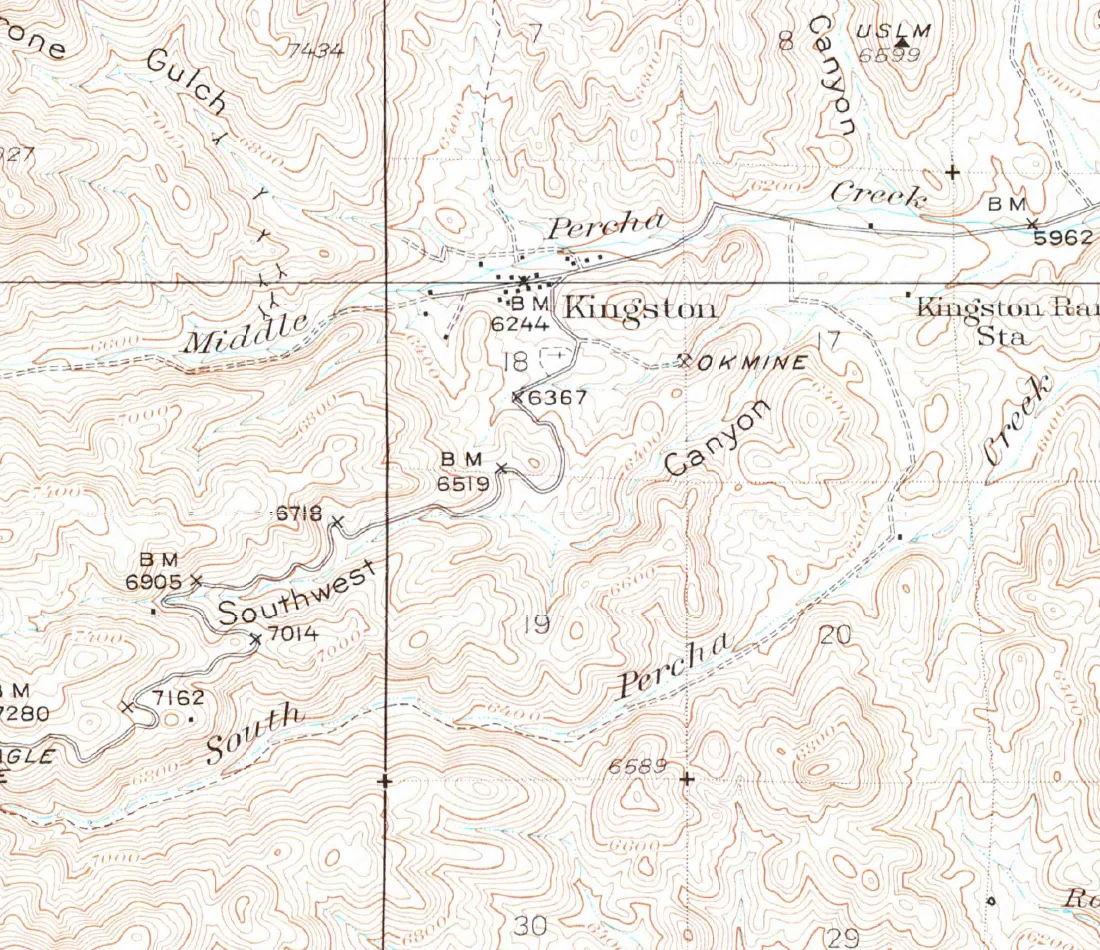
Highway work crossed the Black Range in the 1930s. Early in 1934, Harley wrote, construction was under way on the part of U.S. Highway 180 across the range to connect Kingston with San Lorenzo, to which the highway had been built from the west. The Geological Survey's Hillsboro map, surveyed in 1935, prints Kingston on Middle Percha Creek with the Kingston Ranger Station just east of town. It shows the O K Mine, the Gray Eagle Mine on South Percha, and State Route 180 climbing southwest toward San Lorenzo, 14 miles away.
Sources: George Townsend Harley, New Mexico State Bureau of Mines and Mineral Resources, The Geology and Ore Deposits of Sierra County, New Mexico (Bulletin 10) (1934 (reprint with 1970s staff list)): p. 98, Location and area; U.S. Geological Survey; topography by W. S. Higginson, M. C. McClellan, R. G. Carpenter, N. H. Epps, F. L. Gregg and L. P. Entwistle, Hillsboro, N. Mex. 1:62,500 topographic quadrangle (surveyed 1935; 1974 reprint) (1935 (reprint 1974))
Traffic followed the road. Joe Britton, writing in the Hillsboro Historical Society's journal in 2022, said a bus line between Silver City and Hot Springs by way of Kingston began in 1937. The official 1939 state road map, he wrote, showed the Black Range Highway as a graded road from Caballo to San Lorenzo. In 1942 the U.S. Bureau of Mines reported that Asarco's Hanover milling unit drew about 22 percent of its feed from small mines around New Mexico. Kingston was on its list of those mines, with Organ, Steins, Lordsburg and Magdalena.
Sources: Joe Britton, Guajolotes, Zopilotes y Paisanos (Journal of the Hillsboro Historical Society) vol. 15 no. 4, The Black Range Highway: A Road Story (2022-11): p. 8, notes 27-28; U.S. Bureau of Mines, Minerals Yearbook 1942 (covering 1942), chapter: Gold, silver, copper, lead, and zinc in New Mexico: pp. 450-451 and county sections (1942)
Read more on Salars.net
Part 4 of 7 of the series Kingston, New Mexico: a Black Range silver camp.
Cite this page: “After the crash, 1893 to 1945.” Grant County Atlas, Salars.net, first published 19 November 2026. https://atlas.salars.net/stories/kingston/after-the-crash-1893-1945
Discussion
What would you add or question? Comments are reviewed before they appear.
Loading comments…