Between 1905 and 1939 Hillsboro's mines dwindled, and on 10 June 1914 a flood swept its business street, the El Paso Herald reported. Moves to take the Sierra County seat began in 1909 and ended with a 1936 vote for Hot Springs, which the New Mexico Supreme Court let stand on 1 February 1938.
One working mine at Hillsboro, 1905 to 1908
In 1905 the Good Hope and Bonanza was the only mine property being worked at Hillsboro, and it employed some 40 men. That count comes from the National Register of Historic Places context for Hillsboro, a history of the town and its buildings written by Corinne P. Sze of Research Services of Santa Fe. Using Lasky and Wootton's 1933 figures, the context traces the fall in gold. Sierra County's output of placer gold, washed from creek gravels, and lode gold, mined from veins in rock, was worth $99,042 in 1905. It fell to $18,048 in 1906 and to $8,224 in 1907. These figures cover the whole county, not Hillsboro alone.
A History of New Mexico, published in 1907 by the Pacific States Publishing Company, gave figures for the district as a whole. It said the Hillsboro district's total output had been estimated as high as $9,000,000. By the History's account, the largest producers were the Bonanza at over $1,000,000, the Opportunity at over $500,000, the Richmond at over $250,000, and the Snake and Bobtail at well over $100,000. Placer diggings, it said, were then generally worked by Mexican miners, and their yield was small, "probably not to exceed $6,000 or $7,000 per year."
In April 1908 the Sierra County Advocate reported on a Hillsboro man just back from the gold strike at Hachita. He told the paper that between 200 and 300 men were in the hills there and that the country was thoroughly staked. Countywide, the gold figure the context gives for 1911 is $27,785, and for 1913 only $857.
Sources: Corinne P. Sze, Research Services of Santa Fe, National Register of Historic Places Multiple Property Documentation Form: Architectural and Historic Resources of Hillsboro, New Mexico, Part 1: Domestic Architecture (NRIS 64500415) (1994-09 (received March 1995)); Sierra County Advocate (Kingston, N.M.), 1908-04-17, page 3: page 3, local column
A county seat of about 600, with a new jail, 1905 to 1909
Hillsboro was the county seat of Sierra County, and the 1907 History gave it a population of about 600 against 3,158 for the county. It said the town had a handsome court house, good schools and hotels. In the state business directory for 1905-1906, Hillsboro had four general merchants, a meat market, a drug store, a bank, a newspaper, a hotel, a restaurant, three saloons, three blacksmiths, a jeweler, a barber, three attorneys and one physician. By the National Register context's count, that directory gave the town 80 entries, among them about twenty mining and milling companies; a mill crushed and treated ore to recover its metal.
Sources: Pacific States Publishing Co. (George B. Anderson, ed.), History of New Mexico: Its Resources and People, vol. 2 (1907): vol. 2, pp. 757 and 759; Corinne P. Sze, Research Services of Santa Fe, National Register of Historic Places Multiple Property Documentation Form: Architectural and Historic Resources of Hillsboro, New Mexico, Part 1: Domestic Architecture (NRIS 64500415) (1994-09 (received March 1995))
In June 1906 the county commissioners let a contract to H. F. Brown to build a stone jail behind the courthouse for $4,000, according to the Hillsboro Historical Society. It was finished two months later, the society says. Moves to take the seat from Hillsboro began in 1909, the National Register context says, when Cutter, on the Santa Fe railroad, was proposed as the new seat without success. In the Hillsboro Historical Society's account, the territorial legislature approved a 1909 act moving the county seat to Cutter, and Edward Tittmann went to Washington and got the law overturned.
Sources: Hillsboro Historical Society, The HHS Courthouse - Jail Site (accessed 2026-11-18): 'Jailhouse' section; 'Courthouse' section; Corinne P. Sze, Research Services of Santa Fe, National Register of Historic Places Multiple Property Documentation Form: Architectural and Historic Resources of Hillsboro, New Mexico, Part 1: Domestic Architecture (NRIS 64500415) (1994-09 (received March 1995)): Section E, p. 17
Wall of water on Main Street, 10 June 1914
At 10 o'clock on the night of Wednesday 10 June 1914, the El Paso Herald reported, a flood swept through Hillsboro's principal business street. Its dispatch from Albuquerque, printed the next day, said the county seat had been practically destroyed. Continued rain, the dispatch said, was followed by a cloudburst that sent "a wall of water six feet high foaming through the town." Most residents had been warned, it said, and those in the lower town fled to the hillside.
In the Herald's list of losses, the large general store of Keller, Miller and Company, the post office, the drug store, the bank and other buildings were swept away or so weakened that they collapsed. Every adobe house in the flood's path, built of sun-dried mud brick, was destroyed, the paper said. Railroad and telephone lines were cut, it reported. On 26 June 1914 the Sierra County Advocate reported that water and debris had filled its own office to a depth of nearly three and a half feet. It did considerable damage, the paper said, and the Advocate had to leave out two issues.
Sources: El Paso Herald (Albuquerque dispatch), El Paso Herald (El Paso, Tex.), June 11, 1914, Home Edition, p. 1, 'Swept by Torrent: Hillsboro, County Seat, Is Virtually Destroyed by Wall of Water' (1914-06-11): p. 1, 'Stores Are Destroyed'; Sierra County Advocate (Kingston/Hillsboro, N.M.), June 26, 1914, p. 3, local news and Thomas Murphy obituary (1914-06-26): p. 3, local news column (OCR checked against page image)
Thomas Murphy, a former Sierra County sheriff, drowned in the flood, the Advocate reported. On 10 July 1914 the paper printed resolutions of Kingston Lodge No. 16, A.F. and A.M., the Masonic lodge to which he belonged. They gave his birth in Portland, Maine, in 1848 and his service in the Civil War. The lodge said that when the flood overcame him and carried him away, he was making his way to the lodge rooms of the Order of the Eastern Star to try to rescue his wife and others there.
Clearing the wreckage at Hillsboro, June and July 1914
Two weeks after the flood the Advocate wrote that "Hillsboro is steadily recovering from the effects of the flood." Streets were being cleared of wreckage, it reported, some buildings were wholly destroyed and others had been vacated. Both the old post office and the drug store had been destroyed, it said, and the two moved into the building just west of the old post office. A mail sack carried many miles down Percha Creek was returned to the postmaster, the paper said.
Two National Register forms by Sze follow the repairs in single buildings. After the flood of 10 June 1914, the Alert-Hatcher Building form says, the owner Tom Wedgwood renovated the old Alert Block on Main Street. He added a concrete apron around its base to counter further flood damage, and one of its largest rooms was fitted up for the post office. On West Main Street the front walls of William H. Bucher's house had been swept away in the 1914 flood, and they had to be rebuilt.
Sources: Corinne P. Sze, Research Services of Santa Fe, National Register of Historic Places Registration Form: Alert-Hatcher Building (Alert Block, Hatcher Hotel), NRIS 95000460 (1994-09): Section 8 (citing Sierra County Free Press 15 Oct. and 10-11 Dec. 1914); Corinne P. Sze, Research Services of Santa Fe, National Register of Historic Places Registration Form: Bucher, William H., House, 300 West Main Street, NRIS 95000461 (1994-09): Section 7, description
In late June the Advocate reported that State Engineer French was expected to visit Hillsboro soon. He was to advise the citizens how to build a dike, a protective bank, to shield the town from floods. Another flood followed on Saturday 18 July 1914. According to the Advocate's Hillsboro column, it put the Kingston road out of commission for wagon travel.
Sources: Sierra County Advocate (Kingston/Hillsboro, N.M.), June 26, 1914, p. 3, local news and Thomas Murphy obituary (1914-06-26): p. 3, local news (OCR corrected); Sierra County Advocate, July 24, 1914, p. 2, Hillsboro local column (1914-07-24): p. 2, Hillsboro column (OCR corrected)
A sheriff, a doctor and a highway bridge, 1917 to 1930
Cornelius Sullivan drove Sadie Orchard's stagecoach between Lake Valley and Kingston for 18 years, according to the National Register form for his Hillsboro house. He was later county road foreman, and he was elected Sierra County sheriff for 1917 to 1920 and again for 1921 to 1922. Dr. John O. Hatcher, licensed in New Mexico in 1913, came to Hillsboro in 1916 or 1917. From 1920 to 1930 he kept his home, his office and a small hospital in the old Alert Block, the building Wedgwood had renovated after the flood. He also served as county superintendent of schools from 1925 to 1928, the building's National Register form says.
Sources: Corinne P. Sze, Research Services of Santa Fe, National Register of Historic Places Registration Form: Alert-Hatcher Building (Alert Block, Hatcher Hotel), NRIS 95000460 (1994-09): Section 8 (citing Sierra County Free Press 15 Oct. and 10-11 Dec. 1914); Section 8; Corinne P. Sze, Research Services of Santa Fe, National Register of Historic Places Registration Form: Sullivan, Cornelius (Nell), House, NRIS 95000459 (1994-09): Section 8
In March 1917 the Western Liberal of Lordsburg reported a state road bill describing a route from Elephant Butte through Hillsboro and Lake Valley. Its route would cross the Black Range at Camp Monarch on its way to Santa Rita and Silver City. A volunteer list of Grant County places, compiled in 2007 by Carl W. Scholl, puts Camp Monarch 17 miles southwest of Hillsboro, east of San Lorenzo. It gives the camp a post office from 11 June 1907 to 15 May 1908, and a postal-history database lists the office for the same years.
Sources: Western Liberal (Lordsburg), 16 March 1917, p. 1 (1917-03-16): p. 1, road bill article; Compiled in 2007 by Carl W. Scholl of Silver City; page by Pat Bennett, NMGenWeb (updated 5/1/2017), Grant County Towns: Towns, Camps, Railroad stops and Post Offices that have existed in Grant County, NM (2007/2017): alphabetical list, entry 'Camp Monarch'; Post Offices: New Mexico, Grant County (Jim Forte Postal History database) (accessed 2026-11-18): Grant County list, page 1
The Black Range Highway, now NM 152, went up piecemeal in the late 1920s and was not finished until the mid-1930s, according to the 1997 National Register nomination for the Percha Creek Bridge. Citizens of Grant and Sierra counties accepted two extra mill levies, added property-tax rates, to help pay for it. Two miles west of Hillsboro, in 1927, the Ware Company of El Paso built a 160-foot steel deck truss over a canyon about 120 feet deep. A deck truss is a steel framework that carries the roadway on top.
Project engineer William S. Henderson chose that design for the Percha Creek crossing, although the state highway department had never used it before. With the waterway deep in the gorge below the truss, the nomination says, Henderson realized "there was little danger of flooding." The department later reused the design for other deep canyons. A new bridge bypassed the old one in 1995, and the 1927 truss was kept with parking and a history sign.
A count lost and a high school built, Hillsboro in the 1920s
Hillsboro faced its next contest in 1920. In a county-seat election that year Hot Springs, the town now called Truth or Consequences, won the count 908 to 809, according to the National Register context. Hillsboro kept the seat only because the move needed 60 percent of the vote.
In the summer of 1922 the Sierra County High School was built at Hillsboro, to plans by the El Paso architectural firm Trost and Trost. Its National Register form describes it as the first building in the county built solely as a four-year high school. Students from nearby ranches rode to it on horseback, the National Register context says, and some families rented or bought houses in Hillsboro so their children could attend. By 1924 a bachelor hall housed students who supported themselves.
Sources: Corinne P. Sze, National Register of Historic Places Registration Form: Hillsboro High School (Sierra County High School; Hillsboro Community Center), NRIS 93000254 (1992 (listed 1993-04-15)): Section 8, p. 3 (Summary); Section 7 for 'summer of 1922' and Trost and Trost; Corinne P. Sze, Research Services of Santa Fe, National Register of Historic Places Multiple Property Documentation Form: Architectural and Historic Resources of Hillsboro, New Mexico, Part 1: Domestic Architecture (NRIS 64500415) (1994-09 (received March 1995)): Section E, p. 16
Hillsboro's listings in the state business directories kept falling, by the context's count. From 80 entries in 1905-1906 they dropped to 64 about ten years later, 54 in 1920 and 31 in 1925. Mining companies listed fell to six in 1913-1914, rose to eight in 1920 and dropped to two in 1930. Countywide, lode gold was worth $568 in 1918 and $15,896 in 1920. For the rest of the decade the best year was 1927, at $8,621.
Hillsboro lost its bank and its newspaper in the 1920s. The Sierra County Bank was gone early in the 1920s, the National Register context says, and the Sierra County Advocate, Hillsboro's longest-running newspaper, moved to Hot Springs in 1928. Other businesses appeared. A theater was listed in the 1920s, a Chamber of Commerce was formed early in the decade, and an ice and electric plant was established late in it.
One mine in Sierra County, Hillsboro 1930 to 1936
According to the National Register context, the state mine inspector's reports for 1933 and 1934 list only one operating mine in all of Sierra County: El Oro at Hillsboro, a name the context prints as El Ora. In 1934 the railroad from Nutt to Lake Valley was abandoned. Countywide, lode gold was worth $3,638 in 1930.
William H. Bucher, a Hillsboro banker, moved his banking interests to El Paso as Hillsboro declined, the form for his house says. He kept the house, moved to El Paso himself in the early 1930s and died in 1934, and the house then stood locked up for nearly twenty years. Nell Hatcher, the doctor's widow, came back. In 1931 she returned to Hillsboro and opened the Hatcher Hotel in the old Alert Block, serving mainly salesmen and ranch people in town on business, and later a restaurant.
Sources: Corinne P. Sze, Research Services of Santa Fe, National Register of Historic Places Registration Form: Bucher, William H., House, 300 West Main Street, NRIS 95000461 (1994-09): Section 8; Corinne P. Sze, Research Services of Santa Fe, National Register of Historic Places Registration Form: Alert-Hatcher Building (Alert Block, Hatcher Hotel), NRIS 95000460 (1994-09): Section 8 (citing NM State Business Directory 1938; Lewis Hatcher interview)
Business listings at Hillsboro rose again in the directories: 44 in 1929, 51 in 1930 and 66 in 1936, when they included six restaurants, service stations, repair garages and an auto camp. Mining companies listed rose from two in 1930 to 11 in 1936, an increase the National Register context reads as "expectation rather than reality." Blacksmiths and freighting companies, it says, had disappeared by the mid-1930s.
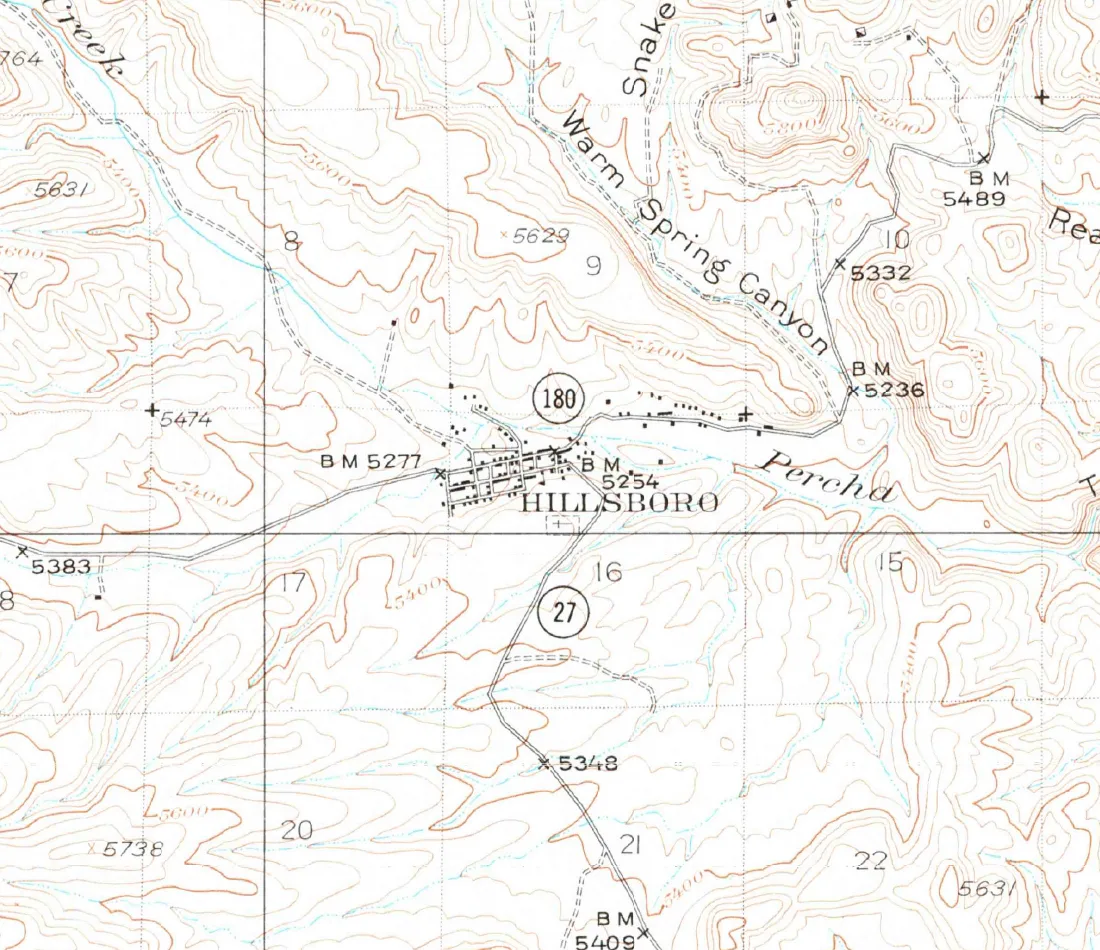
Two maps record the town in these years. A two-sheet Sanborn fire insurance map of Hillsboro, dated January 1930, is in the Library of Congress catalog; it was drawn while the town was still the county seat. In 1935 W. S. Higginson and five other Geological Survey topographers surveyed the Hillsboro quadrangle at a scale of 1:62,500. Their map prints HILLSBORO on Percha Creek and names Snake Gulch, Warm Spring Canyon, Ready Pay Gulch, Wicks and The Box. Mine symbols dot the hills north and northeast of town.
Sources: Sanborn Map Co., Sanborn Fire Insurance Map from Hillsboro, Sierra County, New Mexico, January 1930, 2 sheets (1930-01): LOC item sanborn05691_003; U.S. Geological Survey, USGS 1:62500-scale Quadrangle for Hillsboro, NM 1935 (historical GeoPDF, later printing of the 1935 map): Lower left margin credit; town at upper right of map face, about 32.92 N, 107.56 W; Map face, sections 3-14 around and east of the town
The 1936 vote and Orchard v. Board of Commissioners
Sierra County voted on moving its seat from Hillsboro to Hot Springs at the general election of 3 November 1936. Hillsboro did not give up without a court battle, the National Register context says. Plaintiffs sued the Board of County Commissioners of Sierra County to stop the removal, in a case the court styled Orchard et al.
Sources: Supreme Court of New Mexico (Brice, J.), Orchard et al. v. Board of Com'rs of Sierra County et al., 42 N.M. 172, 76 P.2d 41 (N.M. Sup. Ct., No. 4324, decided February 1, 1938) (1938-02-01); Corinne P. Sze, Research Services of Santa Fe, National Register of Historic Places Multiple Property Documentation Form: Architectural and Historic Resources of Hillsboro, New Mexico, Part 1: Domestic Architecture (NRIS 64500415) (1994-09 (received March 1995)): Section E, p. 17
Three figures exist for the vote. By the opinion's account, the board's certificate gave 2,012 to 572. From its recount of the opened ballots, the district court found 2,038 for removal and 577 against. In contrast, the National Register context gives the referendum vote as 1,012 to 572.
Sources: Supreme Court of New Mexico (Brice, J.), Orchard et al. v. Board of Com'rs of Sierra County et al., 42 N.M. 172, 76 P.2d 41 (N.M. Sup. Ct., No. 4324, decided February 1, 1938) (1938-02-01): 42 N.M. 172, opinion of Brice, J., findings of fact; Corinne P. Sze, Research Services of Santa Fe, National Register of Historic Places Multiple Property Documentation Form: Architectural and Historic Resources of Hillsboro, New Mexico, Part 1: Domestic Architecture (NRIS 64500415) (1994-09 (received March 1995)): Section E, p. 17
Edward D. Tittmann of Hillsboro argued the plaintiffs' case, and at trial he objected to opening the ballot boxes for a recount. Among the issues the plaintiffs raised was that the act creating Sierra County had permanently located the seat at Hillsboro. That question, the trial court held, had already been decided in an earlier suit.
On 1 February 1938 the New Mexico Supreme Court, in an opinion by Justice Brice, affirmed the district court's decree that Hot Springs was the county seat. It reached that result without relying on the recount. The opinion added that the county could not move its offices and property to Hot Springs "until a new courthouse and jail have been constructed" there. Sierra County disclaimed any plan to move sooner.
The Hillsboro courthouse sold and its school closed, 1938 to 1940
The National Register context places the last term of court in the Hillsboro courthouse in 1938. After it, the context says, the building was sold and largely dismantled, and its bricks and fixtures were sold for other uses. A later date comes from the Hillsboro Historical Society. After the Supreme Court ruling, in the society's account, the county commissioners sold the courthouse property for the highest bid of $440, and the building was demolished in 1939. By the society's account, the stone jail of 1906 was abandoned when the county seat moved in 1938.
Sources: Corinne P. Sze, Research Services of Santa Fe, National Register of Historic Places Multiple Property Documentation Form: Architectural and Historic Resources of Hillsboro, New Mexico, Part 1: Domestic Architecture (NRIS 64500415) (1994-09 (received March 1995)); Hillsboro Historical Society, The HHS Courthouse - Jail Site (accessed 2026-11-18): 'Courthouse' section; 'Jailhouse' section
Two dates mark the end of the high school. Its National Register form cites the state school superintendent's report for 1938-40, which lists the Hillsboro high school as suspended in 1939. Yet a class of four graduated in 1940, the form records. After that, high-school students were bused to Hot Springs, and the 1922 building served as an elementary school until about 1970.
Read more on Salars.net
Part 4 of 7 of the series Hillsboro, New Mexico: gold camp and county seat.
Cite this page: “Floods and the fight for the county seat, 1905 to 1939.” Grant County Atlas, Salars.net, first published 19 November 2026. https://atlas.salars.net/stories/hillsboro/floods-and-the-fight-for-the-county-seat-1905-1939
Discussion
What would you add or question? Comments are reviewed before they appear.
Loading comments…