Hillsboro became the seat of the new Sierra County in April 1884, Jones wrote, and on 27 October 1892 the county accepted a court house that George E. Robin said was built for cash. Harley wrote that the camp's first period of important production ended in 1893; in the years after, lessees worked some of the mines, and in 1899, by the Advocate's estimate, the Lee-Gililland trial drew fully 500 strangers to town.
A court house accepted and a county formed, 1884 to 1892
On 27 October 1892 the Sierra County commissioners, meeting at Hillsboro, accepted the county's new court house. They ordered a warrant drawn in favor of its builder, A. Reinghardt, for the balance due on his contract, according to the proceedings printed in the Sierra County Advocate. George E. Robin, who prepared a booklet on the county's resources for the World's Columbian Exposition the next year, called the building "one of the handsomest structures in the Territory."
Sources: Sierra County Advocate, November 18, 1892, page 3 (1892-11-18): p. 3, Commissioners' Proceedings, Hillsboro, 27 Oct 1892; George E. Robin, Hillsborough (prepared for the World's Columbian Exposition), Mineral and Other Resources of Sierra County, New Mexico (1893): County Finances, last page
Two early histories explain how Sierra County came about. Fayette Alexander Jones, in his 1904 book New Mexico Mines and Minerals, wrote that the Hillsboro country first lay in Socorro County. Land within two and a half miles of Hillsboro was later attached to Doña Ana County, he wrote, and Sierra County, created by an act of 1883, was organized in April 1884 with Hillsboro as its seat. The 1907 History of New Mexico said the act took parts of Socorro, Doña Ana and Grant counties. Miners around Lake Valley, Hillsboro and Kingston, the History said, wanted a county in which mining would lead, rather than living on the borders of three large ones.
Sources: Fayette Alexander Jones, New Mexico Mines and Minerals: Being an Epitome of the Early Mining History and Resources of New Mexican Mines (1904): Chapter XII, p. 82; Pacific States Publishing Co. (George B. Anderson, ed.), History of New Mexico: Its Resources and People, vol. 2 (1907): vol. 2, Sierra County, p. 757
That History printed the county's first officers of 1884. José Tafoya was probate judge, J. M. Webster probate clerk, Thomas Murphy sheriff, James P. Parker assessor and F. W. Taylor treasurer, with A. E. Pitkin, G. W. Gregg and Richard Winn as commissioners. Every probate judge on its list from 1884 to 1906 bears a Spanish surname, among them Jose Jesus Garcia, Doniciano Montoya, Julian Chaves and Procopio Torres. Webster's sketch in the same book described him as a Kingston pioneer of 1882 who moved to Hillsboro in 1885 and kept the clerk's post until 1892.
The town itself took legal shape in 1884. That year, the National Register context for Hillsboro's historic buildings says, the townsite was patented, that is, granted a government title, and its lots were deeded by John Donahoe, probate judge and trustee of the townsite. A 13-mile branch railroad was built from Nutt to Lake Valley the same year. Hillsboro's first long-running paper, the Sierra County Advocate, was founded in 1884 as well.
Miners, a bank and the stage to Lake Valley, 1885 to 1892
A territorial census in 1885 counted 120 households and 376 people in the Hillsboro voting precinct, the National Register context says. Among them were sixty-two miners, fifty-six laborers, ten ranchmen, five farmers, three herders and six cowboys. The precinct also held six saloon keepers, three lawyers, a printer and a gambler. By 1890, the context says, the official population had grown to 621.
Hillsboro acquired a bank when William H. Bucher and John W. Zollars moved over from Kingston to found the Sierra County Bank, according to the context. A sketch in the 1907 History follows one man through the camp's work. A. J. Hirsch came to Hillsboro in 1887, kept a blacksmith shop for two years, worked about three and a half years in the Snake mine, then leased it and later ran the Treasury mines.
Sources: Corinne P. Sze, Research Services of Santa Fe, Architectural and Historic Resources of Hillsboro, New Mexico, Part 1: Domestic Architecture (National Register Multiple Property Documentation Form, NRIS 64500415) (1994-09): Section E, p. 11, n. 30; Pacific States Publishing Co. (George B. Anderson, ed.), History of New Mexico: Its Resources and People, vol. 2 (1907): vol. 2, biographies, pp. 761-762
The Director of the Mint reported for 1889 that a 20-stamp gold mill was running at Hillsborough; in a stamp mill, heavy iron stamps crush the ore so the gold can be caught. The report credited the Hillsborough district with $91,000 of Sierra County's gold that year. For 1891 the Mint named the Good Hope-Bonanza at Hillsboro, with the Pacific at Pinos Altos, as leading examples of successful gold mining in New Mexico.
Sources: Report of the Director of the Mint upon the Production of the Precious Metals in the United States during the calendar year 1889 (1890): Sierra County, p. 188; Report of the Director of the Mint upon the Production of the Precious Metals in the United States during the calendar year 1891 (1892): New Mexico, p. 212
Who ran the stage line into town depends on the source. The National Register context says that in 1888 J. W. and Sadie Orchard, who ran a stage line from Silver City to Pinos Altos and Mogollon, bought the line from Lake Valley through Hillsboro to Kingston. Sadie Orchard ran it, the context says, and "often drove the coach herself and broke many of the horses."
A newspaper item from 1892 gives a different picture. The Advocate's Lake Valley column of 15 January 1892 reported that the stage line of Gause & Orchard, from Lake Valley to Hillsboro and Kingston, had been bought by William Mathewson of Wichita, Kansas. A Mr. Orchard was to stay on in Mathewson's employ for a month or so, the column said. The item names the firm, not Sadie Orchard, and a sale in 1892, not a purchase in 1888.
Sources: Sierra County Advocate, January 15, 1892, page 3 (1892-01-15): p. 3, Lake Valley column; Corinne P. Sze, Research Services of Santa Fe, Architectural and Historic Resources of Hillsboro, New Mexico, Part 1: Domestic Architecture (National Register Multiple Property Documentation Form, NRIS 64500415) (1994-09): Section E, pp. 11-12
Brick or stone: the Hillsboro court house of 1892
The case for a new court house was made in public in spring 1892. On 1 April the Advocate printed the district judge's reply to the grand jury. In it the judge said Sierra County had the means in its treasury to build a new court house without taxing the people further. He said he had urged one for years and argued that the existing court-house put off investors.
Sources: Sierra County Advocate, April 1, 1892, page 3 (1892-04-01): p. 3, judge's response to the grand jury
By autumn the building was a campaign point. A Democratic piece in the Advocate of 14 October 1892 credited the county board under its chairman, Fred Lindner, with the county's "magnificent new court house" and good roads, built without adding a dime of debt. The Advocate of 18 November 1892 praised the address Judge A. B. Elliott gave at the dedication as a masterpiece of oratory. Robin wrote in 1893 that the court house was built for cash, the county being out of debt.
Sources: Sierra County Advocate, October 14, 1892, page 2 (1892-10-14): p. 2; Sierra County Advocate, November 18, 1892, page 3 (1892-11-18): p. 3, local items; George E. Robin, Hillsborough (prepared for the World's Columbian Exposition), Mineral and Other Resources of Sierra County, New Mexico (1893): County Finances, last page
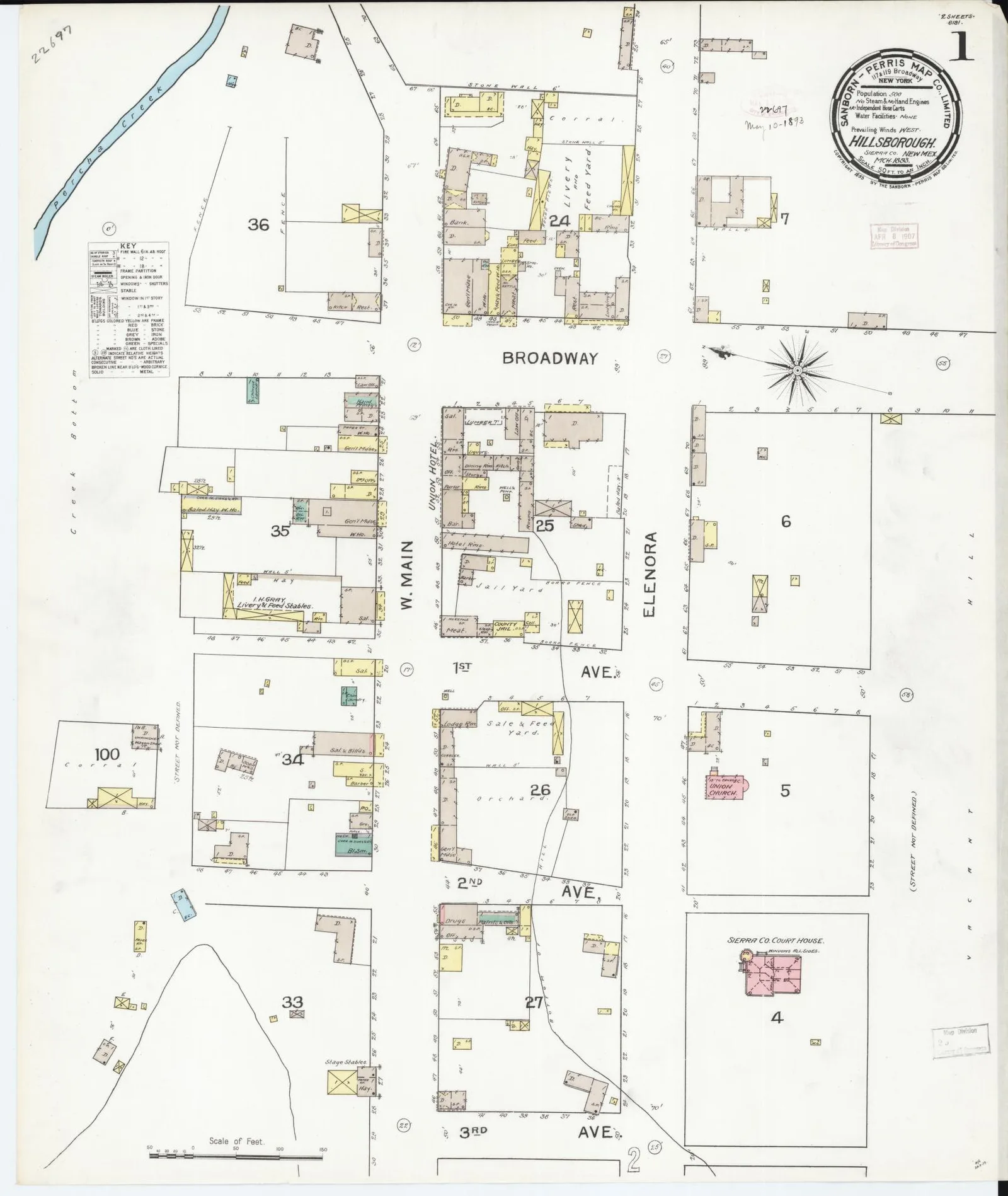
A Sanborn fire-insurance map drawn in March 1893 shows the town around the new building. Its two sheets give Hillsborough a population of 500 and record no water facilities and no fire engines. They mark the brick Sierra County Court House and the brick Union Church, with the county jail and its yard, the Union Hotel, a bank, livery stables and stage stables.
Sources disagree on what the court house was made of. The National Register context says two major brick buildings went up in Hillsboro in 1892, the county courthouse and the nearby Protestant Union church, which agrees with the Sanborn map. The governor's report for 1901, by contrast, called the court-house "a handsome stone structure." None of the three explains the difference.
Sources: Corinne P. Sze, Research Services of Santa Fe, Architectural and Historic Resources of Hillsboro, New Mexico, Part 1: Domestic Architecture (National Register Multiple Property Documentation Form, NRIS 64500415) (1994-09): Section E, p. 12; Sanborn-Perris Map Co., Sanborn Fire Insurance Map from Hillsboro, Sierra County, New Mexico, March 1893, 2 sheets (1893-03): Sheet 1, title cartouche and blocks 4, 5, 25; Governor of New Mexico (Miguel A. Otero), Report of the Governor of New Mexico to the Secretary of the Interior, 1901: 1901 report, Sierra County, Settlements, p. 613
Mills, matte and wages at Hillsboro, 1892 to 1893
In January 1892 the Advocate's annual review pinned the town's hopes on one group of claims. It predicted that by the end of the year Hillsboro would boast the biggest mining enterprise in New Mexico, the Standard company's Opportunity group. The review added that "the history of the Opportunity group has also been that of Hillsboro." In June 1892 two large freighting outfits from Hanover Gulch, in Grant County, arrived in Hillsboro with their mules, wagons and families, the Advocate reported. On the Monday they began hauling ore for the Standard company.
Sources: Sierra County Advocate, January 15, 1892, page 3 (1892-01-15): p. 3, mining review; Sierra County Advocate (Kingston, N.M.), 1892-06-24, page 3: page 3
That year the camp found a way to treat its difficult ore. The Mint report for 1892 said Hillsboro succeeded in producing copper matte from gold ores that had been milled only with difficulty. Matte is the crude metal mixture a smelting furnace yields. The district's output, mainly gold, rose 50 per cent over 1891, the report said. Robin listed the works in 1893. Four mills, the Bonanza, Standard, Richmond and Hopewell, ran constantly on milling and concentrating ore, together handling 75 tons a day. A 30-ton copper-matte furnace worked alongside them, and its matte was shipped to Denver. The great mines, he wrote, were the Bonanza, Snake, Opportunity and Richmond.
Sources: Report of the Director of the Mint upon the Production of the Precious Metals in the United States during the calendar year 1892 (1893): New Mexico, p. 159; George E. Robin, Hillsborough (prepared for the World's Columbian Exposition), Mineral and Other Resources of Sierra County, New Mexico (1893): Hillsborough, Mills and Smelters, p. 17; Hillsborough, p. 16
Robin's booklet gave wages. Miners at Hillsborough earned $3 a day in 1893, he wrote, and laborers $1.50 to $2.50. For Sierra County as a whole he wrote that most of the labor was performed by Mexican people, in his words, with a steady immigration from Texas and Mexico. Miners had warm springs between the town and the mines, with a bath house and swimming and private baths, and came in great numbers at least once a week, Robin said.
Supplies came from far off, by Robin's account. Mining towns imported most of their corn, hay and flour from Kansas, he wrote. Closer to hand, the 200-acre Kahler ranch on the Palomas cut four crops of alfalfa a year and sold the whole yield in Hillsborough at about $20 a ton. Travelers came by stage from Lake Valley, he wrote, a two-hour ride of less than eighteen miles. By 13 June 1893, the Southwest-Sentinel of Silver City reported, a Hillsborough team had entered the rock-drilling match at Silver City's Fourth of July contests, with two from Pinos Altos and one from Georgetown.
Sources: George E. Robin, Hillsborough (prepared for the World's Columbian Exposition), Mineral and Other Resources of Sierra County, New Mexico (1893): Agriculture section, near end; Hillsborough, p. 16; The Santa Fe Railroad, p. 6; Southwest-Sentinel (Silver City, N.M.), June 13, 1893, page 3 (1893-06-13): p. 3, local column and 'Judges of drilling match' program
After the panic of 1893: lessees and new owners
George Townsend Harley, in a 1934 state geology bulletin, wrote that work at Hillsboro was intermittent and that the camp's first period of important production ended in 1893. A mill put into operation on the Richmond property in 1893 was destroyed by fire in 1894, he wrote. Governor W. T. Thornton's report for 1894, protesting the fall of silver, said Sierra County had twenty rich camps besides Hillsboro that were practically idle.
Sources: George Townsend Harley, New Mexico School of Mines, State Bureau of Mines and Mineral Resources, The Geology and Ore Deposits of Sierra County, New Mexico (Bulletin 10) (1934): Bulletin 10, History and Production, p. 140; Bulletin 10, Mary Richmond mine, p. 148; Governor of New Mexico (W. T. Thornton for 1893-1896), Report of the Governor of New Mexico to the Secretary of the Interior (bound volume containing the reports for 1892-1896): 1894 report, p. 30
The governor's report for 1895 carried a Sierra County report by M. A. Salazar. It said Hillsboro's miners had weathered the depression that followed the panic of 1893, with important successes that year by miners working on the leasing system. A lessee rents a mine, or part of one, from its owner and works it. The report put the district's yearly output of gold, silver and copper at about $350,000 for the past few years. For 1895 it estimated 22,000 ounces of gold and 85,000 to 90,000 ounces of silver, with about 220 tons of copper.
Writing from Lake Valley on 10 August 1896, D. S. Miller told the governor that mining in Sierra County was at a standstill except at Hillsboro. There lode output had fallen, he wrote, but placer gold, the gold washed from loose gravel rather than mined from veins, was up 3.5 per cent by his firm's books. His firm handled the district's placer gold, even for the bank at Hillsboro.
A Pittsburgh investor entered the district in 1897. The governor's report for 1899 said W. H. Andrews of Pittsburgh entered New Mexico mining that year and bonded many claims in the Hillsboro district, that is, took options to buy them. He kept the El Oro, Golden Rule, Trippe, Homestake and others for his Philadelphia Mining and Milling Company. Its 20-ton Trippe mill turned out about $10,000 a month in bullion and concentrates, and a little town called Andrews was springing up around the mill and the post-office store. Older mines, the Richmond, Wicks and Snake, kept 100 to 150 men at work, the report said.
The National Register context describes the same years from the lessees' side. After the 1893 collapse, it says, some Hillsboro mines owned by outside financiers were worked by local lessees paying royalties to the owners. It puts the 1899 gold output at about $181,500, more than half produced under lease. The Snake was the main producer that year, the context says, and the Bonanza and Opportunity were shut down.
Four totals for Hillsboro's gold, 1893 to 1904
Period sources give very different totals for the camp. Robin put the total production of the camp's lodes, the veins of ore in rock, at $1,500,000 in 1893, exclusive of the placer fields nearby. He counted the placers on their own. The field east of the lode mines, which he dated to 1880, had yielded over $500,000, he wrote, worked mostly with dry washers that saved only coarse gold.
Two later sources gave their own totals. The governor's report for 1901 said Hillsboro, the oldest camp in Sierra County, had produced about $9,000,000 in gold, and that the Bonanza mine alone had paid about $250,000 in dividends. Jones placed the camp's estimated production to 1 January 1904, placer and lode together, at $6,750,000, principally gold. None of these sources reconciles its figure with the others.
Sources: Governor of New Mexico (Miguel A. Otero), Report of the Governor of New Mexico to the Secretary of the Interior, 1901: 1901 report, Sierra County, The Hillsboro District, p. 609; Fayette Alexander Jones, New Mexico Mines and Minerals: Being an Epitome of the Early Mining History and Resources of New Mexican Mines (1904): Chapter XII, p. 83
Harley gathered figures for single mines in 1934. For the Bonanza vein he relied on W. H. Bucher, vice-president and cashier of the old Sierra County Bank, through which most of the district's bullion was shipped; Bucher put its total near $700,000. The Snake and Opportunity together were reported to have produced $2,170,000 in shipping ore, concentrates and bullion, Harley wrote, with $1,500,000 credited to the Snake. He gave the Richmond about $600,000.
The Lee-Gililland trial at Hillsboro, 1899
The trial of Oliver Lee and James Gililland came to Hillsboro in the spring of 1899, as the Sierra County Advocate reported it. On 28 April the paper said that, after another case collapsed at Silver City, Judge Frank W. Parker had set their trial for 25 May at Hillsboro. Its next account said the district court opened on a Monday under Judge Parker. That evening, the paper said, a deputy sheriff arrived from Socorro with Lee and Gililland, who were placed in the Hillsboro jail, and many people called at the jail during the week to see them.
Sources: Sierra County Advocate, April 28, 1899, page 1 (1899-04-28): p. 1, 'The McNew Case'; Sierra County Advocate, May 26, 1899, page 1 (1899-05-26): p. 1, district court report
The Advocate named the defense lawyers as former Delegate to Congress H. B. Fergusson, former District Judge A. B. Fall and a leading attorney of Socorro County. District Attorney Barnes and two other lawyers conducted the prosecution. About 75 witnesses had been summoned, the paper said. Western Union had two stenographers in town so the country would be kept fully informed, it added.
Sources: Sierra County Advocate, May 26, 1899, page 1 (1899-05-26): p. 1, district court report
Hillsboro filled up, by the Advocate's account. Its hotels were crowded to their fullest capacity and every other family in the place had two or three roomers, the paper said. A conservative estimate put the strangers drawn by the Fountain cases, as the paper called them, at fully 500. The paper also reported a "beefsteak famine": the meat market had been without fresh meat all week, and residents sent to Kingston for it. The National Register context adds that news went out over a telegraph wire strung from Lake Valley and that tents were set up for witnesses.
Sources: Sierra County Advocate, May 26, 1899, page 1 (1899-05-26): p. 1, district court report; p. 1, local items; Corinne P. Sze, Research Services of Santa Fe, Architectural and Historic Resources of Hillsboro, New Mexico, Part 1: Domestic Architecture (National Register Multiple Property Documentation Form, NRIS 64500415) (1994-09): Section E, p. 13
On 27 May the Santa Fe New Mexican reported that Lee told Judge Parker he feared assassination. At Lee's request, the paper said, the judge made two of Lee's friends armed guards who shared the prisoners' room. Sheriffs Pat Garrett and George Curry were present, it added. The prosecution chose to try Lee and Gililland first on the indictment charging them with the murder of an eight-year-old boy, the New Mexican reported.
Sources: Santa Fe New Mexican, May 27, 1899, page 1 (1899-05-27): p. 1, Hillsboro trial report; p. 1
A Hillsboro dispatch in the New Mexican of 13 June 1899 reported the end. The jury, back in the consultation room of the court house, found Lee and Gililland not guilty, and people cheered and congratulated the defendants for half an hour. Summing up on 16 June, the Advocate said the lawyers had taken eighteen days and several evenings to try the case, "but the jury took only a few minutes to decide it."
Sources: Santa Fe New Mexican, June 13, 1899, page 1, 'Found Not Guilty' (1899-06-13): p. 1, 'Found Not Guilty'; Sierra County Advocate, June 16, 1899, page 1 (1899-06-16): p. 1
Churches, schools and neighbors in Hillsboro, 1893 to 1902
Several congregations shared the town. In early August 1897 the Advocate announced Episcopal services at the Union Church. The same issue reported the sudden death of Hillsboro's parish priest at his home near Hatch. At the Methodist Episcopal conference of October 1899, the El Paso Daily Herald reported, J. Mussell was appointed to Pinos Altos from Hillsboro. For Christmas Eve 1899 the Advocate announced services at the Catholic church with rosary and sermon in Spanish at 2 p.m. and in English at 7 p.m., followed by a midnight High Mass sung by a local choir.1
Sources: Sierra County Advocate, August 6, 1897, page 1 (1897-08-06): p. 1, local items; Sierra County Advocate, December 22, 1899, page 1 (1899-12-22): p. 1, 'Church Notice' and 'Grand Xmas Services'
Sierra County scheduled its teachers' examinations at the county seat. In August 1897 the Advocate gave notice that the county's board of school examiners, W. H. Bucher, A. B. Elliott and County Superintendent Mayer, would examine teachers at Hillsboro on 13 and 14 August. It reported that young people from across the county were attending the county normal institute, a training session for teachers, which had opened that week. Hillsboro's public school opened in September 1902 with Miss Cora Miller, a normal-school graduate, as principal and Miss Nona Murphy teaching the primary room, the paper reported.
Sources: Sierra County Advocate, August 6, 1897, page 1 (1897-08-06): p. 1; Sierra County Advocate, September 19, 1902, page 3 (1902-09-19): p. 3, Hillsboro local column
Two figures for Hillsboro in 1900 differ. The National Register context says the 1900 Census found 145 dwellings, 160 families and 557 people at Hillsboro, still the largest community in Sierra County by about 100 people. The governor's report for 1901 gave Hillsboro precinct a 1900 population of 657, ahead of Monticello at 391, Derry at 350 and Kingston at 284. That report described Hillsboro as the county's largest settlement, with a bank, a weekly paper and good stores. In June 1900 the territorial adjutant general listed Troop A of the National Guard's First Squadron of cavalry as stationed at Hillsboro, not furnished with uniforms.
Sources: Corinne P. Sze, Research Services of Santa Fe, National Register of Historic Places Multiple Property Documentation Form: Architectural and Historic Resources of Hillsboro, New Mexico, Part 1: Domestic Architecture (NRIS 64500415) (1994-09 (received March 1995)); Corinne P. Sze, Research Services of Santa Fe, Architectural and Historic Resources of Hillsboro, New Mexico, Part 1: Domestic Architecture (National Register Multiple Property Documentation Form, NRIS 64500415) (1994-09): Section E, p. 14, n. 40; Governor of New Mexico (Miguel A. Otero), Report of the Governor of New Mexico to the Secretary of the Interior, 1901: 1901 report, Sierra County, p. 603; 1901 report, Sierra County, Settlements, p. 613; Governor of New Mexico (Miguel A. Otero), Report of the Governor of New Mexico to the Secretary of the Interior (bound volume containing the 1899 and 1900 reports) (1899-1900): 1900 report, National Guard, adjutant general's statement dated 30 June 1900
On 19 September 1902 the Advocate recorded a Chinese man who ran a laundry, which it called a wash house, in Hillsboro. When a local man assaulted him, the attacker was jailed, charged with assault and battery, paid the costs and was released, the Advocate reported. In August 1904 the paper's list of flood damage in Hillsboro included a Chinese restaurant, badly flooded along with a saloon.
Sources: Sierra County Advocate, September 19, 1902, page 3 (1902-09-19): p. 3, Hillsboro local column; Sierra County Advocate, August 12, 1904, page 3, 'Hillsboro Swept by Big Flood' (1904-08-12): p. 3, 'Hillsboro Swept by Big Flood'
Hotels, placers and a stampede, 1900 to 1904
Mrs. Orchard opened the Ocean Grove Hotel in the Purple block in March 1900, the Advocate reported, proposing to run a first-class eating and lodging house. The Black Range Museum now occupies an adobe building that its society says was partly built before 1883 for the Hillsboro Hydraulic Mining Company and by 1900 was Sadie Orchard's first hotel. The New Mexico Historic Women marker text says she and her husband divorced in 1901. He left Hillsboro, the marker says, while she stayed to run the Ocean Grove and opened a second hotel, the Orchard. In April 1904 the Advocate reported that Mrs. Orchard had moved her hotel business from the Ocean Grove building to the Webster building, opposite José Alert's store.
Sources: Sierra County Advocate, March 30, 1900, page 1 (1900-03-30): p. 1, local items; Hillsboro Historical Society, Our Sites: Museum & Courthouse-Jail (Black Range Museum; Courthouse-Jail Site) (accessed 2026-11-18): 'Black Range Museum' section; New Mexico Historic Women Marker Program, Sarah Jane Creech, "Sadie" Orchard, 1860-1943 (accessed 2026-11-18): Biography text; Sierra County Advocate, April 8, 1904, page 3 (1904-04-08): p. 3, local items
New owners kept coming to the lode mines. John Kasser, from Austria, came to Hillsboro in 1900 as superintendent of the Ready Pay and bought the Bonanza and Good Hope mines in 1903, the 1907 History said. As manager of the Empire Gold Mining and Milling Company, it said, he built a ten-stamp concentrating plant in 1904. Harley wrote that a mill built at the Bonanza mine in 1904 began operating that December with 10 stamps, soon raised to 20.
Sources: Pacific States Publishing Co. (George B. Anderson, ed.), History of New Mexico: Its Resources and People, vol. 2 (1907): vol. 2, biographies, p. 766; George Townsend Harley, New Mexico School of Mines, State Bureau of Mines and Mineral Resources, The Geology and Ore Deposits of Sierra County, New Mexico (Bulletin 10) (1934): Bulletin 10, Bonanza mine, p. 149
Placer gold set off a rush in 1903, as Jones told it. Jones wrote that Encarnacion Silva sold placer gold in Hillsboro for about two years without revealing where it came from. The secret came out on the Sunday night of 22 November 1903, Jones wrote, and on the morning of the 23rd a general stampede emptied the village toward the new Pittsburg, or Caballo, placers. The District Court, then sitting at Hillsboro, was said to have adjourned. In 1904, Jones reported, several placer properties were being worked in a small way, generally by Mexican miners in his words, producing about $450 a month on average.
The Percha comes down Main Street, 5 August 1904
On the Friday night of 5 August 1904, after two hours of torrential rain, the main Percha could not hold the water, the Sierra County Advocate reported on 12 August. It jumped its east bank and "came straight down main street, fully five feet high," the paper said. People in exposed places sheltered with neighbors, in the Union church and in the school house, the paper said, and no lives were lost.
The Advocate listed the damage building by building. The Union Hotel's dining room and office had two feet of water in them, and there was mud in Stanley's hotel and Alert's store. Both butcher shops were flooded, and a Chinese restaurant and a saloon were badly flooded. An adobe house on Main Street, opposite the old Mercantile building, was ruined. The family living there barely escaped with their lives, the paper reported, losing many household effects, some clothing and a trunk containing $40.
Read more on Salars.net
Part 3 of 7 of the series Hillsboro, New Mexico: gold camp and county seat.
Sources
- At the October 1899 Methodist Episcopal conference J. Ruoff was moved from Pinos Altos to Silver City and J. Mussell was appointed to Pinos Altos from Hillsboro. El Paso daily herald. (El Paso, Tex.), October 18, 1899, p. 8, "Methodist Conference", https://www.loc.gov/resource/sn86064199/1899-10-18/ed-1/?sp=8 — 'Methodist Conference'. View source ↗ (reported)
"Documented" means the source is a record of the time or a direct survey; "reported" means a later account or secondary history, attributed in the text.
Cite this page: “A county seat and its courthouse, 1884 to 1904.” Grant County Atlas, Salars.net, first published 19 November 2026. https://atlas.salars.net/stories/hillsboro/a-county-seat-and-its-courthouse-1884-1904
Discussion
What would you add or question? Comments are reviewed before they appear.
Loading comments…