Between 1900 and 1950 mining in the Hanover district passed from iron quarried for the Colorado Fuel and Iron steel works at Pueblo to zinc. The federal mineral yearbooks follow Empire Zinc's Hanover mine and mill through idle spells in 1911, 1920-22 and 1931-37 to 1949, when it was New Mexico's largest zinc producer.
Iron ore for Pueblo at Hanover and Fierro, 1900 to 1908
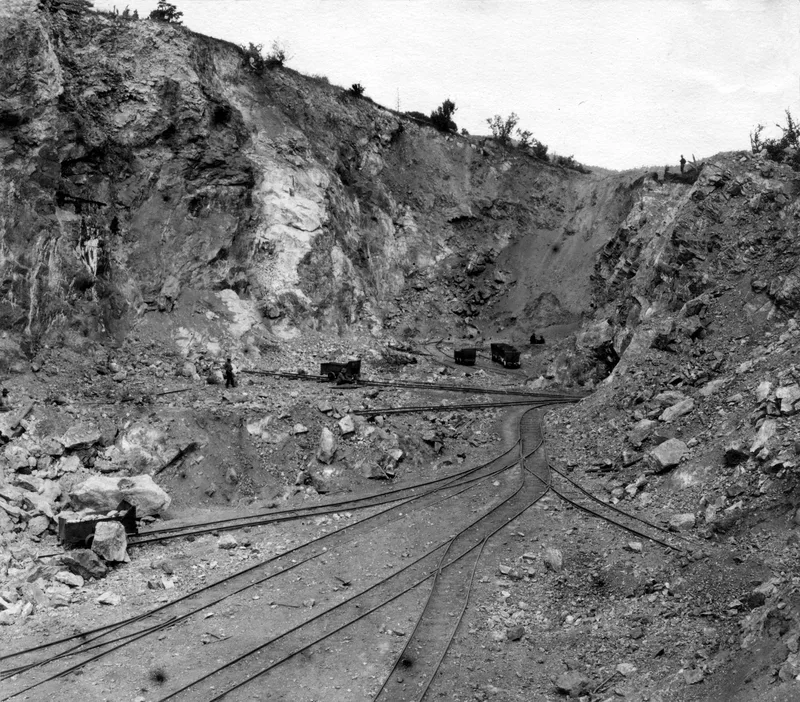
In 1905 about 350 tons of iron ore a day were mined at Hanover, according to the 1910 Geological Survey report on New Mexico ore deposits by Waldemar Lindgren, L. C. Graton and C. H. Gordon. Graton, who wrote its section on the Santa Rita and Hanover districts, gives 350 tons a day shipped to Pueblo, Colorado, at the time of his visit. The ore was magnetite, a magnetic iron oxide, mixed with a little limonite. It outcropped in bold masses at the Republic, or Union, workings on the west side of Hanover Creek, about halfway between Hanover and Fierro. Most of it was quarried from open cuts. Graton called the Fierro deposits "really part of the Hanover district," and wrote that the Colorado Fuel and Iron Company was still shipping several carloads a day from there.
Colorado Fuel and Iron, the steel company at Pueblo, leased the main iron mines. A 1930 Bureau of Mines circular on the Hanover Bessemer company's methods says the Hanover Bessemer Iron Ore Association was organized in 1899. That was the year the railroad was built to Fierro, and the association leased its ore to Colorado Fuel and Iron. The governor's report of 1901 said Hanover iron ore was shipped daily to Pueblo for Bessemer steel. Jones, in his 1904 book on New Mexico mines, wrote that Colorado Fuel and Iron controlled the Fierro iron mines that year. Sidney Paige of the Geological Survey named the working mines in 1908: "The principal mines are the Union and the Jim Fair." Both were leased by Colorado Fuel and Iron, which sent all the ore to Pueblo.1, 2, 3
Paige described how the work was done in 1908. Except for some ore recently taken underground from the southern part of the Union mine, the ore at both mines came from open cuts. The Union lay on a steep hillside, and the Jim Fair sat high enough for ore to move downhill by gravity. Tunnels, an open cut and trams carried it to bunkers at the railroad.
Two federal counts of the output agree closely. Paige's table, taken from the yearly Mineral Resources volumes, gives the Hanover district 61,160 long tons of iron ore in 1901 and 192,488 in 1907. His total for 1901 to 1907 is 1,010,779 long tons. Graton's report gives more than 1,000,000 long tons of magnetic iron ore mined at Fierro from 1900 to 1908.4
Copper companies around Hanover, 1902 to 1918
Two copper companies worked around Hanover in 1907. The Copper Queen Company at Fierro worked the Hanover, Modoc and Engineer mines. That year the Hermosa Copper Company sharply increased its shipments of silver-bearing copper-lead ore from Hanover Gulch, mainly from the Ivanhoe mine. A. C. Spencer and Sidney Paige, in their 1935 Geological Survey bulletin on the Santa Rita area, write that Hermosa was affiliated with General Electric. They say it sank shafts at eight points and opened nearly 3 miles of underground workings within two years. They report that it blocked out only 25,000 tons of 3 percent copper ore.5
Two dates are given for the start of Hermosa's work. Graton's 1910 section says the company began extensive prospecting and development about 1904. Spencer and Paige say Hermosa was organized in 1905.5
The old Hanover mine's change of owners has two dates as well. Jones wrote that it passed from T. B. Catron to C. F. Grayson and Co. of Silver City, which sold it to Phelps, Dodge and Co. in 1902. Spencer and Paige date Phelps Dodge's taking over of the Modoc, Hanover and Emma properties to about 1898-99. They add that lessees worked the Emma in 1908 and the Copper Queen Consolidated Mining Co. in 1910.6, 7
Hermosa's ventures ended in a transfer. Spencer and Paige write that it built a test concentrator on Hanover Creek about a mile and a half below Hanover, and that its lands passed to the Chino Copper Co. in 1918. The Engineering and Mining Journal reported on 22 September 1917 that a Hanover firm had taken over 29 claims formerly under option to Chino. Its heading calls the firm El Norte Copper Co., and its text calls it Del Norte Copper Co. The journal named W. A. Ulman of New York and associates as raising funds, and G. E. Coxe of Hanover as general manager.
Sources: A. C. Spencer and Sidney Paige, Geology of the Santa Rita mining area, New Mexico (USGS Bulletin 859) (1935): p. 8, History of mining; Engineering and Mining Journal, vol. 104 (1917), mining news: vol. 104, p. 540 (Sept. 22, 1917), Mining news, New Mexico, Grant County
Even the old copper dumps found a use. In 1917 a considerable quantity of oxidized ore from the dumps of the Hanover and Modoc mines, low in copper but high in iron, went to the Copper Queen smelter at Douglas, Arizona. It was used there as fluxing ore, material added to a smelter charge to help it melt.
Zinc carbonate from Hanover, 1903 to 1915
The sources disagree on when zinc mining began at Hanover. Spencer and Paige place the start of oxidized zinc mining between 1891 and 1899. Mineral Resources for 1915 says the Empire Zinc deposits had been worked at intervals since about 1894. The 1910 report by Lindgren, Graton and Gordon dates the start of zinc ore production to 1903, but for New Mexico as a whole. L. Michael Kaas, in a Silver City tour guide for the Mining History Association, puts the start at Hanover around 1904.8
Sources: A. C. Spencer and Sidney Paige, Geology of the Santa Rita mining area, New Mexico (USGS Bulletin 859) (1935): p. 7, History of mining (period 1891-1899); U.S. Geological Survey (to 1923) / U.S. Bureau of Mines (from 1924), Mineral Resources of the United States, 1915, Part I, Metals (chapter: gold, silver, copper, lead and zinc in New Mexico) (1917): Zinc chapter, New Mexico, Hanover district; Waldemar Lindgren, L. C. Graton and C. H. Gordon, The ore deposits of New Mexico (USGS Professional Paper 68); Santa Rita and Hanover districts section by L. C. Graton (1910): p. 19, production tables, explanatory note
Early zinc went a long way from Hanover. Jones wrote that in 1904 zinc ore from the Thunderbolt mine near Hanover was shipped to Mineral Point, Wisconsin, for treatment. The 1910 report says most New Mexico zinc ore went into the making of paint. Mineral Resources for 1907 records zinc carbonate ore shipped from the Empire Zinc Company's mines at Hanover. The Engineering and Mining Journal reported on 22 October 1910 that Empire Zinc was shipping zinc carbonates from the Hanover district to Mineral Point.3
Sources: Waldemar Lindgren, L. C. Graton and C. H. Gordon, The ore deposits of New Mexico (USGS Professional Paper 68); Santa Rita and Hanover districts section by L. C. Graton (1910): p. 19, production tables, explanatory note; U.S. Geological Survey (to 1923) / U.S. Bureau of Mines (from 1924), Mineral Resources of the United States, 1907, Part I, Metals (chapter: gold, silver, copper, lead and zinc in New Mexico) (1909): p. 408, Grant County, Central district (1907); Engineering and Mining Journal, vol. 90 (1910), New Mexico news column: vol. 90, p. 833 (Oct. 22, 1910), New Mexico, Grant County
Other mines shipped zinc as well. In 1909 Central district zinc ore was shipped from the Pewabic and Black Jack property and the New Mexico mine, and copper ore from the Clearwater, Hanover and Philadelphia mines. Hanover's zinc tonnage rose in 1910, when New Mexico's zinc mines were at Kelly, Hanover and near Los Cerrillos. In 1911 Grant County's zinc output fell because the Empire Zinc mines at Hanover were idle. By 1912 four shippers sent zinc carbonate ore from Hanover: the Mountain Home group, the Pewabic, the Welch group and Empire Zinc.
Sources: U.S. Geological Survey (to 1923) / U.S. Bureau of Mines (from 1924), Mineral Resources of the United States, 1909, Part I, Metals (chapter: gold, silver, copper, lead and zinc in New Mexico) (1911): Grant County, Central district (1909); U.S. Geological Survey (to 1923) / U.S. Bureau of Mines (from 1924), Mineral Resources of the United States, 1910, Part I, Metals (chapter: gold, silver, copper, lead and zinc in New Mexico) (1912): New Mexico, zinc (1910); U.S. Geological Survey (to 1923) / U.S. Bureau of Mines (from 1924), Mineral Resources of the United States, 1911, Part I, Metals (chapter: gold, silver, copper, lead and zinc in New Mexico) (1913): Grant County (1911); U.S. Geological Survey (to 1923) / U.S. Bureau of Mines (from 1924), Mineral Resources of the United States, 1912, Part I, Metals (chapter: gold, silver, copper, lead and zinc in New Mexico) (1914): Central district (1912)
Spencer and Paige write that after copper mining at Santa Rita began in 1912, zinc and lead production, mainly from mines around Hanover, increased greatly. Their table gives the Central district 2,205,824 pounds of zinc in 1912. Mineral Resources for 1914 lists Hanover first among New Mexico's principal zinc districts, ahead of Cooks Peak in Luna County and Kelly in Socorro County.
Sources: A. C. Spencer and Sidney Paige, Geology of the Santa Rita mining area, New Mexico (USGS Bulletin 859) (1935): p. 9, Production; pp. 9-10, production table 1904-32; U.S. Geological Survey (to 1923) / U.S. Bureau of Mines (from 1924), Mineral Resources of the United States, 1914, Part I, Metals (chapter: gold, silver, copper, lead and zinc in New Mexico) (1916): New Mexico, zinc (1914)
Empire Zinc's magnetic mill at Hanover, 1914 to 1919
Empire Zinc's next step was a mill for sulphide ore, in which the zinc is combined with sulphur. The El Paso Herald reported in October 1914 that the company, a subsidiary of Mineral Point Zinc, had decided to build a power plant and mill at Hanover. The Engineering and Mining Journal reported the same plan the next month. Mineral Resources for 1915 records carbonate ore shipped from Empire Zinc's Hanover mine, and says the building of a mill for sulphide ores at Hanover was begun. That volume does not name the builder.9, 10
Mineral Resources for 1916 names Empire Zinc's magnetic separation mill at Hanover, which ran from June 1916 on zinc sulphide ore for the rest of the year. Magnetic separation uses magnets to pull iron-bearing minerals out of crushed ore. That year the Central district produced 7,278,575 pounds of zinc. Besides the Chino mines at Santa Rita and Empire Zinc's mines at Hanover, it had 22 other producing mines.
The travel writer John Mulhouse, writing as El Chuqueño in 2017, said Hanover still lay in the shadow of the "massive Empire Zinc Company headframe," built during the First World War. A headframe is the tower over a mine shaft that carries the hoisting gear. His essay gives no source for the date.
In 1917 the Republic Mining & Milling Co. shipped iron ore to the steel mill at Pueblo and to lead smelters at Deming, and developed a large body of zinc sulphide ore. In 1918 the Central district produced 8,826,967 pounds of zinc, and Empire Zinc ran its Hanover separating mill continuously on ore from its mines. Mineral Resources for 1918 adds that the Hanover concentration mill ran steadily that year but closed in the spring of 1919.
Sources: U.S. Geological Survey (to 1923) / U.S. Bureau of Mines (from 1924), Mineral Resources of the United States, 1917, Part I, Metals (chapter: gold, silver, copper, lead and zinc in New Mexico) (1919): pp. 708-709; U.S. Geological Survey (to 1923) / U.S. Bureau of Mines (from 1924), Mineral Resources of the United States, 1918, Part I, Metals (chapter: gold, silver, copper, lead and zinc in New Mexico) (1920): Central district (1918); p. 309, New Mexico zinc (1918)
Hanover Bessemer and the Fierro iron mill, 1914 to 1930
Iron at Fierro gained a mill of its own during the same years. According to Mineral Resources for 1917, the Hanover-Bessemer Iron & Copper Co., owner of the Fierro iron mines, which it had for many years leased to Colorado Fuel and Iron, built an electrostatic separation mill in 1917. Electrostatic separation sorts crushed ore by how its particles take an electric charge. In 1918 the company ran the mill all year on iron ore and recovered a very large quantity of copper products as well.
Sources: U.S. Geological Survey (to 1923) / U.S. Bureau of Mines (from 1924), Mineral Resources of the United States, 1917, Part I, Metals (chapter: gold, silver, copper, lead and zinc in New Mexico) (1919): p. 709, Central district; U.S. Geological Survey (to 1923) / U.S. Bureau of Mines (from 1924), Mineral Resources of the United States, 1918, Part I, Metals (chapter: gold, silver, copper, lead and zinc in New Mexico) (1920): Central district
The 1930 Bureau of Mines circular gives a different date. It says the Hanover Bessemer Iron & Copper Co. was incorporated in 1914 and built a mill in 1916. Mineral Resources for 1917 puts the electrostatic mill in 1917. The circular adds that the company passed under the control of the United States Smelting, Refining & Mining Co. in 1919.11
Fierro's iron kept moving north through the 1920s. In 1927 Hanover-Bessemer shipped about 240,000 short tons of magnetite from Fierro to Colorado Fuel and Iron at Pueblo. In December 1928 its magnetic separation plant at Fierro, rated at 1,200 tons, ran at 600 tons a day. The Hanover Bessemer circular described the Fierro mine as the only operating iron mine in the southwestern United States. It said nearly all the ore went 694 miles by rail to Pueblo, about 200,000 tons a year, and that about 175 men were employed.12, 13
Sources: U.S. Geological Survey (to 1923) / U.S. Bureau of Mines (from 1924), Mineral Resources of the United States, 1927, Part I, Metals (chapter: gold, silver, copper, lead and zinc in New Mexico) (1929): Central district; U.S. Geological Survey (to 1923) / U.S. Bureau of Mines (from 1924), Mineral Resources of the United States, 1928, Part I, Metals (chapter: gold, silver, copper, lead and zinc in New Mexico) (1930): Metallurgic industry, New Mexico mills
Empire Zinc idles, restarts and turns to flotation, 1920 to 1930
Empire Zinc's mill stopped and started through the early 1920s. In 1920 the company shipped zinc carbonate ore from its Hanover mines and ran a 150-ton magnetic separating plant on sulphide ore. The mill then stood idle from November 1920. In 1921 the Hanover mines produced nothing, and only experimental work was done at the mill. Empire Zinc put the mill back in operation in November 1922.
Sources: U.S. Geological Survey (to 1923) / U.S. Bureau of Mines (from 1924), Mineral Resources of the United States, 1920, Part I, Metals (chapter: gold, silver, copper, lead and zinc in New Mexico) (1922): Central district (1920); U.S. Geological Survey (to 1923) / U.S. Bureau of Mines (from 1924), Mineral Resources of the United States, 1921, Part I, Metals (chapter: gold, silver, copper, lead and zinc in New Mexico): Central district (1921); U.S. Geological Survey (to 1923) / U.S. Bureau of Mines (from 1924), Mineral Resources of the United States, 1922, Part I, Metals (chapter: gold, silver, copper, lead and zinc in New Mexico): Central district (1922)
In 1923 the mill ran steadily. Its product was a high-grade zinc sulphide concentrate, ore with most of the waste rock removed, and it went to the company's zinc oxide plant at Canon City, Colorado. In 1924 the Hanover mine's 250-ton magnetic separating mill ran continuously. In 1927 Empire Zinc began making its concentrate in a new flotation mill. In flotation, finely ground ore is stirred in water with chemicals so that the wanted mineral clings to air bubbles and floats off. The new mill treated the zinc tailings, the leftover material, from the magnetic mill.
Sources: U.S. Geological Survey (to 1923) / U.S. Bureau of Mines (from 1924), Mineral Resources of the United States, 1923, Part I, Metals (chapter: gold, silver, copper, lead and zinc in New Mexico) (1925): p. 600, Central district (1923); U.S. Geological Survey (to 1923) / U.S. Bureau of Mines (from 1924), Mineral Resources of the United States, 1924, Part I, Metals (chapter: gold, silver, copper, lead and zinc in New Mexico) (1926): p. 586, Central district (1924); U.S. Geological Survey (to 1923) / U.S. Bureau of Mines (from 1924), Mineral Resources of the United States, 1927, Part I, Metals (chapter: gold, silver, copper, lead and zinc in New Mexico) (1929): New Mexico review (1927)
Two more operators worked near Hanover by the late 1920s. During 1927 the Peru Mining Co., a subsidiary of the Illinois Zinc Co., bought the holdings of the Hanover Copper Co. and the Grant County Copper Co. between Santa Rita and Hanover. It started an adit, a horizontal tunnel, and built an aerial tram to the railroad. Mineral Resources for 1928 says Peru bought the holdings early in 1927 and reopened them in June. The Black Hawk Consolidated Mines Co. ran a flotation mill a mile south of Hanover, beside the railroad and 400 feet from the Combination mine shaft.
Sources: U.S. Geological Survey (to 1923) / U.S. Bureau of Mines (from 1924), Mineral Resources of the United States, 1927, Part I, Metals (chapter: gold, silver, copper, lead and zinc in New Mexico) (1929): Central district (1927); U.S. Geological Survey (to 1923) / U.S. Bureau of Mines (from 1924), Mineral Resources of the United States, 1928, Part I, Metals (chapter: gold, silver, copper, lead and zinc in New Mexico) (1930): p. 546, Central district (1928); p. 546 (1928)
The Black Hawk mill has two building dates. A 1930 Bureau of Mines circular on the mill says it was built in summer 1926 for 100 tons a day and later handled 160 to 180 tons. Mineral Resources for 1928 says Black Hawk completed its 145-ton selective flotation mill that year. In 1929 the mill was rated at 150 tons and ran at 125 to 162 tons a day. The 1930 circular says about half its ore in the two preceding months came from the Asarco Mining Co.'s Ground Hog mine. The mill bought its power from the Texas-Louisiana Power Co., which generated it in a diesel plant at Silver City, 16 miles away.14, 15, 16
Sources: U.S. Geological Survey (to 1923) / U.S. Bureau of Mines (from 1924), Mineral Resources of the United States, 1928, Part I, Metals (chapter: gold, silver, copper, lead and zinc in New Mexico) (1930): p. 546 (1928); U.S. Geological Survey (to 1923) / U.S. Bureau of Mines (from 1924), Mineral Resources of the United States, 1929, Part I, Metals (chapter: gold, silver, copper, lead and zinc in New Mexico) (1931): p. 737, active metallurgical plants in New Mexico (1929)
By Spencer and Paige's count, zinc output from the Central district peaked in 1930. In 1929 Empire Zinc's 300-ton flotation mill at Hanover worked at only 120 tons a day. They write that copper production reached its maximum in 1929, but lead and zinc rose further in 1930. Their table gives the Central district 30,638,000 pounds of zinc in 1930, then 10,241,000 pounds in 1932.
Sources: U.S. Geological Survey (to 1923) / U.S. Bureau of Mines (from 1924), Mineral Resources of the United States, 1929, Part I, Metals (chapter: gold, silver, copper, lead and zinc in New Mexico) (1931): p. 737, active metallurgical plants in New Mexico (1929); A. C. Spencer and Sidney Paige, Geology of the Santa Rita mining area, New Mexico (USGS Bulletin 859) (1935): pp. 9-10, production table 1904-32
Closed mines and a custom mill, 1931 to 1937
Empire Zinc closed its Hanover zinc mine and 300-ton flotation mill on 1 April 1931. Spencer and Paige's count of iron ore ends the same year. They give about 4,685,301 long tons mined at Fierro-Hanover from 1896 to 1931, most of it by the Hanover Bessemer Iron Association and its successor, the Hanover Bessemer Iron & Copper Co. Before that, they write, the Southwestern Coal & Iron Co. mined 44,500 long tons in 1891-96.
Sources: U.S. Bureau of Mines, Minerals Yearbook 1937 (covering 1936), chapter: Gold, silver, copper, lead, and zinc in New Mexico: Central district (1936); A. C. Spencer and Sidney Paige, Geology of the Santa Rita mining area, New Mexico (USGS Bulletin 859) (1935): p. 10, Production
Two dates for the Hanover Bessemer association do not match. Spencer and Paige credit it with output from 1896, while the Hanover Bessemer circular says the association was organized in 1899.1
The end of iron mining has two dates as well. Kaas writes that iron mining at Fierro for Colorado Fuel and Iron continued until 1931. Yet the Bureau of Mines recorded that in 1937 oxidized hematite from the McKenna mine went to the Colorado Fuel and Iron steel plant at Pueblo. About 4,000 tons of iron-copper fluxing ore went from Fierro and Hanover to El Paso that year.17
Other zinc mines kept working. In 1935 the Peru Mining Co. mined zinc sulphide ore at its Pewabic mine at Hanover and shipped it 60 miles by rail to its 500-ton flotation mill at Deming. That year Black Hawk's 250-ton concentrator south of Hanover ran as a custom mill, one that treats ore for other mine owners. It worked 335 days at an average of 224 tons a day. Its feed was ore from Asarco's Ground Hog and San Jose properties near Cobre, along with company ore of a similar type. McLemore's booklet on New Mexico mining districts dates the Ground Hog's first production to 1928.18
Empire Zinc's Hanover mine came back in 1937. In April the Bureau of Mines reported preparations to reopen it, and Empire Zinc reopened the mine in May after six years idle. It ran for the rest of the year and shipped concentrates to the Mineral Point Zinc plant at Depue, Illinois. Peru's Pewabic ore was concentrated and roasted at Wemple near Deming in 1937. It then went to the Dumas, Texas, smelter of the Illinois Zinc Co., Peru's parent company. In July 1937 Peru took an option on the Kearney claims.19
Sources: U.S. Bureau of Mines, Minerals Yearbook 1937 (covering 1936), chapter: Gold, silver, copper, lead, and zinc in New Mexico: Central district (1936); U.S. Bureau of Mines, Minerals Yearbook 1938 (covering 1937), chapter: Gold, silver, copper, lead, and zinc in New Mexico: Central district (1937)
Leases and changing hands, 1938 to 1940
In 1938 the Hanover zinc mine and mill ran continuously. Their concentrates went to American Zinc plants and to plants of the New Jersey Zinc Co. at Palmerton, Pennsylvania, and Depue, Illinois. The yearbook lists the Depue plant as New Jersey Zinc's Mineral Point Zinc Division. The El Paso Herald had reported in 1914 that Empire Zinc was a subsidiary of Mineral Point Zinc.9
Leases moved other mills and mines between operators. In April 1938 Asarco stopped sending Ground Hog ore to the Black Hawk company's 200-ton Combination custom mill at Hanover, and the mill closed. Asarco later leased it. The Pewabic mine and Peru's Wemple mill ran from March to June 1938 and then shut down. On 15 October they were leased to the Callahan Zinc-Lead Co., which ran them to the end of the year. Callahan returned the property to Peru on 1 January 1940.
Sources: U.S. Bureau of Mines, Minerals Yearbook 1939 (covering 1938), chapter: Gold, silver, copper, lead, and zinc in New Mexico: p. 428, Central district (1938); U.S. Bureau of Mines, Minerals Yearbook 1940 (covering 1939), chapter: Gold, silver, copper, lead, and zinc in New Mexico: p. 410, Central district (1939)
By 1939 the two largest underground mines in New Mexico were at Hanover. The Empire Zinc Hanover group ranked first in tonnage that year and the Pewabic group second. Six flotation mills treated 96 percent of New Mexico's ore. Two of them were in the Hanover area: Empire Zinc at Hanover and the Combination near Hanover. The others were Chino at Hurley, Banner near Lordsburg, Peru near Deming and Pecos in San Miguel County.
Full capacity at a loss, 1941 to 1946
In the early 1940s Empire Zinc fed its Hanover mill with ore from Kelly. In 1941 the Hanover mine yielded less zinc concentrate than in 1940, and Empire Zinc partly made up the loss with ore from its Kelly mine in Socorro County. In 1942 the Bureau of Mines said the Hanover mill kept full capacity only by bringing in ore from the company's Lynchburg mine at Kelly. Those shipments, it added, represented a money loss. Asarco ran the old Combination-Black Hawk mill under lease as its Hanover milling unit. In 1942 the unit treated mostly Asarco's ore from the Ground Hog-San Jose group. About 22 percent of its feed was custom ore from small mines across New Mexico, from Organ, Kingston, Steins, Lordsburg and Magdalena to Cerrillos.
Sources: U.S. Bureau of Mines, Minerals Yearbook 1941 (covering 1941), chapter: Gold, silver, copper, lead, and zinc in New Mexico: p. 425, Central district (1941); U.S. Bureau of Mines, Minerals Yearbook 1942 (covering 1942), chapter: Gold, silver, copper, lead, and zinc in New Mexico: p. 450, Central district (1942); pp. 450-451 and county sections (1942)
Peru expanded in the same years. Its New Mexico Consolidated Mining Co. began sinking two shafts on the Kearney claims in March 1942, and zinc production there began in March 1943. By 1943 Peru ran a 1,000-ton flotation mill at Wemple near Deming, averaging 700 tons a day. Its ore came from the Pewabic, Copper Flat and Kearny mines near Hanover, as the 1943 yearbook spells the last name. In 1944 producers near Hanover sent some concentrate to the electrolytic zinc plant at Corpus Christi, Texas.19
Sources: U.S. Bureau of Mines, Minerals Yearbook 1943 (covering 1943), chapter: Gold, silver, copper, lead, and zinc in New Mexico: Central district (1943); U.S. Bureau of Mines, Minerals Yearbook 1944 (covering 1944), chapter: Gold, silver, copper, lead, and zinc in New Mexico: Zinc smelting, Texas (1944)
By 1945 Empire Zinc's mill took in Kennecott ore as well as its own. In 1945 Empire Zinc ran its Hanover mine group and flotation mill all year and was New Mexico's second-largest zinc producer. Besides its own ore, the mill treated ore from the company's Kelly group and Kennecott's Oswaldo mine, and it shipped concentrates to Palmerton and Depue. In 1946 it added ore from the Cleveland mine at Pinos Altos, and Kennecott shipped increasing quantities of Oswaldo ore to Hanover. On 1 July 1946 U.S. Smelting, Refining & Mining took possession of the Combination, Hobo and Hobo No. 2 mines, bought from Black Hawk.
Sources: U.S. Bureau of Mines, Minerals Yearbook 1945 (covering 1945), chapter: Gold, silver, copper, lead, and zinc in New Mexico: p. 431, Central district (1945); p. 431 (1945); U.S. Bureau of Mines, Minerals Yearbook 1946 (covering 1946), chapter: Gold, silver, copper, lead, and zinc in New Mexico: p. 1506 (1946); p. 1506, Central district (1946)
New Mexico's largest zinc producer, 1947 to 1950
In 1947 the Bureau of Mines called the Empire Zinc Hanover group "a large, steady producer of zinc for many years." Its mine and mill ran continuously that year. The smaller mines were less steady. A Bureau of Mines circular on the Kearney mine says the wartime Premium Price Plan for copper, lead and zinc expired on 30 June 1947. The Kearney then shut for about a month, and the company's main office moved from Silver City to the Pewabic mine near Hanover. The Pewabic itself closed on 12 August 1947 and did not reopen until 31 July 1948. All Kearney ore went to the Peru mill near Deming.20, 21
Sources: U.S. Bureau of Mines, Minerals Yearbook 1947 (covering 1947), chapter: Gold, silver, copper, lead, and zinc in New Mexico: Central district (1947); U.S. Bureau of Mines, Minerals Yearbook 1948 (covering 1948), chapter: Gold, silver, copper, lead, and zinc in New Mexico: Zinc (1948)
In 1949 the price of zinc fell to a low of 9 cents a pound on 15 June, and most of New Mexico's zinc and zinc-lead mines shut down. The Pewabic and Kearney worked from January to 17 June 1949, then stopped because lead and zinc prices had dropped too low to cover their high production costs. Empire Zinc's Hanover mine ran continuously and was New Mexico's largest zinc producer that year. The Bureau of Mines recorded that a work stoppage shut the Empire Zinc Division's Hanover mine and mill on 17 October 1950. The Oswaldo and other mines served by the mill then had to stop shipping ore.22
Read more on Salars.net
Part 3 of 9 of the series Hanover, New Mexico: iron, zinc and the Empire Zinc strike.
Sources
- The Hanover Bessemer Iron Ore Association was organized in 1899, when the railroad was built to Fierro, and leased its ore to the Colorado Fuel & Iron Co. Information Circular 6361: Mining and Engineering Methods and Costs of the Hanover Bessemer Iron and Copper Co., Fierro, New Mexico, IC 6361, History, p. 2. View source ↗ (documented)
- The report said the Hearst estate owned the Pinos Altos gold properties and ran a 240-ton-a-day smelter at Silver City, and that Hanover iron ore was shipped daily to Pueblo, Colorado, for Bessemer steel. Report of the Governor of New Mexico to the Secretary of the Interior, 1901, Report of the Governor 1901, p. 449. View source ↗ (reported)
- In 1904 the Colorado Fuel & Iron Co. controlled the Fierro iron mines, and zinc ore from the Thunderbolt mine near Hanover was shipped to Mineral Point, Wisconsin, for treatment. New Mexico Mines and Minerals: being an epitome of the early mining history and resources of New Mexican mines, p. 43. View source ↗ (reported)
- More than 1,000,000 long tons of magnetic iron ore were mined at Fierro from 1900 to 1908. The Ore Deposits of New Mexico (USGS Professional Paper 68), Chloride Flat district and Fleming Camp sections by L. C. Graton, USGS PP 68, p. 296. View source ↗ (reported)
- The Hermosa Copper Co., affiliated with General Electric and organized in 1905, sank shafts at eight points and within two years opened nearly 3 miles of underground workings near Hanover, but reportedly blocked out only 25,000 tons of 3 percent copper ore; in 1918 its lands were transferred to the Chino Copper Co. Geology of the Santa Rita Mining Area, New Mexico (USGS Bulletin 859), USGS Bulletin 859, History of mining, p. 8 (footnote 10 cites Copper Handbook vol. 8, 1908). View source ↗ (reported)
- The Hanover mine later passed from T. B. Catron to C. F. Grayson and Co. of Silver City, which sold it to Phelps, Dodge and Co. in 1902. New Mexico Mines and Minerals: being an epitome of the early mining history and resources of New Mexican mines, p. 41. View source ↗ (reported)
- About 1898-99 the Phelps Dodge Co. took over several properties near Hanover, including the Modoc, Hanover and Emma; the Emma was worked by lessees in 1908 and by the Copper Queen Consolidated Mining Co. in 1910. Geology of the Santa Rita Mining Area, New Mexico (USGS Bulletin 859), USGS Bulletin 859, History of mining, p. 8. View source ↗ (reported)
- Zinc mining at Hanover began around 1904; the Empire Zinc mine was the site of a 15-month strike in 1950-1952 over a dual wage system that paid Mexican American miners less, and remained a major producer until 1969. L. Michael Kaas, Silver City historical tour guide, Mining History Association (c. 2011, inferred), Kaas, Hanover section. View source ↗ (reported)
- In October 1914 the Empire Zinc company (subsidiary of Mineral Point Zinc) decided to build a power plant and mill at Hanover and a mill at Pinos Altos. El Paso herald (El Paso, Tex. : 1901), October 21, 1914, p. 11, https://www.loc.gov/resource/sn88084272/1914-10-21/ed-1/?sp=11 — Empire Zinc article, subhead 'To Erect Power Plant'. View source ↗ (reported)
- In 1914 the Empire Zinc Co. announced a power plant and concentrator at Hanover and another concentrator at Pinos Altos for its sulphide ore. Engineering and Mining Journal, November 7, 1914, p. 849, Engineering and Mining Journal, vol. 98, Nov. 7, 1914, p. 849 (leaf n875; running head "November 7, 1914 ... 849"). View source ↗ (reported)
- The Hanover Bessemer Iron & Copper Co. was incorporated in 1914, built a mill in 1916, and passed under the control of the United States Smelting, Refining & Mining Co. in 1919. Information Circular 6361: Mining and Engineering Methods and Costs of the Hanover Bessemer Iron and Copper Co., Fierro, New Mexico, IC 6361, History, p. 2. View source ↗ (documented)
- In 1930 the Hanover Bessemer Iron & Copper Co. mine at Fierro was described as the only operating iron mine in the southwestern United States. Information Circular 6361: Mining and Engineering Methods and Costs of the Hanover Bessemer Iron and Copper Co., Fierro, New Mexico, IC 6361 (Kniffin), Introduction, p. 1. View source ↗ (documented)
- Nearly all Fierro iron ore went 694 miles by rail to Pueblo, Colorado, to be smelted by the Colorado Fuel & Iron Co.; shipments ran about 200,000 tons a year and about 175 men were employed. Information Circular 6361: Mining and Engineering Methods and Costs of the Hanover Bessemer Iron and Copper Co., Fierro, New Mexico, IC 6361, Introduction, p. 1. View source ↗ (documented)
- The Black Hawk Consolidated Mines Co. concentrator, a mile south of Hanover on the Hanover-Fierro spur of the Santa Fe, was built in summer 1926 for 100 tons a day and later handled 160 to 180 tons. Information Circular 6359: Milling Methods and Costs at the Black Hawk Concentrator, Hanover, New Mexico, IC 6359 (Wright), General description, p. 1. View source ↗ (documented)
- In the two months before the 1930 report, about half the ore treated at the Black Hawk mill came from the Ground Hog mine of the Asarco Mining Co.; the mill also handled some custom ore from the Central district and other districts. Information Circular 6359: Milling Methods and Costs at the Black Hawk Concentrator, Hanover, New Mexico, IC 6359, Ore treated, p. 2. View source ↗ (documented)
- In 1930 the Black Hawk mill bought its power from the Texas-Louisiana Power Co., which generated it in a diesel plant at Silver City, 16 miles away. Information Circular 6359: Milling Methods and Costs at the Black Hawk Concentrator, Hanover, New Mexico, IC 6359, p. 2. View source ↗ (documented)
- Iron ore mining at Fierro, shipped mostly to Colorado Fuel and Iron in Pueblo after the railroad reached Hanover in 1891, continued until 1931. L. Michael Kaas, Silver City historical tour guide, Mining History Association (c. 2011, inferred), Kaas, Fierro/Hanover iron section. View source ↗ (reported)
- The Ground Hog mine in the Fierro-Hanover district began production in 1928. Mining districts and prospect areas in New Mexico (NMBGMR Resource Map 24, booklet), p. 4 (PDF p. 5). View source ↗ (reported)
- The Peru Mining Co. optioned the Kearney claims in July 1937; its New Mexico Consolidated Mining Co. began sinking two shafts in March 1942, and zinc production began in March 1943. Information Circular 7507: Mining Methods and Costs at the Kearney Zinc-Lead Mine, Central Mining District, Grant County, N. Mex., IC 7507, History, p. 3. View source ↗ (documented)
- The Kearney mine shut for about a month in 1947 after the wartime Premium Price Plan for copper, lead and zinc expired on June 30, 1947, and the company's main office moved from Silver City to the Pewabic mine near Hanover. Information Circular 7507: Mining Methods and Costs at the Kearney Zinc-Lead Mine, Central Mining District, Grant County, N. Mex., IC 7507, History p. 3 and Organization. View source ↗ (documented)
- All ore from the Kearney mine was shipped to the Peru company's mill near Deming. Information Circular 7507: Mining Methods and Costs at the Kearney Zinc-Lead Mine, Central Mining District, Grant County, N. Mex., IC 7507, Surface plant section. View source ↗ (documented)
- The Bureau of Mines recorded that a work stoppage shut the Empire Zinc Division's Hanover mine and mill on October 17, 1950, also forcing the Oswaldo and other mines served by the mill to stop shipping ore. Minerals Yearbook 1950, Minerals Yearbook 1950, New Mexico chapter, Zinc. View source ↗ (documented)
"Documented" means the source is a record of the time or a direct survey; "reported" means a later account or secondary history, attributed in the text.
Cite this page: “Iron, copper and zinc at Hanover, 1900 to 1950.” Grant County Atlas, Salars.net, first published 16 November 2026. https://atlas.salars.net/stories/hanover/iron-copper-and-zinc-1900-1950
Discussion
What would you add or question? Comments are reviewed before they appear.
Loading comments…