Fort Bayard, near Central, New Mexico, became an Army tuberculosis hospital in 1899 and 1900; its historic district nomination links benefit cuts in 1933 to lost spending in Central City, and local dependence on hospital jobs to the state's takeover in 1965.
A second bed outside: Fort Bayard, 1918
In a nursing account published in 1918, Mrs. E. C. Hamill wrote that a frail patient at Fort Bayard’s tuberculosis hospital could have two beds: one indoors and one outside. The indoor bed, she explained, was reserved for severe rain and sandstorms. That arrangement made the climate part of the daily work. Someone had to care for patients, their bedding, their meals, and their comfort across both spaces.1
For nearby Central, the War Department’s conversion of the Army post into a hospital in 1899 meant that the institution across the reservation boundary would continue to bring people and income into the area. Its purpose had changed. Familiar buildings now served long courses of treatment, and the surrounding land helped supply an establishment organized around care.2, 3, 4
From cavalry post to hospital in stages: Fort Bayard, 1899 to 1902
On 28 August 1899 the War Department designated Fort Bayard for tuberculosis treatment. Dr. Daniel M. Appel arrived on 3 October; the last cavalry troops did not leave until 12 January 1900. Military and medical uses overlapped during the transition. Fort Bayard’s new hospital treated Army patients and beneficiaries of the Soldiers’ Home, an institution serving former soldiers.2, 5
In the fiscal year ending 30 June 1902, the Surgeon General’s report counted 439 cases under treatment at Fort Bayard. Fifty-two patients died, and 150 remained at the end of the year. These categories make the length and seriousness of the work visible. Admission did not mean a short visit, and the hospital’s books carried patients forward from one reporting period into another.6
Fort Bayard’s admissions, the Surgeon General warned in that 1902 report, were not limited to favorable early cases. Its totals therefore cannot, on their own, show how well treatment worked compared with another institution. They do establish a substantial continuing need for nursing, meals, beds, and facilities at a place that had recently housed cavalry.7
The hospital in three photographs: Fort Bayard, about 1909 to 1922
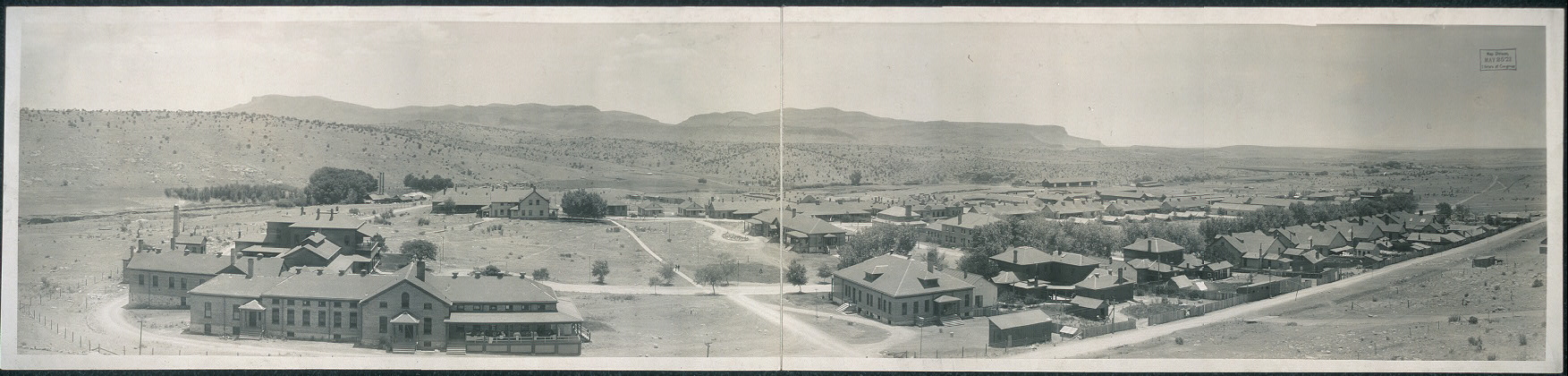
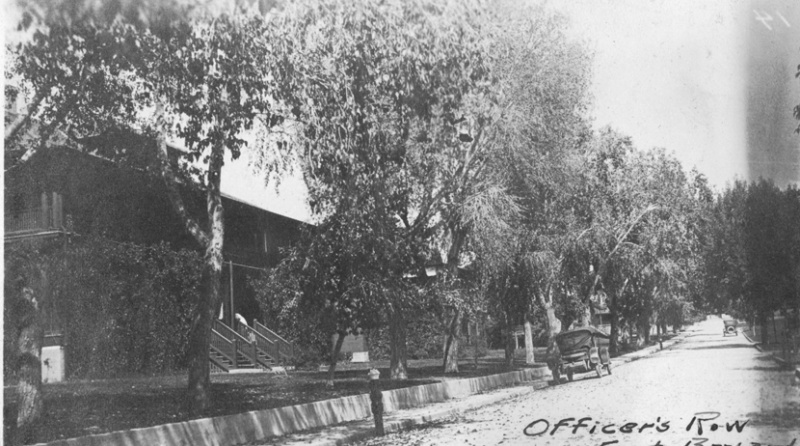
Three surviving photographs make the scale of the Fort Bayard hospital easier to see. A panorama cataloged by the Library of Congress as about 1909 spreads buildings around a large open parade ground. An October 1917 photograph in Lorain H. Cunningham’s album takes the view down Officers’ Row instead: trees, porches, steps, and the road between them. The Truman Library identifies the post in this image as a government hospital for soldiers with tuberculosis. Its old military name remained attached to a place now serving patients.
Sources: Library of Congress, Fort Bayard panorama, approximately 1909, item 2007664263; Harry S. Truman Library, Officers’ Row, October 1917, accession 2007-806
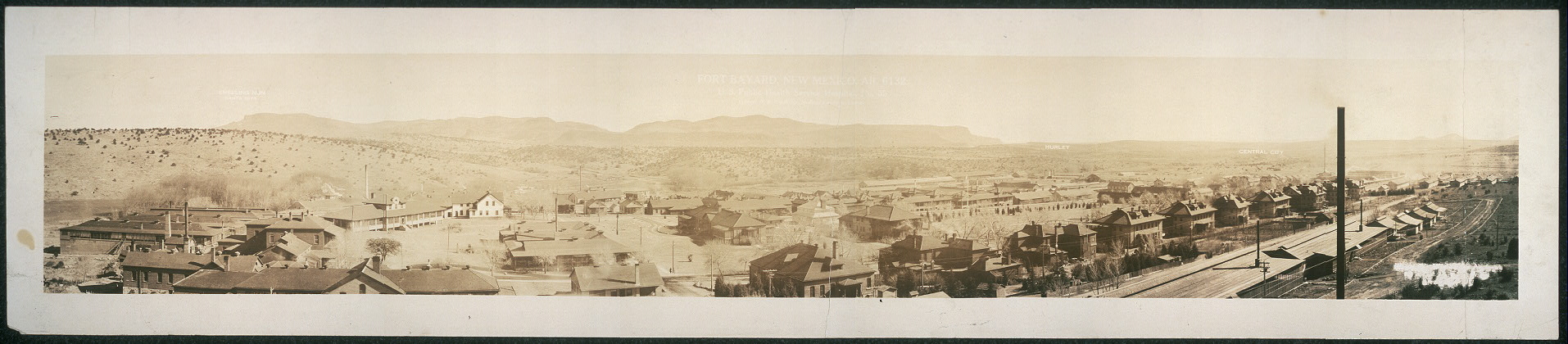
A later panorama, dated by the Library of Congress between 1920 and 1922, names U.S. Public Health Service Hospital No. 55 and labels Central City beyond the post. That label places the village in the hospital’s wider landscape without confusing the two settlements. Together, the views show a substantial establishment of buildings, roads, and grounds that had to be maintained throughout a patient’s stay. They cannot identify who did every job or show whether a particular patient recovered.
Open the photograph collection and local archival leads
Sources: Library of Congress, Hospital No. 55 panorama, 1920–1922, item 2007664272
Care had a supply chain: Fort Bayard, 1906 to 1918
In her 1918 account, Hamill described Fort Bayard patients carrying paper cups for sputum. Used cups went into cans on the porches and were collected for burning. She described frequent meals and encouragement to consume eggs, milk, and butter; some patients, she wrote, ate eight to twelve raw eggs daily. This was the hospital routine she recorded in her time. Small repeated tasks—collecting, carrying, cooking, serving—made up much of the institution’s life.8
Fort Bayard’s grounds were part of that system. By 1906, according to the historic district nomination, the hospital maintained a herd of 120 dairy cows. A later Army report described the work of 1912: an additional well with an electric pump, and a concrete dam on Cameron Creek about half a mile below the post. Water collected there made roughly ten more acres available for cultivation. Food production, water supply, and treatment occupied one landscape.3, 4
Expansion did not always keep pace with demand. In 1912 Fort Bayard’s commanding officer reported overcrowding among patients who could walk about, which forced some into an old wooden barrack called Ward 5 that he considered unsuitable. A hospital could possess an extensive reservation and still lack the right rooms for the people admitted to it.9
Fort Bayard’s nurses, as Hamill remembered them in 1918, had a community of their own. She recalled a fund for a piano, financed by small fines for slang and talking shop. When the Surgeon General heard of it, she wrote, he sent a check. The detail brings the caregivers into view as people living at an isolated post, seeking company and music after their work.10
Federal decisions reached village shops: Fort Bayard and Central City, 1920 to 1965
Fort Bayard’s hospital passed to the Public Health Service in 1920 and to the Veterans’ Bureau in 1922. According to the historic district nomination, cuts to veterans’ benefits in 1933 reduced many patients’ monthly income from $100 to $20. The nomination specifically connects that lost spending to nearby Central City. A decision about benefits thus became a decision about what local customers could afford.11, 12
When the Veterans Administration closed its Fort Bayard hospital in 1965, New Mexico took over the facility and 484 acres. The nomination identifies local dependence on hospital employment as part of the reason for the transfer. Central’s relationship with the post had lasted through a change from soldiers to patients and then through changes of medical administration. By the mid-twentieth century, as the nomination presents it, keeping care at Fort Bayard meant keeping work in the surrounding communities.13
Read more on Salars.net
Part 5 of 8 of the series Central / Santa Clara, New Mexico: the record.
Sources
- A nurse writing in 1918 described Fort Bayard, at 6,300 feet, as a large tuberculosis hospital for the Army, the Navy and the Soldiers' Homes, with women nurses serving alongside male nurses and feeble patients given two beds, one outdoors. The Fort Bayard Hospital for Tuberculosis, American Journal of Nursing 18 (1918), p. 665 (archive.org jstor-3405862). View source ↗ (reported)
- A War Department order of August 28, 1899 authorized the Army sanatorium; Major Daniel M. Appel arrived October 3, 1899, and the last 9th Cavalry detachment left the discontinued post on January 12, 1900. Fort Bayard Historic District, National Register nomination, npgallery NRHP 02000726 nomination (online PDF text identical to local extract), Section 8, p. 29. View source ↗ (documented)
- By 1906 the sanatorium kept a dairy herd of 120 Jersey and Durham cows watered by a new gravity system from springs north of the post; by 1919 it had dairy barns, silos, hog and chicken farms and an orchard. Fort Bayard Historic District, National Register nomination, npgallery NRHP 02000726 nomination (online PDF text identical to local extract), Section 8, pp. 33-34. View source ↗ (documented)
- In 1912 the hospital dug a new electrically pumped well and built a small concrete dam on Cameron Creek about half a mile below the post to irrigate about ten acres; 928 cases were treated that year. Report of the Surgeon-General of the Army to the Secretary of War (bound volume containing the reports for 1911, 1912 and 1913), archive.org reportofsurgeon1912unit (bound Surgeon General reports for fiscal years ended June 30, 1912, 1913 and 1914); FY1913 report, "General Hospital, Fort Bayard", p. 143. View source ↗ (documented)
- The sanatorium was to treat Army officers and enlisted men with pulmonary tuberculosis and also discharged soldiers entitled to the U.S. Soldiers' Home; its retention reflected Surgeon General George M. Sternberg's interest in tuberculosis. Fort Bayard Historic District, National Register nomination, npgallery NRHP 02000726 nomination (online PDF text identical to local extract), Section 8, p. 29. View source ↗ (documented)
- In the fiscal year ending June 30, 1902 the Army general hospital at Fort Bayard treated 439 cases, of whom 52 died; they included many Soldiers' Home beneficiaries and 162 enlisted men who remained as Soldiers' Home beneficiaries after discharge. Report of the Surgeon-General of the Army to the Secretary of War (bound volume containing the reports for fiscal 1902 and calendar 1903), Report of the Surgeon-General of the Army, fiscal year ending June 30, 1902 (archive.org reportsurgeonge01offigoog), p. 69. View source ↗ (documented)
- The Surgeon General noted that, unlike sanatoria that ordinarily admitted only about a quarter of the cases they examined, the Army sent patients to Fort Bayard regardless of how far their disease had gone or whether they wished to go; 62 had come back after discharge with their disease much advanced. Report of the Surgeon-General of the Army to the Secretary of War (bound volume containing the reports for fiscal 1902 and calendar 1903), Report of the Surgeon-General of the Army, fiscal year ending June 30, 1902 (archive.org reportsurgeonge01offigoog), p. 70. View source ↗ (documented)
- Hamill recalled that patients carried paper sputum cups that were collected from cans on the porches and burned, and that they were encouraged to eat eggs, milk and butter freely, some taking eight to twelve raw eggs a day. The Fort Bayard Hospital for Tuberculosis, AJN 18 (1918), p. 666. View source ↗ (reported)
- The commanding officer reported in 1912 that rising numbers of Soldiers' Home beneficiaries had overcrowded the wards, forcing some patients into an old wooden barrack, 'ward 5', that was unsuited to the purpose. Report of the Surgeon-General of the Army to the Secretary of War (bound volume containing the reports for 1911, 1912 and 1913), archive.org reportofsurgeon1912unit (bound Surgeon General reports for fiscal years ended June 30, 1912, 1913 and 1914); FY1913 report, p. 143. View source ↗ (documented)
- Hamill recalled that the nurses at the isolated post, ten miles from Silver City, had their own home, and that when they fined each other for slang and "shop" talk to pay for a piano, the Surgeon General sent a check for it. The Fort Bayard Hospital for Tuberculosis, AJN 18 (1918), p. 666-667. View source ↗ (reported)
- The U.S. Public Health Service took over Fort Bayard in June 1920, and in summer 1922 the U.S. General Hospital there passed to the new Veterans' Bureau as United States Veterans' Hospital No. 55. Fort Bayard Historic District, National Register nomination, npgallery NRHP 02000726 nomination (online PDF text identical to local extract), Section 8, pp. 35-36. View source ↗ (documented)
- Veterans' benefit cuts of 1933 reduced many Fort Bayard patients' monthly income from $100 to $20, money that had been spent in nearby Central City. Fort Bayard Historic District, National Register nomination, Section 8, page 38. View source ↗ (reported)
- When the Veterans Administration closed the Fort Bayard hospital in 1965, the State of New Mexico took over the facility and 484 acres, partly because local communities depended on it for jobs. Fort Bayard Historic District, National Register nomination, Section 8, page 39. View source ↗ (reported)
"Documented" means the source is a record of the time or a direct survey; "reported" means a later account or secondary history, attributed in the text.
Cite this page: “Central and the Fort Bayard hospital years.” Grant County Atlas, Salars.net, first published 13 November 2026, revised 16 November 2026. https://atlas.salars.net/stories/santa-clara/hospital-years
Discussion
What would you add or question? Comments are reviewed before they appear.
Loading comments…