From 1883 to 1895 Lake Valley was a company mining camp, served from 1884 by a branch railroad from Nutt. Company mining ended in 1893, in March by Homer E. Milford's account and in August by Ellis Clark's, who gave the low price of silver as the reason; a fire in 1895 burned the center of town, the Sierra County Advocate reported.
One company's camp and a militia raid, Lake Valley in 1883
The Mint's report for 1883 said shipments of Lake Valley's higher-grade ore alone were put at something over $100,000 a month. Only ore of 50 ounces of silver a ton and up had been shipped, the report said, leaving great dumps of lower-grade ore behind. About 125 men worked most of that year for the Sierra Grande, mining and prospecting, the report said. They had thoroughly explored a section of ground 1,000 by 250 feet, and a diamond drill was now used for prospecting.
By 1883 the Sierra Grande Mining Company almost wholly owned and controlled the district, the Mint report said, and at least a dozen original locations, or staked claims, were folded into its three mines. The company, which owned the Sierra Plata and Apache as well, built a twenty-stamp mill that year, the report said. A stamp mill crushes ore under heavy falling stamps, and this one was rated at 60 to 75 tons a day. A trial run, the Mint reported, showed that ore of only 10 ounces a ton could be treated at a profit.
On 22 March 1883 Territorial militia under Major Albert J. Fountain raided Lake Valley in search of suspected cattle thieves, Homer E. Milford writes in his history of the district for the New Mexico Abandoned Mine Lands Program. Sierra Grande employees guided the militia, he writes. Two men arrested in the camp were shot dead before dawn near the cienega, a marshy spring, at a ranch, by Milford's account. Fountain said the two had fled. His report, as Milford quotes it, said a party went about two hundred yards up the road and came upon the bodies.
Late in 1883 the Lake Valley Herald reported that manager F. M. Endlich had cut 25 men from the Grande, 35 from the Bella and 10 from the Apache. That left forces of 120, 30 and 10 men. The Mining Record quoted the item on 15 December 1883, Milford writes.
A branch railroad from Nutt, 1883 to 1884
Grading for a branch railroad from Nutt to Lake Valley began in the fall of 1883, Milford writes, when hauling cost in the low twenty dollars a ton. On 26 February 1884 the Las Vegas Daily Gazette reported that Jim Duncan's outfit would finish grading the Lake Valley road by Sunday. "The track will be laid within three weeks," the paper said. In that column the Gazette put shipments of ore and concentrates from the Lake Valley mines in January 1884 at something like $130,000. Concentrates are ore that a mill has enriched by separating out waste rock.
Sources: Homer E. Milford, New Mexico Abandoned Mine Lands Program, History of the Lake Valley Mining District (from the AML archaeological survey report of Lake Valley by Moiola and Milford, 2000): p. 113 (citing MR 12/29/1883); Las Vegas Daily Gazette, 26 February 1884, p. 3 (1884-02-26): p. 3, territorial items
Milford writes that the branch was finished in the spring of 1884. Passenger cars had at first been added to freight trains. On 18 April 1884 the Black Range, in an issue Milford cites, reported two separate passenger trains making the round trip between Nutt and Lake Valley each day. By May, the Las Vegas Daily Gazette reported, trains on the Lake Valley extension left Lake Valley at seven in the morning and four in the afternoon. The morning train ran through to Rincon to meet the El Paso express. The evening train stopped at Nutt.
Sources: Homer E. Milford, New Mexico Abandoned Mine Lands Program, History of the Lake Valley Mining District (from the AML archaeological survey report of Lake Valley by Moiola and Milford, 2000): pp. 113-114; Las Vegas Daily Gazette, 14 May 1884, p. 4 (1884-05-14): p. 4, local column
A stage road ran on from Lake Valley to Hillsboro and Kingston. Ellis Clark, who later ran the company's work, wrote in 1894 that a valley of black and green shale northeast of the Grande workings was the natural outlet of the district. The road ran through it. By 1891 the Santa Fe Route kept a ticket agent named Swigert at Lake Valley, the Sierra County Advocate reported.
Sources: Ellis Clark, Phoenix, Arizona, The Silver-Mines of Lake Valley, New Mexico (Transactions of the American Institute of Mining Engineers, vol. 24, pp. 138-167) (1894 (read February 1894; volume 1895)): p. 139, Geology; p. 165; Sierra County Advocate, 20 November 1891, p. 2 (1891-11-20): p. 2, advertisements and local items
A new county and a great leaching plant, 1884 to 1886
Lake Valley's county was unsettled in these years. In 1881 the Grant County commissioner's report had said ownership of the district was disputed, and that Grant County would "claim all of the principal mines as a portion of Grant county." The Mint's report for 1883 then filed the district under Doña Ana County. On 23 February 1884 the Engineering and Mining Journal reported that a movement had been started in Lake Valley to create a new county. Milford suggests Sierra County's name may come from the Sierra companies, though he did not pursue the idea. The Mint's report for 1885 listed Lake Valley under Sierra County.1
Sources: Director of the Mint (Horatio C. Burchard), Report of the Director of the Mint upon the Production of the Precious Metals in the United States, calendar year 1883 (New Mexico, Doña Ana County) (1884): Doña Ana County, Lake Valley district, p. 570; Homer E. Milford, New Mexico Abandoned Mine Lands Program, History of the Lake Valley Mining District (from the AML archaeological survey report of Lake Valley by Moiola and Milford, 2000): p. 114; Director of the Mint (James P. Kimball), Annual Report of the Director of the Mint upon the Production of the Precious Metals in the United States, calendar year 1885 (New Mexico, Sierra County) (1886): New Mexico, Sierra County, p. 173
That 1885 report said the Lake Valley district meant simply the property of the Sierra Grande Mining Company. The company had built a lixiviation plant, a mill that leached silver out of low-grade ore. "The plant which has been erected is one of the largest in the world," the report said. Owing to poor construction and faulty plans, it could handle only half its guaranteed tonnage up to 1 June 1886. The new mill treated ore by the Russell process. A large trial run of ores from the Chloride district in the Lake Valley mill gave good results, the report said.
Milford gives the values the Sierra Grande's books set on its improvements in 1885. The mill and machinery stood at $105,976 and the water works at $56,546. A sampling mill was valued at $21,863, the price the company paid to settle a lawsuit, he writes. A smelter, a furnace works that melts ore to free its metal, and a cupel furnace were put at $17,724. The Sierra Bella was winding down that year. Its 1885 report, as Milford gives it, said the Bella's force had been cut to 12 men late in 1884. Those men were released when its mines closed on 13 May 1885. By then the Bella had shipped 2,547 tons of ore worth $85,106 gross, for which it received $35,056.
Lessees in pairs and a new company, 1886 to 1889
After the Sierra Grande let its miners go in 1886 and 1887, it leased the mines, Milford writes. A lessee is a miner who rents the right to work part of a mine for himself. In July 1887, citing the Engineering and Mining Journal, Milford writes that all 140 miners at Lake Valley worked under leases. Most of them worked in pairs for themselves. Together they shipped about 40 railroad cars of ore a month.
A new owner had taken over a month earlier. Sierra Grande stockholders were reorganized into the Silver Mining Company of Lake Valley, which began on 1 June 1887 after holders paid an assessment of 30 cents a share, Milford writes. John B. Mellor was its president. Walter C. Hadley had been superintendent for the Sierra Grande since June 1886, and he became agent of the new company in October 1887. In 1887 and 1888 Hadley restaked claims that had lapsed, often under new names, according to Milford.
Hadley wrote the New Mexico chapter of the Mint's report for 1889 and signed it from Lake Valley. Lake Valley's leaching mill and amalgamating mill, with a joint capacity of 100 tons a day, were both idle, he reported. All ore was shipped to smelters that wanted it for flux, the material added to a furnace charge to help it melt. Hadley credited Lake Valley with $285,000 of Sierra County's silver in 1889. He credited Kingston with $251,000 and Hermosa with $112,000.
In 1889, Milford writes, Hadley installed a new stamp mill and a compressed-air plant to drive pneumatic drills. Company employees, about 70, now outnumbered the lessees, of whom about 30 were left. The ore the lessees shipped was said to average 75 to 83 ounces of silver a ton. Milford takes these figures from the Engineering and Mining Journal of 14 September 1889.
A rich find and a merchant's branch store, 1890 to 1892
Early in 1890 a rich body of ore was found, and local residents at Lake Valley bought company stock at 40 cents before management in the East learned of it, Milford writes. The company produced $100,000 from that ore body after 1 July 1890, he writes, and paid $200,000 in dividends that year. Photographs attributed to Henry A. Schmidt and catalogued as from the 1890s show mine buildings and machinery at Lake Valley, timbers holding up the roof of a Lake Valley mine, and a view from a height over a Lake Valley mining complex.
Sources: Homer E. Milford, New Mexico Abandoned Mine Lands Program, History of the Lake Valley Mining District (from the AML archaeological survey report of Lake Valley by Moiola and Milford, 2000): pp. 126-127; Henry A. Schmidt (attributed), Henry A. Schmidt photographs of Lake Valley mines (University of Colorado Boulder Libraries via DPLA, on Wikimedia Commons) (1890s (as catalogued)): Commons file page
The Sierra County Advocate, published at Kingston, carried news of the camp in 1891. On Thanksgiving Day, the Advocate reported, five marksmen at a Lake Valley shooting match each brought down a turkey. A gardener near Lake Valley would furnish Hillsboro with fresh vegetables once a week, the paper said in November. In December S. F. Keller went to Lake Valley on business of the Keller, Miller & Co. branch store there.
Sources: Sierra County Advocate (Kingston), 4 December 1891, p. 3 ('Lake Valley Doings' and local items) (1891-12-04): p. 3, 'Lake Valley Doings'; p. 3, local column; Sierra County Advocate, 20 November 1891, p. 2 (1891-11-20): p. 2, advertisements and local items
In April 1892 the Silver Mining Company of Lake Valley, through Ellis Clark as attorney in fact, applied at the Las Cruces Land Office for patents to the Bacon, Columbia and Apache lodes. A lode is a vein or body of ore in rock, and a patent is the federal title that turns a mining claim into private property. The notice placed the lodes in Township 18 South, Range 7 West. Company and attorney both gave their post office as Lake Valley.
Clark described the mines in a paper read to the American Institute of Mining Engineers in February 1894. A year's shipment by the company under his management, 4,000 tons, averaged 47.7 ounces of silver a ton, he wrote, with about 28.6 percent silica, 13.9 percent iron and 18.2 percent manganese. A lease was taken on the Boiler shaft in 1892, and the shaft was sunk 72 feet deeper into the green shales without finding ore. At the Emporia Incline, Clark wrote, soft galena, a lead ore, carried 200 to 600 ounces of silver a ton. It was scraped and gadded out by hand onto canvas, not blasted, to avoid scattering and losing it. Gadding means prying ore loose with a pointed steel wedge.
The closing of 1893, March or August
Late in 1892 the company began a drilling program in the heart of the town, Milford writes, hoping to find another bonanza like the Bridal Chamber. The Needles Eye of 25 March 1893, as Milford quotes it, said the Silver Mining Company of Lake Valley had paid $300,000 in dividends. It said the Sierra Grande had paid $860,000 while it owned the property. Milford reckons that expenses ate about 87 percent of the ore's value.
Sources give two months for the end of company mining. Milford writes that the final closure of the Silver Mining Company of Lake Valley's mines was announced in March 1893. Ellis Clark, writing early in 1894, said company work by day's labor stopped in August 1893 "on account of the low price of silver" and had not resumed. Fayette Alexander Jones, in his 1904 book New Mexico Mines and Minerals, dated the closing of the mines to August 1893, after about fifteen years of operation by the Sierra Grande Company. These accounts do not settle which month marks the end.
Sources: Homer E. Milford, New Mexico Abandoned Mine Lands Program, History of the Lake Valley Mining District (from the AML archaeological survey report of Lake Valley by Moiola and Milford, 2000): p. 128 (citing EMJ 1/14/1893 and The Needles Eye 3/25/1893); Ellis Clark, Phoenix, Arizona, The Silver-Mines of Lake Valley, New Mexico (Transactions of the American Institute of Mining Engineers, vol. 24, pp. 138-167) (1894 (read February 1894; volume 1895)): p. 167, closing paragraph; Fayette Alexander Jones, New Mexico Mines and Minerals, being an epitome of the early mining history and resources of New Mexican mines (1904): p. 91, Lake Valley District
Silver at 60 cents and a railroad hope, 1894
Walter C. Hadley reported for the Mint in 1894 that silver stood near 60 cents an ounce. Every strictly silver mine in New Mexico that had to handle water had closed, he wrote. Only occasional shipments still came from Georgetown, Kingston, Lake Valley and Hermosa. Milford writes that Lake Valley's population dropped from about 500 before the mines closed to 150 in 1903, citing the Sanborn fire insurance maps of 1893 and 1904. The town lived on as the railhead for the southern Black Range, he writes.
Sources: Director of the Mint; Walter C. Hadley, Report of the Director of the Mint upon the Production of the Precious Metals in the United States during the calendar year 1894 (New Mexico by Walter C. Hadley) (1895): New Mexico section (by Walter C. Hadley), opening paragraph, p. 87; Homer E. Milford, New Mexico Abandoned Mine Lands Program, History of the Lake Valley Mining District (from the AML archaeological survey report of Lake Valley by Moiola and Milford, 2000): pp. 128-129
Talk of a longer railroad came that winter. In February 1894 the Sierra County Advocate reprinted an item from the Santa Fe New Mexican. It said a corps of Atchison, Topeka and Santa Fe surveyors would take the field between Lake Valley and Hillsboro within two weeks. The Advocate reprinted a second item, from the Las Vegas Optic, which said the building of the Lake Valley branch from Osceola to Hillsboro was probably assured.
Sources: Sierra County Advocate (Hillsborough), 16 February 1894, p. 1 (1894-02-16): p. 1
Small shipments went on after 1893. George Townsend Harley, in a 1934 bulletin of the New Mexico School of Mines, reported an estimate made by people acquainted with the district's early history. By that estimate, odd-lot shipments from 1894 to 1910, with others missing from Clark's table, yielded about 500,000 ounces of silver. Adding about 275,000 ounces from shipments of 1910 to 1931, Harley put the district's total to the end of 1931 near 5,775,000 ounces.
Fire in the center of Lake Valley, 31 May 1895
About 4 a.m. on 31 May 1895, in a high wind, fire broke out behind the vacant Arcade saloon at Lake Valley, the Sierra County Advocate reported a week later. It spread through the frame buildings. There was no water in town except what the houses got from the mine, nearly a quarter of a mile away. Keller, Miller & Co.'s large store and about twenty other buildings burned, the Advocate's headline said, with a loss of about $30,000. The burnt section covered several blocks in the center of town.
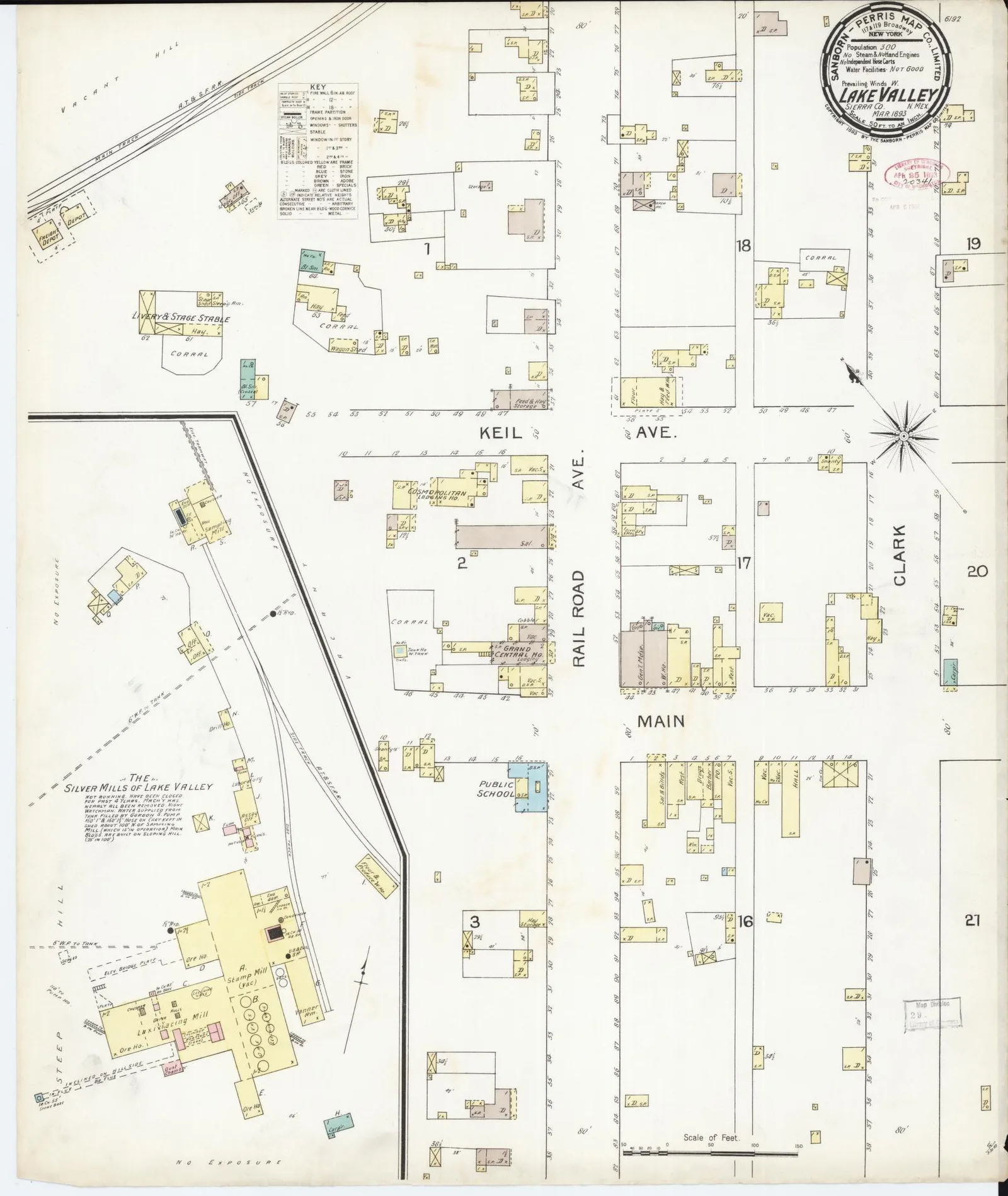
The post office and its contents were destroyed, the Advocate reported. Among the other losses the paper listed a house and barn, several vacant business buildings, and a cabinet of minerals valued at about $2,500. The Advocate called the collection one of the finest in the county. Silver City's Eagle reprinted the Advocate's report on 12 June 1895 under the headline "The Principal Part of Lake Valley Destroyed." A Sanborn fire insurance map dated March 1893 shows Lake Valley as it stood before that Main Street fire. Whether the burnt section would be rebuilt was not known, the Advocate wrote in June 1895. Keller, Miller & Co. moved into the stone schoolhouse and put in an extensive new stock.
Sources: Sierra County Advocate (Hillsboro), 7 June 1895, p. 2 ('Fire at Lake Valley') (1895-06-07): p. 2; p. 2, headline and text; The Eagle (Silver City), 12 June 1895, p. 11 ('A Big Fire', reprinted from the Sierra County Advocate) (1895-06-12): p. 11; Sanborn Map Company, Sanborn Fire Insurance Map from Lake Valley, Sierra County, New Mexico, March 1893 (1893-03): LOC catalog record, dated 1893-03
Read more on Salars.net
Part 3 of 7 of the series Lake Valley, New Mexico: the Bridal Chamber camp.
Sources
- In 1881 the Grant County commissioner's report said ownership of the Lake Valley district was disputed and, since the engineers' report on the line had not come, it would 'claim all of the principal mines as a portion of Grant county.'. W. H. Lawrence, Report of the Commissioner of Grant County [Report as to Grant County] (Silver City, 1881), 1881 report, p. 21, 'Lake Valley'. View source ↗ (reported)
"Documented" means the source is a record of the time or a direct survey; "reported" means a later account or secondary history, attributed in the text.
Cite this page: “The railroad camp, 1883 to 1899.” Grant County Atlas, Salars.net, first published 19 November 2026. https://atlas.salars.net/stories/lake-valley/the-railroad-camp-1883-1899
Discussion
What would you add or question? Comments are reviewed before they appear.
Loading comments…