President William McKinley set apart a forest reserve in New Mexico on 2 March 1899, and on 3 June 1924, Peter Russell writes, District Forester Frank Pooler signed the recreational plan that designated the Gila Wilderness. The sources disagree on when Aldo Leopold inspected the country, who deserves the credit and how many acres the first wilderness held.
Pooler's signature and Jones's paragraph and a half, 1924
On 3 June 1924, Peter Russell writes, District Forester Frank Pooler signed a recreational plan that designated a Gila Wilderness of about 750,000 acres. Russell, who wrote the National Park Service's 1992 administrative history of Gila Cliff Dwellings, places the cliff dwellings in the heart of the new wilderness. Under the plan, he writes, grazing was still permitted, but logging was barred, mining inhibited and public recreation facilities prohibited.1
Sources: Peter Russell, National Park Service, Southwest Regional Office, Division of History, Gila Cliff Dwellings National Monument: An Administrative History (Southwest Cultural Resources Center Professional Papers No. 48) (1992): Chapter I, p. 27, 'Wilderness'; Peter Russell, Gila Cliff Dwellings: An Administrative History, Chapter I (1992): Chapter I, 'Wilderness'
John D. Jones, the district chief of lands, remembered writing the first official wilderness plan for the Gila. In an interview for the region's oral history program, he recalled that it set down the first limitations on what the Forest Service would do there. Ray Marsh, chief of forest management, signed it with him, he said. Jones said "it was about a paragraph and a half long." He remembered keeping it simple so that it could be amended later.
A forest reserve on the Gila, 1899 to 1908
On 2 March 1899 President William McKinley set apart a tract of public land in the Territory of New Mexico as a public reservation. He acted under section 24 of the 1891 act that let presidents reserve forested public land. The Forest Service later called the tract the Gila River Forest Reserve. Its list of establishment dates puts 2 March 1899 first under the heading of the Gila National Forest. The Silver City Enterprise reported on 13 July 1900 that M. Belden had arrived in Silver City to manage the new reserve.2
Sources: William McKinley (text via The American Presidency Project, Gerhard Peters and John T. Woolley), Proclamation 432 - Setting Apart as a Public Reservation Certain Public Lands in the Territory of New Mexico (1899-03-02): Proclamation text, operative clause; Robert D. Baker, Robert S. Maxwell, Victor H. Treat and Henry C. Dethloff (USDA Forest Service, 1988), Timeless Heritage: A History of the Forest Service in the Southwest (FS-409), Chapter 6: Chapter 6, table of national forest establishment and changes, 'Gila National Forest'
The governor of New Mexico's report for 1901 said the Secretary of the Interior had rescinded an order excluding sheep from the Gila Forest Reserve. Sheep could graze there from April through August, the report said. Without that change, in its words, the sheepmen of the section would have lost heavily.
President Theodore Roosevelt's Proclamation 582 of 21 July 1905 enlarged what it called the Gila Forest Reserve. A. O. Waha, a forest assistant assigned to the reserve that month, wrote a memoir for Gifford Pinchot in 1940. In it he recalled supervisor R. C. McClure telling him and others of his troubles since the addition. The governor's report for 1906 estimated the reserve's resident population at 2,000. They lived in small towns and villages such as Mogollon, Cooney, Alma, Frisco Plaza, Reserve and Luna, and along main streams such as the San Francisco. The Forest Service list gives 6 February 1907 for the creation of the Big Burros Forest Reserve and 18 June 1908 for its consolidation with the Gila National Forest.
Sources: Theodore Roosevelt (text via The American Presidency Project), Proclamation 582 - Enlargement of the Gila Forest Reserve, New Mexico (1905-07-21): Proclamation title and date line; Edwin A. Tucker, compiler, USDA Forest Service Southwestern Region; memoir by A. O. Waha (written for Gifford Pinchot, 1940), The Early Days: A Sourcebook of Southwestern Region History, Book 1 (Cultural Resources Management Report No. 7), including 'The Waha Memorandum' (1989-09); Governor of New Mexico Territory (H. J. Hagerman), Report of the Governor of New Mexico to the Secretary of the Interior for the Year Ended June 30, 1906: 1906 report, p. 17; Robert D. Baker, Robert S. Maxwell, Victor H. Treat and Henry C. Dethloff (USDA Forest Service, 1988), Timeless Heritage: A History of the Forest Service in the Southwest (FS-409), Chapter 6: Chapter 6, table of national forest establishment and changes, 'Gila National Forest'
Rixon's survey of the reserve, summer 1903
Theodore F. Rixon examined the Gila River Forest Reserve in the summer of 1903, made a rough survey and drew a reconnaissance map. Henry Gannett transmitted his report for publication on 12 July 1904, and the US Geological Survey printed it in 1905 as Professional Paper 39. Rixon put the area he examined at about 3,640 square miles. He counted 2,593 square miles as covered with merchantable timber, meaning timber fit for sale, 90 square miles as logged and 955 square miles as naturally timberless.
"This reserve has suffered very little from fires," Rixon wrote. Only about 550 acres on the Mogollon Mountains and no more than 1,090 acres on the summit of Eagle Peak had burned. He called grazing the most important industry of the reserve, and warned that overstocking was destroying grass roots, drying springs and speeding floods. In one township given over to sheep, he wrote, about half the land had become barren. He found the country draining to the East Fork of the Gila well grassed, as was the west slope of what he called the Black Mountains. The rest of the reserve, he judged, carried too many cattle.
Rixon described Gila Hot Springs, a short distance above the junction of the forks, as a summer resort visited by people seeking relief from illness. He wrote of a small settlement of Mexican families just above the springs and scattered Mexican farms along the East Fork. Mining, he found, was confined to the Mogollon Mountains, mainly the Cooney district. Five producing mines there had closed in the previous few years, leaving one working. Its concentrates, ore enriched for shipment, went about 90 miles over a rough road to Silver City. He recorded a recently cut trail from the head of Silver Creek along the Mogollon summit and down Little River to the West Fork near the hot springs. Cow trails climbed Diamond Creek and McKnights Canyon over the Black Range.
Pooler, Winn, Leopold and Shepard in the Southwest, 1904 to 1923
Frank C. W. Pooler, born in New York City in 1882, had no technical forestry training when he went west in 1904. Timeless Heritage, the Forest Service's 1988 history of the Southwest, is by Robert D. Baker, Robert S. Maxwell, Victor H. Treat and Henry C. Dethloff. It says Pooler started as a General Land Office forest ranger paid $60 a month, furnishing his own horse. From 1910 to 1919 he was assistant district forester in charge of lands, and in January 1920 he became district forester of the Southwestern District. Frederic Winn, known as Fred, was an artist educated at Princeton and Rutgers and trained at the Art Students' League. He joined the Forest Service in 1907. Winn served on the Apache, Gila and Coronado forests and supervised the Coronado from 1925 to 1942.
Aldo Leopold arrived in Albuquerque in July 1909 with a Yale master's degree in forestry, Timeless Heritage says. His first assignment was to lead a party of six cruising and mapping timber on the Apache National Forest in eastern Arizona. In April 1913, trying to settle a range dispute on the Carson, he was caught in a flood and then a blizzard. He fell so ill that he could barely walk, and he did not return to limited duty until 1915. The same history says he broached the wilderness idea to Elliot Barker as early as 1913.3, 4
In 1914, the Albuquerque Journal reported in 2024, Leopold and other sportsmen formed the New Mexico Game Protective Association, forerunner of the New Mexico Wildlife Federation. Russell writes that the Agricultural Appropriations Act of 1915 first made recreation a legitimate national forest use. Leopold, by Russell's account assistant district forester in charge of grazing by 1915, was then given recreation planning for the district. That work mostly meant campgrounds, summer-home subdivisions and commercial policies. From 1919 to 1923, as assistant district forester, Leopold inspected the district's national forests, and every report had a detailed section on fire control.5
Sources: Albuquerque Journal, Leopold's legacy: New Mexico's Gila Wilderness marks 100th anniversary (2024): Article body; Peter Russell (Southwest Cultural Resources Center Professional Papers No. 48, National Park Service, 1992), Gila Cliff Dwellings National Monument: An Administrative History, Chapter 1: Chapter 1, 'Wilderness'; Robert D. Baker, Robert S. Maxwell, Victor H. Treat and Henry C. Dethloff (USDA Forest Service, 1988), Timeless Heritage: A History of the Forest Service in the Southwest (FS-409), Chapter 12: Chapter 12, early fire control
Ward Shepard was a ranger on the Gila in 1914 and 1915, when his district belonged to the Datil National Forest. Edwin A. Tucker and George Fitzpatrick, in their 1972 Forest Service history Men Who Matched the Mountains, write that Shepard and Leopold were among the first to argue for setting wilderness aside. The two convinced John D. Jones, chief of lands, they write.
Leopold's Journal of Forestry article, November 1921
Leopold set out the idea in "The Wilderness and Its Place in Forest Recreational Policy," in the Journal of Forestry for November 1921. He defined wilderness as a continuous stretch of country kept in its natural state, open to lawful hunting and fishing and big enough to absorb a two weeks' pack trip. Such areas, he assumed, should take only a small fraction of the national forests, probably no more than one in each state. They belonged only in country naturally hard to develop.6
His example was the headwaters of the Gila River on the Gila National Forest, nearly half a million acres isolated by mountain ranges and box canyons. The whole area was grazed by cattle, Leopold wrote, but the ranches would be a recreational asset, and ranchers would gain freedom from new settlers and motorists. Keeping it wild would cost little, he argued, except that its timber would stay inaccessible and available only for limited local use. Kept semi-virgin, it could absorb a hundred pack trains a year. He called it "the last typical wilderness in the southwestern mountains."7, 8
Two later histories give a different year for the proposal. Russell's administrative history dates Leopold's Journal of Forestry proposal to 1920, and Timeless Heritage says 1920 as well, though the article appeared in November 1921.
Sources: Peter Russell (Southwest Cultural Resources Center Professional Papers No. 48, National Park Service, 1992), Gila Cliff Dwellings National Monument: An Administrative History, Chapter 1: Chapter 1, 'Wilderness'; Robert D. Baker, Robert S. Maxwell, Victor H. Treat and Henry C. Dethloff (USDA Forest Service, 1988), Timeless Heritage: A History of the Forest Service in the Southwest (FS-409), Chapter 6: Chapter 6, 'Wilderness Ideas'
An inspection of the Gila, dated 1920 or 1922
Timeless Heritage says Leopold urged Pooler to set aside a large wilderness while one still existed, and that Pooler told him to inspect the Gila in person. From the resulting report, by this account, Pooler designated the Gila Wilderness and drafted rules for its use and protection. Kysh Lindell of the Aldo Leopold Foundation calls Leopold's 1922 proposal a plan for a "Gila National Hunting Ground." Lindell writes that it centered on recreation for hunters who made pack trips.9
Sources: Robert D. Baker, Robert S. Maxwell, Victor H. Treat and Henry C. Dethloff (USDA Forest Service, 1988), Timeless Heritage: A History of the Forest Service in the Southwest (FS-409), Chapter 7: Chapter 7; Kysh Lindell, Aldo Leopold Foundation, Leopold's Wild Idea, Part One (2024): Article, section on critiques
The sources disagree on the year of the inspection and on the size of the proposal. Russell writes that Leopold surveyed the Gila National Forest with Supervisor Fred Winn in 1922 and proposed a roadless area of about 750,000 acres. Timeless Heritage dates the trip to 1922, after Leopold recovered from a near-fatal illness. On his return, it says, he proposed setting aside some 500,000 acres of the Gila headwaters, without roads and with only minimal trails.10, 4
Historian Craig W. Allin dates the tour to the summer of 1920. In his account Leopold finished an inspection report in July, Pooler approved it in August and a formal proposal was completed in October. That proposal was discussed in nearby communities, Allin writes, and then mislaid for some time in the district office.
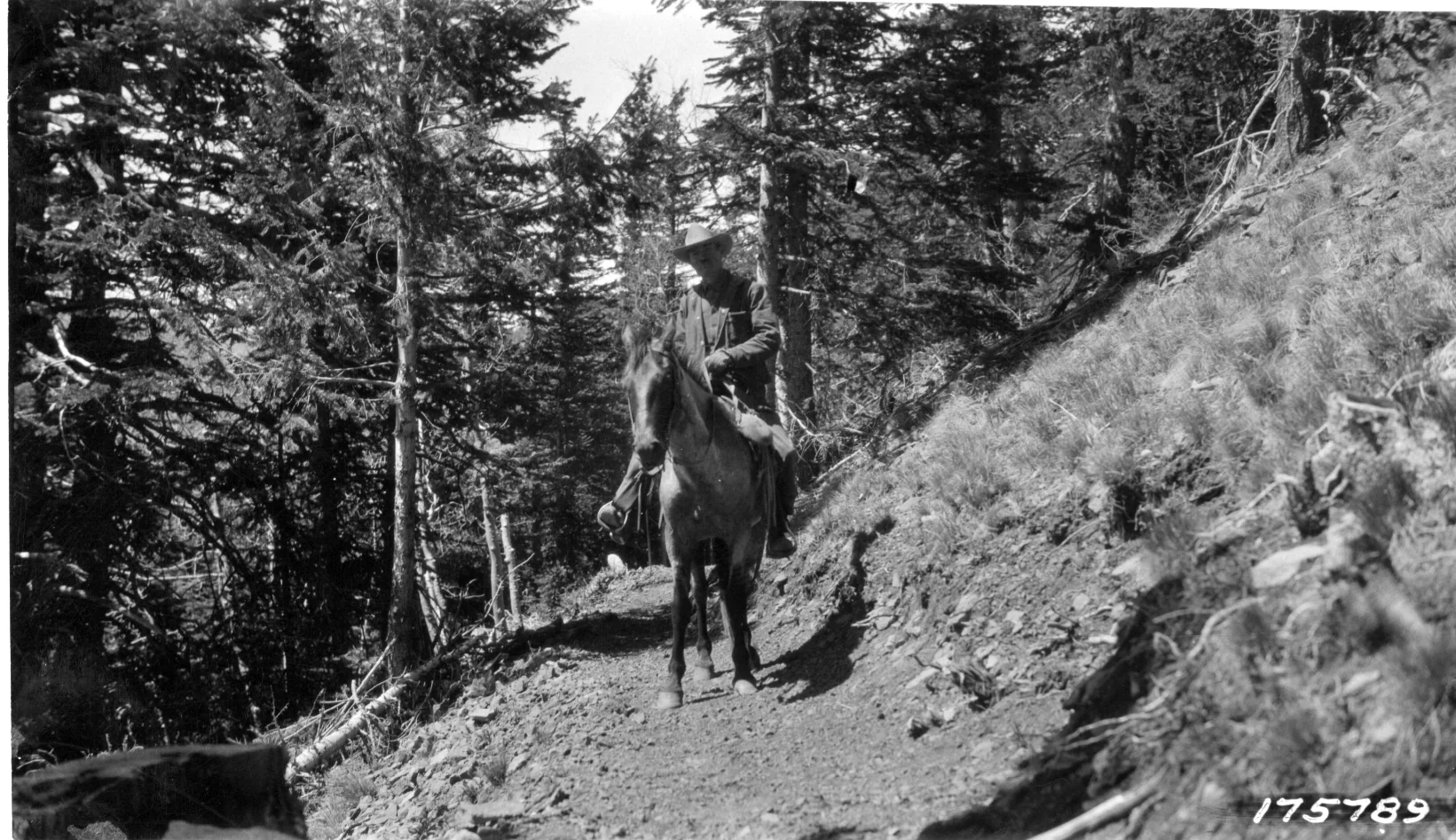
Henry Woodrow, ranger on the McKenna Park district, wrote a history of it after he retired in 1942. Of 1922 he wrote, "This was a bad fire year." His district had four large Class C fires, and men had to be brought in from Cliff, Buckhorn and Pinos Altos. Supervisor Fred Winn was on part of the fires, Woodrow wrote, and so was Aldo Leopold from the Albuquerque office. A Forest Service photograph taken by E. W. Kelley in 1923 shows a section of trail between Mogollon Baldy and Center Baldy. Its caption calls the trail a 1922 project, built 36 inches wide. It ran through high country that became the Gila Wilderness.
Sources: Henry Woodrow (written after his 1942 retirement); USDA Forest Service Southwestern Region, Cultural Resources Management Report No. 7 (1989), The Early Days: A Sourcebook of Southwestern Region History, Book 1, Personal Stories: Henry Woodrow, 'History of McKenna Park District, Gila National Forest'; USDA Forest Service, Southwestern Region (photographers as named in each caption), Gila National Forest Historic Photo Collection (Region 3 Photography), as copied to Wikimedia Commons (1905-1951 (photos); uploaded 2023): Commons file page, description field (FS caption)
Approval on 3 June 1924 and the first acreage
Russell writes that Pooler signed the plan on 3 June 1924, "thereby designating the first official wilderness in the world." A Forest Service overview of the Gila National Forest gives June 1924 as the month of the administrative designation. Allin writes that the Forest Service treats 3 June 1924 as the birth date of the national forest wilderness system. In 2024 Ryan Merrell, the Forest Service's Gila Wilderness Centennial Coordinator, said the Gila became the first wilderness because a road was being planned into it.11
Sources: Peter Russell, National Park Service, Southwest Regional Office, Division of History, Gila Cliff Dwellings National Monument: An Administrative History (Southwest Cultural Resources Center Professional Papers No. 48) (1992): Chapter I, p. 27, 'Wilderness'; Craig W. Allin, Gila Wilderness Area Is Designated (EBSCO Research Starters) (undated (after 2006)): Essay, 'Summary of Event'; USDA Forest Service, Gila Wilderness: Celebrating a Century of Solitude (Forest Service feature) (2024): Feature article, Merrell quotation
Timeless Heritage says Leopold persuaded Pooler to approve the plan over the opposition of some fellow foresters. Jones remembered it otherwise. Asked whether Leopold was the man behind the Gila wilderness, he answered that Leopold was always arguing for it but that Ward Shepard was just as much in it.12
The sources give the first acreage differently. Russell writes about 750,000 acres, and Timeless Heritage credits the 750,000-acre Gila Wilderness of 1924 with giving birth to the National Wilderness Preservation System. The Forest Service marker at Aldo Leopold Vista says Leopold persuaded the agency in 1924 to set aside 755,000 acres of the Gila. USDA gave 755,000 acres as well in its 2024 centennial statement. A January 1973 letter from the Gila Wilderness Committee, printed in a Forest Service hearing record, said the wilderness began in 1924 with over 750,000 acres. Changes in the very early years, the letter said, cut it to 695,000 acres.13, 14
Sources: Peter Russell, Gila Cliff Dwellings: An Administrative History, Chapter I (1992): Chapter I, 'Wilderness'; Marker erected by the United States Forest Service; transcription by HMdb, Aldo Leopold (marker at Aldo Leopold Vista picnic area), HMdb entry 172221 (viewed 2026-11-19): marker inscription; USDA Forest Service, Southwestern Region, A Proposal, Gila Wilderness, Gila National Forest, New Mexico (with hearing record exhibits) (1973): Exhibit, Gila Wilderness Committee letter of 14 January 1973, p. 142
Timeless Heritage says Leopold was ordered in 1924 to take an editorial post in Washington. He answered with a long letter to his friend Arthur Ringland, saying he did not know whether he had "twenty days or twenty years" ahead of him. Ringland intervened, by this account, and the orders were changed.
Leopold left the Southwest in 1924, but the sources place his going on different sides of the approval. Allin writes that Pooler approved the plan five days after Leopold had left for a post as assistant director of a forest products laboratory in Madison, Wisconsin. "Historians are not unanimous on this point," he writes. Lindell writes that the family left a few days after the proposal was approved. Timeless Heritage says Leopold accepted the post of associate director of the US Forest Products Laboratory in Madison later in 1924, after the Gila Wilderness was established.
Sources: Craig W. Allin, Gila Wilderness Area Is Designated (EBSCO Research Starters) (undated (after 2006)): Essay, 'Summary of Event'; Kysh Lindell, Aldo Leopold Foundation, Leopold's Wild Idea, Part Two (2024): Article opening; Robert D. Baker, Robert S. Maxwell, Victor H. Treat and Henry C. Dethloff (USDA Forest Service, 1988), Timeless Heritage: A History of the Forest Service in the Southwest (FS-409), Chapter 6: Chapter 6, closing section
The first season of the Gila Wilderness, 1924
On the McKenna Park district, Woodrow wrote, his crews built a new wooden lookout tower with a house on top on Mogollon Baldy in 1924. They cut several new trails that year, among them one of seven and three-quarter miles down the ridge between the West Fork and Iron Creek. Timeless Heritage says Leopold fought for the Gila as a permanent wilderness hunting ground and urged a no-roads policy for at least one forest area in each Rocky Mountain state. It cites his paper "A Plea for Wilderness Hunting Grounds," revised 10 November 1924. After the designation in 1924, Russell writes, the few residents on the Gila forks were permitted to use an unmaintained wagon track. Only trucks with special gearing could manage it.
Sources: Henry Woodrow (written after his 1942 retirement); USDA Forest Service Southwestern Region, Cultural Resources Management Report No. 7 (1989), The Early Days: A Sourcebook of Southwestern Region History, Book 1, Personal Stories: Henry Woodrow, 'History of McKenna Park District, Gila National Forest'; Robert D. Baker, Robert S. Maxwell, Victor H. Treat and Henry C. Dethloff (USDA Forest Service, 1988), Timeless Heritage: A History of the Forest Service in the Southwest (FS-409), Chapter 13: Chapter 13, recreation; note 7; Peter Russell (National Park Service), Gila Cliff Dwellings National Monument: An Administrative History (Southwest Cultural Resources Center Professional Papers No. 48) (1992): Chapter 1, 'Wilderness'
Read more on Salars.net
Part 2 of 7 of the series The Gila Wilderness: the first wilderness, 1899 to today.
Sources
- Under the 1924 plan grazing was still permitted in the Gila Wilderness, but logging was barred, mining inhibited and public recreation facilities prohibited. Gila Cliff Dwellings National Monument: An Administrative History (Southwest Cultural Resources Center Professional Papers No. 48), npshistory.com/publications/gicl/adhi.pdf (Russell 1992), Chapter I, p. 27. View source ↗ (reported)
- The Silver City Enterprise reported in July 1900 that M. Belden had arrived in Silver City to manage the new Gila forest reserve. Gila Cliff Dwellings National Monument: An Administrative History (Southwest Cultural Resources Center Professional Papers No. 48), npshistory.com/publications/gicl/adhi.pdf (Russell 1992), Chapter I, p. 18, note 66 (Silver City Enterprise, July 13, 1900). View source ↗ (reported)
- Aldo Leopold arrived in Albuquerque in July 1909, fresh from a Yale master's degree in forestry, to begin his Forest Service career in the Southwest. Timeless Heritage: A History of the Forest Service in the Southwest, Chapter 6, npshistory.com Timeless Heritage, Chapter 6. View source ↗ (reported)
- Timeless Heritage says Leopold broached the wilderness idea to Elliot Barker as early as 1913, and made his 1922 inspection trip to the Gila headwaters after recovering from a near-fatal illness. Timeless Heritage: A History of the Forest Service in the Southwest, Chapter 6, npshistory.com Timeless Heritage, Chapter 6. View source ↗ (reported)
- Aldo Leopold, a Yale Forestry School graduate, began working in the Southwestern District in 1909 and was assistant district forester in charge of grazing by 1915. Gila Cliff Dwellings National Monument: An Administrative History (Southwest Cultural Resources Center Professional Papers No. 48), npshistory.com/publications/gicl/adhi.pdf (Russell 1992), Chapter I, p. 27. View source ↗ (reported)
- In his 1921 Journal of Forestry article Aldo Leopold defined wilderness as a continuous stretch of country kept in its natural state, open to lawful hunting and fishing and big enough to absorb a two weeks' pack trip. The Wilderness and Its Place in Forest Recreational Policy (Journal of Forestry 19:7, November 1921, pp. 718-21), as reproduced by the Aldo Leopold Foundation, aldoleopold.org blog reprint of "The Wilderness and Its Place in Forest Recreational Policy," Journal of Forestry, 1921, definition paragraph. View source ↗ (documented)
- Leopold named the headwaters of the Gila River on the Gila National Forest as the example of an area that could easily be kept as wilderness. The Wilderness and Its Place in Forest Recreational Policy (Journal of Forestry 19:7, November 1921, pp. 718-21), as reproduced by the Aldo Leopold Foundation, aldoleopold.org blog reprint of "The Wilderness and Its Place in Forest Recreational Policy," Journal of Forestry, 1921. View source ↗ (documented)
- Leopold described the Gila headwaters area as nearly half a million acres, isolated by mountain ranges and box canyons. The Wilderness and Its Place in Forest Recreational Policy (Journal of Forestry 19:7, November 1921, pp. 718-21), as reproduced by the Aldo Leopold Foundation, aldoleopold.org blog reprint of "The Wilderness and Its Place in Forest Recreational Policy," Journal of Forestry, 1921. View source ↗ (documented)
- The Gila wilderness was designated by Pooler from a report written by Leopold with the help of Frederic Winn and Ward Shepard. Timeless Heritage: A History of the Forest Service in the Southwest, Chapter 7, npshistory.com Timeless Heritage, Chapter 7. View source ↗ (reported)
- In 1922 Leopold surveyed the Gila National Forest with Supervisor Fred Winn and proposed a roadless area of about 750,000 acres; District Forester Frank Pooler signed the recreation plan on June 3, 1924. Gila Cliff Dwellings National Monument: An Administrative History (Southwest Cultural Resources Center Professional Papers No. 48), npshistory.com/publications/gicl/adhi.pdf (Russell 1992), Chapter I, p. 27, note 106 (Spray 1989). View source ↗ (reported)
- June 1924. Gila National Forest overview, Wilderness on the Gila National Forest, Gila Wilderness bullet. View source ↗ (documented)
- Over the opposition of some fellow foresters, Leopold persuaded regional forester Frank Pooler to approve the Gila wilderness plan. Timeless Heritage: A History of the Forest Service in the Southwest, Chapter 6, npshistory.com Timeless Heritage, Chapter 6. View source ↗ (reported)
- The Forest Service history credits the 750,000-acre Gila Wilderness of 1924 with giving birth to the National Wilderness Preservation System. Timeless Heritage: A History of the Forest Service in the Southwest, Chapter 13, npshistory.com Timeless Heritage, Chapter 13. View source ↗ (reported)
- USDA, marking the centennial in 2024, gave the Gila Wilderness's founding date as June 3, 1924, said 755,000 acres were first set aside, and gave current sizes of 559,688 acres (Gila) and 202,016 acres (Aldo Leopold). Vilsack marks centennial of Gila Wilderness (USDA statement reprinted), HPJ, release body. View source ↗ (documented)
"Documented" means the source is a record of the time or a direct survey; "reported" means a later account or secondary history, attributed in the text.
Cite this page: “A forest reserve and Leopold's idea, 1899 to 1924.” Grant County Atlas, Salars.net, first published 19 November 2026. https://atlas.salars.net/stories/gila-wilderness/a-forest-reserve-and-leopolds-idea-1899-1924
Discussion
What would you add or question? Comments are reviewed before they appear.
Loading comments…