From 1917 to 1919 Camp Cody brought a National Guard division to Deming, at strengths that C. A. Gustafson, writing in Desert Winds Magazine, and other writers give differently. After the camp closed, Deming turned to a sanatorium in the old camp hospital and a revival of pumped irrigation, and from 1935 it served as headquarters of a WPA district, according to the 2013 historic district nomination.
Bread, water and soldiers at Camp Cody, 1917 to 1918
In 1917 the Army put a training camp for a National Guard division beside Deming. A 1990 Bureau of Land Management history of the Cooke's Peak country, written by Donald Howard Couchman, describes Camp Cody as a 2,000-acre post. Its 30,000 men of the 34th, or Sandstorm, Division ate 10,000 loaves of bread a day, Couchman writes. Each day, in his words, they used "2 million gallons of Deming's excellent water."
Sources: Donald Howard Couchman, Bureau of Land Management, New Mexico State Office, Cooke's Peak - Pasaron Por Aqui: A Focus on United States History in Southwestern New Mexico (BLM Cultural Resources Series No. 7) (1990): Chapter 8, p. 237; C. A. Gustafson, Inside Camp Cody (Desert Winds Magazine, February 1995), reproduced on the Deming New Mexico Genealogy Village site (1995-02): paragraph 2; Rick Phillips; History of Luna County (compilers), Camp Cody (The Enterprise Magazine, June 24, 1982), with a list of Camp Cody-era entertainment from History of Luna County, and the 34th Division organization text (1982-06-24): 34th Division section
The accounts differ on the camp's size and strength. C. A. Gustafson, in a 1995 Desert Winds Magazine essay reproduced on the Deming New Mexico Genealogy Village site, puts the camp at about 1,800 acres on the town's northwest fringe. The 2013 National Register nomination for the Downtown Deming Historic District gives 2,000 acres and 28,000 to 30,000 soldiers at the camp's height. That nomination also counts 1,200 wooden barracks and an 800-bed hospital.
Sources: C. A. Gustafson, Inside Camp Cody (Desert Winds Magazine, February 1995), reproduced on the Deming New Mexico Genealogy Village site (1995-02): paragraph 2; Heather Barrett, Architectural Historian, National Register of Historic Places Registration Form: Downtown Deming Historic District (2012-09-15): Section 8, pp. 15-16
Gustafson writes that the often-quoted figure of 30,000 soldiers held only for a short period. By his count about 10,000 troops were at Camp Cody in early October 1917, 22,000 by November and about 25,000 early in 1918. After the 34th Division shipped out to Fort Dix, N.J., in late summer 1918, he counts about 3,000, and about 9,000 at the Armistice as the 97th Division formed. He estimates that 45,000 troops served at the camp in its less than two years. Of the 32 national training camps, he writes, only four were in the far West, and Camp Cody was the one in New Mexico.
How Deming got Camp Cody, May and June 1917
Rebecca Seybert's condensed history, Camp Cody Days 1917-1918, describes an Army examining board. Headed by Brig. Gen. Henry Green, the board met Deming citizens on 17 May 1917, she writes. Mayor M. A. Nordhaus then proclaimed draft registration day, 5 June 1917, a holiday in Deming, and the Deming Headlight headed its report "427 registered here Tuesday." On 14 June 1917, in Seybert's account, the businessman Joe Mahoney received word from Senator Fall that Deming had been chosen and that the camp would be named Cody. Gustafson places the news in June 1917 and writes that the camp took its name from the buffalo hunter.
Sources: Rebecca Seybert, Camp Cody Days 1917-1918 (condensed): paragraph 3; paragraph 4; C. A. Gustafson, Inside Camp Cody (Desert Winds Magazine, February 1995), reproduced on the Deming New Mexico Genealogy Village site (1995-02): paragraph 2
An unsigned History of Camp Cody says the Deming city government offered the camp land to the federal government free. In that account the Southern Pacific laid extra track into the camp for unloading supplies and troops. Jack Noyes, a United Land and Water Company employee who later became Deming's water and gas superintendent, recalled that his company supplied the water to the camp tanks. He remembered as well that wholesale houses such as Crombie of El Paso and Murray & Layne opened warehouses in Deming.
Sources: History of Camp Cody (author unknown): Historical Background, paragraph 2; A. J. (Jack) Noyes (United Land and Water employee, later Deming water and gas superintendent), Village of Deming - Camp Cody: paragraph 3-4
Tents, horses and a locked spring at Camp Cody, 1917 to 1918
The 34th Division, made up of National Guard troops from Minnesota, Iowa, Nebraska, North Dakota and South Dakota, was organized at Camp Cody on 2 October 1917. It trained there until September 1918. Draftees came in batches of 500 from Camp Dodge, Iowa, and Camp Funston, Kansas, Gustafson writes, and a group of Mennonite conscientious objectors was among the inductees of late 1917. Sam Wintroub, a Russian-born draftee from Omaha, recalled arriving on 15 October 1917. He remembered tents with no wooden floors, eight men to a tent, and sand that "was blowing day and night."
Sources: Rick Phillips; History of Luna County (compilers), Camp Cody (The Enterprise Magazine, June 24, 1982), with a list of Camp Cody-era entertainment from History of Luna County, and the 34th Division organization text (1982-06-24): 34th Division section; C. A. Gustafson, Inside Camp Cody (Desert Winds Magazine, February 1995), reproduced on the Deming New Mexico Genealogy Village site (1995-02): paragraphs 8-10; Sam Wintroub, Footprints In The Sand (from The History of Luna County, 1978): paragraph 2
Gustafson describes a camp built for animals as well as men. Its remount station, the depot that handled the Army's horses and mules, stood in the north of the base and covered 100 acres. It was built for 10,000 horses and mules, with corrals, a veterinary hospital and a horseshoeing school. An old reservoir once used to supply water to El Paso became an outdoor amphitheater for the whole division, dedicated in November 1917, and the Liberty Theatre opened in April 1918. Laura Krol, in her essay Camp Cody, Deming's Forgotten Legacy, writes that the El Paso Herald published a weekly camp paper, Trench and Camp, from 8 October 1917 to 5 December 1918.
Sources: C. A. Gustafson, Inside Camp Cody (Desert Winds Magazine, February 1995), reproduced on the Deming New Mexico Genealogy Village site (1995-02): paragraph 14; paragraph 16; Laura Krol, Camp Cody, Deming's Forgotten Legacy: paragraph 11
Training reached well beyond the camp. Couchman's BLM history says Sandstorm Division troops marched across the desert and camped at places such as Cooke's Spring. The railroad had locked the springhouse there. Soldiers had to make a 10-mile round trip to Florida Station for the key and another 10 miles to return it, Couchman writes, until B. H. Gibbs, an inspector for the General Land Office, had the lock removed.
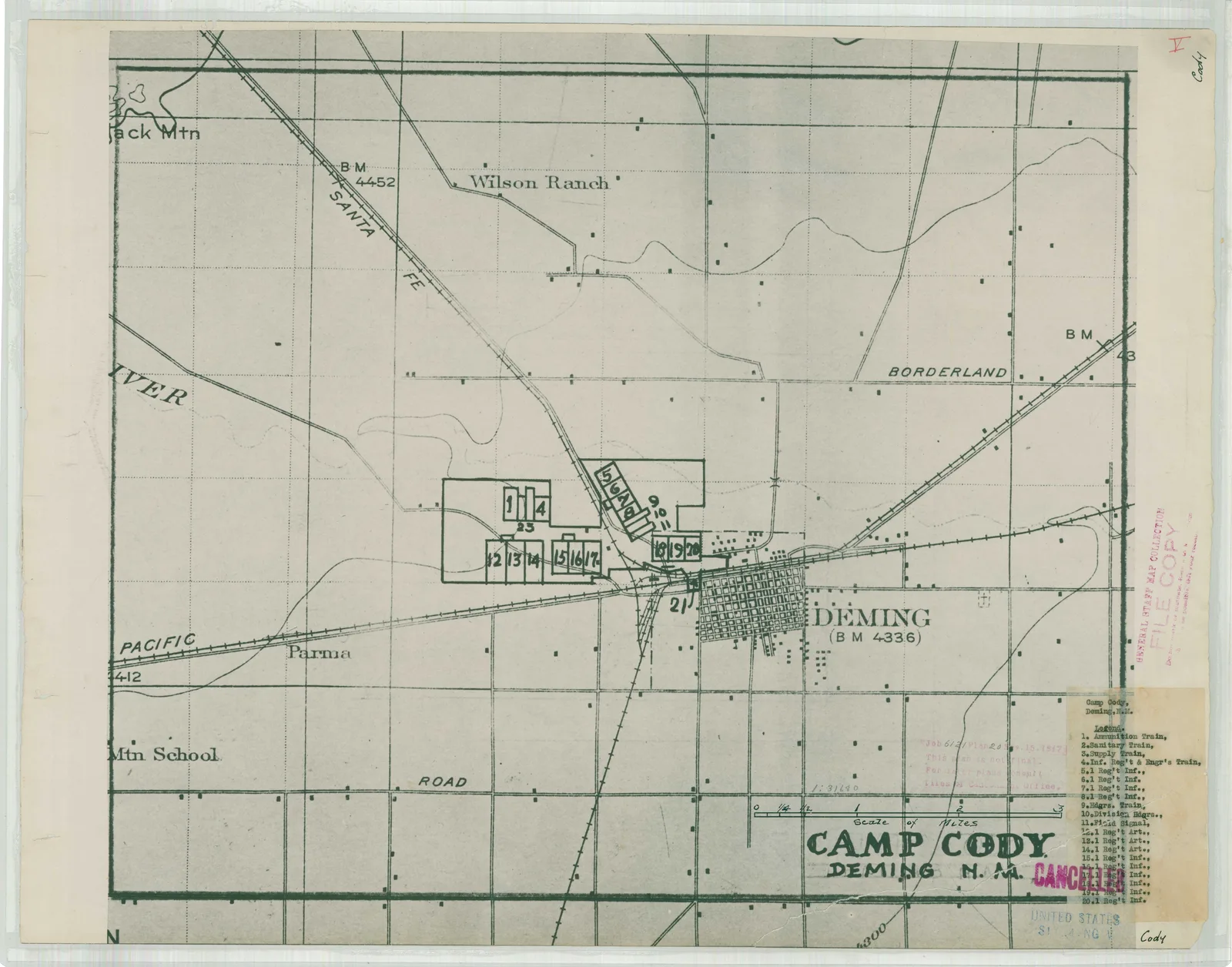
A map and a set of photographs record the camp's working parts. A layout plan dated 15 November 1917, stamped as not final, shows the camp's unit areas beside the Deming town grid; it survives in the War Department Map Collection at the National Archives. Almeron Newman, a photographer with a Deming address, made a labeled panorama of the camp in June 1918 and deposited it for copyright on 6 July 1918. His photographs include the reclamation service's shoe repair shop and the dental infirmary. A Committee on Public Information photograph of 10 August 1918 shows soldiers baling clothing at the reclamation warehouse, and another view shows a cement swimming pool that soldiers built at the base hospital.
Sources: War Department, Office of the Chief of Engineers, Map of Camp Cody - Deming, New Mexico (War Department Map Collection) (1917): NARA catalog 148720452; DPLA 74d8a8e4dfaaa17c1e6728cd4dbb2ea4; Almeron Newman, Camp Cody, N.M., June 1918; Brig. Gen. F. G. Mauldin, N.A. C.O. (1918-06): LOC catalog record, notes (copyright J230537; claimant's address Deming, N.M.); Almeron Newman (War Department records), Military Administration - Supply Service - RECLAMATION SERVICE. The shoe repair shop at Camp Cody, Deming, New Mexico (1918): NARA NAID 45501394; scope note 'Date Taken: 1918', photographer Almeron Newman; Almeron Newman (photographer), Camp Cody, Deming, New Mexico. Section of the dental operation room in dental infirmary (1918): NARA NAID 45493870, original caption; Committee on Public Information, CAMP CODY, DEMING, N.M. Baling up clothing at Reclamation Warehouse (1918-08-10): NARA NAID 45501374; Committee on Public Information (War Department records), Medical Department - Hospitals - Cody, New Mexico - Cement swimming pool at base hospital, Camp Cody, New Mexico. Built by soldiers (1917-1918): NARA NAID 45494496, title
Rents, dance halls and a fire in boom-time Deming, 1918
Officers at Camp Cody complained of rent gouging in Deming, the unsigned History of Camp Cody says. A furnished room rented for $50 a month and a small cottage for $150. An Army board of officers set lower rates, and the community protested them.
Sources: History of Camp Cody (author unknown): Family Housing
Just off the base on the east end, Gustafson writes, grew a small settlement called Codyville. Its dance halls took names from the soldiers' home states, such as the Nebraska and the Iowa, and a dance cost 25 cents. A list in the History of Luna County names some ten theaters in Deming in the camp years, among them the Princess, Isis, Cody, Majestic, Rialto, Teal, Pastime and Crystal. The same list says the saloons were closed, because none could operate within five miles of an Army camp. Wintroub remembered Jewish women from Silver City who brought food and cider on Sunday visits to soldiers at the camp's Jewish Welfare Board.
Sources: C. A. Gustafson, Inside Camp Cody (Desert Winds Magazine, February 1995), reproduced on the Deming New Mexico Genealogy Village site (1995-02): paragraph 16; Rick Phillips; History of Luna County (compilers), Camp Cody (The Enterprise Magazine, June 24, 1982), with a list of Camp Cody-era entertainment from History of Luna County, and the 34th Division organization text (1982-06-24): List of Entertainment Available for the Camp Cody Soldiers; Sam Wintroub, Footprints In The Sand (from The History of Luna County, 1978): paragraph 4
Mail measured the boom. The Deming Headlight reported on 7 June 1918 that the Deming post office, with over $90,000 in stamp sales from January 1917 to January 1918, would become a first-class office on 1 July. The El Paso Morning Times reported in August 1918 that the separate Camp Cody post office did the business of a city of 100,000. It cancelled about $700 of stamps a day on some 25,000 pieces of outgoing mail, the paper reported.
The armory took on camp work. During the camp's height, the 2013 nomination says, the Deming Armory, built in 1916, served as the War Camp Community Service building. A 1983 nomination for the armory says that over its years of use it trained soldiers for both world wars and served as a recruiting center and a USO headquarters. It was a social hall too, where the Guard sponsored dances and fiestas. From its reading of the 1910 Census, the 2013 nomination says Deming's Black population had nearly quintupled by 1920, partly because of Camp Cody.
Sources: Heather Barrett, Architectural Historian, National Register of Historic Places Registration Form: Downtown Deming Historic District (2012-09-15): Section 8, pp. 15-16; Section 8, p. 19; Thomas W. Merlan, State Historic Preservation Officer, New Mexico Historic Preservation Bureau, National Register of Historic Places Inventory-Nomination Form: Deming Armory (1983-01-05): Continuation sheet, item 8
On 12 July 1918 the Deming Headlight reported a fire that began in the Deming garage on West Pine Street. It wiped out most of the block bounded by Pine Street, Gold Avenue, Cedar Street and Copper Avenue, including the Cody Theatre, with losses over $100,000, the paper reported. Insurers had rated nearly all the block's buildings extra-hazardous, the Headlight said, so many occupants carried no insurance; the Cody Theatre had been valued at $28,000 when built. The paper credited the Camp Cody fire department, working with Deming's firemen, with holding the fire in check, while military police kept crowds back and prevented looting.
Influenza in Camp Cody and the village, October 1918
Gustafson traces the 1918 influenza epidemic in a second Desert Winds essay, A Silent Enemy, published in November 1992. In late September 1918, he writes, the base hospital commander reported no flu among about 3,000 men at Camp Cody. By 4 October there were 500 flu cases, 125 pneumonia patients and 21 deaths. More than 4,000 draftees arrived late in October, and cases then reached 2,737, with 556 pneumonia patients and 128 deaths.
Deming shut down on 3 October 1918, in Gustafson's account. The village closed its schools and four movie theaters, shut the Palace skating rink and allowed no church services or public gatherings. By 18 October the flu had killed 16 people in the village, he writes, 13 of them among those he called Mexicans. He writes that Mexican American residents were more exposed through overcrowded housing, poor nourishment and lack of money for medical care.
Gustafson records rumors as well. He writes that the camp commander, Brig. Gen. James R. Lindsay, denounced talk that half the troops were down with flu as lies spread by German propagandists. He quotes a Deming Graphic item of the time. That item said, "It is generally accepted that the epidemic has been spread by German agents." Gustafson records one Deming resident's memory of soldiers and a band escorting caissons with coffins down Pine Street to the railroad station, returning by Spruce.
In his 1995 essay Gustafson gives the camp's hospital deaths for 1917 and 1918. He counts 67 deaths in the hospital in the last four months of 1917 and 426 in 1918. Sixty percent of the 1918 deaths came in the last three months of the year, during the epidemic, he writes, and 194 in November alone.
Armistice and the end of Camp Cody, 1918 to 1921
News of the Armistice reached Deming by wire at 1:30 a.m. on 11 November 1918, Gustafson writes. Fire whistles and railroad engines sounded and a holiday was declared. Young men took the unhung bell of St. Ann's Mission, then being built on Ruby Street, and rang it from a truck. The Associated Press reported in 2018 that Santa Ana (St. Ann) Catholic Church in Deming, which it called a historic Hispanic church, was celebrating 100 years since it was built in 1918.
Sources: C. A. Gustafson, A Silent Enemy: The Flu Epidemic of 1918 (Desert Winds Magazine, November 1992), reproduced on the Deming Genealogy Village site (1992-11): paragraphs 21-22; Associated Press / KRWG, Deming Catholic Church Celebrates A Century (AP, via KRWG) (2018-05-20): article, paragraph 1
Notes appended to a transcription of two 1918 post office articles say demobilization orders in December 1918 directed that Camp Cody be salvaged and abandoned except for the base hospital. In that account a Base Hospital branch post office opened on 10 December 1918, about 2.5 miles west of Deming. Gustafson divides the camp's life into a rise from July to November 1917, a crest from November 1917 to November 1918 and a decline from November 1918 to June 1919. The unsigned History of Camp Cody says the Army moved some buildings to Camp Furlong at Columbus and salvaged or destroyed the rest. Only the 16 main hospital buildings were kept, it says, and they served for some months as a convalescent hospital.
Sources: El Paso Morning Times; Deming Headlight, Camp Cody Has Big Post Office (El Paso Morning Times, August 1918) and Deming Post Office is First Class (Deming Headlight, June 7, 1918), transcribed: closing section; C. A. Gustafson, Inside Camp Cody (Desert Winds Magazine, February 1995), reproduced on the Deming New Mexico Genealogy Village site (1995-02): paragraph 4; History of Camp Cody (author unknown): Closure
Couchman's BLM history says Deming's economy was devastated when the camp closed. Some works were left unfinished. Gustafson writes that a half-million-dollar sewage system, with a 2,500,000-gallon septic tank draining to the Mimbres, was approved in June 1918 and nearly complete at the Armistice, when it was abandoned. Its spillway off North Eighth Street was, as he wrote in 1995, "one of the few visible remains from the Camp Cody era." Krol writes that the foundations of the camp's warehouses could still be seen east of the ASARCO mill that later stood on part of the old camp. In 1921 a granite monument went up in front of the Luna County Courthouse for the man the courthouse nomination calls Luna County's only World War I fatality, killed in the St. Mihiel sector on 24 September 1918.
Sources: Donald Howard Couchman, Bureau of Land Management, New Mexico State Office, Cooke's Peak - Pasaron Por Aqui: A Focus on United States History in Southwestern New Mexico (BLM Cultural Resources Series No. 7) (1990): Chapter 8, p. 237; C. A. Gustafson, Inside Camp Cody (Desert Winds Magazine, February 1995), reproduced on the Deming New Mexico Genealogy Village site (1995-02): paragraph 20; Laura Krol, Camp Cody, Deming's Forgotten Legacy: paragraph 9; John O. Baxter, State Records Center and Archives, National Register nomination: Luna County Courthouse and Park (NRIS 77000925) (1977): Continuation sheet #1
Holy Cross Sanatorium in the old camp hospital, 1922 to 1939
The camp hospital became a sanatorium. Krol writes that the Deming Chamber of Commerce paid $10,000 for the former Camp Cody hospital. The Sisters of the Holy Cross of Notre Dame, Indiana, invited by the Deming pastor Rev. G. C. Van Gothem, took it over, and in her account they dedicated the Holy Cross Sanatorium on 12 May 1923.
Sources: Laura Krol, Camp Cody, Deming's Forgotten Legacy: paragraphs 12-13
The 2013 nomination adds other details. It says the sanatorium could take 300 patients and was established at the request of El Paso Bishop Anthony J. Schuler, J. A. Mahoney and Senator H. O. Bursum. The nomination describes a 300-acre farm and charges of $20 to $50 a week.
Two dates are given for the opening. Citing its source, the 2013 nomination dates the sanatorium from 1922. Krol gives 12 May 1923 as the day the sisters dedicated it.
Sources: Heather Barrett, Architectural Historian, National Register of Historic Places Registration Form: Downtown Deming Historic District (2012-09-15): Section 8, p. 16; Laura Krol, Camp Cody, Deming's Forgotten Legacy: paragraphs 12-13
On the end the two agree. Krol writes that the sanatorium closed after patient numbers fell in 1938, and that a fire starting in the administration building on 12 March 1939 destroyed most of it. The 2013 nomination gives the same date for the fire that largely burned the sanatorium.
Sources: Laura Krol, Camp Cody, Deming's Forgotten Legacy: paragraph 17; Heather Barrett, Architectural Historian, National Register of Historic Places Registration Form: Downtown Deming Historic District (2012-09-15): Section 8, p. 16
Pumps, falling water and a highway, 1918 to 1939
Irrigation around Deming fell away and then revived in these years, by the account of the U.S. Geological Survey. The Deming Chamber of Commerce asked State Engineer Herbert W. Yeo to plan a survey of the valley's water supply. USGS engineer Albert G. Fiedler studied it in August 1927, and Walter N. White began field work in July 1928. White's report, Water-Supply Paper 637-B, found that many boom-era irrigators had been inexperienced and that their costs had outrun their returns. By 1918 or 1919, he wrote, only about 25 pumping plants were still operating.
White dated a revival to about 1923 or 1924. By about 1929, he found, 116 pumping plants were working, among them railroad, smelter, sanitarium, county and city plants near Deming. About 6,000 acres were under pumped irrigation, and most farmers were making money. White estimated total pumping at about 10,500 acre-feet a year; an acre-foot is the water that covers an acre one foot deep. Boom-year pumping from 1914 to 1917 was perhaps more than twice that, he wrote, and slump-year pumping from 1918 to 1923 less than half.
The water table had dropped. White found levels had fallen almost everywhere since 1914, by about 6 feet on average over some 100,000 acres around Deming. Within the city of Deming the fall was about 10 feet, and in the heavily pumped Miesse district at least 15 feet. White put Deming's population at about 3,500 around 1930. He described a town on the Southern Pacific main line, on the Santa Fe's Silver City branch and on a well-improved east-west highway much used by transcontinental winter traffic.
Ore mills came for the groundwater. In a 2000 history of the Deming-area mills, Ibrahim H. Gundiler writes that abundant water for milling, land for tailings and nearby highways and railroads brought the Peru and Asarco flotation mills to Deming. The town lay about 55 miles from the Grant County zinc mines. A flotation mill separates the valuable mineral from crushed ore by floating it off in a froth. Peru Mining Company built a 100-ton-a-day mill at Wemple, on Peru Hill 3.5 miles northwest of Deming, early in 1928. Gundiler writes that it grew to 300 tons the next year and 500 tons in 1935, and that a small mill for the region's fluorspar ores was built in Deming in 1937.
Sources: Ibrahim H. Gundiler, Brief history of Deming-area mills and manganese stockpiles (2000): p. 279
The highway remade the streets. In the 1920s, the 2013 nomination says, growing automobile traffic on Spruce Street, part of Highway 70-80, brought gas stations, car dealerships and auto courts. Linen postcards of about 1930 to 1945 advertised the Ruebush Courts and the Hub Motel and Cafe on the highway. One advertised the Round-Up Lodge under the slogan "drink the purest water on Earth." In August 1939 Russell Lee photographed a roadside display of automobile tires and wheels in Deming for the Farm Security Administration.
Sources: Heather Barrett, Architectural Historian, National Register of Historic Places Registration Form: Downtown Deming Historic District (2012-09-15): Section 8, p. 15; Section 7 inventory (122 E Spruce); Alfred Mc Garr Adv. Ser., Albuquerque, 'In the Kingdom of the Sun,' on U.S. Highways 70 and 80. Ruebush Courts, Deming, New Mexico (Tichnor Brothers postcard) (ca. 1930-1945): BPL Tichnor record title; Alfred Mc Garr Adv. Ser., Albuquerque, For the rest of your life stop at Hub Motel and Café, on Highway 70 and 80, Deming, New Mexico (Tichnor Brothers postcard) (ca. 1930-1945): BPL Tichnor record title; Alfred Mc Garr Adv. Ser., Albuquerque, Round-Up Lodge, drink the purest water on Earth -- In the Kingdom of the Sun. Deming, New Mexico (Tichnor Brothers postcard) (ca. 1930-1945): BPL Tichnor record title; Russell Lee (FSA), Display of automobile tires and wheels, Deming, New Mexico (1939-08): LOC catalog record, title; created 1939 Aug
The WPA district and a federal post office, 1935 to 1941
Deming served as headquarters of the Works Progress Administration's southwest district, the 2013 nomination says. The district oversaw hundreds of projects in Catron, Socorro, Grant, Sierra, Hidalgo, Dona Ana and Luna counties. Between 1935 and 1941, by the nomination's account, Deming gained the former City Hall and Fire Station, now Morgan Hall, the Deming Public Library and the post office, along with sidewalks, paved streets, highways and parks. In the nomination's words, "As a result of the WPA, Deming's architecture shifted to the Pueblo Revival style."
Morgan Hall, the former city hall and fire station on East Pine Street, is a Pueblo Revival building put up by the WPA in 1939 on the site of the 1908 city hall. WPA sidewalks downtown still carry their stamps, among them one dated 1938 at the southeast corner of Copper and Hemlock streets. The WPA also ran a cannery in the former Manhattan Cafe on North Silver Avenue, the 2013 nomination says, canning produce that townspeople supplied to feed the poor, and two sewing rooms made clothing for the needy. About 175 Civilian Conservation Corps men worked on Cooke's Peak and in the Florida Mountains on revegetation and on erosion, flood and rodent control, the nomination adds. A CCC camp stood nine miles northeast of Deming.
The post office's 1988 National Register nomination, by H. J. Kolva and Steve Franks, calls it "Deming's first and only federally-constructed post office." The building was designed under Supervising Architect Louis A. Simon; its site was acquired in 1936 and the building was finished in 1937, after years of local lobbying. At the dedication on 29 May 1937 the guests included Governor Clyde Tingley, Senator Dennis Chavez, Congressman J. J. Dempsey, state WPA head E. H. Oakley and Postmaster General James A. Farley.
Sources: H. J. 'Jim' Kolva and Steve Franks, Institute for Urban & Local Studies, National Register of Historic Places Registration Form: Deming Main Post Office (Historic U.S. Post Offices in New Mexico MPS) (1988-09); H. J. Kolva and Steve Franks, Institute for Urban & Local Studies, National Register nomination: US Post Office--Deming Main (NRIS 90000139) (1988-09): Section 8, continuation p. 1
In 1938 Kenneth Adams painted the lobby mural, Mountains and Yucca, a 5-by-12-foot oil on canvas made under the federal Section of Fine Arts. The post office nomination calls Adams the last member of the Taos Society of Artists. His mural shows the yucca flats and desert peaks around Deming.
Sources: H. J. 'Jim' Kolva and Steve Franks, Institute for Urban & Local Studies, National Register of Historic Places Registration Form: Deming Main Post Office (Historic U.S. Post Offices in New Mexico MPS) (1988-09): Section 8, p. 1-2; H. J. Kolva and Steve Franks, Institute for Urban & Local Studies, National Register nomination: US Post Office--Deming Main (NRIS 90000139) (1988-09): Section 8, continuation p. 1
Deming and Luna County in the Census, 1920 to 1940
The Census printed Deming village's population as 3,212 in 1920, 3,377 in 1930 and 3,608 in 1940. For all of Luna County it printed 12,270 in 1920, 6,247 in 1930 and 6,457 in 1940. In 1920 the Columbus precinct alone held 6,536 people.
The 2013 historic district nomination gives a different 1940 figure. It puts Deming's population that year at 3,591 and says it was about 1,000 lower than in the 1930s. The printed Census gives 3,608 for 1940 and 3,377 for 1930.
Sources: Heather Barrett, Architectural Historian, National Register of Historic Places Registration Form: Downtown Deming Historic District (2012-09-15): Section 8, p. 15 (citing Inventory of the County Archives of Luna County); U.S. Bureau of the Census, Sixteenth Census of the United States: 1940, Population, Volume I, Number of Inhabitants (New Mexico section; Table 4, Population of counties by minor civil divisions: 1920 to 1940) (1942): Table 4, Luna County, PDF p. 7 (columns 1940, 1930, 1920)
Farming in Luna County declined through the 1930s, by the 2013 nomination's account. By 1930 the county had 235 farms covering nearly 600,000 acres, and in the 1930s severe drought and the Depression hit agriculture. By the 1940s the number of farms had fallen to 170, and growers had turned to cotton, pinto beans, sorghum and feed crops. A federal range photograph dated 15 November 1940 shows cattle watering at a private well 12 miles southwest of Deming.
Sources: Heather Barrett, Architectural Historian, National Register of Historic Places Registration Form: Downtown Deming Historic District (2012-09-15): Section 8, p. 15; Heather Barrett, architectural historian, National Register nomination: Downtown Deming Historic District (NRIS 13000769) (2012-09-15): Section 8, historical background; Bureau of Land Management (Grazing Service era), Cattle watering at a private well, 12 miles southwest of Deming (BLM photo 6628) (1940-11-15): BLM photo 6628, caption
Part 4 of 8 of the series Deming, New Mexico: railroad junction and county seat.
Cite this page: “Camp Cody, wells and the WPA, 1917 to 1941.” Grant County Atlas, Salars.net, first published 19 November 2026. https://atlas.salars.net/stories/deming/camp-cody-wells-and-the-wpa-1917-1941
Discussion
What would you add or question? Comments are reviewed before they appear.
Loading comments…