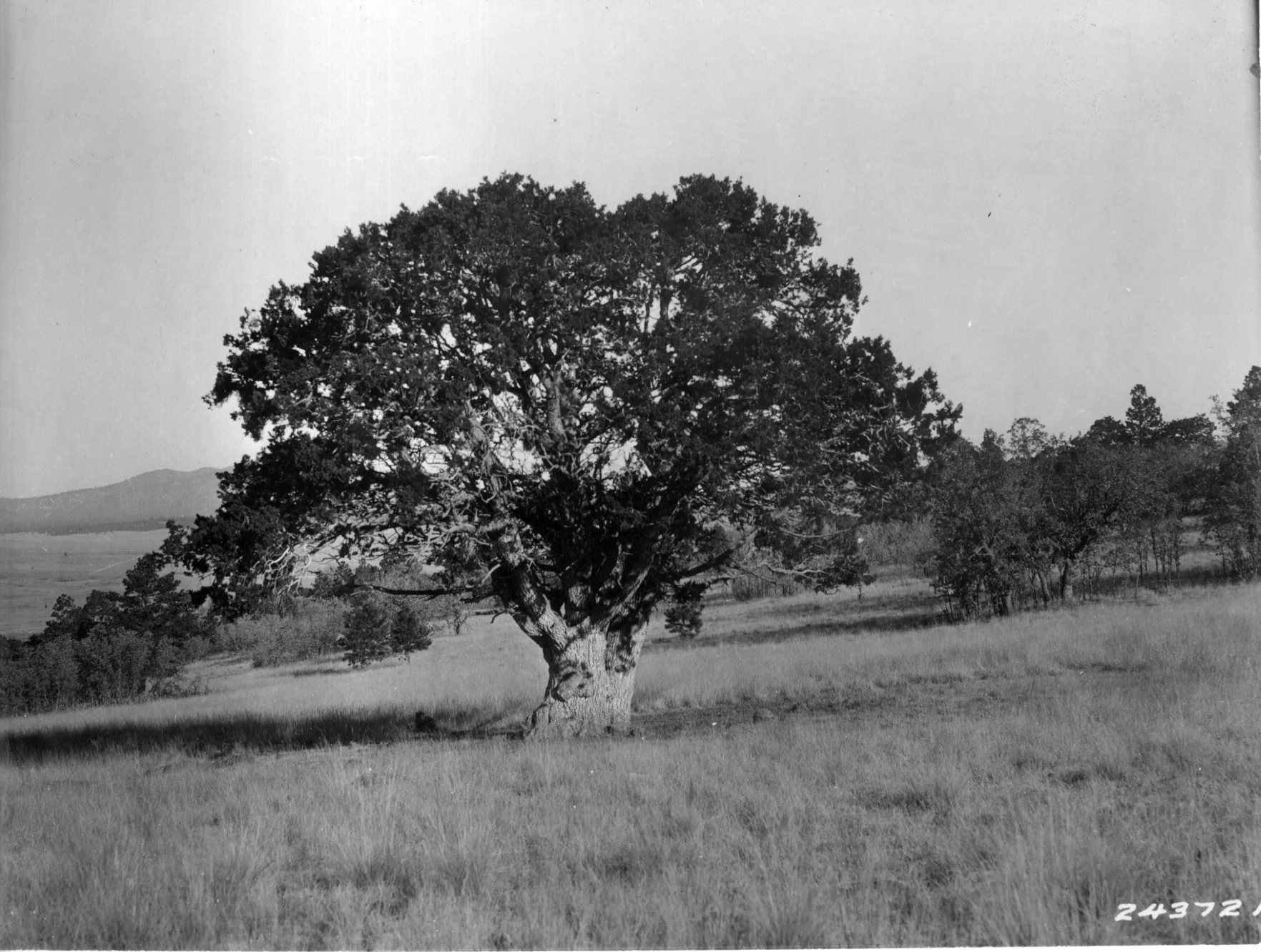
The Fort Bayard alligator juniper stands 63 feet tall in both New Mexico's big-tree database, from a 1981 Forest Service entry, and the Forest Service's trail page, but the state does not mark it champion. Every national champion alligator juniper in the registers of 1978, 1988, 1992, 1996, 2012, 2014 and 2024 is an Arizona tree; the Forest Service says the Fort Bayard tree ranks second largest in the nation, citing a 1980 register.
Two sets of figures for the Fort Bayard tree, 1981 and undated
On 1 June 1981 Bob Williamson of the U.S. Forest Service submitted an alligator juniper at Fort Bayard, in Grant County, to New Mexico's list of big trees. The state's Forestry Division still carried his entry in its database last updated on 14 April 2020. It gives the tree, Juniperus deppeana, a height of 63 feet and a circumference of 220 inches. Its average crown spread, the width of the leafy top, is 61.5 feet. For those figures the database gives a score of 344.5 points.
The Gila National Forest publishes a second set of figures on its page for Fort Bayard Big Tree Trail #755. There the Forest Service gives the Big Tree a diameter of 70.2 inches and a circumference of 18 feet 4 inches. It puts the crown spread at 62 feet and the height at 63 feet. The page gives no date for these measurements, so they cannot be placed beside the state's 1981 entry by year.
Sources: USDA Forest Service, Gila National Forest, Fort Bayard Big Tree Trail #755 (page fetched 2026-11-19): Trail page, main description; New Mexico Energy, Minerals and Natural Resources Department, Forestry Division, New Mexico Big Tree Database (Last Updated 4/14/2020) (2020-04-14): Alligator Juniper rows, p. 1 (columns re-joined from the table)
Both lists give a height of 63 feet, and they part on the crown. New Mexico's database prints an average crown spread of 61.5 feet, while the Forest Service page prints 62 feet. For the trunk, the state's circumference of 220 inches and the Forest Service's 18 feet 4 inches are the same length. Neither source says that it corrects the other.
Sources: USDA Forest Service, Gila National Forest, Fort Bayard Big Tree Trail #755 (page fetched 2026-11-19): Trail page, main description; New Mexico Energy, Minerals and Natural Resources Department, Forestry Division, New Mexico Big Tree Database (Last Updated 4/14/2020) (2020-04-14): Alligator Juniper rows, p. 1 (columns re-joined from the table)
The largest southwestern juniper, as FEIS describes it
Alligator juniper takes its name from its bark. The Forest Service's Fire Effects Information System, known as FEIS, describes the species in a 1999 review by D. Tirmenstein of its Fire Sciences Laboratory. Tirmenstein writes that the thick, checkered, furrowed bark is "divided into scales resembling the back of an alligator." FEIS gives the range as western Texas to northwestern New Mexico. Its northern limit lies in north-central Arizona near Flagstaff, and to the south it extends into northern and central Mexico.
FEIS calls alligator juniper the largest southwestern juniper. Most trees, it says, grow to 20 to 40 feet at maturity, but the species can reach 65 feet and trunk diameters of 7 feet. Growth is slow. A tree stops growing when moisture is short and starts again when moisture returns. FEIS gives a typical diameter growth of about 0.6 inch per decade for young trees, slowing to 0.4 inch per decade after about 170 years.
Drought and fire mark the species' limits in the same review. Alligator juniper survives short droughts well, FEIS says, but trees can die after more than six years of drought. Junipers 2 feet or more in diameter rarely sprout. In a fire, the smallest trees are the most likely to be killed. At the large end, FEIS says trees 31 inches or more in diameter at breast height do not resprout and may be killed by fire.
Not the state champion: New Mexico's list in 2020
New Mexico's 2020 database does not mark the Fort Bayard tree as state champion. That mark belongs to a different alligator juniper, in Catron County on the Gila National Forest. Its entry was submitted on 6 February 2017 and scores 307 points. In the same table the Fort Bayard tree carries 344.5 points, the Forest Service as submitter, the 1981 date and no champion mark.
New Mexico State Forestry attaches a condition to the title. Its guidance on finding or registering a big tree says: "Big Trees must be re-measured every 10 years to remain champions." Beside that rule, the Fort Bayard entry in the 2020 database still bears Williamson's date of 1 June 1981. The Catron County champion's entry dates from 6 February 2017, and the database was last updated on 14 April 2020.
Sources: New Mexico EMNRD Forestry Division, Find or Register a Big Tree (fetched 2026-11-19): Find or Register a Big Tree page, body text; New Mexico Energy, Minerals and Natural Resources Department, Forestry Division, New Mexico Big Tree Database (Last Updated 4/14/2020) (2020-04-14): Alligator Juniper rows, p. 1 (columns re-joined from the table); Alligator Juniper rows, p. 1
National champions in Arizona and a second-place claim, 1962 to 2024
The National Register of Big Trees, issued by the American Forestry Association and in later editions by American Forests, lists national champions by species. Its 1978 edition listed the champion alligator juniper in the Tonto National Forest, Arizona, last measured in 1962. That tree stood 57 feet tall with a 57-foot spread and a circumference of 29 feet 7 inches, for 368 points. With 1962 still its last measurement, the Tonto tree remained champion in the 1988 register at 426 points, and the 1992 register printed 426 points as well.
Sources: American Forestry Association, National Register of Big Trees (1978), American Forests: PDF p. 8, JUNIPER entries (OCR); American Forestry Association, 1988 Full National Register of Big Trees: PDF p. 13, JUNIPER (OCR); American Forests, 1992 National Register of Big Trees: PDF p. 38 (OCR, errors as read)
By the 1996 register the champion was a tree on Granite Mountain in the Prescott National Forest, Arizona. William Litzinger nominated it, and its 1995 measurement gave 328 inches around, 46 feet tall and 49 feet of spread, for 386 points. In 2012 and spring 2014 the register listed two Prescott National Forest trees as co-champions, at 380 and 383 points. Those two were first nominated in 2004 and 1998. Neither register lists a New Mexico alligator juniper.
Sources: American Forests, 1996 National Register of Big Trees: PDF p. 30 (OCR); American Forests, National Register of Big Trees 2012: 2012 register p. 35, JUNIPER entries; Spring 2014 register, JUNIPER entries
American Forests' 2024 National Register of Champion Trees names its national champion alligator juniper, a tree in Yavapai County, Arizona. It was nominated in 2007 and last measured in 2015, at 324 inches around, 52 feet tall and a crown spread of 70 feet, for 394 points. No New Mexico alligator juniper appears in that register.
The Gila National Forest makes a narrower claim for its tree. Its trail page says the Big Juniper Tree is "nationally ranked as the second largest alligator juniper tree in the United States." For that ranking the page cites American Forests' 1980 National Register of Big Trees. It quotes no entry from that register. In the registers of 1978, 1988, 1992, 1996, 2012, 2014 and 2024, the champion named is an Arizona tree, and the last three list no New Mexico alligator juniper.
Sources: USDA Forest Service, Gila National Forest, Fort Bayard Big Tree Trail #755 (page fetched 2026-11-19): Trail page, main description; American Forestry Association, National Register of Big Trees (1978), American Forests: PDF p. 8, JUNIPER entries (OCR); American Forestry Association, 1988 Full National Register of Big Trees: PDF p. 13, JUNIPER (OCR); American Forests, 1992 National Register of Big Trees: PDF p. 38 (OCR, errors as read); American Forests, 1996 National Register of Big Trees: PDF p. 30 (OCR); American Forests, National Register of Big Trees 2012: 2012 register p. 35, JUNIPER entries; Spring 2014 register, JUNIPER entries; American Forests, 2024 National Register of Champion Trees (2025-01-15): Champion table, Juniperus rows, PDF p. 20
An age of 1,000 years and a species limit of 500
A photograph caption on the photo-sharing site ViewBug gives the Fort Bayard tree an age. Undated and posted by a photographer under the name 1Ernesto, the caption says: "It has been estimated that it is over 1,000 years old." It does not say who made the estimate. The Forest Service and state entries for the tree give its measurements.
Sources: photographer '1Ernesto' on ViewBug, Alligator Juniper N.M. (photo caption) (undated): Photo description; USDA Forest Service, Gila National Forest, Fort Bayard Big Tree Trail #755 (page fetched 2026-11-19): Trail page, main description; New Mexico Energy, Minerals and Natural Resources Department, Forestry Division, New Mexico Big Tree Database (Last Updated 4/14/2020) (2020-04-14): Alligator Juniper rows, p. 1 (columns re-joined from the table)
FEIS gives a figure for the species rather than for any one tree. For alligator juniper as a whole, Tirmenstein's review reports a maximum longevity of 500 years.
Part 2 of 6 of the series The Big Tree: an alligator juniper north of Fort Bayard.
Cite this page: “An alligator juniper and its measurements.” Grant County Atlas, Salars.net, first published 19 November 2026. https://atlas.salars.net/stories/big-tree/an-alligator-juniper-and-its-measurements
Discussion
What would you add or question? Comments are reviewed before they appear.
Loading comments…