Two Sunday floods in August 1902 cut Silver City's Main Street into an arroyo that the Albuquerque Daily Citizen put at thirty feet deep, and the town answered with brush dams and then a large dam planned by the railroad bridge builder J. A. Harlan. The floods of 11 and 12 August 1903 carried away part or all of that dam, depending on which paper is read.
Two Sunday floods on Main Street, Silver City, August 1902
On a Sunday afternoon in August 1902 the Silver City Enterprise lost its building to what the Socorro Chieftain called the greatest flood to visit Silver City in many years. A correspondent's letter to the Albuquerque Daily Citizen said the water undermined the bank of Main Street until the front half of the building fell into the arroyo, by then thirty feet deep. In the account of the Western Liberal, a Lordsburg paper, Enterprise owner Fred Bush and friends carried most of the paper's equipment out the back door before the front went into the stream. That paper then mocked the Enterprise for building on sand.
Sources: Socorro Chieftain, 30 Aug 1902, p. 2 (editorial notes) (1902-08-30): p. 2 (OCR); Albuquerque Daily Citizen correspondent, Albuquerque Daily Citizen, 29 Aug 1902, p. 5: 'From Silver City ... A Delayed Letter' (dated Aug. 26) (1902-08-29): p. 5 (OCR); Western Liberal (Lordsburg), 29 Aug 1902, p. 2 (1902-08-29): p. 2 (OCR: 'Hush' = Bush)
That flood came on 24 August, and it was not the first that month. In a report reprinted in the Albuquerque Daily Citizen, the Silver City Independent said the first rain began between 9 and 10 o'clock on the evening of Sunday 10 August and fell until nearly daylight. It was "The heaviest rain which has visited this section" since the storm behind the disastrous flood of July 1895, the Independent said. Flood water, it said, soon came tearing down the Main Street gulch.
Sources: Albuquerque Daily Citizen, reprinting the Silver City Independent, Albuquerque Daily Citizen, 14 Aug 1902, p. 4: 'Grant County Floods' (from the Silver City Independent) (1902-08-14): p. 4, 'Grant County Floods' (OCR; '1 189S' = 1895); Albuquerque Daily Citizen (special dated Silver City, Aug. 25), Albuquerque Daily Citizen, 25 Aug 1902, p. 1: 'Silver City Damaged. Deep Arroya Washed Out in the Main Street' (1902-08-25): p. 1, 'Silver City Damaged' (OCR)
The Santa Fe New Mexican reported on 14 August what that night had cost. City officials had spent something like $5,000 over two years putting Main Street in good shape, and the flood practically obliterated the work in a single night. For six hours an immense volume of water filled the Main Street channel. It carried away the city's new breakwater across Broadway and the large breakwater at the lower end of Main Street, walls the city had built to hold the water off. Gone too, the report said, were the wooden wagon bridge and the footbridge at Broadway and Main, with a large cottonwood, standing since 1872, to which the footbridge was fastened. Damage to the Kilburn building came to about $2,000.
Buildings on both sides: the flood of 24 August 1902
A special from Silver City, printed by the Albuquerque Daily Citizen on 25 August, reported that heavy rains of three days and nights had washed an arroyo thirty feet deep in Main Street. An arroyo is a channel cut by running water. Its soft banks crumbled on the afternoon of 24 August, the dispatch said, taking buildings on both sides. For the past two rainy seasons Main Street in the old section of town had been a waterway for floods from the mountains. By the same account, the town had for years been moving back to higher ground.
A correspondent's letter of 26 August, printed in the Citizen on 29 August, gave the street's recent history in feet. Main Street had for several years been a flood waterway, the writer said. It had been cut gradually to about fifteen feet deep in places before the Sunday flood, despite heavy breakwaters the city council had built. According to the letter, that flood undermined the bank until the front half of the Enterprise building came down. Across the street O. C. Hinman's furniture warehouse fell, and so did the east end of the Rosenberg block.
The papers did not agree on how deep the new channel was. Both the Citizen's dispatch of 25 August and its correspondent's letter put the arroyo at thirty feet. In the Western Liberal of 29 August, the Sunday flood left the street a channel twenty feet deep. The width the Liberal printed cannot be read in the digitized text. Neither paper says how its depth was measured.
Sources: Albuquerque Daily Citizen (special dated Silver City, Aug. 25), Albuquerque Daily Citizen, 25 Aug 1902, p. 1: 'Silver City Damaged. Deep Arroya Washed Out in the Main Street' (1902-08-25): p. 1, 'Silver City Damaged' (OCR); Albuquerque Daily Citizen correspondent, Albuquerque Daily Citizen, 29 Aug 1902, p. 5: 'From Silver City ... A Delayed Letter' (dated Aug. 26) (1902-08-29): p. 5 (OCR); Western Liberal (Lordsburg), 29 Aug 1902, p. 2 (1902-08-29): p. 2 (OCR)
Meetings, money and brush dams, Silver City, August and September 1902
Correspondence of 18 August in the New Mexican said the city fathers had decided on a four-foot cable footbridge across Main Street at the Broadway crossing. It would hang from cement piers set back from the gulch, at an estimated cost of $300. After the second flood the Citizen's correspondent wrote that a meeting of citizens and taxpayers in Morrill Hall had raised $500 in a few minutes. It was raised for temporary brush dams in the bottom of the arroyo. The New Mexican reported on 28 August that Silver City people had subscribed over $500 toward a brush dam at the lower end of Main Street.
Sources: Santa Fe New Mexican, special correspondence dated Silver City, Aug. 18, Santa Fe New Mexican, 19 Aug 1902, p. 1: 'Grant County News: Cable Foot Bridge for Silver City' (1902-08-19): p. 1, 'Grant County News' (OCR); Albuquerque Daily Citizen correspondent, Albuquerque Daily Citizen, 29 Aug 1902, p. 5: 'From Silver City ... A Delayed Letter' (dated Aug. 26) (1902-08-29): p. 5 (OCR); Santa Fe New Mexican, 28 Aug 1902, p. 1: 'Will Build a Dam' (1902-08-28): p. 1, 'Will Build a Dam' (OCR '8500' = $500)
Men went into the arroyo to build them. Correspondence of 29 August in the Citizen said the city still had a large force at work there, putting in brush and sandbag dams to help fill the ditch. By that report, the Enterprise had moved temporarily to a building on Broadway. In early September the Citizen's correspondent wrote that a large force of workers, whom he called Mexicans, was still sandbagging the sides of the Main Street arroyo to keep its banks from caving in. Mayor Fleming, the same dispatch said, had heard from J. A. Harlan, a Santa Fe railway bridge builder, about a dam just below town.
Sources: Albuquerque Daily Citizen correspondent, Albuquerque Daily Citizen, 30 Aug 1902, p. 4: 'Working in Flooded District' (dated Silver City, Aug. 29) (1902-08-30): p. 4, 'Working in Flooded District' (OCR); Albuquerque Daily Citizen, 4 Sept 1902, p. 1 (Silver City correspondence) (1902-09-04): p. 1 (OCR)
A dam at that spot had a history. The Western Liberal wrote in late August that some years earlier, when the dam at the foot of Main Street was taken out, the town chose to leave it out and abandon the street to floods. In the Liberal's phrase, "the wise people concluded to leave it out." By mid-September Silver City was planning a new dam at the foot of Main Street.
Sources: Western Liberal (Lordsburg), 29 Aug 1902, p. 2 (1902-08-29): p. 2 (OCR); Albuquerque Daily Citizen, 17 Sept 1902, p. 1 (Silver City correspondence) (1902-09-17): p. 1 (OCR)
Harlan's dam at the foot of Main Street, September 1902 to March 1903
J. A. Harlan came to the work from the railroad. The New Mexican described him in September 1902 as former superintendent of bridges and buildings on the Santa Fe's El Paso division. In that paper's report his plans were for a breakwater dam about 210 feet long, at an estimated cost of between $16,000 and $17,000. The Citizen's correspondent reported on 17 September that Harlan had drawn plans for an enormous dam about thirty-three feet high. It was meant to stop flood damage and to reclaim Main Street by filling it to grade, with a waterway in its center.
Sources: Santa Fe New Mexican, 18 Sept 1902, p. 1: 'Breakwater Dam. Proposition to Build One at Silver City' (1902-09-18): p. 1, 'Breakwater Dam' (OCR); Albuquerque Daily Citizen, 17 Sept 1902, p. 1 (Silver City correspondence) (1902-09-17): p. 1 (OCR)
Harlan also won the city's contract for an iron bridge across Main Street at Broadway, where floods had washed an arroyo, the Citizen reported. Its cost is printed as $1,47 followed by a figure that cannot be read. By March 1903 the dam was under way. The Las Vegas Daily Optic reported on 7 March that Silver City was making a determined effort to dam the big arroyo. That arroyo, in the Optic's words, had ruined one of the principal streets, cost thousands of dollars and forced the removal of the business center.
Sources: Albuquerque Daily Citizen, 17 Sept 1902, p. 1 (Silver City correspondence) (1902-09-17): p. 1 (OCR; amount partly illegible); Las Vegas Daily Optic, 7 March 1903, p. 3 (territorial news) (1903-03-07): p. 3, territorial notes (OCR); Albuquerque Daily Citizen, 28 March 1903, p. 4 (Silver City news) (1903-03-28): p. 4, Silver City items (OCR)
Three papers followed the dam through late March 1903. The Albuquerque Daily Citizen said on 28 March that the big Main Street dam was progressing under the personal supervision of Harlan, the contractor. Harlan, the Citizen said, believed no flood in the next fifty years would give it a fair test. Two other papers reported the dam nearing completion, the Daily Optic on 27 March and the Santa Fe New Mexican on 31 March. In the New Mexican's report the dam was expected to save Silver City from heavy flood losses, and it was believed effective.
Sources: Albuquerque Daily Citizen, 28 March 1903, p. 4 (Silver City news) (1903-03-28): p. 4, Silver City items (OCR); Las Vegas Daily Optic, 27 March 1903, p. 3 (1903-03-27): p. 3 (OCR); Santa Fe New Mexican, 31 March 1903, p. 1 (1903-03-31): p. 1, Grant county notes (OCR)
Two afternoons in August 1903 and the loss of the dam
The dam's test came in August 1903. A press despatch reprinted by the Socorro Chieftain said two of the most disastrous floods in Silver City's history struck on the afternoons of Tuesday 11 August and Wednesday 12 August. Rain fell in sheets from 3 to 4 o'clock on the Tuesday, the despatch said. A territorial weather and crop bulletin in the New Mexican gave the same two days. A letter from a Silver City woman to her husband in Santa Fe appeared in the New Mexican. She wrote that most of Silver City was in ruins and that it was the worst flood that had ever visited the town.1, 2, 3
Accounts of what happened to the dam differ in extent, in price and in height. The woman's letter said the flood washed away every bit of the new $16,000 dam and went clear through the Broadway Hotel. The Chieftain's despatch said the flood carried away the western portion of the new 40-foot dam, built the previous spring at a cost of $15,000. According to the Deming Graphic of 19 August, the floods undermined a section of the $15,000 dam, which would need about $2,500 to repair. Harlan's plans of September 1902, as the Citizen reported them, had called for a dam about thirty-three feet high.4, 5, 6
Sources: Albuquerque Daily Citizen, 17 Sept 1902, p. 1 (Silver City correspondence) (1902-09-17): p. 1 (OCR)
Dozens of families lost everything, the Chieftain's despatch said, and it was fortunate that the floods came in daytime, or loss of life would have been heavy. No lives were lost, the Deming Graphic reported. It put the Silver City Mercantile company's loss of stock at about $1,000. The New Mexican's weekly weather and crop bulletin repeated a damage estimate of $100,000. In the same weekly issue the New Mexican reported the Silver City Independent's answer. It denounced the $100,000 report as a lie.7, 6, 8, 2, 9
More water followed that month. The New Mexican reported another flood down Bear Mountain, on a Saturday, that made two small buildings fall in and washed out Main Street. A breakwater had been built alongside the Silver City National Bank and the Murray and Lane buildings on Main Street, the paper said. In its pages the New Mexican suggested moving Silver City's business section out of the gulch to higher ground, since future floods were certain. Silver City's Independent agreed, by the New Mexican's account.10, 11
What the Forest Service photographs of 1905 and 1906 blame
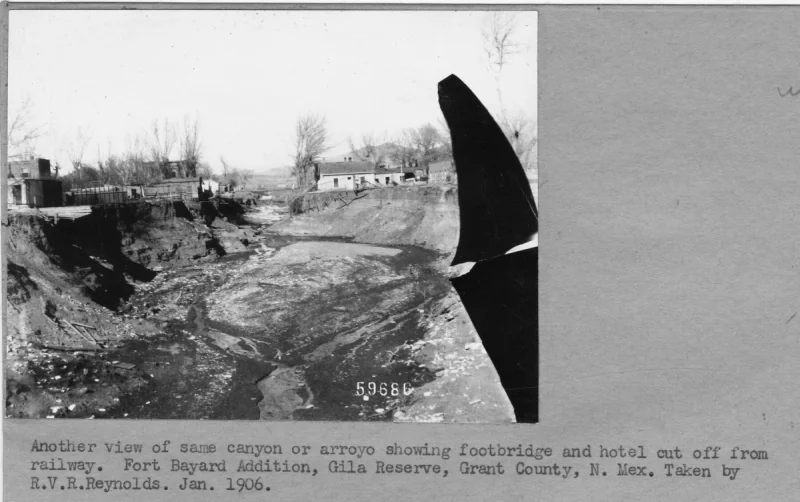
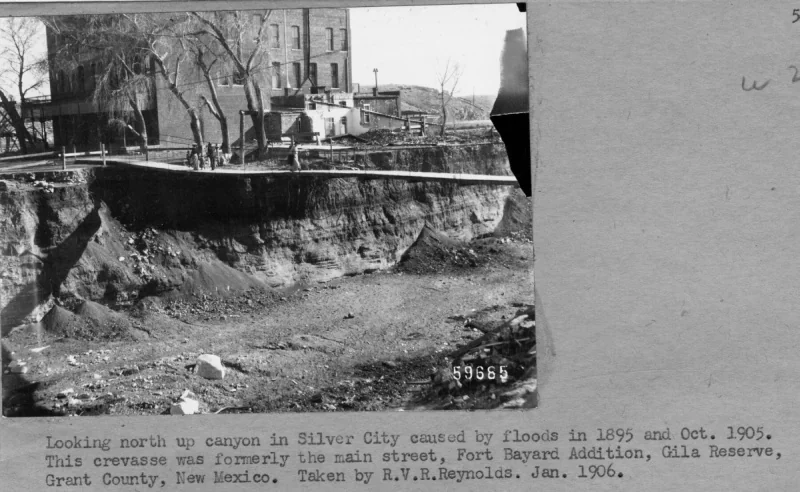
In January 1906 the Forest Service photographer R.V.R. Reynolds made a picture looking north up the canyon in Silver City. His caption calls the canyon a crevasse that was formerly the main street. Floods in 1895 and October 1905 caused it, the caption says. A second Reynolds photograph from that month shows the same arroyo with a footbridge and a hotel. Its caption describes the hotel as cut off from the railway, and names no hotel.
Sources: R.V.R. Reynolds, photographer; USDA Forest Service Rocky Mountain Research Station (Sierra Ancha Historical Images), Flood effects (imageID 22831): looking N. up canyon in Silver City (1906-01): Comments field, imageID 22831; R.V.R. Reynolds, photographer; USDA Forest Service RMRS, Flood effects (imageID 22832): another view of same canyon or arroyo showing footbridge and hotel (1906-01): Comments field, imageID 22832
W.R. Mattoon's Forest Service photographs show gullies in the Cameron Creek watershed, and none of them shows Silver City's Main Street. In August 1905 Mattoon photographed a tributary of Cameron Creek above Fort Bayard. His caption says it had cut down through five feet of rich agricultural soil during the heavy floods of the previous two or three years. In April 1906 he photographed erosion gullies on the deforested slope of Avalanche Peak, 10 to 20 feet wide and 6 to 15 feet deep. Their caption says the gullies formed in the past two to four years from deforestation and overgrazing. A companion view calls them of very recent origin.
Sources: W.R. Mattoon, photographer; USDA Forest Service RMRS, Watershed (imageID 22834): recent erosion above Fort Bayard (1905-08): Comments field, imageID 22834; W. R. Mattoon, photographer; USDA Forest Service RMRS, Watershed (imageID 22838): erosion gullies on deforested slope of Avalanche Peak, Cameron Creek watershed (1906-04): Comments field, imageID 22838; W.R. Mattoon, photographer; USDA Forest Service RMRS, Watershed (imageID 22840): erosion gullies, Cameron Creek watershed (1906-04): Comments field, imageID 22840
Which flood cut the gulch: 1895, 1902, 1903, 1904 or 1905
Sources from the period and later name different floods for the gulch where Main Street ran. The Albuquerque Daily Citizen's dispatch of 25 August 1902 described an arroyo thirty feet deep washed in Main Street by three days and nights of rain. Reynolds's caption of January 1906 names floods in 1895 and October 1905. The 2013 amendment to the Silver City Historic District nomination to the National Register of Historic Places lists the 1895 flood, which destroyed the original Main Street, and another flood in 1904 among the town's challenges. The district's main nomination says that after the 1895 flood the fissure was stabilized with concrete and became known as San Vicente Arroyo or the Big Ditch.12
Sources: Albuquerque Daily Citizen (special dated Silver City, Aug. 25), Albuquerque Daily Citizen, 25 Aug 1902, p. 1: 'Silver City Damaged. Deep Arroya Washed Out in the Main Street' (1902-08-25): p. 1, 'Silver City Damaged' (OCR); R.V.R. Reynolds, photographer; USDA Forest Service Rocky Mountain Research Station (Sierra Ancha Historical Images), Flood effects (imageID 22831): looking N. up canyon in Silver City (1906-01): Comments field, imageID 22831; Heather Barrett (preparer); National Park Service, Silver City Historic District (Boundary Increase & Amendment), National Register nomination (2013 (listed 2013-09-25)): Section 8, p. 19
A 2020 article in the Chronicles of Grant County series names two floods. It says the lots along San Vicente Arroyo that are now part of the park once held stores, houses and other buildings, many destroyed as Main Street disappeared, with the floods of 1895 and 1903 especially devastating. Two other accounts give no year at all. Mrs. O. S. Warren recalled in 1937 that a flood isolated the hotel so that it had to be torn down, a loss she put at $40,000 and the best hotel in Silver City. A 1952 article said the Hotel San Vicente was forced to close by the flood that turned Main Street into the Big Ditch.13, 14, 15
One piece of the wreckage reportedly went into a house. The National Register nomination for Silver City's North Addition Historic District says a bronze newel figure was reportedly rescued after one of the floods. Col. J. W. Carter, the nomination says, remodeled the E. G. Shields house on West Street, reportedly using a massive steel girder from a railroad bridge wrecked in one of the Big Ditch floods of the early 1900s.
Part 3 of 7 of the series The Big Ditch: how Silver City's Main Street became a channel.
Sources
- A press despatch reprinted by the Socorro Chieftain said two of the most disastrous floods in Silver City's history struck on Tuesday and Wednesday afternoons (11 and 12 August 1903), with rain falling in sheets from 3 to 4 o'clock on Tuesday. The Socorro Chieftain, August 15, 1903, page 1 ('Silver City Flooded'), Socorro Chieftain, August 15, 1903, p.1, 'Silver City Flooded'. View source ↗ (reported)
- The territorial weather and crop bulletin in the New Mexican dated the Silver City flood to the 11th and 12th of August 1903 and repeated the $100,000 damage estimate. Santa Fe New Mexican (weekly), August 20, 1903, pages 1, 3, 6, 7, Santa Fe New Mexican (weekly), August 20, 1903, p.7, weekly climate and crop bulletin (https://www.loc.gov/resource/sn84020630/1903-08-20/ed-1/?sp=7). View source ↗ (reported)
- The Santa Fe New Mexican printed a letter from a Silver City woman to her husband in Santa Fe describing the cloudburst of Tuesday afternoon (11 August 1903); she wrote that most of Silver City was in ruins and that it was the worst flood that had ever visited the town. Santa Fe New Mexican, August 13, 1903, page 8: 'Silver City Again Suffers Greatly Cloudburst', Santa Fe New Mexican, 13 Aug. 1903, p. 8, 'Another Disastrous Flood. Silver City Again Suffers Greatly Cloudburst Tuesday Destroys New Dam'. View source ↗ (reported)
- A letter printed in the Santa Fe New Mexican said the August 1903 flood washed away every bit of Silver City's new $16,000 dam and went clear through the Broadway Hotel. Santa Fe New Mexican, August 13, 1903, page 8: 'Silver City Again Suffers Greatly Cloudburst', Santa Fe New Mexican, 13 Aug. 1903, p. 8. View source ↗ (reported)
- The despatch said the flood carried away the western portion of the new 40-foot dam the city had built the previous spring at a cost of $15,000. The Socorro Chieftain, August 15, 1903, page 1 ('Silver City Flooded'), Socorro Chieftain, August 15, 1903, p.1, 'Silver City Flooded'. View source ↗ (reported)
- The Deming Graphic reported that the August 1903 floods undermined a section of Silver City's new $15,000 dam, needing about $2,500 to repair, and that no lives were lost. Deming Graphic (Deming, N.M.), August 19, 1903, page 1: Silver City floods, Deming Graphic, 19 Aug. 1903, p. 1, 'Silver City Flood. Described by an Eye Witness'. View source ↗ (reported)
- The despatch said dozens of families lost everything and called it fortunate that the floods came in daytime, or loss of life would have been heavy. The Socorro Chieftain, August 15, 1903, page 1 ('Silver City Flooded'), Socorro Chieftain, August 15, 1903, p.1, 'Silver City Flooded'. View source ↗ (reported)
- The Deming Graphic reported a loss of about $1,000 to stock at the Silver City Mercantile company in the 1903 flood. Deming Graphic (Deming, N.M.), August 19, 1903, page 1: Silver City floods, Deming Graphic, Aug. 19, 1903, p. 1 (seq 1), 'Silver City Flood. Described by an Eye Witness.'. View source ↗ (reported)
- The New Mexican reported in August 1903 that the Silver City Independent denounced the $100,000 flood-damage report as 'a lie, pure and simple'. Santa Fe New Mexican (weekly), August 20, 1903, pages 1, 3, 6, 7, Santa Fe New Mexican (weekly), August 20, 1903, p.3, territorial news (Grant County). View source ↗ (reported)
- In August 1903 the New Mexican reported another flood down Bear Mountain 'on Saturday' that made two small buildings fall in and washed out Main Street, and that a breakwater had been built alongside the Silver City National Bank and the Murray and Lane buildings on Main Street. Santa Fe New Mexican (weekly), August 20, 1903, pages 1, 3, 6, 7, Santa Fe New Mexican (weekly), August 20, 1903, p.3, territorial news. View source ↗ (reported)
- The New Mexican said the Silver City Independent agreed with its suggestion that Silver City's business section be moved out of the gulch to higher ground, since future floods were certain. Santa Fe New Mexican (weekly), August 20, 1903, pages 1, 3, 6, 7, Santa Fe New Mexican (weekly), August 20, 1903, p.3, territorial news. View source ↗ (reported)
- After the 1895 flood the fissure was stabilized with concrete and became known as San Vicente Arroyo or the Big Ditch. Silver City Historic District, National Register nomination, Item 7, Description, page 1. View source ↗ (documented)
- He writes that lots along San Vicente Arroyo incorporated into the park had originally held stores, houses and other buildings, many destroyed as Main Street disappeared, with the 1895 and 1903 floods especially devastating. The Chronicles of Grant County: Main Street As The Big Ditch - Part Four, Grant County Beat, McDonough, 'Main Street As The Big Ditch - Part Four' (datePublished 2020-09-02), Wayback 20210624163145, article body paras. 1-2. View source ↗ (reported)
- Mrs. Warren recalled that after the flood ruined many Main Street buildings and set the street sinking she started the rock wall that the W.P.A. finished, and that the flood isolated the hotel so that it had to be torn down, 'thus losing $40,000. and the best hotel in Silver City with the tearing down of San Vicente.'. [Mrs. O. S. Warren] 'Early Days Around Silver City', loc.gov/item/wpalh001305, image 3 (typescript p. 3, typed '2'). View source ↗ (reported)
- The 1952 article says the Hotel San Vicente was forced to close by the flood that turned Main Street into the 'Big Ditch'. This is Silver City, New Mexico, 1888-1890 (compilation of Silver City Enterprise items), This is Silver City, New Mexico, 1888-1890 (https://archive.org/details/silvercity1888), IA full text lines 7860-7864; under heading "From the December 27, 1889, Issue of The Enterprise"; text of the March 1952 New Mexico Magazine article reprinted in the book (credit line at line 8012), not Enterpr. View source ↗ (reported)
"Documented" means the source is a record of the time or a direct survey; "reported" means a later account or secondary history, attributed in the text.
Cite this page: “The floods of 1902 and 1903 and the town's dams, 1900 to 1910.” Grant County Atlas, Salars.net, first published 19 November 2026. https://atlas.salars.net/stories/big-ditch/the-floods-of-1902-and-1903-and-the-towns-dams-1900-1910
Discussion
What would you add or question? Comments are reviewed before they appear.
Loading comments…